Use up your packaging on regular purchase orders
Many brands send their own pouches, care cards and boxes to a factory, then buy the finished goods from that factory on an ordinary purchase order, not an outsourced production order. That packaging used to sit at the factory in SKU.io forever. Its stock never went down, and its cost never reached the goods it went into. Now you can turn on Use up packaging on purchase orders for a factory, and each receipt takes the packaging it used off the factory's stock and adds its cost to the goods.
✨ What this means for you:
- Say once what each product needs. A product's Factory packaging card lists each packaging product, how many one unit uses, and any expected scrap.
- See what to send before the factory packs. The purchase order's Factory packaging card shows what the order needs, what the factory holds, what other orders need, and what to send, such as Send 50.
- The cost lands in your goods. On receipt, the packaging leaves the factory's stock, and its cost shows as Factory Packaging in the received goods' cost breakdown. What you owe the supplier doesn't change.
- Receiving is never blocked. If the factory holds too little, SKU.io uses what's there, records the rest as short, and lets you Record short packaging once more arrives.
- Off until you choose. It's set per factory, and only receipts from then on are affected.
Turn it on for a factory
Add the packaging to each product under Shipping → Factory packaging. Then go to Manufacturing → Contractors → Packaging at factories, click Site settings on the factory's card, and turn on Use up packaging on purchase orders.
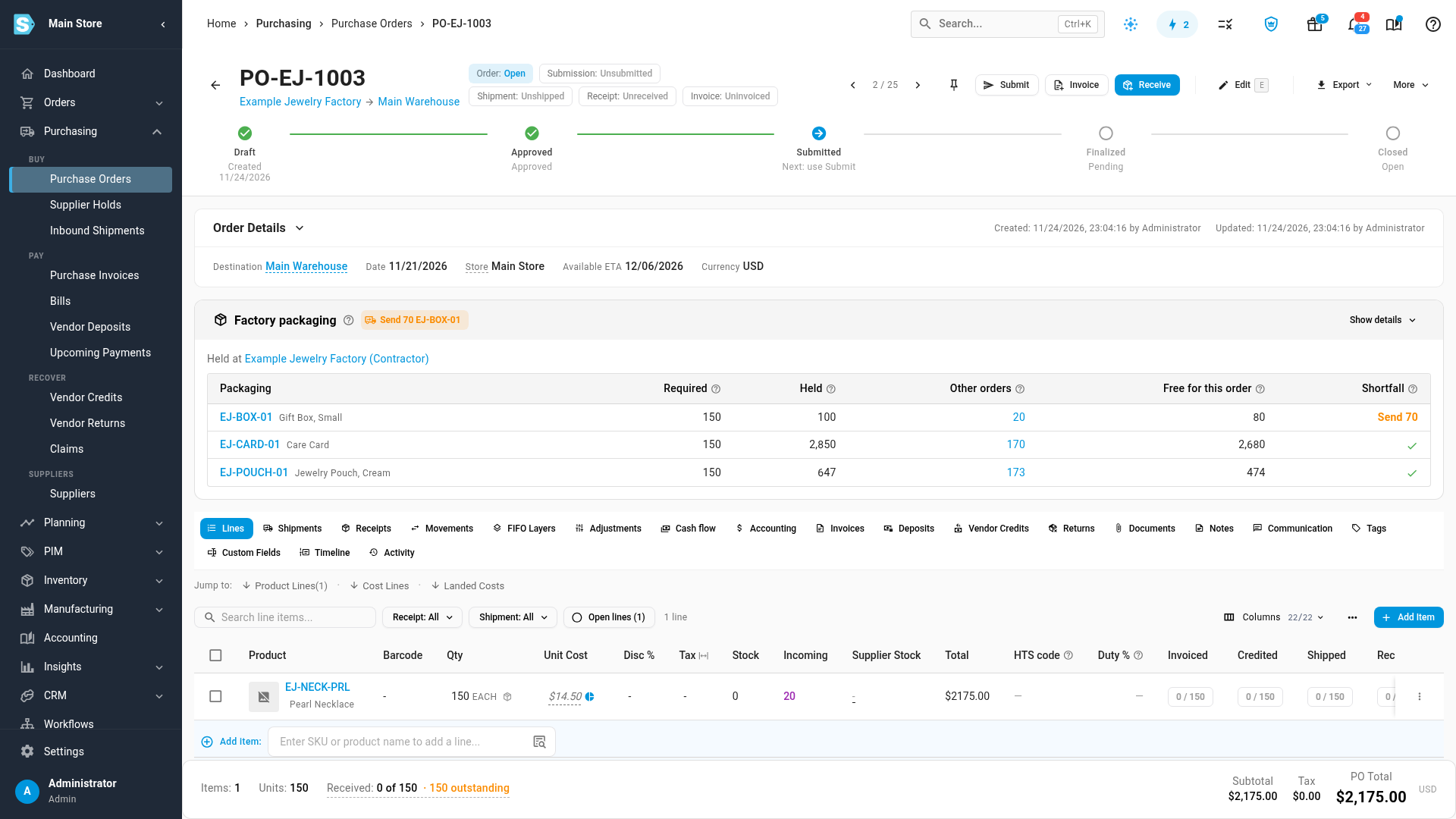
Deleting a receipt puts its packaging back at the factory, and changing a received quantity adjusts the packaging with it.
Where to find it
- What a product needs: the product's Shipping section, Factory packaging card.
- Turn it on: Manufacturing → Contractors → Packaging at factories → Site settings.
- On an order: the Factory packaging card on a purchase order to that factory.
Full guide: Use up packaging on purchase orders