Multi-stage co-manufacturing — build the whole vendor chain in one pass
Plenty of products aren't made in one place. You send ingredients to a co-packer who cooks and blends them, truck the result to a second vendor for filling and pasteurizing, and land the finished cases at a 3PL — three vendors, two hand-offs, one product, and you own the goods the entire way. Until now, modelling that meant inventing the whole structure by hand: a work-in-progress SKU per hand-off, a recipe per stage, lot-tracking flags on every node, contractors, and a production order for each leg — roughly 25 minutes of setup, with several places to get the cost model quietly wrong.
Multi-stage co-manufacturing turns that into one guided flow. Tell SKU.io who does what and what they charge, and it builds the intermediate products, the per-stage recipes, and the vendor terms in a single transaction — then keeps them honest every time you run it.
✨ What this means for you:
- Enter a toller's quote once. Contractors quote "$0.85 a pound", not a lump sum. Record the rate and every receipt computes the fee from the quantity actually received — no hand arithmetic, no rounding drift into your cost of goods.
- Split a recipe you already have. If a product outgrew a single facility, you don't start again — open its recipe and split it across vendors, and its existing ingredients become stage one.
- Order the finished good, not each leg. The stages that supply it are raised automatically, each for the right quantity.
- Yields are applied for you. If a stage only yields 94%, the upstream order is planned for more than you asked for, so you finish with the amount you wanted.
- Middle-mile freight lands in inventory. Freight between two vendors is prompted for and capitalized into what the goods are worth, rather than quietly becoming an expense that overstates your margin.
- Every hand-off is a lot, so a recall question traces from an ingredient batch through both vendors to the customers who received it.
Build the chain in one pass
The builder asks for the finished good, then a row per stage: who makes it, what they charge, and what survives the step. Each vendor hand-off mints a storable work-in-progress product so the goods in transit between two sites are real, countable inventory rather than a gap.
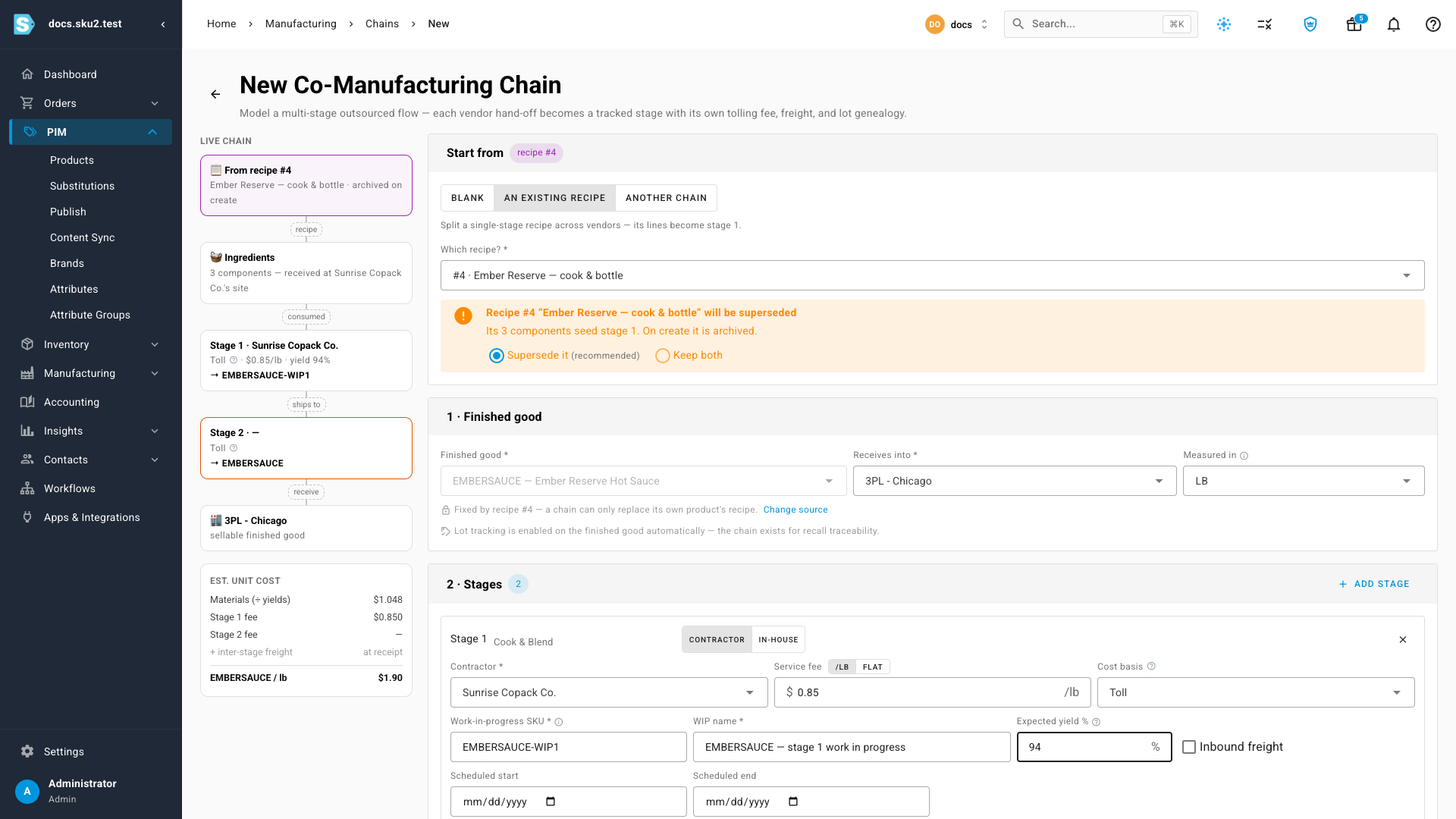
The estimate on the left updates as you type, so you can see what the split does to your unit cost before you commit to it. Watch the materials figure when you enter a yield — it goes up, because to finish with a pound you have to start with more than a pound.
Each stage also carries how that vendor charges you. Toll is the arrangement where you own the materials the whole way and the vendor invoices only for the work; choose supplier price + components when they supply materials of their own. Both are explained in place, so nobody has to know the vocabulary in advance.
Read it back off the product
There's no separate chain record to maintain. A stage is simply a product with its own recipe, and the chain is worked out by following those recipes — which is why it can never disagree with them.
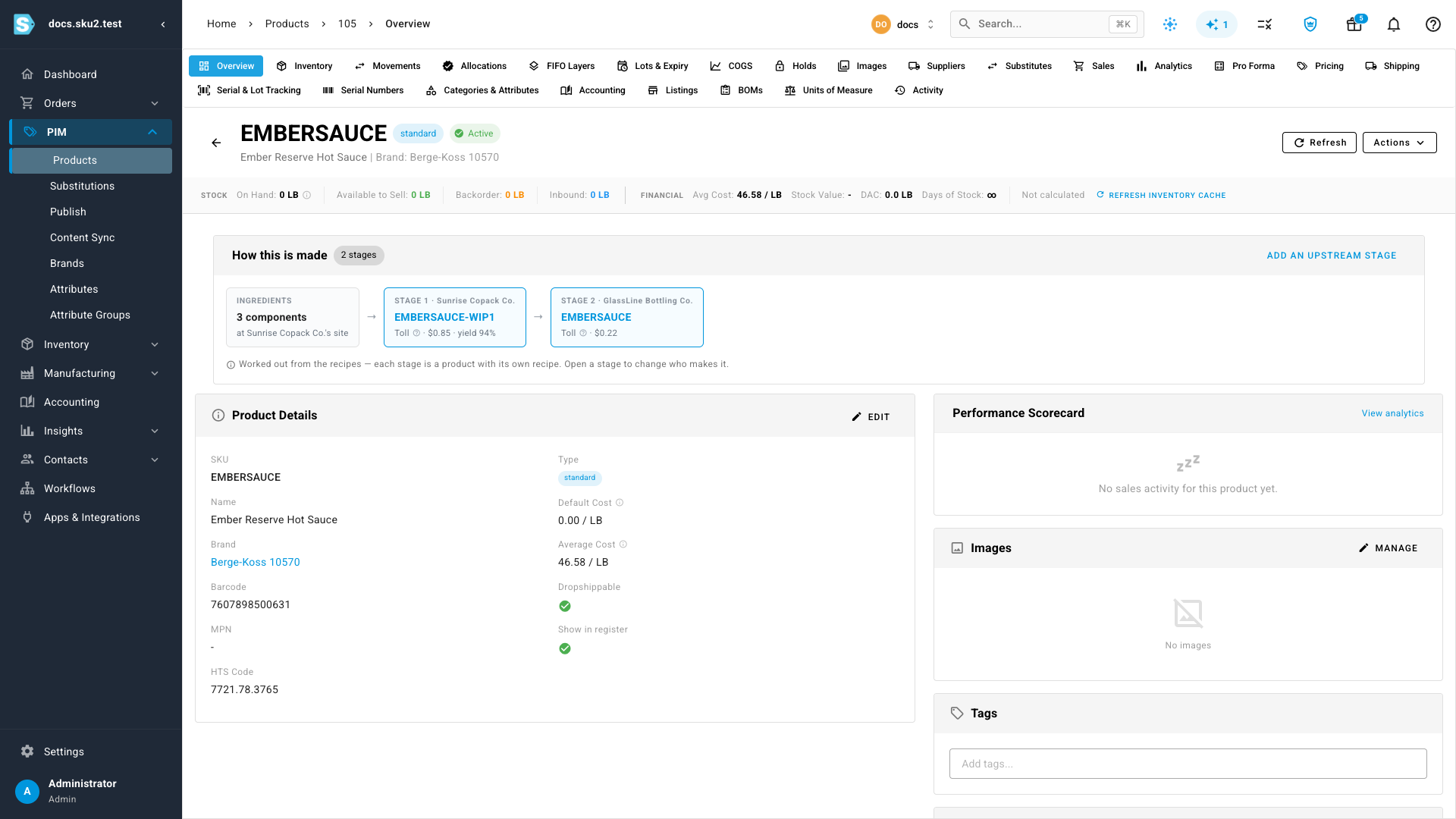
Open any stage and you land on an ordinary product page that names its own maker and terms. That's the point: there's nothing bespoke to keep in sync, only products that reference each other.
Run it by ordering the finished good
To produce it, order the finished good and nothing else. The stage that supplies it is raised at the same time, divided by that stage's expected yield so it starts enough to finish what you need.
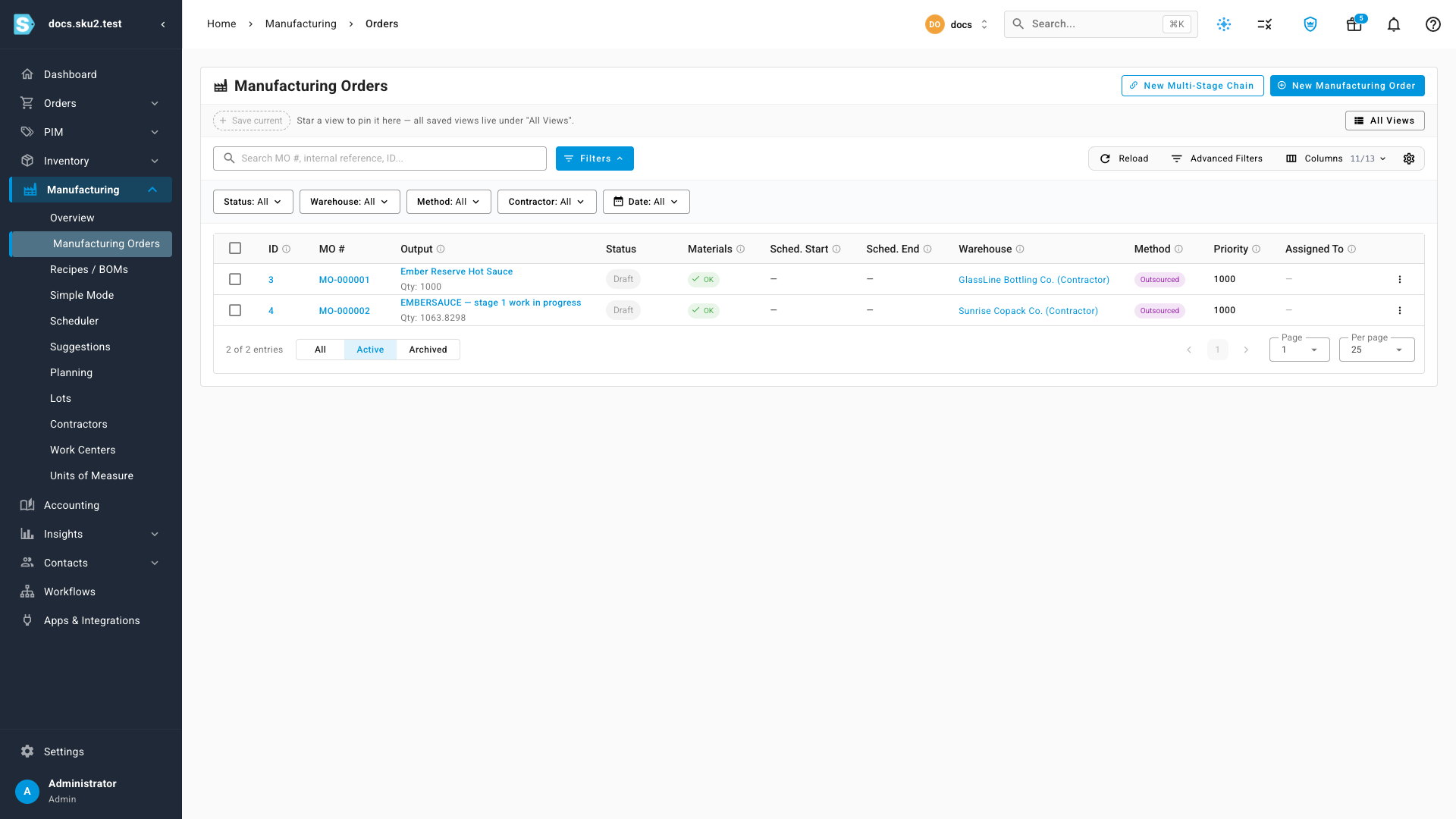
Ask for 1,000 pounds and the upstream stage is planned at 1,063.83 — the yield, applied in reverse. Everything raised is a draft, so nothing reaches a vendor until you confirm it. Each outsourced stage raises its own purchase order carrying your goods and that vendor's service fee, which is the shape of a toll arrangement: the vendor is paid to process, not to sell you a product.
Ordinary recipes are unaffected. A normal multi-level recipe — a sub-assembly you've always made in-house — still creates exactly one order, as it always has.
Where to find it
Manufacturing → Manufacturing Orders → New Multi-Stage Chain, or from a product's recipe, Split across vendors. Contractors and their default tolling rates live under Manufacturing → Contractors.
Full guide: Set up a multi-stage co-manufacturing chain — a 9:36 walkthrough plus the written steps, from an ordinary one-step recipe through to orders that plan their own upstream stages.