
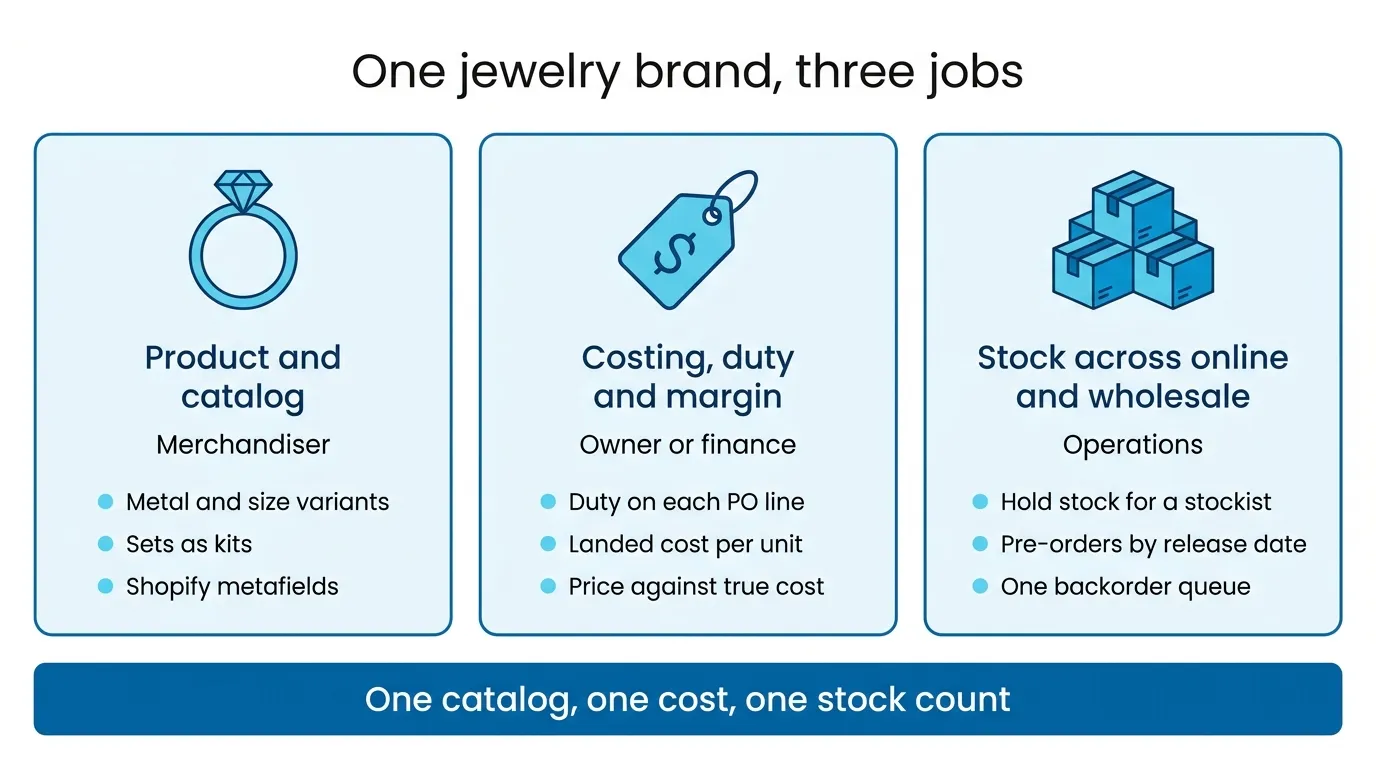
A jewelry brand that sells on Shopify and to stockists does three jobs, and its software has to do all of them off the same numbers. It keeps a catalog where one ring is really dozens of products, one per metal and size. It works out what each piece cost to land, duty included, and whether the price still leaves a margin. And it keeps one stock count across the website, the wholesale orders and the pre-orders for a collection that hasn’t arrived yet. Most “jewelry inventory software” lists are written for jewelry stores, and they score repairs, appraisals and the till. A brand with ten stockists and a Shopify store needs something else.
A disclosure first. I founded SKU.io, so weigh what I say about it accordingly. I don’t sell jewelry myself. My other company resells other brands’ products, which is where my opinions about stock and wholesale come from. What follows is what I’d check if I were choosing software for a jewelry brand, and where I think SKU.io fits and doesn’t.
Written November 2026. Product behavior is checked against our own user documentation, and vendor facts against each vendor’s own site, linked in “How we checked this page” at the bottom.
Which should you choose?
- Choose SKU.io if you design and source your own pieces, sell them on Shopify (and maybe Amazon), and also sell to boutiques or department stores on purchase orders. You import, so duty is part of your cost, and you sell sets whose pieces also sell alone.
- Choose jewelry store software if the counter is the business. Store systems like Jewel360 are built as a jewelry store’s point of sale, with repair tickets, appraisals and trade-in evaluations. SKU.io has a register and a repairs module, but it has no appraisal or trade-in tools, and a showroom that runs on those will feel the gap every day.
- Choose Craftybase, Zoho Inventory or inFlow if you’re one maker selling under about $1M a year on one channel. Craftybase (which is renaming itself Stocksmith) is built for makers and tracks wire, findings and stones down to the gram. Zoho Inventory and inFlow are general inventory apps for small teams. SKU.io is more system than you need.
- Switching probably isn’t worth it if your wholesale is a handful of stores that order twice a year, you don’t import, and one spreadsheet still tells you what each piece cost.
Why the usual lists don’t fit a brand
Search Google for jewelry inventory software this month and the top results are roundups of store systems: tag printing, repair envelopes, certificates for diamonds, a customer’s ring size on file. All useful if you own a shop. A brand’s week looks different. Its problems start upstream, with a supplier quote for a style in three metals, and end downstream, with the same units sold once on the website and promised again to a store.
Three people usually own those jobs, even in a small team. Someone keeps the catalog straight. The owner or a finance lead watches cost and margin. Someone in operations decides which order gets the next delivery. The sections below take them one at a time. Each links to the shorter articles that go into one task in detail.
Product and catalog
A jewelry catalog is mostly variants. One co-founder of a jewelry brand put the scale of it plainly: “we have our style SKU and then there might be 400 different options underneath that one style.” Metal times stone times size multiplies fast, and Shopify’s variant model is where the pain usually shows first.
Take a made-up brand, Wrenmere Jewelry. Every Wrenmere number on this page is made up. Its stacking ring comes in sterling silver, yellow gold vermeil and rose gold vermeil, in ring sizes 5 to 9 with half sizes. That’s 3 metals and 9 sizes, so 27 products, each with its own SKU, its own stock and, for the vermeil, a different cost from the silver. Typing those by hand is how SKU lists end up with a typo in size 7.5 that nobody finds until a store orders it.
What to check in any software:
- Variants generated, not typed. Pick the attributes and their values and let the system make every combination. In SKU.io, Generate Variants takes up to three attributes, builds each SKU from a pattern, and copies the parent’s suppliers, cost, customs codes and images onto every variation. One small thing to know: spaces and punctuation are stripped from SKUs, so size 7.5 becomes 75 in the SKU. I’d use short metal codes like SS and YG for the same reason. See generating jewelry variants by metal and size.
- Sets that keep one stock count. A stack of three rings, sold as a set and also one ring at a time, should be a kit made of those three rings. A kit can hold stock of its own if you pre-pack it, or be built from its pieces, and SKU.io names the piece that limits how many sets you could build. When the set comes in silver and gold, you set the pieces up once and copy them to the other metal, and the silver ring is swapped for the gold one. More in jewelry sets as kits.
- Product details that reach the product page. Metal, stone, chain length and care notes belong in Shopify metafields so your theme can show them. In SKU.io you map each metafield once, for a product or for every variant, and each value is checked against Shopify’s definition before you publish. A new product is created in Shopify as a draft unless you set it otherwise, and later updates don’t change its status. See Shopify metafields for jewelry.
Costing, duty and margin
Watch on YouTube: jewelry landed cost from the purchase order to the sale, covering duty, sets and the true margin on a piece.
Jewelry cost moves more than most products. The same co-founder described two customers ordering the same gold ring a few days apart: “We are going to have two different costs for that on the back end because it’s all based on the weight and the price of gold that time.” Add freight split across a shipment, duty that depends on where the piece was made, and a wholesale price that is often a multiple of the cost, and a single “cost” field on the product stops meaning much.
Duty is where brands get surprised. Jewelry of precious metal is heading 7113 in the US tariff schedule, and imitation jewelry is 7117. Silver jewelry alone, subheading 7113.11, has three general rates on the USITC schedule today: 6.3% for chain sold by length, 13.5% for pieces valued at no more than $18 a dozen, and 5% for everything else. Extra duty tied to the country of origin can sit on top. Rates change and yours depend on the exact code, so check them on the schedule or with your broker. Two silver pieces from the same supplier can carry different duty, and a cost field on the product can’t show that.
Follow one of Wrenmere’s sterling rings from order to sale. The supplier quotes $14.00. On the purchase order line, before anything ships, SKU.io estimates the duty from the ring’s HS code, its country of origin and the country of the warehouse it’s going to, and shows which rate matched. Say that comes to $0.70. The line also carries the ring’s HTS code and its duty as a share of the line’s value, and the built-in purchase order PDF prints both under the description, so your supplier and your broker see the code you chose. A ring with no code of its own takes the default code on its product type. This is the moment to change the supplier or push back on the price, not after the broker’s invoice arrives. When the goods land, the freight and brokerage bills are spread onto the units they came with, $0.60 a ring here, and the duty booked at receipt sits next to the broker’s actual bill, line by line. The ring has landed at $15.30. HTS codes and duty on every purchase order line covers the setup.
Then the price. Keystone means doubling. A store that keystones sells at twice what it paid you. A brand that keystones its own wholesale price sets it at twice its cost, and that’s the step this example is about. Double the $14.00 supplier price and wholesale is $28. Double the $15.30 landed cost and it’s $30.60. Sold at $28, the ring earns $12.70 over what it really cost, not the $14 the owner thinks it earns, and that’s before a set discount takes its share. Keystone pricing for jewelry works through the set and the supplier’s price breaks.
Keystone is a sanity check, not a price. It ignores the set discount, the stockist who negotiates better terms, and the supplier break you only get above a certain order size. In SKU.io a supplier’s quantity break is its own pricing tier, and you move a purchase order onto it when the order qualifies. It won’t switch tiers by itself, and I’d rather it didn’t guess.
After the sale, the cost that counts is the cost of the unit that shipped, so a ring from the June delivery carries June’s freight and duty. The Landed Cost Breakdown report splits what you sold into product, freight, duty and the rest, by channel, brand, product or supplier. If landed cost is new to you, read what landed cost is first. Landed cost per SKU on Shopify explains why Shopify’s single cost field can’t hold two receipts at two costs, and Amazon fees in landed cost covers the Amazon side.
Stock across online and wholesale
Jewelry stock is thin. The owner of a watch and jewelry business that sells to stores as well as online said “we have a low inventory on almost every item. Not more than two, three.” He also described how stores buy: “people don’t buy but they actually put the hold on the specific items.” With two of a piece on the shelf, one hold, one website order and one store order are already more than you have.
A brand’s version of this is the new collection. Wrenmere has 60 of a new pendant on a purchase order due in six weeks. A department store has ordered 24 for its spring floor. The website wants to take pre-orders. The other stockists will reorder once they see it selling. Who gets the first 60?
The store order should get them. A website pre-order can carry a ship date and a refund if the customer won’t wait. A store that misses its floor date remembers it when it plans next season.
To make that stick, the store’s order has to claim units on the incoming purchase order line before the website can sell them. In SKU.io you reserve part of the incoming purchase order line for that one sales order, either from the purchase order line or from the sales order. Here that’s 24 of the 60. The purchase order line shows what is reserved and for whom, and when the delivery is received the reserved units go to the store’s order before the normal priority order runs for the rest. Everyone else, the website included, waits on the other 36. Holding incoming stock for a wholesale order walks through it.
The pre-orders run off a release date on the pendant. Until that day its orders take stock as usual but nothing is sent to the warehouse or 3PL, and on the day they ship. Lines the stock can’t cover backorder against the purchase order like any other order. More in pre-orders against your next purchase order.
Everything that is short ends up in one list: a Shopify order, a stockist’s short-shipped line, the pre-orders past the first 36. They wait in the same backorder queue, ranked by priority, and are filled when stock is received. Backorders across online and wholesale covers who gets the next delivery after this one.
Two smaller things. For a store that wants a piece held without buying it yet, an order can be put in a Reserved status, which holds its stock and blocks shipping until you release it. And the delivery itself, what’s on the water, when it lands and what you still owe the supplier, belongs on the purchase order. That’s stock on the water.
If your stockists order by email today, the dealer portal and price levels are covered in our wholesale distribution software guide.
Questions to ask any vendor in a demo
Bring one of your own styles and ask them to do this on screen:
- Make every metal and size of one ring from two lists of values. How many did you type?
- Build a three-piece set from pieces that also sell alone. Sell one piece. What does the set’s stock say now?
- Put a piece’s metal and chain length on the Shopify product page without opening Shopify.
- Show the duty estimate on a purchase order line before it ships, and the actual duty after it lands.
- Show the margin on one order of that ring, using the cost of the unit that shipped, not an average.
- Hold 24 units of an incoming purchase order for one store. Then place a website order for the same piece. Which one gets the delivery?
- Take a pre-order for a piece that releases next month. Does anything reach the warehouse early?
Question 6 is the one I’d watch most closely. A lot of systems can show stock on a purchase order. Fewer can promise it to one customer and keep it promised.
What SKU.io doesn’t do
It has no appraisal, trade-in or certificate tools, so it isn’t the system to run a jewelry store counter on. It does have a point-of-sale register and a repairs and warranty module, but they serve a brand with a showroom or an after-sales bench, not a retail jeweler’s daily workflow. It doesn’t track memo stock you place in a store and get paid for only when it sells: SKU.io’s consignment runs the other way, for stock a supplier places with you. It doesn’t reprice from the gold price on its own. You enter each purchase order’s cost, and each receipt keeps its own. It isn’t your accounting system: it posts invoices, bills and cost of goods to your accounting software. And it’s built for brands between about $1M and $50M a year, so a one-person studio will find it more than it needs.
If you run a jewelry brand that sells online and to stores, and some of this sounds like your week, book a call with me. Bring one style with all its sizes, your last purchase order and a stockist order you’re trying to hold stock for.
How we checked this page
This lists the facts on this page that you can open and check yourself: SKU.io's documentation, the vendors' own pages, the US tariff schedule, and the recorded calls the quotes come from. The Wrenmere Jewelry figures are a made-up example and are not listed. Prepared by Kalvin Mizzi, founder, SKU.io. Last checked . SKU.io behavior was read off our own user documentation, and vendor facts off each vendor's own website, on the date shown. Tariff headings and rates were read off the USITC Harmonized Tariff Schedule. Call quotes are from recorded sales calls, unattributed.
| Claim | Source | Plan or version | Checked | How we know |
|---|---|---|---|---|
| Jewel360 is a jewelry store point of sale with repair and custom-work tickets, appraisal management and trade-in evaluations. | jewel360.com | — | Vendor documented | |
| Craftybase is jewelry inventory software built for makers. It tracks materials down to the gram or gauge, works out cost per piece, and syncs Etsy and Shopify stock. It is being renamed Stocksmith. | craftybase.com | — | Vendor documented | |
| Zoho Inventory is general inventory and order software, with Shopify and Etsy integrations. | zoho.com | — | Vendor documented | |
| inFlow is general inventory and order software, aimed at businesses from solo entrepreneurs to teams of 50. | inflowinventory.com | — | Vendor documented | |
| Generate Variants takes up to three attributes, creates one variation per combination with a SKU built from a pattern, and can copy the parent's suppliers, cost, customs codes and images. Spaces and punctuation are removed from the SKU. | sku.io | — | Vendor documented | |
| A kit holds its own stock and can also be assembled from its components; SKU.io shows how many could be built and which component limits it. | sku.io | — | Vendor documented | |
| Components set on one variant of a set can be copied to its other variants, and a component that is itself a variant is swapped for the matching option (the gold chain for the silver one). | sku.io | — | Vendor documented | |
| A Shopify metafield, on the product or on each variant, is mapped once and filled on every product you publish; values are checked against the metafield's definition. | sku.io | — | Vendor documented | |
| A product SKU.io creates in Shopify is a draft unless the listing profile sets another status, and later updates keep the product's status. | sku.io | — | Vendor documented | |
| Each purchase order line gets a duty estimate from the product's HS code, country of origin and the receiving warehouse's country, with a breakdown of the rates that matched, before the goods ship. | sku.io | — | Vendor documented | |
| The duty booked at receipt can be compared with the broker's actual bill, line by line. | sku.io | — | Vendor documented | |
| The Landed Cost Breakdown report splits the cost of what you sold into product, freight, duty and other categories, grouped by channel, brand, product, supplier or warehouse. | sku.io | — | Vendor documented | |
| A supplier quantity break is modeled as its own supplier pricing tier, and a purchase order is moved onto it by repricing; SKU.io doesn't switch tiers on its own. | sku.io | — | Vendor documented | |
| US tariff heading 7113 covers jewelry of precious metal and 7117 imitation jewelry. Silver jewelry (7113.11) carries general rates of 6.3% for chain sold in continuous lengths, 13.5% for pieces valued at no more than $18 per dozen, and 5% for other articles. | hts.usitc.gov | General (column 1) rates, 2026 schedule | Vendor documented | |
| A product with a future release date is a pre-order: its orders take stock as usual, nothing is sent to the warehouse or 3PL, and they ship on the release date. Lines stock can't cover are backordered as usual. | sku.io | — | Vendor documented | |
| A sales order can be put in Reserved status, which holds its allocated stock and blocks fulfillment until it is released. | sku.io | — | Vendor documented | |
| SKU.io has a point-of-sale register for in-person sales. | sku.io | — | Vendor documented | |
| SKU.io has a Repairs & Warranty module for claims, repairs and their costs. | sku.io | — | Vendor documented | |
| SKU.io's consignment covers stock a supplier places with you and owns until it sells. | sku.io | — | Vendor documented | |
| Quotes from a co-founder of a jewelry brand and from the owner of a watch and jewelry business that sells to stores and online, both unnamed. | Recorded sales calls (internal archive) | — | Recorded call | |
| A kit's cost after an assembly is the cost of the components used; a sales order's Profit tab shows that order's margin at the cost of the units that shipped. There is no screen for a set's margin on its own. | skuio/sku master = production build e73792d (kit assembly costing; sales order Profit tab); checked on the jewelrydemo tenant 2026-11-20 | — | Tested ourselves | |
| Both reserve dialogs (on a purchase order line and on a sales order line) can include units an order already holds on the shelf: those units go back on sale and the order is reserved from the purchase order instead; units being picked, on a fulfillment order or on a shipping label stay with the order. | skuio/sku #6961 (SKU-8871), dialog text captured on the jewelrydemo tenant 2026-11-20; ship only once #6961 is on production | — | Tested ourselves |