
Inventory Management for Shopify + Amazon FBA (2026)
If you sell on Shopify and Amazon FBA, the hard part is not holding one stock number in two places. It is that one of those two systems is an unreliable narrator. Amazon’s inventory ledger and Amazon’s inventory summary routinely disagree with each other, and most tools that sync your channels settle that disagreement by believing whichever number Amazon handed over last.
I sell on FBA myself, and I have had the same problem in my own business. So this page is about what actually breaks between the two channels, how to test a vendor on it in a demo, and where we fit. Which is not everywhere.
Product behavior below checked against our own deployment on 19 August 2026.
Why doesn’t one stock number work across Shopify and Amazon?
Because Shopify and FBA are not the same kind of thing. Shopify is a storefront that tells you what you have. FBA is a third party holding your goods, moving them between fulfillment centers, losing some, damaging some, taking some back as returns in unknown condition, and reporting on all of it after the fact.
Treating those as two equal channels to sync is the mistake underneath most of the tooling in this category. One of them is a source of truth. The other is a counterparty you need to audit.
An operator running four warehouses and four Amazon accounts, describing what happens when you try to check Amazon’s work by hand:
“It is so detailed that you get lost in it. I think it’s designed that way specifically.”
He was talking about the FBA inventory ledger. He is not wrong about the effect, whatever the intent.
Can you trust the inventory number Amazon gives you?
Not on its own, and this is the part nobody selling you software wants to spell out.
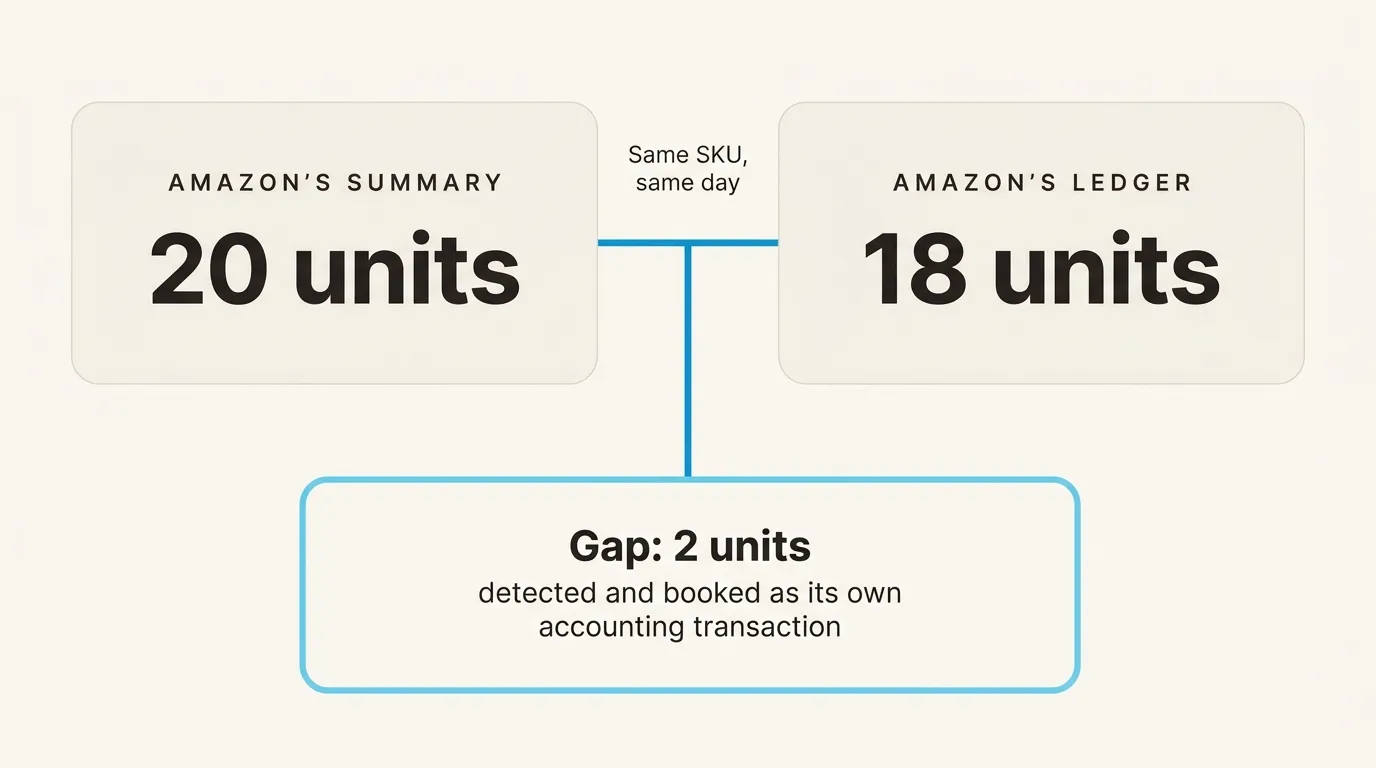
Amazon publishes an inventory ledger, an event-level record of everything that happened to your stock. It also publishes summary figures. They do not always reconcile. Take the smallest version of it: a day where the summary says 20 units and the ledger events add up to 18. Neither number is flagged as wrong. Both come from Amazon. The real ones are rarely that tidy, which is the problem, because a two-unit gap you can see is a gap you would have caught anyway.
Amazon’s own seller forums are full of sellers working these gaps by hand, and every guide I have read on the problem gives the same advice: pull both reports, compare the ending balance, trace the difference through receipts, returns, adjustments and removals, one ASIN at a time. That advice is correct. It is also a description of a job that should not be done by a person.
Here is the thing I would push back on if you were sitting in front of me: that reconciliation is not an accounting nicety you get to the following quarter. It is the difference between knowing what you own and guessing. A German reseller put the consequence in four words on a call:
“Sometimes stock just vanishes.”
He had come looking for an explanation of Amazon’s inventory ledger report and found us on the way, which is its own small comment on how well this question gets answered.
An e-commerce accounting consultant we work with described what most tools do instead:
“Most of the other IMS tools aren’t getting to this. They don’t have any logic that says you sent 1000 units, you sold 900 units, you’re out of units. They just pull down a report from Amazon that says you have 900 units.”
What does reconciling FBA actually involve?
Mirroring Amazon’s audit trail rather than accepting its conclusion.
The way we do it: every event in Amazon’s ledger gets translated into an equivalent document on our side. A shipment becomes a fulfillment, a return becomes a return, an adjustment becomes an adjustment. You end up with a double set of books, Amazon’s version and ours, built from the same events. The two can then be compared automatically. Where the ledger and the summary disagree, that gap gets detected and booked as its own accounting transaction instead of being quietly absorbed into a stock figure.
That last part matters more than it sounds. A discrepancy that gets absorbed disappears. A discrepancy that gets booked has a date, an amount and a place to look.
I wrote up the longer history of this specific problem back in 2021, as an open letter to Amazon, and what has actually changed about it since.
The same consultant, on what sellers actually lose in FBA:
“Everybody thinks FBA is this huge black hole, and they think it just gets bigger and bigger. And they might be thinking it’s 80 grand a month when it’s 800 when all said and done.”
Both errors cost you. Overestimating FBA shrinkage means you are pricing in losses you are not taking. Underestimating it means you never chase the ones you are.
How should FBA stock be valued?
On its real cost layers, not a blended average.
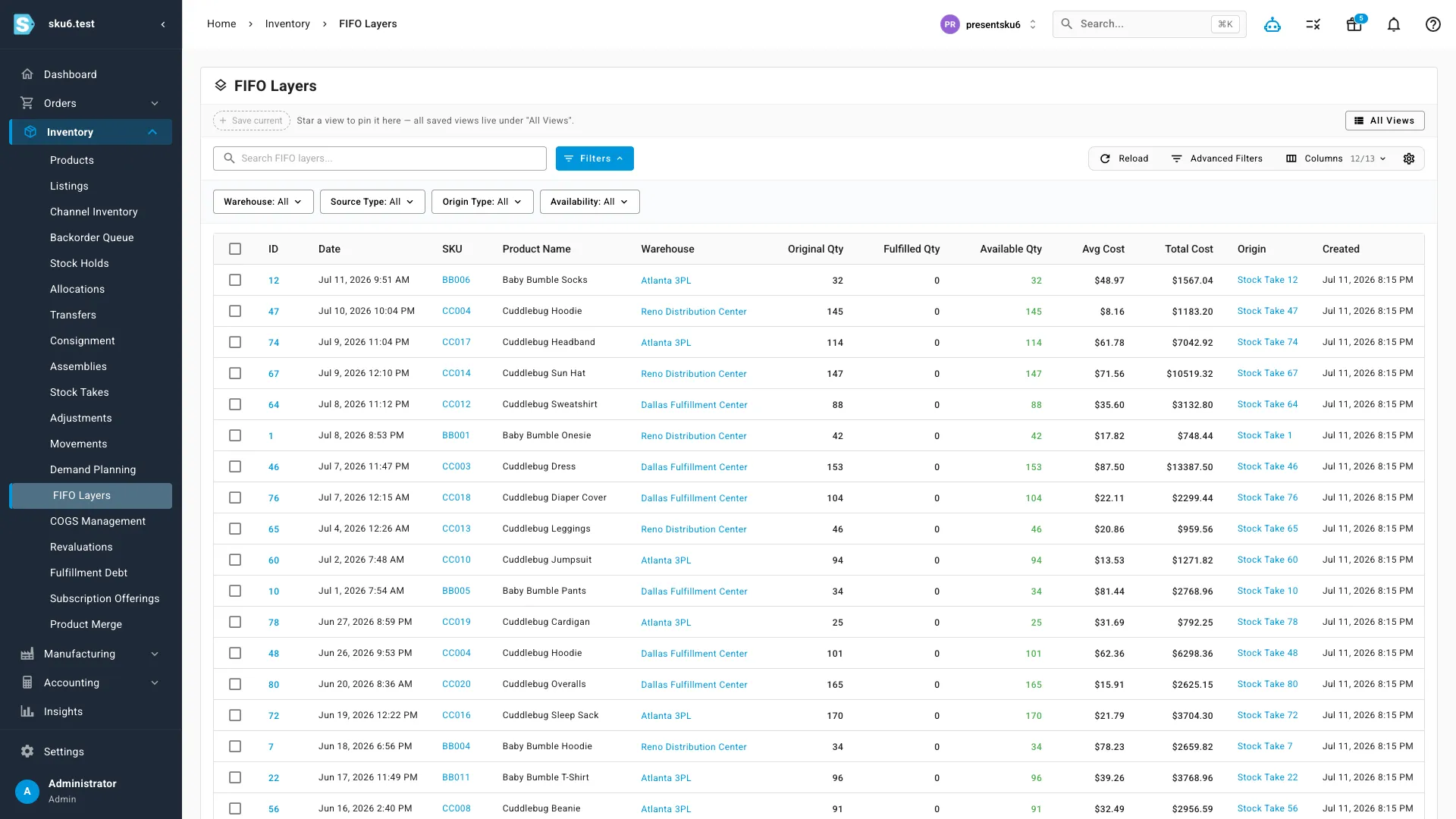
Most systems assign one average cost to a SKU and value your FBA position by multiplying it out. That is fine until your landed cost moves. A different freight rate, a duty change, a supplier increase, and then the number is confidently wrong. We value FBA stock on FIFO layers, the same way we value stock in a warehouse you own, so the units sitting in an Amazon fulfillment center carry the cost you actually paid for those units.
This is also where marketplace fees belong. Amazon’s settlement data maps into the accounting side, so per-order profit carries the fees rather than showing you a gross number that flatters everything.
What breaks when you send inventory into FBA?
The inbound leg, and it breaks in mundane ways.
You create a shipment in Seller Central. You create a matching transfer in your inventory system. Now two systems have an opinion about the same units. Amazon receives 94 of the 100 you sent. Box dimensions no longer match the template. Placement fees land somewhere.
The fix is not clever. Inbound shipments should be pulled from Amazon and turned into the transfer automatically, so the shipment exists once. Shortages against what you sent should be recorded as shortages, with a value, rather than silently reducing your stock. Removal orders coming back need receipt tracking and a per-unit disposition, because “returned” covers both sellable and destroyed and those are not the same asset.
What about AWD?
AWD adds a second Amazon-controlled layer between your supplier and FBA, and it deserves an honest answer rather than a feature tick. We track the AWD-to-FBA flow as real inventory movements and reconcile it, but Amazon’s APIs are uneven across this surface and some steps are more manual than they should be. Where their API does not exist, we say so rather than pretending the gap is a design choice.
An operator, a few months into it, said the quiet part out loud:
“Complicated. This is a complicated. Like, it is not the normal FBA thing. Why did we do it?”
If you are evaluating AWD support, ask the vendor which parts are API-driven today and which are not. Any vendor who says all of it is either not doing it or not doing it carefully.
What should you test a vendor on?
Six things to ask for on a screen share, against real data, not slides. I have put reconciliation first because it is the one that invalidates the others: if the stock number is wrong, every figure computed from it is wrong too. Past that, which of these hurts most depends on your operation, and you are better placed than I am to rank them.
| Check | What good looks like | How to test it in the demo |
|---|---|---|
| Does it reconcile Amazon's ledger against Amazon's summary? | Automatic detection of the gap, booked as its own transaction with a date and a value | "Show me a SKU where Amazon's numbers disagreed, and what your system did about it" |
| How is FBA stock valued? | Real cost layers (FIFO), same treatment as your own warehouse | "Change my landed cost and show me what happens to the value of my FBA position" |
| Do marketplace fees reach order-level profit? | Settlement data mapped into accounting, fees as line items | "Show me the true profit on one order including Amazon's fees" |
| Are inbound shipments created once or twice? | Pulled from Seller Central into a transfer, with shortages recorded against what you sent | "Walk me through an inbound where Amazon received fewer units than I shipped" |
| What happens to removal orders? | Receipt tracking with per-unit disposition, sellable separated from damaged | "Receive a removal order and show me the condition of each unit" |
| Which AWD steps are automated? | A straight answer naming the manual ones | "Which parts of AWD does Amazon's API not support yet?" |
If a vendor cannot demo the first row, the rest is a channel sync with an Amazon logo on it.
Is SKU.io the right fit for Shopify + Amazon FBA?
We are a good fit if Amazon is a serious part of your business. Meaningful volume through FBA, hundreds to thousands of SKUs, Shopify alongside it and probably Walmart, TikTok Shop or wholesale as well. The FBA depth above is the thing we get told we do better than the alternatives, usually by people who arrived skeptical. A watch reseller opened his second call with this:
“I almost canceled this meeting just because I thought you guys weren’t serious on Amazon. I went through three calls with some companies and they were not even close to having anything on Amazon. It was like an afterthought.”
Pricing starts around $1,000 a month with no onboarding fees, which tells you the size of business it suits. Every demo is given by me, and I run my own e-commerce business on the product, which is why the FBA reconciliation exists at all. I built it because I needed it.
Where we are the wrong answer, plainly. If Amazon is a small side channel and Shopify is the business, this depth is overkill and you should buy something simpler. If you are under about $1M on effectively one channel, start with Zoho Inventory or inFlow. Manufacturing-first operations are better served by Katana. And we do not automate Amazon reimbursement recovery at your true cost. That is a real gap, sellers lose real money in it, and specialist services exist that do only that.
Where to go from here
If FBA accounting specifically is the thing biting you, Amazon FBA inventory reconciliation and accounting issues goes deeper on that one problem, and a breakdown of Amazon fees covers where margin actually goes. If you are comparing platforms rather than diagnosing a problem, what Cin7 switchers choose and where SkuVault went after Linnworks bought it apply recorded-call evidence to those two decisions. And if you would rather judge a vendor on architecture than on a feature grid, run the six checks in inventory management API: what to check first.
Or bring me one ASIN where Amazon’s numbers have never quite added up, and I will run the reconciliation on it live. Book a demo.