
Keystone Pricing for Jewelry, Checked Against Landed Cost
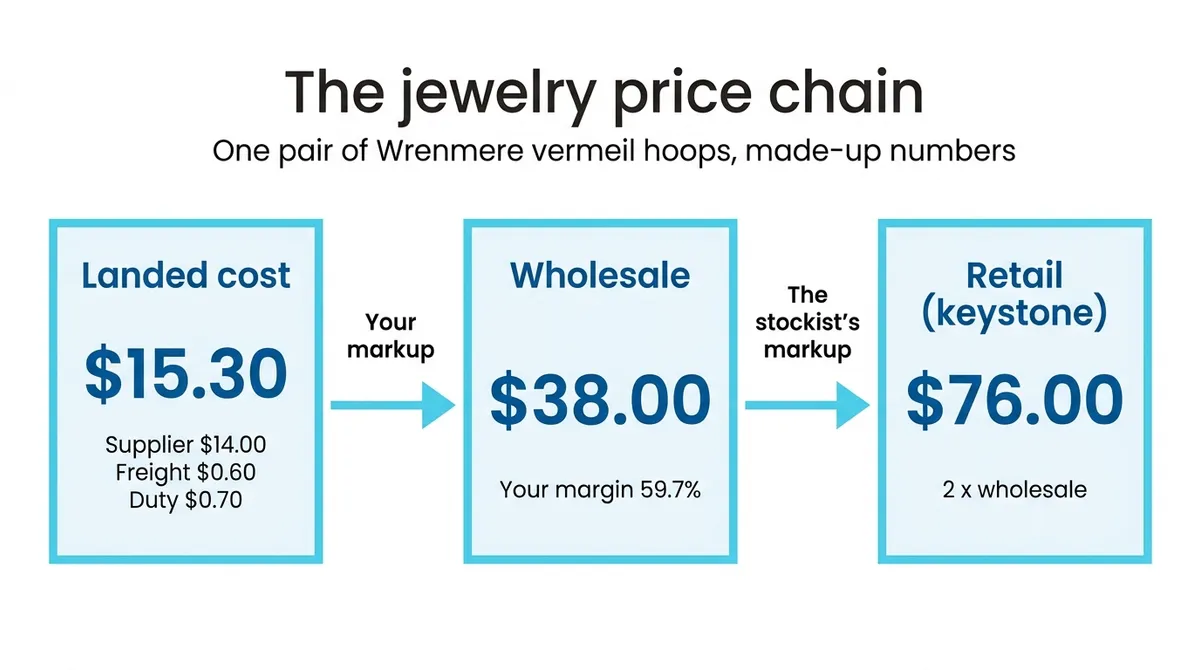
Keystone pricing means retail is twice wholesale: a boutique buys a pair of earrings at $38 and tags them at $76. That doubling is the stockist’s margin. The brand’s margin is decided a step earlier, by the wholesale price against the landed cost, and on a $15.30 landed cost a $38 wholesale price leaves 59.7%.
Keystone is easy to apply. Landed cost is the number that drifts, because freight and duty change under a price list that’s printed for a season. This is part of costing, duty and margin for jewelry brands.
When the cost moves, the price has to follow
When the 2025 tariffs landed, the cost of what my other company brings in went up with them. On our internal call that March my answer took one line: “I just raised my price the same as the tariffs.” I’d do the same with a jewelry line sheet. A keystone retail price is only as good as the landed cost it started from, and landed cost is the number people stop checking once the line sheet is printed.
One pair of hoops, priced three ways
The examples use a fictional brand, Wrenmere Jewelry, and the numbers are made up.
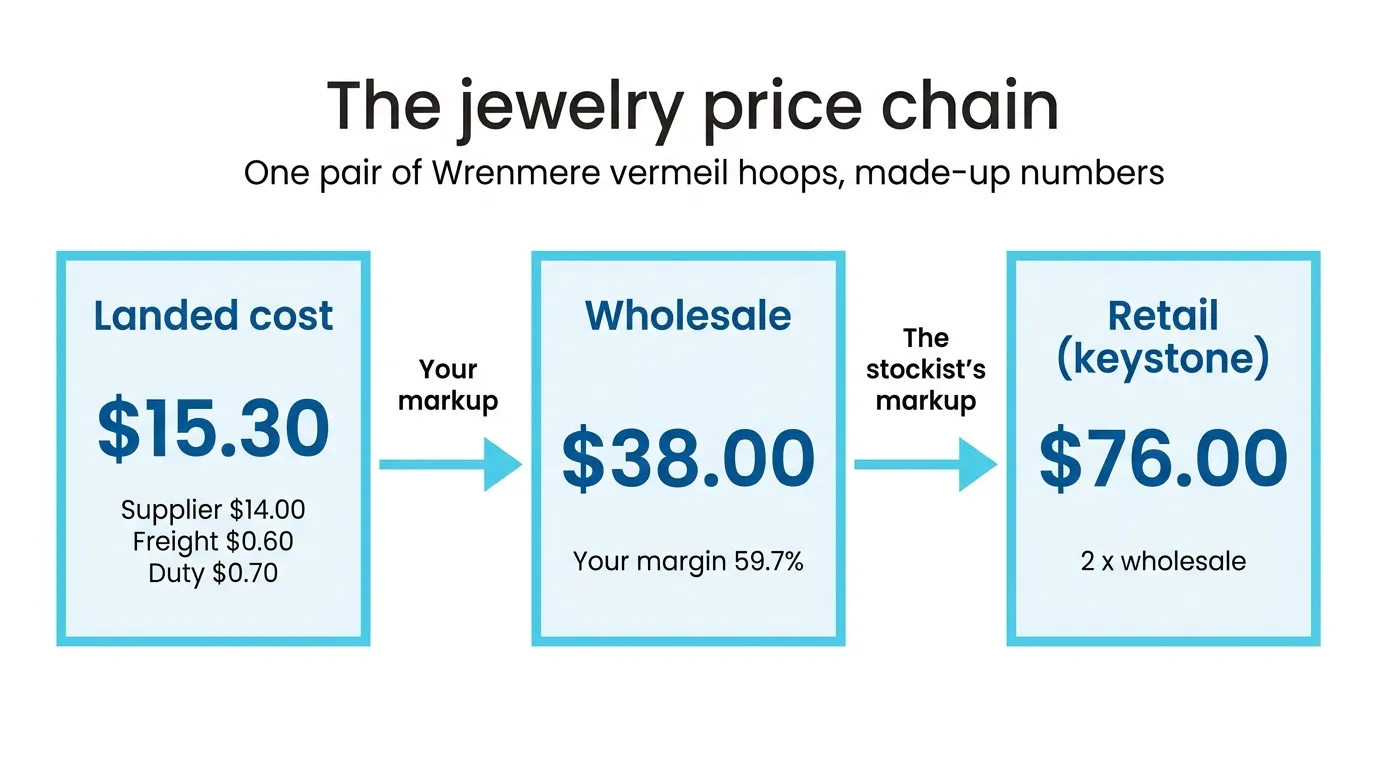
Wrenmere’s vermeil hoops cost $14.00 from the supplier, plus $0.60 a pair of freight and $0.70 of duty, so they land at $15.30. Wholesale is $38.00 and keystone retail is $76.00. Price off the supplier’s $14.00 and the same $38 looks like 63.2%. The real figure is 59.7%.
Duty makes the gap uneven. In November 2026 the US general rate for silver jewelry valued over $18 a dozen is 5%, and vermeil, being sterling silver plated with gold, normally falls under silver (your broker has the final word). Gold-plated brass is imitation jewelry at 11%. A plated brass pendant at $9.00 with $0.40 of freight and $0.99 of duty lands at $10.39. Price it at 2.5 times the supplier’s price and you get $22.50 wholesale, which looks like 60.0% and is 53.8%. A supplier-cost formula underprices exactly the pieces customs charges most for.
Those are base rates. Say the hoops come from a country with an additional 10% stacked on top. Duty becomes $2.10, the pair lands at $16.70, and the same $38 wholesale leaves 56.1%. Those 3.6 points are what a tariff takes from a line sheet that doesn’t move. HTS codes on purchase order lines covers getting that rate in front of you before you order.
I’d set wholesale from landed cost and let retail fall out of it. If $76 is more than your own customers will pay, look for a cheaper piece or a better supplier price. Cutting wholesale until the keystone retail looks right moves the problem onto your margin.
Selling the same pair on your own Shopify store looks like 79.9%, but shipping to the customer, payment fees, ads and returns come out of it, and none of those are landed cost. Returns are the one I’d watch. In my own business we had helmets that looked like a 75% margin until the returns from sizing and colors were counted. Rings sold by size online have the same exposure.
Freight is small enough per piece that it gets skipped. An operations lead at a jewelry brand described doing it by hand: “say that we have five rings ordered in one order and our shipping’s 11.99. You have to divide it.” The landed cost guide covers how a freight bill should be split. Packaging works the same way. If the supplier puts each pair on a card in a pouch, that’s in their price. If you do it yourself, the card, the pouch and the time belong in the unit’s cost.
Solid gold: cost per order, not per product
Solid gold breaks the idea of one cost per product. The co-founder of a jewelry brand that sells rings explained it: “the same gold ring… We are going to have two different costs for that on the back end because it’s all based on the weight and the price of gold that time.” His example was $201 for one order of a ring and $207 for the same ring days later. On a plain gold band, a different piece, he said the cost “might be $4 difference and I need to be able to understand that and see that at the order level.”
Some brands move gold retail with the metal price. If yours holds retail for the season, the margin on each sale depends on which purchase order that ring came from, so check it per order, not per product.
Pricing a set whose pieces sell alone
Wrenmere also sells the hoops with a pair of vermeil studs and a $1.50 gift box. The studs land at $8.70, wholesale at $22 and retail at $44. Bought apart, the two pieces retail at $120. The set retails at $98, so keystone puts its wholesale at $49.
| Pieces sold separately | The set | |
|---|---|---|
| Landed cost | $24.00 | $25.50, box included |
| Wholesale | $60.00 | $49.00 |
| Your margin at wholesale | 60.0% | 48.0% |
| Your dollars per wholesale sale | $36.00 | $23.50 |
| Your margin selling at retail yourself | 80.0% | 74.0% |
The set is at keystone and earns $12.50 less per wholesale sale than the two pieces: the $11.00 wholesale discount plus the box. If it sells studs that weren’t selling alone, that’s money well spent. If it mostly goes to people who’d have bought both, it’s a discount with a box around it.
Your cost side: supplier price breaks
The first number also moves with how much you buy. Say the hoop supplier quotes three prices, with freight held at $0.60 a pair and duty at 5%:
| Tier | Supplier price | Landed cost | Your margin at $38 wholesale | Your margin selling at $76 yourself |
|---|---|---|---|---|
| Standard | $14.00 | $15.30 | 59.7% | 79.9% |
| 300 and up, 10% off | $12.60 | $13.83 | 63.6% | 81.8% |
| 1,000 and up, about 16% off | $11.80 | $12.99 | 65.8% | 82.9% |
The 1,000 tier saves $0.84 a pair landed over the 300 tier, $840 across 1,000 pairs, and only if you’d otherwise have bought 300 at a time three or four times. Wrenmere sells about 300 pairs a season. At landed cost the big order is $12,990 against $4,149, so $8,841 more sits in one style of earring for more than three seasons, assuming demand holds. I’d take the 300 break and skip the 1,000. An owner with cheap money and a style that doesn’t date would choose the other way.
Doing this in SKU.io
Each price break is its own supplier pricing tier. A 10% break can be a relative tier at -10 on the standard tier, so it follows when the standard price changes. SKU.io doesn’t move an order onto the bulk tier by itself when a line crosses 300: you select the lines, pick the tier and click Reprice, any time before receiving locks in the cost. The steps are in set up supplier pricing tiers and price breaks.
A set is a kit with the pieces as its components. Assemble sets from loose stock and the pieces come off their own cost layers, and the set takes the rolled-up cost of what was used, freight and duty included. A freight or customs bill added to a purchase order after some of the goods have sold reaches the units that already sold, so the margin on those sales is corrected too.
SKU.io doesn’t have a screen that shows a set’s margin on its own, so the table above is arithmetic you do once per set. Take the set’s cost after an assembly, which is the cost of the pieces and the box that went into it, and set it against the set’s wholesale and retail prices. After a sale, the sales order’s Profit tab shows what that order earned at the cost of the units that shipped.
If you make every piece yourself and sell under $1M a year on one channel, Craftybase, Zoho Inventory or inFlow will hold your costs. A jewelry store with repairs, appraisals and a point of sale needs store software. This is for brands that import, sell wholesale and sell on their own site. If that’s you, book a demo and bring your line sheet with the supplier prices behind it.