
Stock on the Water: What You Ordered, When It Lands, What You Still Owe
Stock on the water raises three questions: what you ordered, when it lands, and what you still owe on it. Most importers answer them in a sailing-schedule spreadsheet kept next to their purchasing system, with every PO, payment, shipment and receipt typed in twice. All three answers can live on the purchase order instead, once the supplier’s payment terms are written down as a schedule. If you buy on your suppliers’ calendar, this is the cash side of it.
A five-minute walkthrough of buying on your suppliers’ calendar, on an outdoor gear distributor we made up. The part on counting stock already on its way starts at 2:08.
Watch on YouTube. Narrated with an AI voice; the distributor, its people and its numbers are made up.
Why the spreadsheet exists
Because the terms aren’t “net 30 from invoice”, and the payment is tied to things that happen to the goods. One brand’s founder described his supplier’s terms like this: “20 deposit when we place the PO, then 40 payment when he ships the product… on ocean or he could ship it on air, but when he ships it, that’s the second trigger… the last 40 is triggered on net 30 of when we receive it.”
Count the dates. The deposit has one. The shipment payment has one per shipment, and the supplier decides how many shipments there are and whether they fly or sail. The balance has one per receipt, 30 days out. Your purchasing system records every one of those events and still can’t tell you what’s due, because nothing ties the money to the event. So someone keeps a summary by hand: due now, due in the next 30 days, and a catch-all for “on shipment”.
The same terms, set up once
You put the split on the supplier’s payment term as a payment schedule, with three milestones:
| Milestone | Share | Falls due |
|---|---|---|
| Deposit | 20% | When the PO is approved |
| On shipment | 40% | As each shipment leaves, for its share |
| Balance | 40% | 30 days after each receipt, for its share |
If the supplier changes terms later, edit the term rather than making a new one. Each change is saved as a revision, and deposits already recorded keep the version they were made under.
Then take a made-up 100,000 order on that term. The supplier sends 15,000 of it by air because you’re short, and the other 85,000 by sea a few weeks later.
- Approve the PO: a 20,000 deposit is due that day, before there’s any invoice.
- The air piece leaves: 6,000. It lands, and 6,000 more is due 30 days later.
- The sea piece leaves: 34,000. It lands, and 34,000 is due 30 days after that.
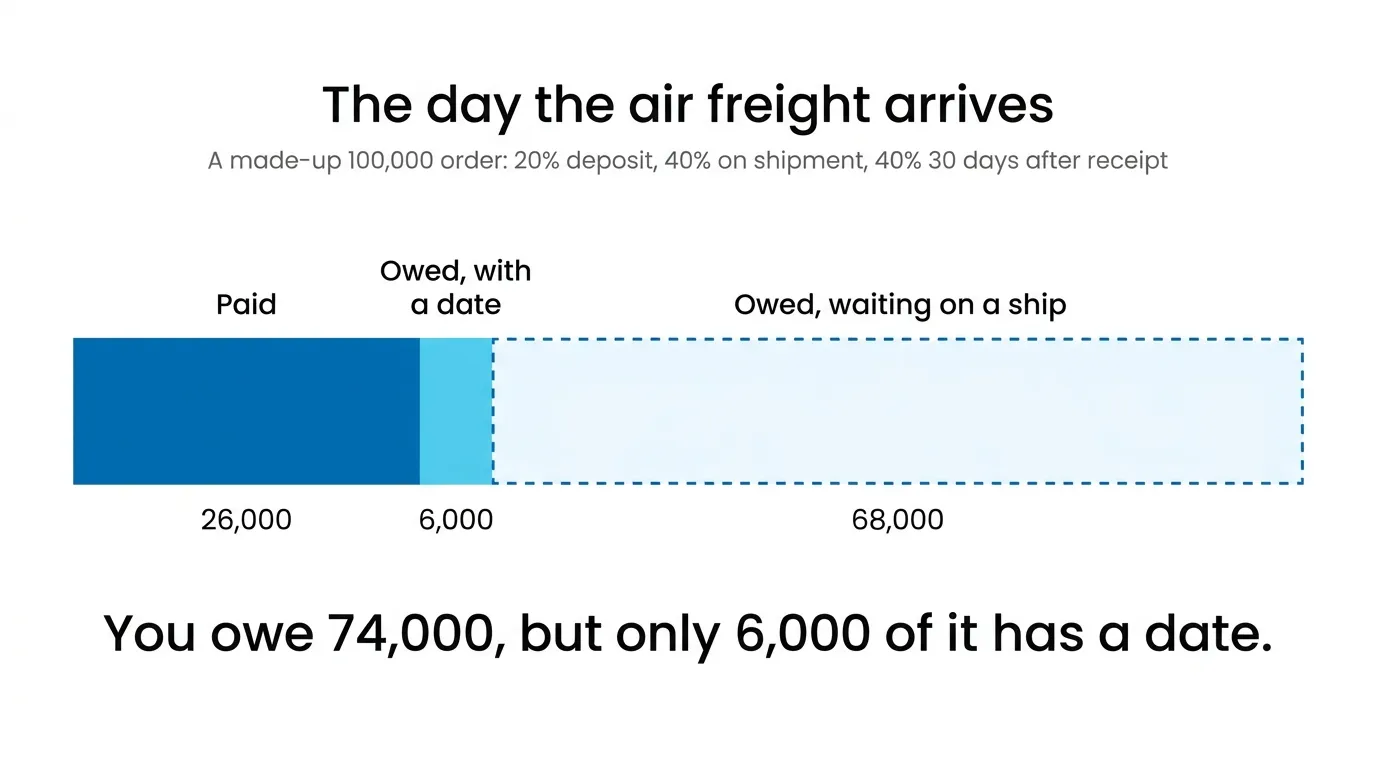
Now look at the order on the day the air freight arrives, with the container not yet loaded. You’ve paid 26,000. You owe 74,000, but only 6,000 of it has a date. The other 68,000 waits on a ship the supplier hasn’t booked.
Should you put a ship date on the order?
Only if you believe it. With a supplier that slips, any date you type starts to look like the day the money goes, and it isn’t. So the on-shipment payment works without one: if nobody has put a ship date on the order, the cash-flow view doesn’t make one up, and the payment is counted in the total, marked as having no date, and left off the chart. I’d rather look at 68,000 with no date than at 68,000 on a week I guessed. When the supplier does give you a date, put it on, and change it by hand when it moves.
If you pay in the supplier’s currency, that undated 68,000 is also the part most exposed to the exchange rate, and the part where you still have some say in timing. That’s where I’d look first when the rate moves.
Whose stock is it while it moves?
When do the goods become yours? That depends on your incoterm. On FOB terms it’s when they’re loaded, so on this order it’s the on-shipment milestone. The schedule has a box for that, ticked on one milestone, and from there the deposit counts as goods you’ve bought instead of money the supplier is holding. At month end your accountant will want to know which it is.
Once goods are yours while they move, they need to sit in exactly one count, and stock in motion is where they end up in two. I also run a company that resells other brands’ products, and our purchaser started sending stock straight to Amazon’s AWD warehouses. Those units stayed on our own count after they left, and showed up again in FBA once AWD sent them on. Send 100 in and the books carry 200. I asked for everything sent to AWD to be checked and adjusted, because the extra 100 costs money: inventory is higher, cost of goods is lower, profit looks higher than it is, and you pay more tax on it. So before month end, check every shipment that’s between two places, from a supplier or between two of your own warehouses, against both ends.
Payment timing is a different question from budget. Open-to-buy counts the goods in the month they arrive and doesn’t know about deposits, so keep the cash on the order and the buying plan in the plan.
If you buy domestic and it shows up within a week, you don’t need any of this. Receive it when it comes and pay on the invoice. It starts to matter once one order is split across shipments and each one moves money. If your sailing schedule is still a spreadsheet, book a demo and bring it.