
Katana MRP vs SKU.io: An Honest Comparison (2026)
Katana is a manufacturing system that also sells across channels. SKU.io is a multichannel system that also manufactures. If the complicated part of your business is what happens on the production floor, Katana is very likely the better answer, and I’ll spend most of this page explaining why rather than talking you out of it.
I’ve got an obvious interest here, so read accordingly. But on seven other pages of this site I already tell manufacturing-first operators to go to Katana by name, and one of them says the quiet part out loud: I send them there and they don’t come back, which I take as a good sign for them.
Katana’s pricing, plans, integrations and API details on this page were loaded from their own site on September 14, 2026.
What is the actual difference between Katana and SKU.io?
Both keep stock accurate across sales channels. They disagree about which end of your business is hard.
Katana’s product is organized around production. Work orders, a shop floor app, operations with labor cost, batch and serial traceability. Their own industry list reads like a factory directory: food and beverage, cosmetics, pharmaceuticals, industrial machinery, apparel, electronics.
Ours is organized around channels and the money that comes off them. Order routing across marketplaces, marketplace fee accounting, drop ship, 3PLs, purchasing against demand, and one perpetual ledger underneath it that you can audit movement by movement.
I put it this way in a competitor rundown I dictated for our own team in April 2025, before either of us had reason to be diplomatic: there are e-commerce ERPs, there are inventory-focused tools, and then there is “a manufacturing optimized one called Katana.” That’s still the cleanest description of the split I have.
Why do we send people to Katana?
Because for a real manufacturer they are better at the part that matters, and I’ve said so on sales calls.
Talking to an operator in July who was evaluating both of us, I told him we had modeled a lot of our manufacturing on Katana, that we consider them best in class for a lot of the manufacturing workflows. That wasn’t diplomacy. When we built our manufacturing module the method was explicit competitive analysis against Katana, feature by feature: contract manufacturing, component tracking, demand, all of it.
You should weight that appropriately. A company that copied your homework isn’t a neutral judge of your homework, but it is a fairly strong signal about whose homework was worth copying.
What does Katana cost?
There’s a genuine free plan, and the paid ladder starts at $299 a month. Every figure below came off their pricing page this morning.
The Free plan is capped at 30 SKUs and is otherwise generous: unlimited users, unlimited integrations, unlimited locations, API access, and all their add-ons available to try. That is not a typo on my part, and it is worth a second look, because Core below it includes exactly one location and bills you for the rest. The catch for a multichannel seller sits in their own FAQ, which says that for e-commerce integrations “only Shopify is available at the moment.”
The Core plan starts at $299 a month with unlimited SKUs and unlimited users, one inventory location included, and more locations billable. Their calculator moves the price on sales order volume, locations and add-ons, so $299 is a floor rather than a quote.
Onboarding is where their own page disagrees with itself, and it is worth knowing before you budget. The comparison table prices it at $2,000 on Core and labels it optional, and includes it on Advantage. The FAQ further down the same page is firmer: its question is headed “Why do I need an onboarding package with the Core plan?”, and the answer explains that because Katana connects inventory, production and sales channels, guided setup configures your data, workflows and integrations properly. Optional in the table, assumed in the FAQ. I would budget for it.
Then there is the part I would look at hardest if I were buying a manufacturing system. Four things are add-ons rather than included, and three of them now carry published prices. Traceability, which is batch and serial number tracking, is $249 a month. Manufacturing Management, which is routings and manufacturing insights, is $199 a month. Warehouse Management, the bin locations and pick, pack and receive app, is $149 a month. The Shop Floor app is listed as an add-on with no price on the page.
Batch traceability and production routings are add-ons on a manufacturing product. That is a packaging choice rather than a trick, and plenty of buyers will never need either. But it changes the arithmetic you are comparing. A manufacturer who wants traceability and routings is at $299 plus $249 plus $199, so $747 a month, and that is before order volume, extra locations, the shop floor app or the onboarding package. Price the add-ons you actually need rather than the $299.
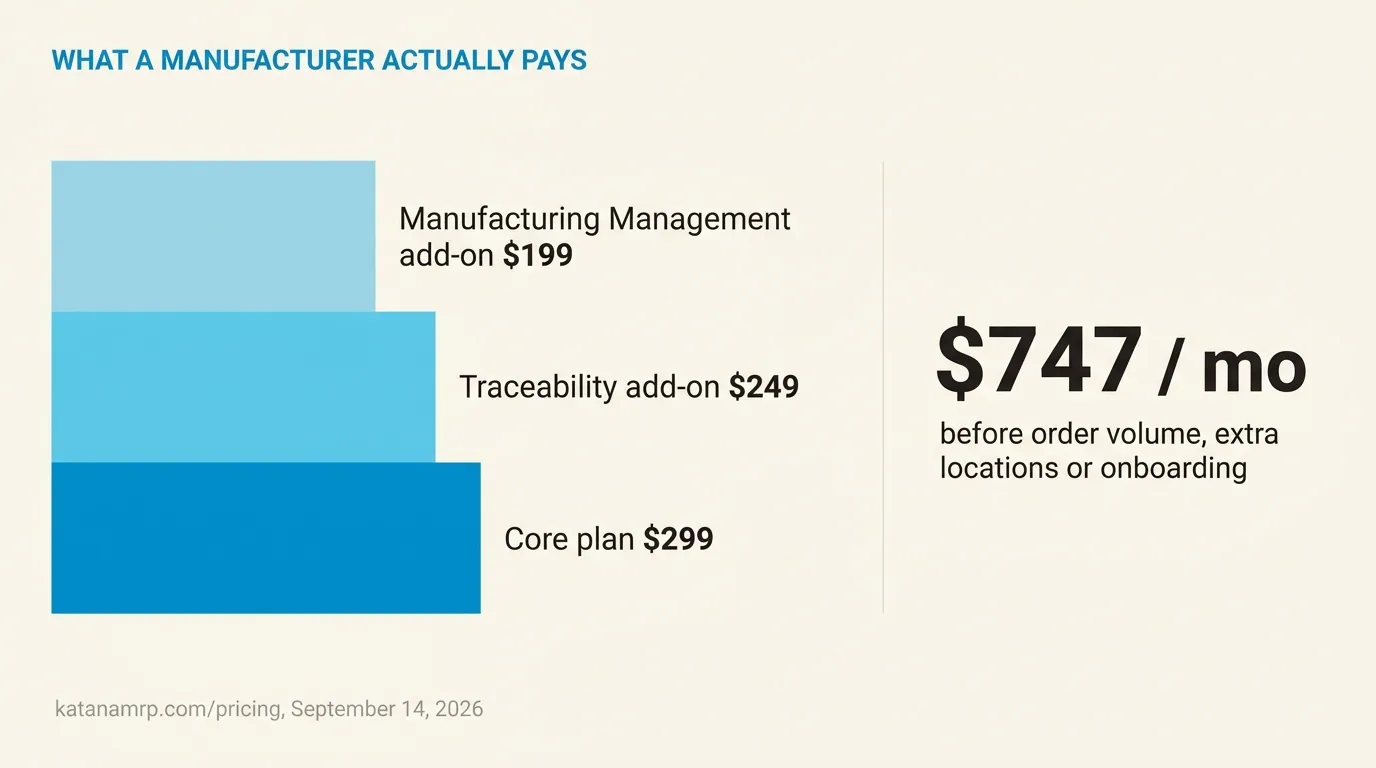
The two add-ons a manufacturer is most likely to need, stacked on the entry price. Every figure is from their published pricing table.
Above Core is an Advantage plan at custom pricing, which is Katana building and maintaining a configured solution for you, with a dedicated solutions engineer and SLA-backed maintenance.
For contrast, we are about $1,000 a month with no onboarding fees, and it scales with orders and SKUs. We are more expensive than Katana’s entry point and we don’t have a free tier.
Why do operators leave Katana for us?
Almost always for one specific reason, and it has nothing to do with manufacturing. What follows is a buyer’s account of what Katana told him. It is not something I found in Katana’s own documentation, and I could not find it there either way.
A distributor evaluating three systems in July told me on the call that they had just crossed Katana off the list. His words: they don’t handle drop ships natively, and that is what we model, we do. He wasn’t happy about it. He said they had a very nice presentation, an engineer walked them through the process, and it was the second call where drop ship came up. “We were very disappointed to have to cross them off our list.”
That’s the shape of nearly every Katana-to-us conversation I have. Somebody liked Katana, and then hit a channel-side or fulfillment-side requirement that a production-first system doesn’t lead with. Drop ship. Marketplace fees landing in the right place. Routing an order across three fulfillment paths.
The other version’s quieter. An Australian operator running a showroom and a warehouse on about 10,000 SKUs told me in 2024 that he had a call with Katana and loved how it did certain things, but that it “just doesn’t link.” What he wanted was a reorder that ties back to the sales order that caused it.
SKU.io ships manufacturing now. Does that change the recommendation?
Less than I’d like it to, and I’d rather tell you that here than in month three.
The module is real and it is live. Bills of materials with operations and per-component scrap, effective date ranges, expected yield, unit-of-measure conversion, additional outputs typed as co-product or byproduct with their own valuation, contractors with a cost basis that distinguishes pure assembly from value-add, work centers, outsourced manufacturing orders that raise their own purchase order, lot and serial tracking with first-expiry-first-out picking, and lot genealogy that traces forward from a recalled input to affected customers and backward from a customer order to its inputs.
Here’s the honest part. It shipped in June 2026. When a prospect asked me about it in July I told him we didn’t have anyone fully using it yet. I checked before publishing this and it is still true in September.
It was built from competitive analysis rather than from running a factory, and I say so on demos, because I’m not a manufacturer and the exceptions are where that shows.
I had a list of three things we hadn’t built and I was going to print it here. Checking it against our own deployed code this morning, two of the three had closed since I wrote them down.
The multi-stage outsourced chain shipped on August 17. That is the blank hat that goes to an embroiderer, then to a customizer, then to a co-packer: one work-in-progress product at each vendor boundary, a separate bill of materials per stage, toll processing costed with per-unit service fees, and each stage’s manufacturing order delivering into the next contractor’s site. It had been planned twice before and dropped both times for want of a customer to sponsor it.
Lot override on sales order fulfillment shipped too. That one was a gap I found myself in the middle of a demo: you could see and override the chosen lot on a manufacturing order, but not when you shipped the sales order. Now you can, on fulfillment and on warehouse transfers and on adjustments, with a setting that decides whether overriding away from first-expiry-first-out passes silently, warns, or is blocked outright.
The one still missing is dynamic assemblies. A technician can record the quantity actually consumed and actually scrapped on every component, but each line has to be one the bill already named. Editing which components went into this particular unit, and closing the work order against a bill that changed on the floor, is a problem I have described and not solved.
None of that should move you if production is the complicated part of your business. Buy Katana. A module nobody is fully running on yet is not what you want underneath a factory, however quickly the gaps are closing, and closing gaps quickly is a different thing from having been in production for five years. If your production is one contract manufacturer and your real complexity is nine sales channels and a 3PL, we’ll probably suit you better, and the manufacturing module is a bonus rather than the reason.
Can an AI agent drive either one?
Yes, both. This is the section where a vendor page normally cheats, so here is the part that costs me.
Katana publishes open API documentation at developer.katanamrp.com with no gate on it. They document a 60 requests per 60 seconds rate limit, return a 429 with a Retry-After header when you cross it, and put your remaining quota in response headers on every call. They publish an llms.txt index, they serve a markdown version of any docs page if you append .md, and they ship an MCP server whose page is titled “Manage your inventory with Claude and ChatGPT.”
That’s a better agent story than most systems in this category have, including several that market themselves as modern. On one specific point it is better than ours, so here it is. Their MCP server is a hosted connector: you sign into Claude or ChatGPT with your Katana account, no API key and no code, and it answers from your live data and can create or change records. Ours is a documentation server. It searches our docs and hands over the OpenAPI spec, and that is the whole of what it touches.
What we publish instead is the machine surface for building on. The full spec, an error catalog with retry guidance, a webhook event catalog, an operating manual written for agents, and a manifest of task-oriented skill files covering things like creating and fulfilling an order or syncing inventory. Our published platform limit is 1,000 requests a minute against their 60, and our docs say a given token’s limit can be lower. That suits someone wiring an agent up to do a job repeatedly against their own data.
It does not suit an operations manager who wants to ask a chat window a question this afternoon. If that is the shape you want, Katana has it today and we do not. Either way, run the six checks in inventory management API: what to check first against both of us and believe the docs rather than either sales team.
Side by side
| Katana | SKU.io | |
|---|---|---|
| Built around | Production | Channels and the money off them |
| Entry price | Free to 30 SKUs; Core from $299/mo | About $1,000/mo, no onboarding fee |
| Onboarding | $2,000 on Core, listed as optional; included on Advantage | None charged |
| Batch and serial traceability | Traceability add-on, $249/mo | Included |
| Routings and manufacturing insights | Manufacturing Management add-on, $199/mo | Included |
| Shop floor app | Add-on, no price published | No |
| Sales channels listed | Shopify, Amazon, eBay, BigCommerce, WooCommerce | Those plus Walmart, TikTok Shop, Etsy, Faire and B2B |
| Native drop ship | Not mentioned on their pricing or integrations pages; a buyer evaluating them in July 2026 was told it is not native | Yes |
| Manufacturing maturity | Their pricing page claims 1,500+ businesses in one place and 1,600+ in another | Module shipped June 2026; no customer fully running on it yet |
| API rate limit | 60 per minute, 429 with Retry-After (their docs) | 1,000 per minute (ours, published at developer.sku.io) |
| MCP server | Hosted connector for Claude and ChatGPT; sign in with your Katana account, reads live data and creates or changes records | Documentation server only; agents drive the product through the API with published skill files and a token |
Channel names in the Katana column are the ones listed on katanamrp.com/integrations, read the same morning. Walmart, TikTok Shop, Etsy and Faire were not among them, which isn’t the same as saying they can’t be reached some other way.
The question almost nobody asks: what is your supplier running?
This is the part of the comparison I find genuinely interesting, and it isn’t a comparison at all.
In August I sat in on a call with a caviar importer that supplies one of our customers. We weren’t selling to them. We were asking how to make the ordering relationship less annoying from their side. Their sales manager described their process in one sentence: a purchase order arrives from our customer by email, somebody types it into Katana, and Katana pushes it to ShipStation for a label.
So we asked whether we could put the purchase order straight into their Katana through its API instead, as a draft that a human approves. His answer: “directly into Katana would be great, yeah, that would be great actually.” Then, flatly: “right now we’re just manually entering it anyways, so it just saves us time.”
Two things about that are worth your attention. The first is that we haven’t built it. We scoped it on that call, we asked about restricted user permissions on their side, and the honest status is agreed in principle with nothing shipped. I’m telling you about it because it’s the direction, not because it’s a feature.
The second is the thing I keep running into. Every system in this category integrates the money side beautifully and stops at your own four walls. The supplier end is still a PDF and a human retyping it. In this case the human retyping it was sitting inside a perfectly good MRP with a documented API, which nobody was talking to. And the same call turned up a smaller, more human problem underneath: their SKUs and our customer’s SKUs do not match, so somebody has been translating part numbers by hand on every order.
If your suppliers run Katana, that isn’t a reason to buy Katana. It might be a reason to ask both vendors what talking to it would take.
Who should look at something else
If you’re a pure manufacturer, meaning production scheduling and shop floor execution are the job, buy Katana. If made-to-order work means the technician rewrites the bill of materials on the floor, neither of us does that today, and a specialist will. If you’re under about $1M on a single channel, Zoho Inventory or inFlow will cost less and annoy you less than either of us. If your requirement list opens with SOC 2 and a big-firm implementation program, we’re not your lane today.
Where we’re worth a conversation is the shape that breaks simple tools: several thousand SKUs, Shopify plus Amazon plus a marketplace or two, FBA next to a 3PL, bundles and kits, wholesale running beside DTC, drop ship in the mix, and a finance person who needs marketplace fees to land in the right account.
Where to go from here
If you’re comparing more broadly, what Cin7 switchers actually choose is built from recorded operator calls, and Cin7 API vs SKU.io API is the technical read on the other system you’re probably looking at.
If you want to see the manufacturing module rather than read my caveats about it, I will do the demo myself and build your bill of materials live, including the parts where it doesn’t fit. Book a demo.