
What Happened to TradeGecko? The Full Story (2026)
TradeGecko is gone, twice over. Intuit acquired it in August 2020 for a reported $80 million, renamed it QuickBooks Commerce, retired the platform on June 10, 2022, then discontinued QuickBooks Commerce itself on August 31, 2023. As of August 2026, tradegecko.com serves an unrelated Korean-language link directory. The product’s users scattered to Fishbowl, Cin7, Unleashed, spreadsheets, and in some cases to building their own software, and a striking number of them are still unhappy about how it ended.
I sell inventory software, so read this page knowing that. What I can offer that the other “TradeGecko alternatives” pages cannot: I have been on recorded calls with TradeGecko refugees for years, and this page is built from what they actually said. Quotes are verbatim, lightly cleaned of transcription artifacts, attributed by role with names withheld.
Dates and domain facts checked August 31, 2026.
What exactly happened to TradeGecko?
The short timeline, every date checkable:
| Date | What happened |
|---|---|
| August 2020 | Intuit acquires TradeGecko, a Singapore-built inventory and order platform, for a reported $80 million |
| Late 2020 | TradeGecko is rebranded QuickBooks Commerce |
| June 9, 2021 | Intuit announces the retirement; the product stops accepting new customers |
| June 10, 2022 | The TradeGecko platform is retired. US customers are offered a version folded into QuickBooks Online; customers outside the US lose the product entirely |
| August 31, 2023 | QuickBooks Commerce is discontinued for everyone, including the customers who took the US bundle a year earlier |
| August 2026 | tradegecko.com serves an unrelated Korean-language link directory. The brand's domain is no longer in Intuit's hands |
Two shutdowns is the part people forget. The customers who did what Intuit asked in 2022, migrated into the QuickBooks Online bundle and re-learned their workflows, got fourteen more months before the same thing happened again. If you are reading this years later trying to reconstruct what your old system was, that is why your records show two migrations.
The domain is the detail I did not expect to find. I checked tradegecko.com while writing this page expecting a redirect to quickbooks.intuit.com, the way skuvault.com redirects to Linnworks. Instead it loads a Korean link-collection site with no mention of inventory, QuickBooks, or Intuit anywhere on it. Every old blog post and forum answer that says “learn more at tradegecko.com” now points there. I wrote about this pattern on the SkuVault page, where the dead brand’s subdomains keep serving the API docs four years on. TradeGecko got the harsher version: nothing survived, not even the redirect.
Why do people still talk about it like a lost friend?
Because it was good, and the people who ran their businesses on it knew it was good. This is the thing that separates TradeGecko from most discontinued software, where the shutdown announcement reads like a mercy.
An importer-distributor of dive equipment, on a call with me in April 2024, gave the history in one sentence:
“We were using TradeGecko, which got turned into Commerce when acquired by QuickBooks. And then QuickBooks managed to turn it from actually a brilliant, inexpensive solution with lots of subscribers, into an inexpensive solution that had no subscribers and closed it down.”
The same operator, on what running it was actually like:
“When I go back to Commerce or TradeGecko, I probably had fewer than ten support calls in a two year period once I got up and running.”
Ten support calls in two years. He said it while describing the system he moved to afterwards, which was costing him a full working day of tech support every week.
I will add my own assessment, because I was evaluating this market as a competitor while all of this happened. On a call in early 2025 I put it this way: TradeGecko was beautiful, really great workflows and really good looking, but there were so many holes in the software and how it operated. Both halves of that were true. It had real gaps, some of which I will name below because they are what a replacement should be judged on. And it was still the best-designed product at its price that this category had produced. Those two facts coexisted, which is exactly why nobody has felt like a clean replacement.
Where did TradeGecko users actually go?
The listicle answer is “the top 10 alternatives.” The recorded-call answer is messier and more useful.
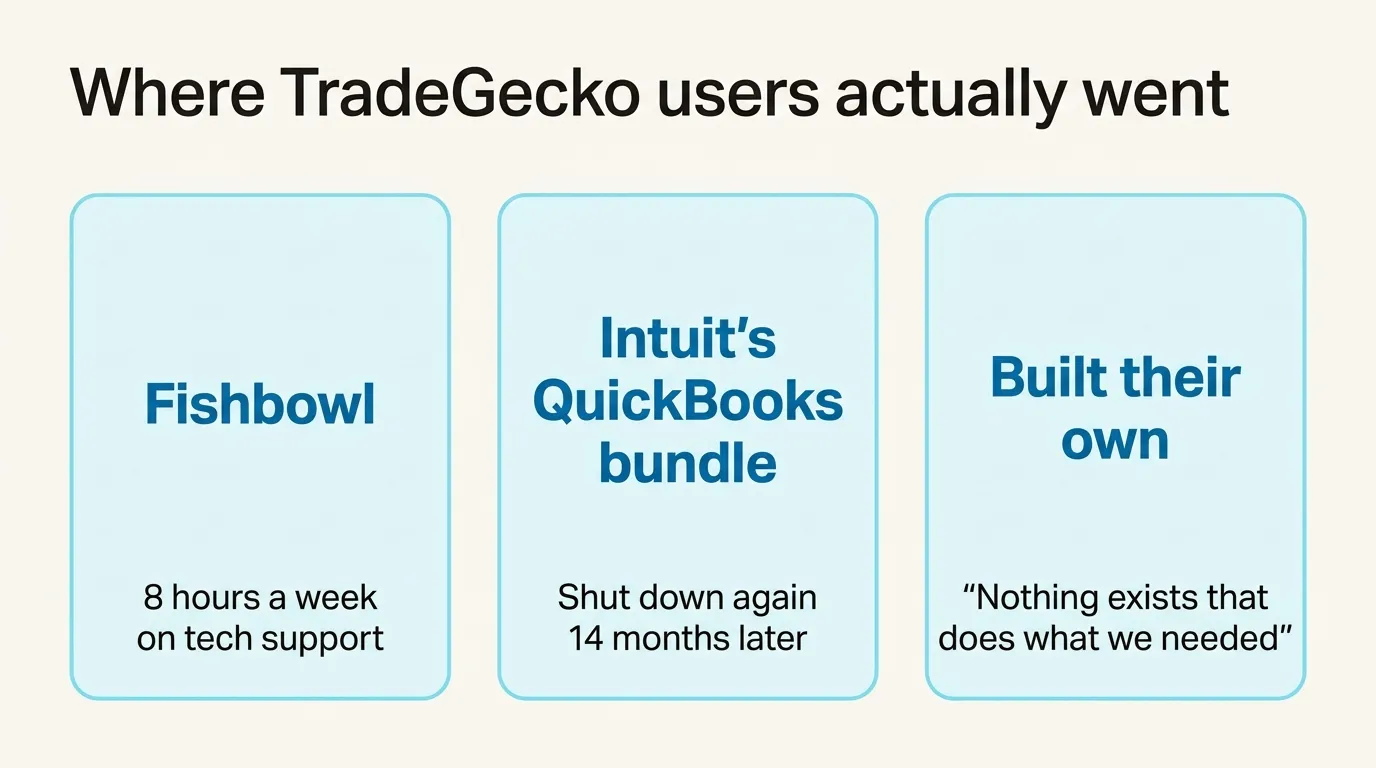
Some went to Fishbowl and regretted it. (What Fishbowl costs in labor prices that pattern out across several more calls.) The dive-equipment distributor moved there and described it to me as “having a nightmare with it, frankly.” The specifics are worth hearing because they are what a bad migration actually feels like. His pickers scan orders with the mobile app, but the app cannot print packing slips, so on every one of his 30 to 40 daily transactions someone logs out of the mobile app, logs into the desktop app, prints, and logs back in. The vendor could not fix it. He totaled the overhead:
“I spend, I would say 8 hours a week, a full working day, on either being on the phone with tech support or solving internal things… My pain point is I need shit to work properly.”
Others took Intuit’s own migration path and got burned. The co-founder of an online retailer told me in late 2022 what the transition did to his stock accuracy:
“QuickBooks Intuit took what I thought was actually one of the better products on the market, TradeGecko… They messed up my inventory so bad. We were doing cycle counts and they weren’t counting it correctly. I mean basic stuff.”
His co-founder’s summary of the whole episode was three words: “We were so mad.”
And at least one operator concluded nothing on the market fit, and nearly built his own. A wholesale distributor opened a 2025 call with me still processing that decision, years after the shutdown forced it:
“Nothing exists that does what we needed to do. Should we build it? … We need to quickly figure out is there something out there that can help us or do we have to actually build some parts of this ourselves.”
That is a rational conclusion to reach, and I say that as someone whose pitch depends on it being wrong. The same operator had spent years building mapping tables in a data warehouse to work around TradeGecko’s weak variant handling, so “software will not do this, we will” was already his lived experience.
And the market-gap line that explains all three stories, from the dive-equipment distributor again:
“Actually trying to find something that had the functionality of Commerce for less than ten times the price of it is quite challenging, of course.”
That gap is real. TradeGecko sat at a price point where a genuinely capable multichannel platform cost a few hundred dollars a month. Most of what does its job today either costs four figures or does noticeably less. Anyone selling you a like-for-like swap at the old price is worth interrogating closely.
If you moved to Cin7 or QuickBooks and are still fighting it, two things are worth doing before you look at anything else. Check whether your counts agree: export stock from your current system and from Shopify or Amazon and drop both into the inventory mismatch checker, which lists every SKU that disagrees. Then read what to look for in a Cin7 alternative, which is the same question asked about the system many TradeGecko users landed on.
Is QuickBooks Commerce still available in 2026?
No. There is no product called QuickBooks Commerce you can buy. What exists is QuickBooks Online’s built-in inventory: quantity tracking, FIFO cost, basic reorder points, in the US on the higher QBO tiers.
If you sell on one channel, your SKUs are simple, and your accountant already lives in QBO, the built-in inventory may genuinely be all you need, and it is the cheapest possible answer because you are already paying for it. The people it fails are the ones TradeGecko was actually for. Multiple channels, bundles and kits, purchase orders against overseas lead times, a 3PL or FBA in the mix. QBO’s inventory does not manage channels at all, which is the entire job.
What should a replacement have that TradeGecko itself lacked?
This is the question the alternatives listicles skip, because answering it requires having watched the product fail somewhere. TradeGecko’s users loved it. The ones I have recorded still hit walls, and the walls tell you what to evaluate now.
Variants as first-class records. The wholesale distributor above built mapping tables in a separate data warehouse because, in his words, TradeGecko “likes products, they don’t really like variants.” If your catalog is apparel, consumables, or anything where one product is thirty SKUs, make the vendor show you variant-level costing, purchasing, and channel listings before anything else.
Forecasting that replaces the spreadsheet instead of decorating it. The dive-equipment distributor orders four to five months ahead, and his biggest brand is about 70% of his sales, so purchasing is the whole game for him. TradeGecko had a forecasting module. He ran a massive manual spreadsheet anyway, and he was still running it on the next platform too. A forecasting feature that operators quietly bypass is a checkbox, not a feature. Ask to see a purchase order actually generated from velocity, lead time, and minimum order quantity, with your numbers in it.
An audit trail under the stock number. The retailer whose cycle counts stopped matching during the QuickBooks migration was not undone by a missing feature. He was undone by a number that changed and could not explain itself. Whatever you evaluate, ask where a stock figure comes from and whether the system can show you every movement behind it. This is what that looks like in our product, and it is the right thing to demand of anyone’s:
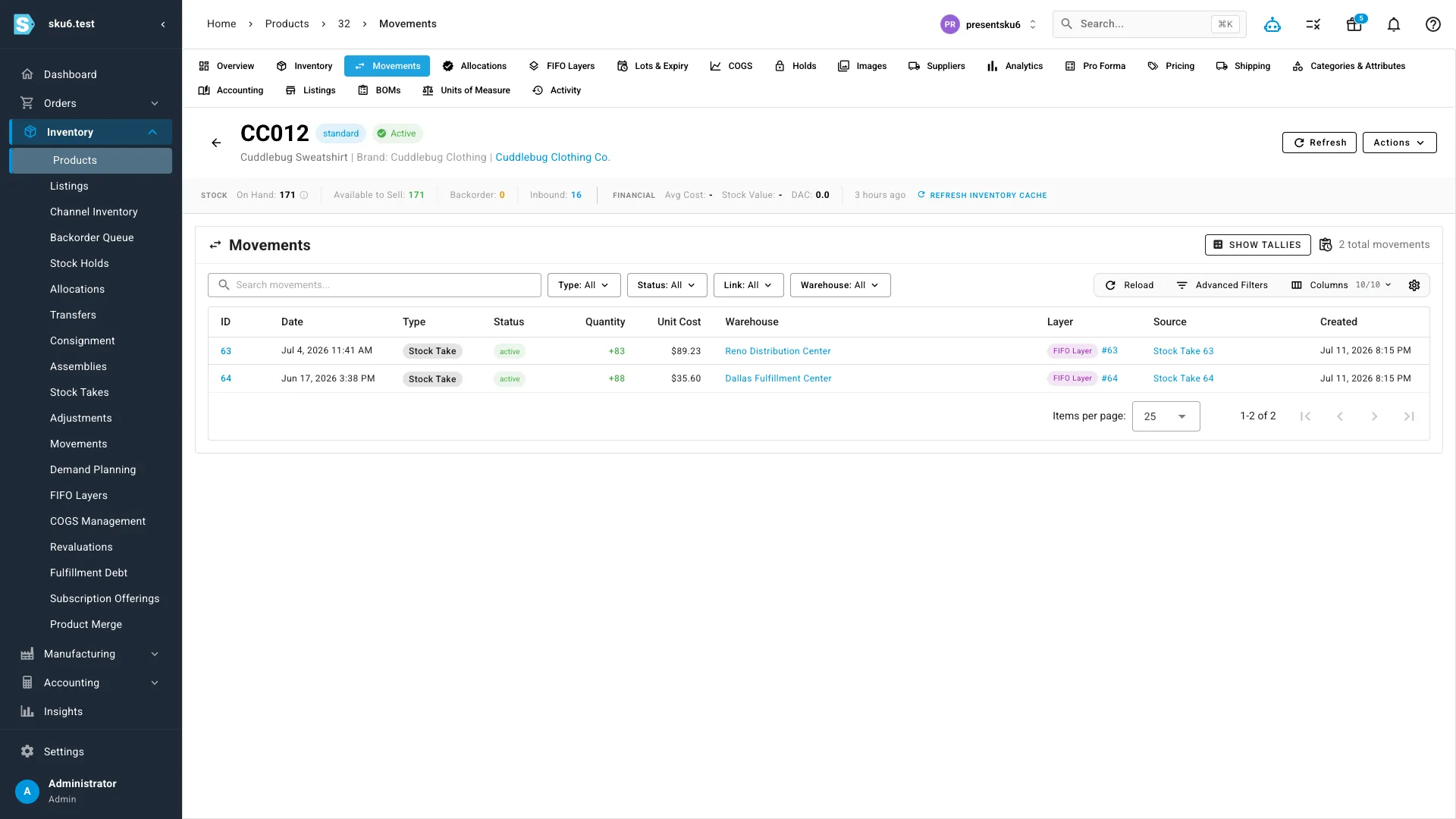
I wrote six checks for evaluating any inventory platform’s API that cover this in detail, and they apply whether or not you ever plan to call the API yourself.
Is SKU.io the right home for a former TradeGecko operation?
Sometimes. I have customers who came from TradeGecko, which is why its refugees keep ending up on my calls, and the fit question splits cleanly.
We fit the operation TradeGecko grew out of: $1M to $50M in revenue, Shopify plus Amazon including FBA, often Walmart, TikTok Shop, or wholesale alongside, hundreds to thousands of SKUs, bundles and kits, a 3PL or several warehouses. Inventory lives in one perpetual ledger where every movement traces to its source document, purchasing runs from velocity and lead times instead of a spreadsheet, and order-level profit includes the marketplace fees. Pricing starts around $1,000 a month with no onboarding fees, and I give every demo myself.
We are the wrong answer if TradeGecko’s price was the thing you loved most. We cost more than it did, and pretending otherwise would waste your afternoon. Under about $1M on one or two simple channels, Zoho Inventory or inFlow will get you further faster and cheaper, and QBO’s built-in inventory is a fair answer at the bottom of that range. Manufacturing-first operations should look at Katana before anyone multichannel-first.
Where to go from here
If you left TradeGecko for a platform that is now failing you, the same recorded-call evidence behind this page produced what Cin7 switchers choose and what happened to Skubana after the Extensiv rename. If you are rebuilding your evaluation from scratch, start with inventory management API: what to check first and run its six checks on everyone, including us.
Or tell me what your TradeGecko setup did that nothing since has managed, and I will show you honestly whether we clear that bar. Book a demo.