
SKU.io vs NetSuite (2026): Which Fits Your Operation?
I’m Kalvin, the founder of SKU.io. I give every demo myself, which means I’ve spent the last few years listening to people describe their NetSuite evaluations to me. Before writing this I went back through our call archive to check my memory. Or rather I had an agent go through it, which is how I work now: 1,435 recorded calls, 73 of them mention NetSuite. What I remembered held up. Almost none of those people were using NetSuite. They’d evaluated it, collected a quote, and walked away. A few got deep into an implementation first and then walked.
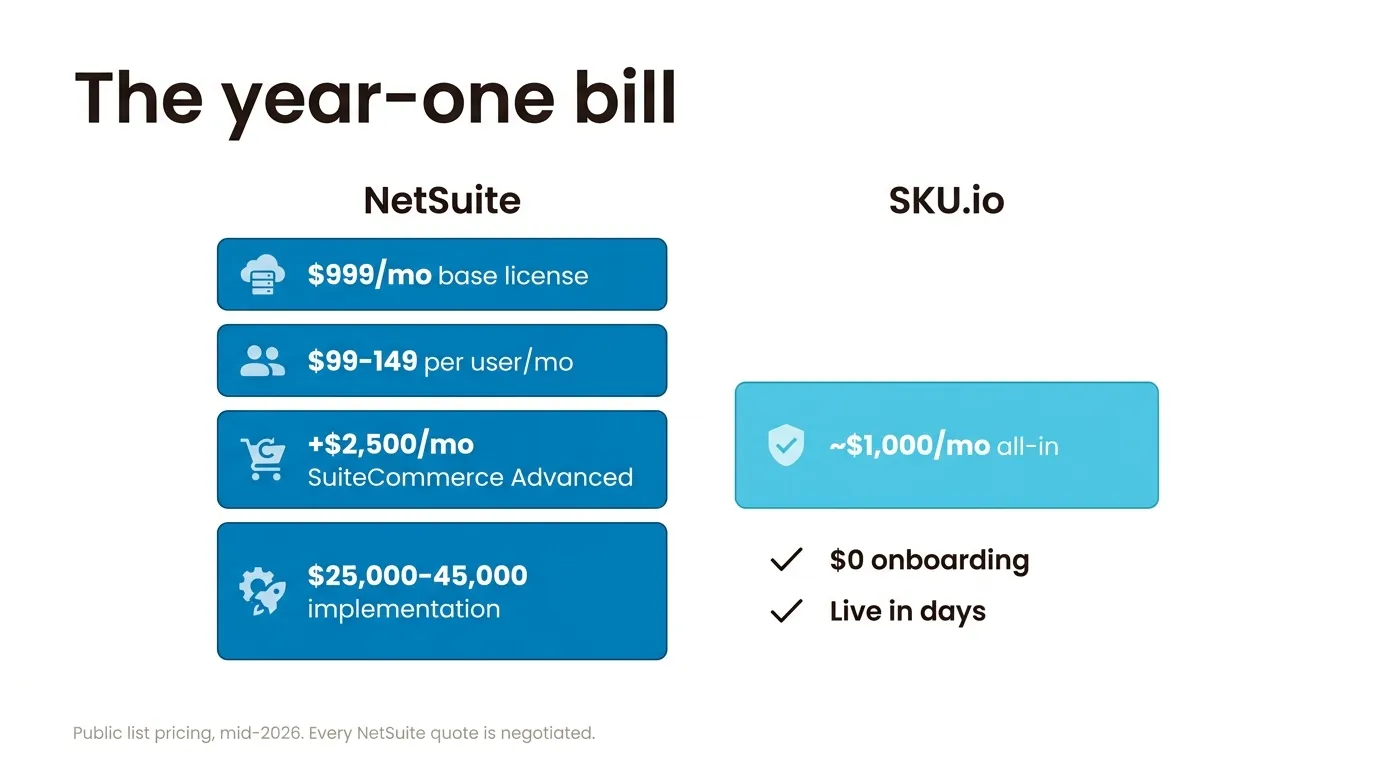
So I should say up front that these aren’t really two versions of the same product. NetSuite is Oracle’s general-purpose ERP. The base license is $999 a month before users, modules, or the implementation project. SKU.io is an operations platform for multichannel e-commerce, Shopify plus Amazon FBA plus Walmart plus wholesale, and it starts around $1,000 a month with no onboarding fee. The monthly sticker is about the only place they overlap.
One housekeeping note. The quotes below are word for word from our recorded calls. I’ve left the names off because I haven’t asked those people for permission to put their words on my website, and until I do, role and industry is what you get.
What does NetSuite actually cost an e-commerce company?
More than the license page says, and the license page already says $999 a month. Users are another $99 to $149 each. SuiteCommerce, their e-commerce storefront layer, is about $2,500 a month more at the Advanced tier. Then the implementation. This year’s pricing guides put a basic financials rollout around $25,000, a typical small business at $35,000 to $45,000, and past $100,000 once you have multiple entities or real customization. Every NetSuite quote is negotiated so none of these numbers are promises, but they set the shape.
The people who reach my calls after shopping that tier report worse. A supplements CEO in New Zealand told me:
“They’re all wanting like 80 to 150,000 dollars to onboard and get set up.”
He wasn’t only talking about NetSuite there, to be fair. That was his summary of the whole enterprise class he’d been quoted by. NetSuite was in it.
Why do operators walk away from NetSuite?
The call I think about most was with the owner of a golf-accessories brand. He’d almost implemented NetSuite, exited before go-live, then spent six months on a second ERP and got within a week of launching that one before pulling out too. The transcript renders the second system’s name as “Zerosoft,” which I’m fairly sure is the transcription mangling something. His words:
“I went to NetSuite, I almost implemented it, and then I exited it. Then went through another ERP — spent six months on it, and we were a week away from go-live, and I felt like that was not a system that we liked. Everything was pain. So it’s been two years now. I’ve been exploring.”
Two years. He also went through Apparel Magic and then Luminous in that stretch. And the thing he actually held against NetSuite wasn’t the price:
“I don’t want a NetSuite, which is like 800 things need to be pushed just to push one thing. We have a very simple thing to manage.”
I hear versions of this constantly. A co-founder who’d spent years selling enterprise software himself told me he wouldn’t even take the meeting. His words were “I will not go down the Oracle path. I just won’t. They’re just going to consult you to death.” A supply-chain lead at a woodworking-tools manufacturer got a long way in before the cost stopped him, and when I gave him our number on that call he said it was in the ballpark his team had already budgeted. I remember noticing what the NetSuite process had done to his sense of what software costs. And a finance lead at a multi-brand holding company, one subsidiary already live on NetSuite, was pulling the e-commerce side off it while we talked: “NetSuite seems to be a little bit more than we need for the e-commerce side of things.”
Then there’s the objection I hear on calls far more than I ever see written down. This one came from someone who runs a refurbished-phones operation now but had done software selection at a much bigger company before that:
“NetSuite and all these big fancy names that we could have definitely afforded — they just don’t work well with Amazon. You’ve got to buy like 60 different integrations.”
Here’s my actual opinion, and plenty of consultants would argue with it. For a $2–25M e-commerce brand, NetSuite isn’t a software purchase. It’s a consulting engagement with software attached. Nothing wrong with that when you need the engagement. But it means the evaluation should be priced and staffed like hiring a systems integrator, because that’s what you’re doing. If you wouldn’t hire an SI this quarter you aren’t really in a NetSuite evaluation, whatever the sales rep’s calendar says.
What is SKU.io, and what does it cost?
SKU.io is an e-commerce operations platform. Inventory, purchasing, order routing, and order-level profit across Shopify, Amazon including FBA, Walmart, TikTok Shop, eBay and wholesale, with bundles and kits, 3PLs and multiple warehouses. Every inventory movement lands in one perpetual, auditable ledger. Order-level profit includes marketplace fees as line items. The fees NetSuite hands to those “60 different integrations” are the center of our accounting model.
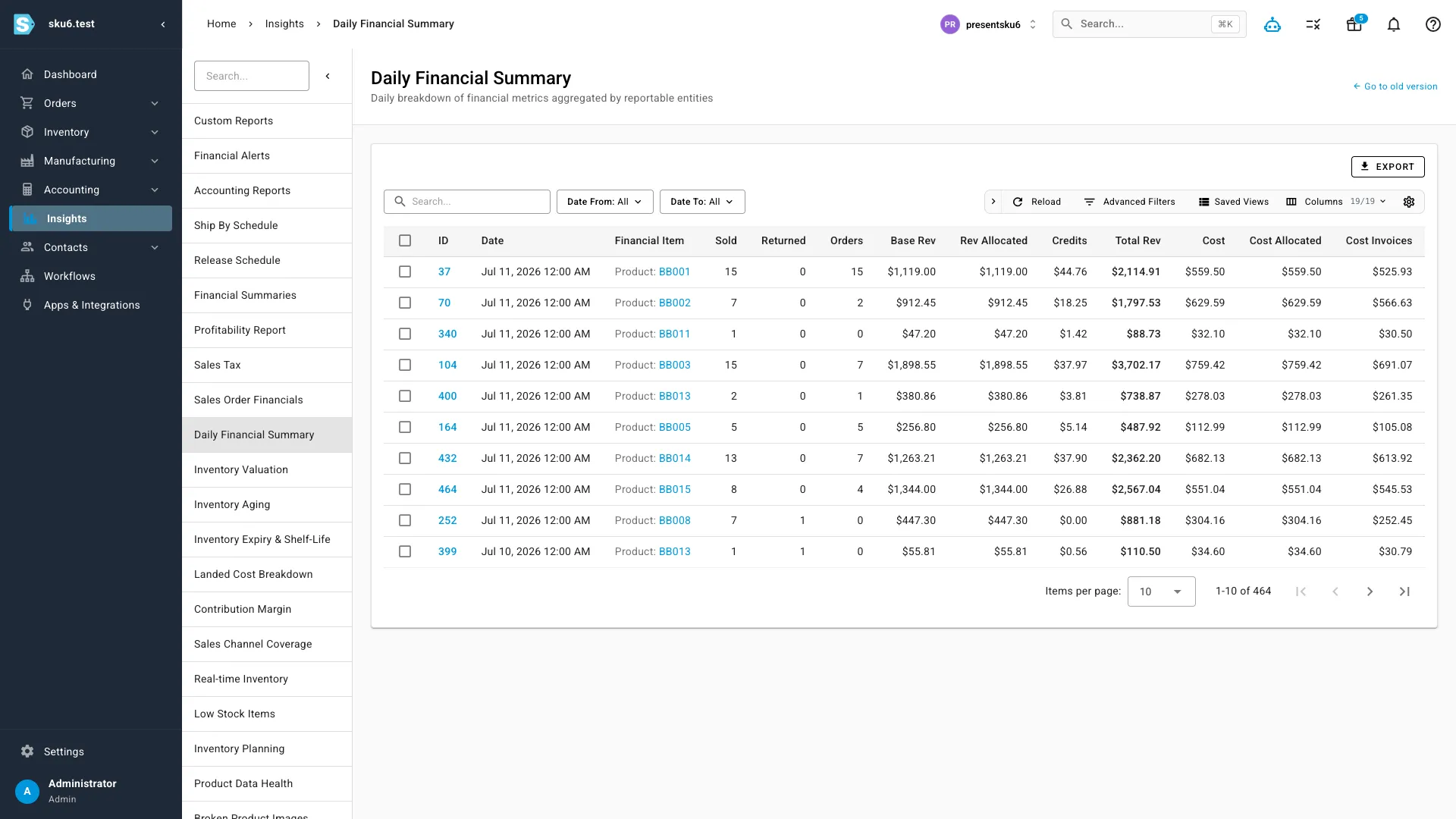
This is the screen NetSuite buyers are usually trying to reach through those integrations: revenue, credits, cost and allocations, per product, per day, in the same system that runs the warehouse.
Pricing starts around $1,000 a month and moves on order volume and SKU count. Every module, every integration and API access are included. No onboarding fees. Onboarding takes days and I’m personally in each one, and the whole onboarding path is public if you want to see what it involves before talking to anyone. I also run my own e-commerce business on SKU.io, which is easy to say in marketing copy, so in a demo I’ll just show you my account.
When is NetSuite the right answer?
When the hard problem is the general ledger rather than the warehouse. Multiple legal entities consolidating across countries and currencies. An accounting team that lives in the GL all day. A mandate to put manufacturing, financials, HR and e-commerce under one vendor. Compliance postures that expect a big-firm implementation program behind them. If your board asks for consolidated multi-subsidiary financials before it asks whether Amazon inventory reconciled, NetSuite belongs on your shortlist and SKU.io honestly does not. Enterprises that need SOC 2 attestations and SI-led implementations aren’t our lane today.
And below both of us: under $1M in revenue, or effectively one channel, you don’t need either platform yet. Zoho Inventory or inFlow will cost less and do the job until channel count or SKU structure becomes the real problem. I tell people this on calls and it costs me nothing, because they come back when it’s true.
How do they compare, line by line?
Public list pricing as of mid-2026. Verify current numbers with each vendor, especially NetSuite’s, since every quote there is negotiated.
| NetSuite | SKU.io | |
|---|---|---|
| Starting price | $999/mo base license | ~$1,000/mo |
| Per-user fees | $99–$149/user/mo | None — price moves on order volume and SKU count |
| E-commerce layer | SuiteCommerce; Advanced tier ~$2,500/mo extra | Marketplace and cart integrations included |
| Implementation | $25,000–$45,000 typical small business; SI-led; months | No onboarding fee; days; founder-run |
| Marketplace accounting | Via integrations and configuration | Order-level profit with marketplace fees as line items |
| API access | Included; concurrency is licensed — base 5–20 concurrent requests by tier, +10 per SuiteCloud Plus license | Included, never charged extra |
| Best fit | Multi-entity consolidation, large accounting teams, one-vendor ERP mandates | $1M–$50M multichannel e-commerce: Shopify + Amazon FBA plus Walmart, TikTok Shop, wholesale; bundles/kits, 3PLs, multi-warehouse |
Whatever you pick, make both vendors prove it on your data before you sign. Get the total cost through month twelve in writing. Then sit in the demo yourself and process one real order end to end, counting the clicks as you go. The golf-accessories owner found the “800 things” months into an implementation, and a demo where he drove would have shown him in half an hour. If you sell on Amazon, also trace one FBA payout into your accounting software and see which fees survive as line items. That single test would have settled the “60 integrations” complaint before anyone signed anything.
If you’re still deciding whether you need an ERP at all, ERP inventory system vs. inventory software is the place to start. If what you’re leaving is a mid-market system rather than an enterprise quote, the same call archive produced what Cin7 switchers choose and Skubana alternatives after the Extensiv rename. The API-access row in the table above deserves its own evaluation on any platform — inventory management API: what to check first is the six-check version, and NetSuite API vs SKU.io API runs all six against Oracle’s public docs. And if you want those tests run on your own catalog, book a demo with me.