
Inventory Management API: What to Check First (2026)
I’m Kalvin, SKU.io’s founder, and before I built an inventory platform I spent over a decade buying software as a multichannel seller. Somewhere in that decade I stopped watching demos first. The demo shows what the vendor wants you to see. The API documentation shows what the system will let you do in three years, when the vendor’s roadmap and yours stop agreeing. Here is exactly what I said about it on a recorded call last year:
“As a seller for over a decade, I’ve looked for solutions for years and never been satisfied with one, because oftentimes I look at their API docs and immediately I’m like, well, I don’t feel I have control over my data in the way that I need.”
That filter became a design principle. SKU.io publishes 5,161 documented API operations — I had them counted from our OpenAPI spec the day this page went live, because the old “600+ API calls” line on our site had gone stale and I’d rather publish a number I can regenerate than a round one I can’t. API access is included in every plan. I still run my own e-commerce business, it runs on SKU.io, and half of what I know about our own API comes from being its customer. This page is the checklist I’d use on anyone’s API. Run it on ours too.
Updated August 2026. Quotes are verbatim from recorded calls, lightly cleaned of transcription artifacts, attributed by role with names withheld.
Why the API matters even if you never call it
Everything you connect calls it constantly. Your 3PL, your accounting software, your channel listings, and now the AI agents you hand work to — they all inherit whatever the API can’t do, and they inherit it forever.
The docs are also where “integrates with everything” goes to die. Early last year I was on a call with a wholesale distributor who had evaluated most of the enterprise tier. He didn’t need convincing about any of this; he’d arrived at the same test on his own, the expensive way:
“Deposco is an enterprise tool. So if something else has an API, they’ll sort of say, yeah, we integrate with that… But it’s not a perfect integration… It’s not saying you have 75 of something, it’s saying you have 5 less than you had before.”
“5 less than you had before” is a delta feed, and it’s the reason his stock counts couldn’t be trusted. I think it’s the single most useful question in a software evaluation, so it gets its own section below.
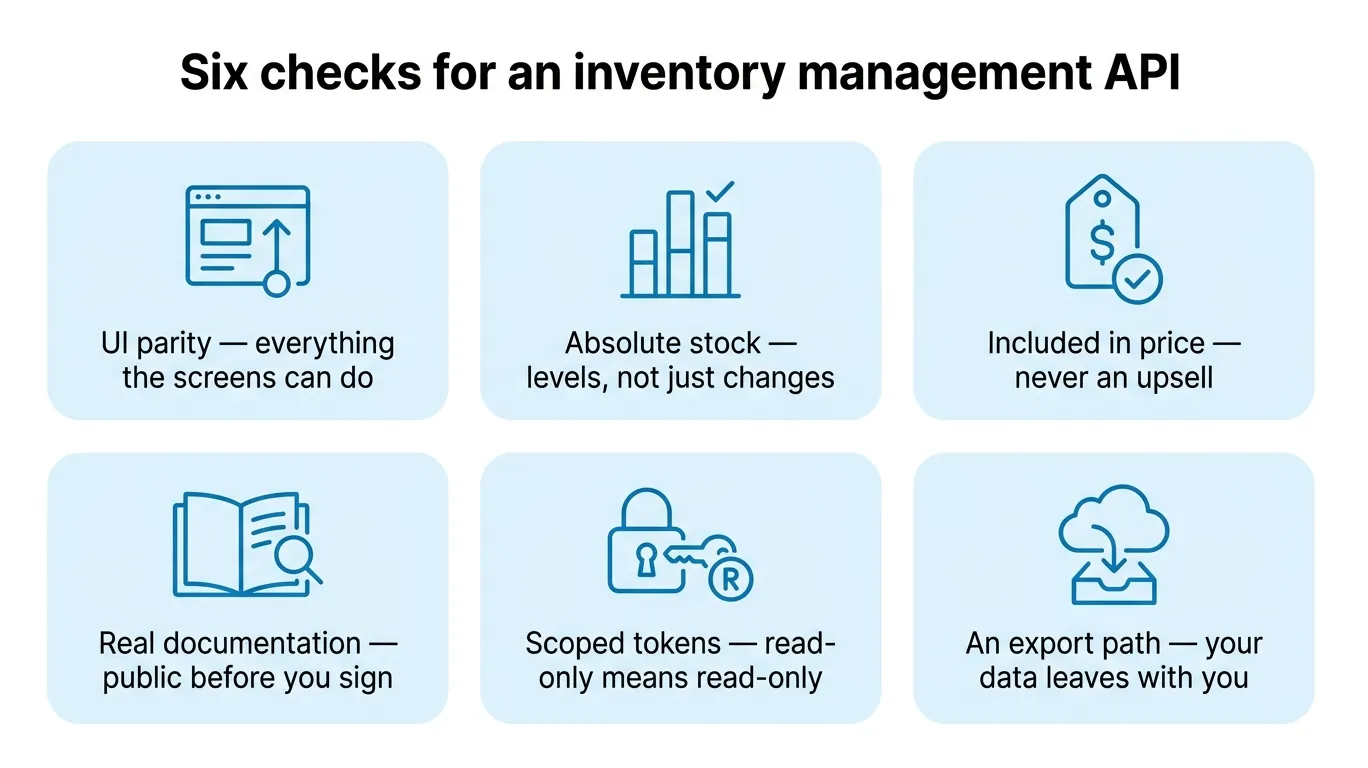
The six checks
Each one takes a few minutes with the vendor’s public docs. Each one traces to a specific operator on a specific recorded call who got burned skipping it.
| Check | What to ask | Why it matters |
|---|---|---|
| UI parity | Can the API do everything the app's screens can? | Whatever the API can't reach, a person will be re-typing forever. |
| Absolute stock | Does it return current stock levels, or only stock changes? | Delta-only feeds drift after any missed event, and you find out at the physical count. |
| Included in price | Is API access in your plan, or a higher tier or add-on? | If reaching your own data is an upsell, every future integration starts with a pricing call. |
| Real documentation | Are the docs public, complete, and current — before you sign? | Gated docs are usually gated for a reason. |
| Scoped access | Can you mint tokens limited to specific permissions? | A reporting script needs to read sales orders, not be able to delete them. |
| An export path | Can you pull all of your data out, completely, via the API? | TradeGecko users needed one on June 10, 2022. QuickBooks Commerce users again on August 31, 2023. |
Does the API cover everything the UI does?
For most inventory platforms, no. The API grew integration by integration as customers asked, so it reads orders and stock well and does everything else thinly or not at all. Ask the sales engineer to create a purchase order, receive it into a specific warehouse, and close a stock take — all through the API — and watch what happens.
We built in the opposite direction. The platform was API-first seven years ago, the UI is itself a consumer of the same API, and I’ve repeated the consequence in more demos than I can count, including this one in June:
“Every single thing you could do in the front end we have an API call for, which means that Claude could do as well.”
That’s the honest reason the operation count is 5,161 and not the couple of hundred endpoints a bolt-on API tops out at. It’s all public at developer.sku.io — and my favorite way to test a parity claim, ours included, is to pick the most obscure thing you do in your current system and search the vendor’s docs for it.
Does it report stock levels, or just stock changes?
Ask this one verbatim. Vendors rarely volunteer it.
A delta feed (“you sold 5”) requires whatever sits on the other end to keep its own running total and never miss an event. Events get missed. A webhook fails during a deploy, a rate limit swallows part of a Black Friday burst, and now your total is wrong with nothing to check it against until someone physically counts a shelf. An absolute feed (“you have 75, and here is every movement that got you there”) lets you re-anchor whenever you want and catch drift the day it starts.
SKU.io keeps a perpetual inventory ledger. Every movement — sale, receipt, adjustment, transfer — is a record with its date, quantity, unit cost, warehouse, and source document, and the API serves both the current position and the history behind it.
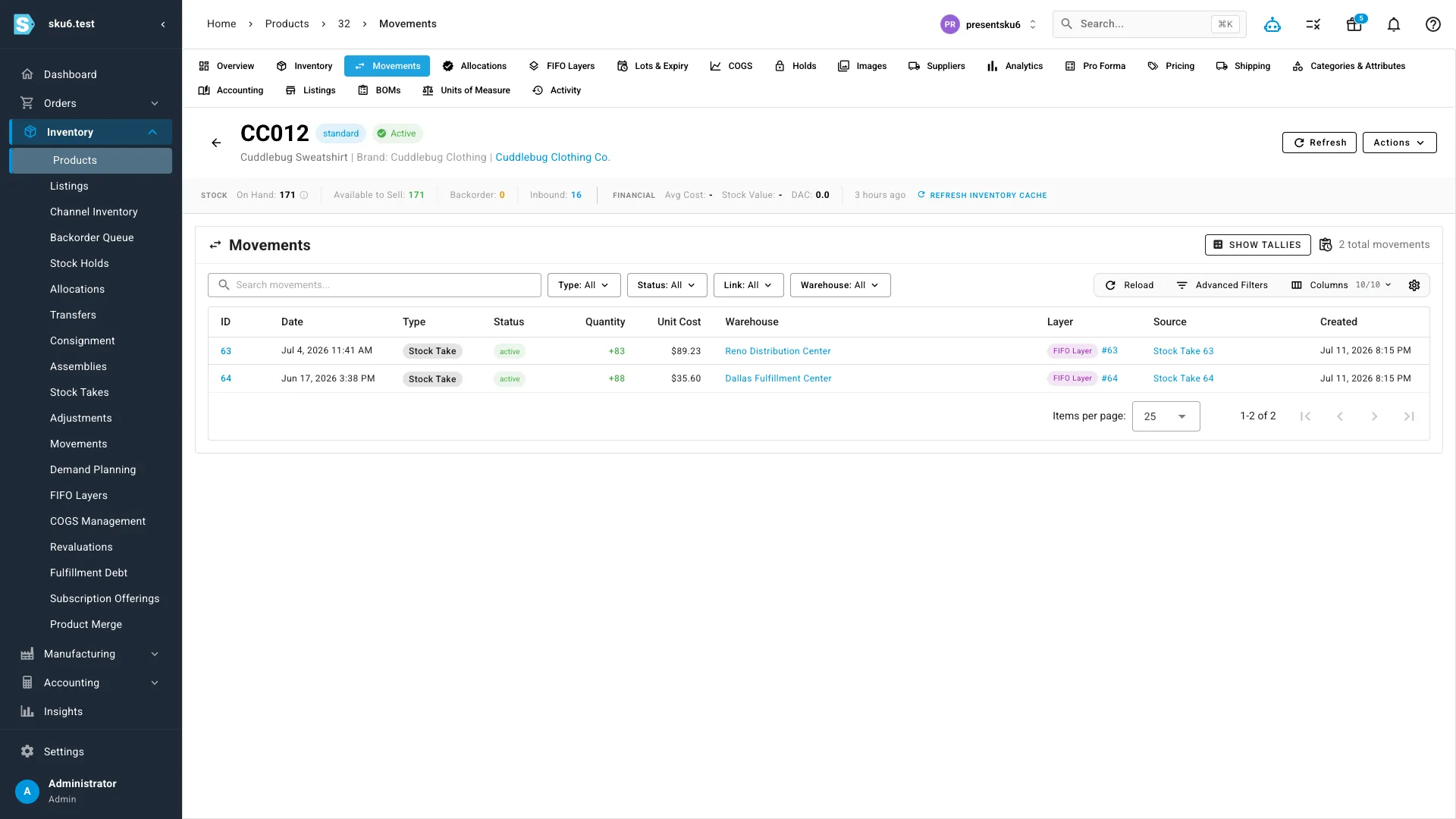
The ledger is also what makes delegation tolerable. A script or an AI agent working through the API writes to the same ledger a person does. When an adjustment looks odd, you open it and see what happened.
Is API access included, or an upsell?
The same distributor again, this time on TradeGecko, a platform he otherwise liked:
“On TradeGecko… if you wanted to use an API integration, then it sort of didn’t exist on the actual platform. … We’re willing to pay, but we want that to be in the UI… so that it’s not janky… so that we don’t have to build that elsewhere.”
He was willing to pay. What he resented was having to negotiate for access to his own data.
TradeGecko is also why the export-path check made the table. Intuit acquired it, renamed it QuickBooks Commerce, shut the original platform down on June 10, 2022, then discontinued the successor on August 31, 2023. Operators who chose it rebuilt their stack twice in three years, and the ones who got out cleanly were the ones who could pull everything through the API. What happened to TradeGecko has the full timeline and where its users ended up.
The cleanest published example of the other answer is Finale Inventory, which lists API and EDI access under its Enterprise tier and nothing below it. Credit where it is due: stating the gate on the pricing page is more than most vendors do, and it means you can answer this check before you take a call. What changed at Finale covers the rest of that page, including the part where integration partners can reach your data on any tier while you cannot.
Our answer here is short. API access is in every plan, we have never charged extra for it, and personal access tokens are self-serve in settings. No ticket, no tier change.
The agent test
The newest check, and the easiest: paste the vendor’s docs URL into Claude Code or another terminal agent and ask it to plan a real task — “create a purchase order for these three SKUs.” If the agent can’t work the API out from the documentation, your developers will have the same problem, just slower. I say a version of this on most demos now:
“Everything you can do on the site via the front end is run through our API… if you need to do anything with AI using Claude Code or Gemini or OpenAI, you could just direct it to the documentation and it could figure out how to do it for you.”
In June I told a partner on a call that I was going to build a public repo of Claude Code skills for our API. It shipped in July: open-source agent skills, MIT-licensed playbooks that teach an agent specific tasks in SKU.io — building a product catalog from a supplier’s price list, adjusting inventory after a count. Scoped tokens are the guardrail. An agent holding a read-only token can answer any question about your data and change none of it. I wrote up how I actually use this on my own business in run inventory and purchasing with AI agents, including where I stop trusting an agent and put a person back in the loop.
One honest caveat while you’re in our docs: we ship API changes weekly, and moving fast has occasionally broken an integration at the worst possible time — which is exactly why the docs carry a mechanical changelog and a separate breaking-changes-only feed you can subscribe to. If a vendor ships fast and doesn’t publish a changelog, that tells you something too.
Who shouldn’t buy on API strength
I’ve ended more than one demo by pointing the person at Zoho Inventory or inFlow. If you’re under about $1M on a single channel, you’ll probably never touch the API, and paying for structural depth you won’t use is how people end up resenting software. Come back when wholesale or a second channel arrives. And if your requirement list opens with SOC 2 attestations and a big-firm implementation program, we’re not your lane today either — I’d rather tell you that here than in month three of an evaluation.
The checks earn their keep when your operation has the shape that breaks simple tools — multiple channels, bundles and kits, FBA plus a 3PL, wholesale alongside DTC — or when there’s a developer in the building. One retail owner I met last year had his own offshore tech team ready to build against a vendor’s API. The build was a two-day job; the vendor took six days to answer one question about field mapping. His project died in the support queue, not in the code. Public docs and testable endpoints are how you avoid ever standing in that queue.
If the developer in the building has started asking why you’re buying any of this, that’s a different question and it has its own page: should you build your own inventory system, written by someone who did.
Where to go from here
If you want the six checks already run against a named vendor, NetSuite API vs SKU.io API applies every one of them to NetSuite using Oracle’s public documentation, and Cin7 API vs SKU.io API applies them to both of Cin7’s APIs — which report the same rate limit with two different status codes, and put API access itself on the price list. Katana MRP vs SKU.io runs them against a vendor that passes most of them, including the one where their answer is better than ours. If you’re comparing platforms more broadly, Cin7 alternatives, Skubana alternatives after the Extensiv rename and SKU.io vs NetSuite apply the same recorded-call evidence to the most common evaluation paths, and ERP vs inventory software covers the category question. The platform behind the API — the ledger, order-level profit, the multichannel engine — is laid out at inventory management.
Or run the checks on us directly. The docs are open at developer.sku.io, and in a demo with me you can put the absolute-versus-delta question to someone who will pull up the ledger and show you — book a demo.