
The inventory software checklist, answered for SKU.io: what it does, its limits and how it bills
SKU.io is inventory and operations software for multichannel e-commerce brands doing roughly $1M to $50M a year on Shopify, Amazon (including FBA and AWD), Walmart, TikTok Shop, eBay and wholesale. The fee is sized to your business when you sign, and it stays there as you grow. Billing is month to month, either side can end it with 30 days’ notice, and the first month does not start until your inventory starts tracking in the system.
Further down is the checklist I would run on any inventory vendor, ours included, and our answer to each line.
Which should you choose?
- Choose SKU.io if you sell on two or more channels at around $1M a year or more, you carry bundles, kits, FBA stock, a 3PL or several warehouses, and you want one audited inventory ledger with order-level profit after marketplace fees.
- Choose SKU.io on one channel too, if you are past $1M and the pain is purchasing, forecasting or landed cost. Several of our customers bought it for exactly that.
- Choose Zoho Inventory or inFlow if you are under about $1M on one simple channel. Zoho has a free plan for up to 50 orders, one user and one location. You will pay less and get going faster.
- Choose a vendor with a formal enterprise compliance program if your procurement needs one today. We do not have one yet.
- Switching probably isn’t worth it if your current system is accurate and your only complaint is price. We are not the cheap option.
The facts you can check for yourself, ours and other vendors’, are linked at the bottom with the date we checked each one. If ChatGPT or Perplexity sent you here, start there.
Why I wrote this page
A bookkeeper setting up an e-commerce practice found us in August by asking ChatGPT which inventory system to recommend to clients. They told me so on the demo, and they are not the only one. Buyers now hand the first round of research to an assistant and show up with a shortlist.
So on 16 October 2026 we put the same kind of question to ChatGPT three ways: “best inventory software for multichannel sellers”, the same with Shopify, Amazon and Walmart named, and a request for a priced shortlist for a $5M seller. We were not named in any of the three. Our own weekly check, which runs 28 buyer questions through ChatGPT, Gemini, Perplexity and Claude, says the same for the closest category questions on 12 October. The names that came back were Cin7, Linnworks, Finale and Extensiv, and the answers were organized around two things for every vendor: how it is priced, and which limit forces you to upgrade.
Then we asked it straight out what SKU.io does, what its limits are and how it is priced. It found us. For limits it gave the 1,000-requests-a-minute API ceiling, which is real, and then a list of field validations from our help docs: a SKU can be up to 255 characters, case quantity must be under 10,000. All correct. None of it would help anyone decide. It had nothing better to go on, because we had never put the limits a buyer cares about on one page.
My view: if how you bill and what you don’t do are not on the page, the assistant fills the gap with whoever’s are. Ours follow.
The checklist
The middle column is what I would want to hear from any vendor. The right one is us.
| Question | What to look for | SKU.io's answer |
|---|---|---|
| Which sales channels does it connect? | Native connections to the channels you sell on today and the next one you plan to add | Shopify, Amazon (FBA, AWD, Multi-Channel Fulfillment, Amazon Ads), Walmart, eBay, TikTok Shop, Temu, Faire, BigCommerce, WooCommerce, Magento. EDI for retail purchase orders. Every channel is included, with no fee per channel. |
| How is the fee set? | What the fee is based on, and what it does and doesn't include | It is sized to your operation when you sign, and every plan includes every channel, unlimited users and the API. Where it starts is on our pricing page. |
| Which limit forces an upgrade? | Caps on orders, users, integrations or locations, and what happens when you pass one | Nothing you would call an upgrade. The plan you sign is the plan you keep: adding users, channels, warehouses or products does not raise the fee. The one thing that can move it is a sustained rise in order volume, measured over months, with 30 days' written notice. |
| How long is the contract? | Annual or multi-year terms, auto-renewal, early-exit fees | No annual term. Month to month, cancel with 30 days' notice at any time. |
| Are there setup or onboarding fees? | Implementation fees, which run to five and six figures at the ERP end | No setup fee. Two things can carry a one-time charge, both optional and quoted before you sign: importing sales history from before launch, and custom development. |
| When does billing start? | Whether you pay through months of implementation | A deposit equal to the first month is charged at signing. The first month starts on your launch date, the day inventory starts tracking, and billing recurs on that day each month. |
| Is anything priced on top? | Add-on modules, per-integration fees, pass-through charges | Optional modules for manufacturing (bills of materials, manufacturing orders, material requirements planning) and warehouse execution (put-away, picking, barcode scanners), added if and when you need them. A 3PL connection through Trackstar is passed through at Trackstar's price. |
| Is there an API, and does it cost extra? | Public docs, rate limits, whether API access is a paid tier | Everything the app does runs through a public API: 4,685 documented endpoints at developer.sku.io. Included in every plan, with webhooks. The platform limit is 1,000 requests a minute per user. |
| Can an AI agent operate it? | An MCP server or published agent instructions, scoped tokens | Yes. There is an MCP server, scoped access tokens, and MIT-licensed agent skills for Claude, OpenAI and Gemini that tell an agent which endpoints to call for real tasks. |
| How does it handle accounting? | Whether it replaces your ledger or feeds it, and how COGS is costed | It feeds your ledger. FIFO cost of goods with landed cost, posted as summarized journals to QuickBooks Online or Xero. Bank reconciliation, payroll and rent stay in your accounting software. |
| Who answers support, and when? | Hours, channels, and whether you reach people who can fix things | 9am to 5pm Pacific through the in-app ticket system, with a shared Slack channel during onboarding. Not 24/7. |
| Who is it not for? | A vendor willing to say no | Brands under about $1M on one simple channel, companies that need a formal enterprise compliance program today, and buyers who want a vendor they never have to talk to. |
How SKU.io bills, in order
You sign a short service agreement, and a deposit equal to one month’s fee is charged. Onboarding happens next, and you are not paying a monthly fee during it. The first month begins on your launch date, which is the inventory start date you set in the app. After that you are billed monthly on that day of the month. Either of us can end it with 30 days’ notice.
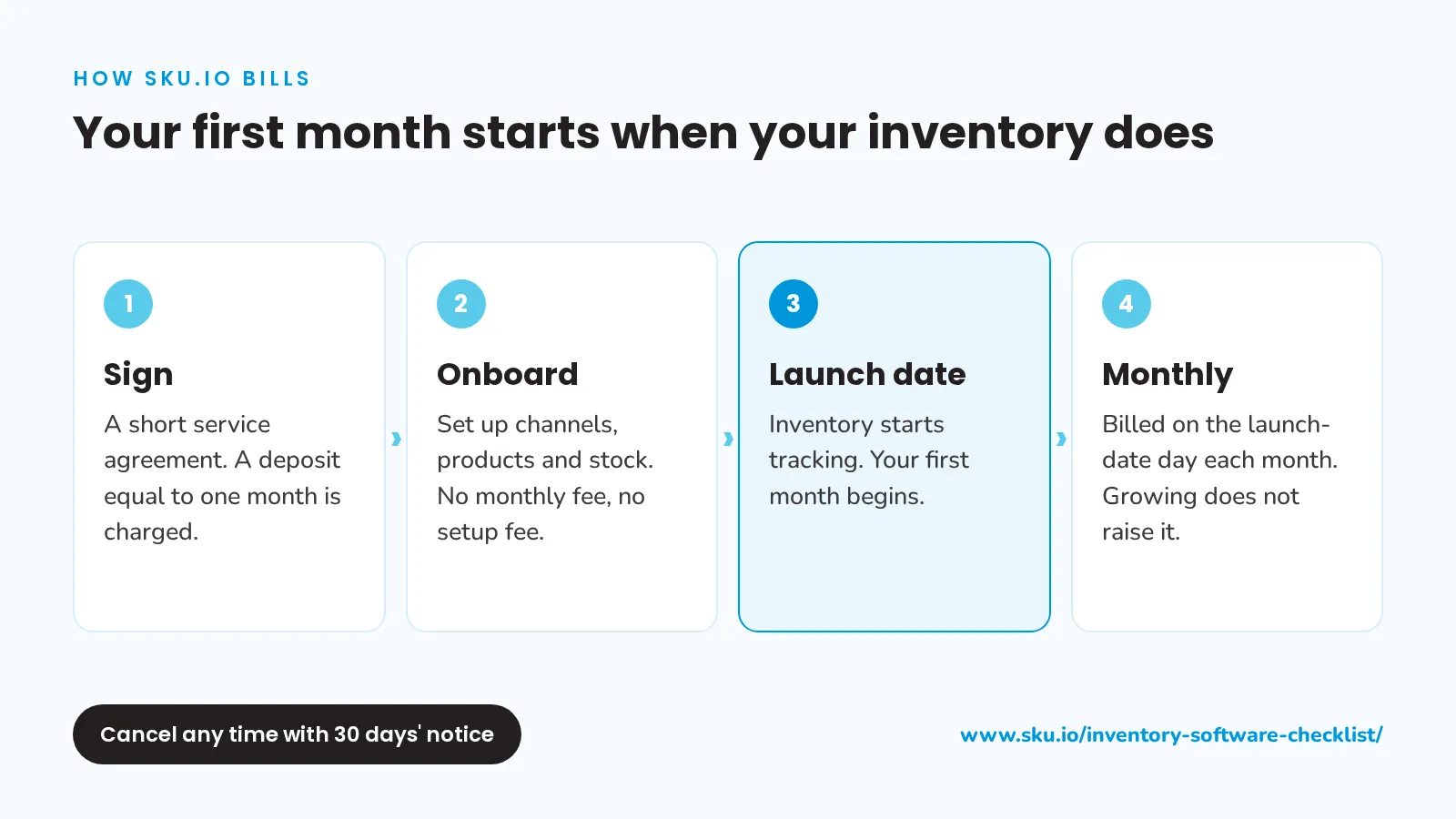
The fee itself is set when you sign, from the size of your operation, and the agreement names the only things that can change it. Growing is not one of them. We do not reprice you because you added a channel, hired three people or doubled your catalog. A sustained rise in order volume is the exception, because orders are what actually cost us money to process, and even then you get 30 days’ written notice.
Every plan includes every feature apart from the optional modules, every sales channel, unlimited users, and unlimited API access and webhooks. One-off items get quoted on their own line before you sign: importing past sales history, a pass-through 3PL connection, custom work. One thing about pass-through billing catches people out, so here it is: a Trackstar connection starts billing when that connection goes live, which is usually at launch but can be before it.
I say the month-to-month part on nearly every first call, usually in about these words:
“We hence don’t do an annual contract. It’s like month to month, 30 days notice.”
That is me on a recorded call in May 2025, word for word, and the agreements still say it. Onboarding is the month we spend the most on a customer, so locking them in would be the easy move. We skip it because a customer who can leave in 30 days is one we have to keep earning.
The buyers’ side of it came from an operator I spoke to in July 2025, describing the vendor they had used before, right after asking me who answers when something breaks:
“But once you sign the contract, everything is gone.”
What SKU.io doesn’t do, or doesn’t do yet
- No self-serve sign-up. You start with a call with me. If you want software you can buy and configure without talking to anyone, we are the wrong vendor.
- No formal enterprise compliance program today. If your security review needs one, we will not pass it yet.
- Support is business hours, Pacific time. Most tickets are solved within a day, but nobody is on call at 2am.
- Manufacturing and warehouse execution are add-ons. Bills of materials and MRP, and put-away, picking and scanners, are optional modules. Bundles and kits are in the base plan.
- It is not your general ledger. It posts journals to QuickBooks Online or Xero. It does not replace them.
- There is no price calculator. The fee comes out of a conversation about your operation, so you will not get an exact number from this page.
- The API has a ceiling. 1,000 requests a minute per user, shared across that user’s tokens, with an optional lower cap per token.
- History before your launch date is reporting, not inventory. Imported past orders feed reports and sales velocity. Inventory movements are tracked from the launch date forward.
How this compares with a vendor that publishes tiers
It helps to see how a vendor that publishes tiers handles the same question. On 16 October 2026 Cin7’s pricing page listed three plans: Standard at $349 a month for 5 users, 2 integrations and 6,000 sales orders a year; Pro at $599 for 10 users, 4 integrations and 24,000 orders a year; Advanced at $1,199 for 15 users, 6 integrations and 120,000 orders a year, with more integrations and order volume available to buy. Three different limits can push you up a tier there: people, connections and orders.
Ours has one thing that can move the fee, sustained order volume, and users, channels and integrations are unlimited. Cin7 Standard costs less than we do. If you are at 500 orders a month with two people and two channels, it may be the better buy for you.
Where to go from here
Where the price starts, and a fit check, are on the pricing page. If you are judging platforms by their API, start with inventory management API: what to check first. If an agent will be doing the operating as well as the shortlisting, running inventory with AI agents shows what that looks like on a real account.
Or bring the shortlist your assistant gave you, and I will answer every line of it against our product on a call. Book a demo.
How we checked this page
The facts on this page you can open and check yourself. Our own contract terms are stated above and written into every agreement. Prepared by Kalvin Mizzi, founder, SKU.io. Last checked . Each page was loaded on the date shown and the fact read off it.
| Claim | Source | Plan or version | Checked | How we know |
|---|---|---|---|---|
| Channels connected include Shopify, Amazon, Amazon Ads, Walmart, eBay, TikTok Shop, Temu, Faire, BigCommerce, WooCommerce and Magento, with FBA, AWD, Multi-Channel Fulfillment and EDI. | sku.io | — | Our own data | |
| The public API has 4,685 documented endpoints. | developer.sku.io | Distinct paths in the OpenAPI spec, measured 6 September 2026 | Our own data | |
| The API platform limit is 1,000 requests a minute per user, shared across that user's tokens, with an optional per-token cap. | developer.sku.io | — | Vendor documented | |
| MIT-licensed agent skills for Claude, OpenAI and Gemini are published, and an MCP server connects AI agents to an account. | developer.sku.io | — | Vendor documented | |
| SKU.io posts FIFO cost of goods with landed cost as summarized journals to QuickBooks Online or Xero. | sku.io | — | Our own data | |
| Cin7 lists Standard at $349/month (5 users, 2 integrations, 6,000 sales orders a year), Pro at $599 (10 users, 4 integrations, 24,000) and Advanced at $1,199 (15 users, 6 integrations, 120,000). | cin7.com | USD, new customers | Vendor documented | |
| Zoho Inventory has a free plan for 50 orders, one user and one location. | zoho.com | US pricing page | Vendor documented |