
Unleashed Alternatives (2026): Who Should Actually Switch
I give every SKU.io demo myself, and I keep a rough tally of which system the person across the screen is trying to escape. Cin7 refugees could fill a conference room. To check the impression, I had an agent count mentions across 1,435 recorded calls: Cin7 comes up in 82 transcripts. Unleashed comes up in 12, and almost nobody in those twelve was angry at it.
Most “Unleashed alternatives” pages are written as if Unleashed failed you. That’s not what I hear on calls. People leave Unleashed because their business changed shape underneath it, and a page that ignores that will point half its readers at the wrong software. So this one is about diagnosing the shape change, with real prices and real quotes, and it includes the case for staying put.
Full disclosure: we compete with Unleashed. I’ll also admit the limits of what I know. In April 2025 I recorded a voice memo in the car naming every competitor I could think of, and when I got to Unleashed my note was that I didn’t know them well, because so few of their users ever land in my demos. The operators who outgrow it are the ones I know. That’s the part I can speak to.
Unleashed prices and plan limits below are from unleashedsoftware.com/pricing, checked September 2, 2026. All figures USD.
Who is Unleashed actually built for?
Read their price list instead of their homepage. Every Unleashed plan, from Lite at $99 a month to Pro at $729, includes 100 sales orders a month in the base price. Volume above that is a paid tier: $70 a month for up to 500 orders, $200 for 1,500, $320 for 3,000, $490 for unlimited.
A business doing 100 orders a month at meaningful revenue is doing few, large orders. That’s wholesale and distribution. That’s a manufacturer selling through trade accounts, with batch tracking and bills of materials, reconciled into Xero. Unleashed is genuinely good at that shape, and it’s an NZ company with deep roots in exactly that AU/NZ customer base.
A DTC brand at the same revenue does thousands of small orders across Shopify, Amazon, maybe Walmart and a wholesale side. Different shape entirely. The co-founder of a fast-growing NZ supplements brand said it to me plainly on a call this February:
“Cin7 and Unleashed and all those, they’re just not really kitted out for any commerce company, if I’m honest.”
He’d been shopping the whole class of systems for months. What he was describing is what it feels like to push an e-commerce operation through software built around a different kind of order book.
What does Unleashed cost at e-commerce volume?
The $99 sticker is not what a multichannel operation pays. Configure Unleashed for a brand doing around 3,000 orders a month across a few channels and the published price list adds up like this:
| Line item | Published price |
|---|---|
| Core plan (3 users) | $399/mo |
| Unlimited sales orders | $490/mo |
| Advanced Inventory Manager | $149/mo |
| Two additional integrations | $78/mo |
| Two additional users | $138/mo |
| Total | $1,254/mo |
Onboarding is separate: $449 self-service, $799 standard, $5,549 for the full package.
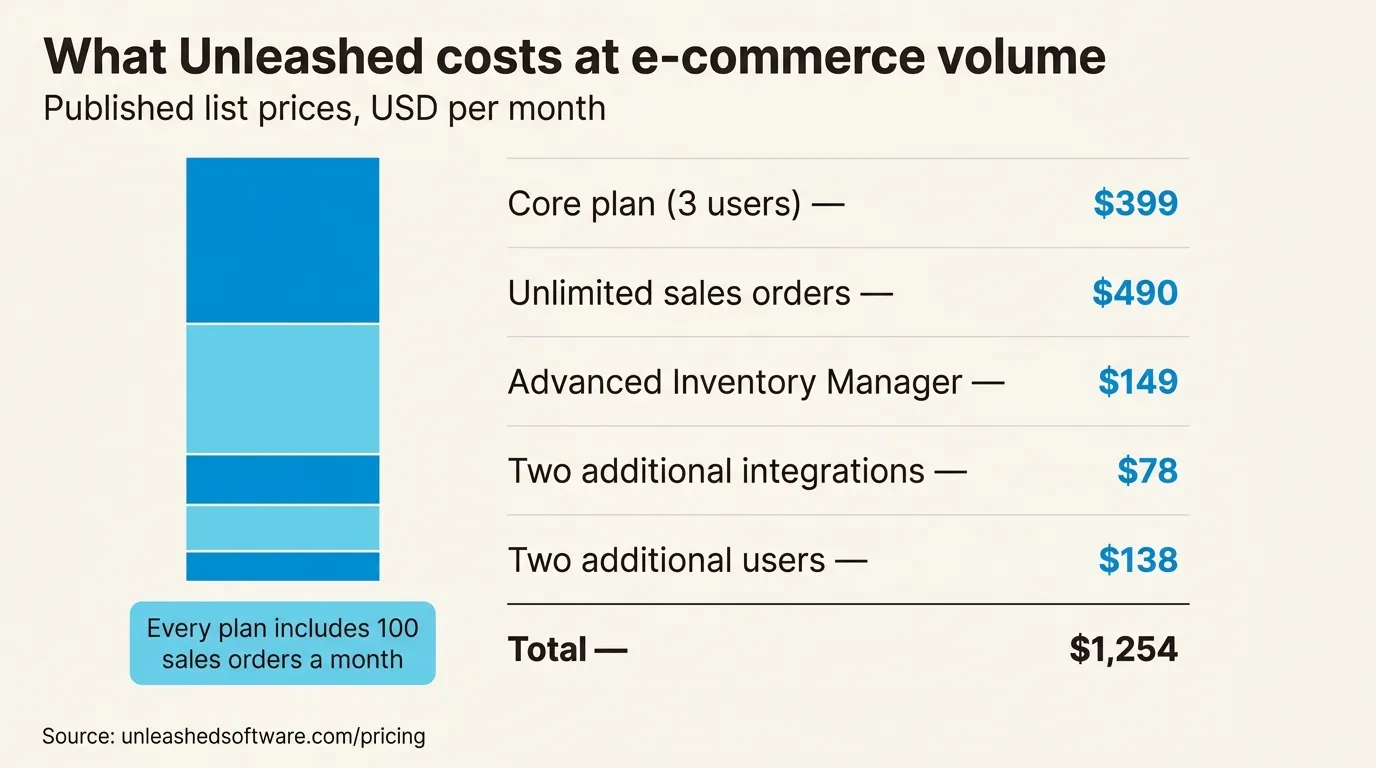
The point isn’t that Unleashed is expensive. The point is that at e-commerce volume the price advantage most people assume isn’t there anymore, and once the numbers converge, what you’re actually choosing is what the software is shaped for. SKU.io starts around $1,000 a month with no onboarding fees. At wholesale volume Unleashed is cheaper than us, full stop. At multichannel volume you’re paying about the same for two very different architectures.
Why do operators actually leave?
Because the order book changed underneath the software. The common story in our call archive: a wholesale or manufacturing business adds Shopify, then Amazon, then a 3PL, and the tools that were fine at 80 orders a month meet 3,000 orders a month of channel sync, marketplace fees, bundles and returns.
A freelance operations lead who has run several systems in this class, Unleashed among them, gave me the least romantic software assessment I have on tape:
“They all have their quirks. They all pretty much do the same thing. It’s just navigating how they’re all set up. They’re all very different.”
I think she’s right about the middle of this market, and the conclusion is unfashionable for a vendor page: if Unleashed is working for you, stay. A migration costs weeks of data work and retraining. Swapping between two systems built for the same kind of business mostly gets you new quirks. Switch when the shape argument applies to you, not because a listicle ranked something first.
Is Cin7 the right alternative to Unleashed?
It’s the default answer. When I asked Perplexity for an Unleashed alternative for a Shopify-and-Amazon brand in August 2026, it answered Cin7 Core, and its top citations were Cin7’s own comparison page and a handful of listicles. The two products get shopped together constantly, which is what the supplements founder above was doing when he lumped them into one sentence.
Our call archive holds 71 curated quotes about Cin7, and they’re dominated by one theme: stock numbers that couldn’t be trusted after sync failures, and support that couldn’t explain them. Cin7 is the single largest source of switchers to us, so I have hours of recordings of what its customers went through before they moved. If you’re considering that path, read what Cin7 switchers actually say before you commit. From what’s on those recordings, I wouldn’t trade a fit problem for a trust problem.
What about batch and expiry tracking?
One place I’ll grant Unleashed specific product respect: batch traceability for manufacturers is core to what they built, and if recall-grade traceability on your own production is the reason you bought it, that reason may still hold.
For the e-commerce shape of the same problem, sellable stock with expiry dates moving through marketplaces and 3PLs, we shipped expiry date, lot tracking and inventory aging in June 2026: lot-level receiving, expiry-aware picking, and aging reports against the same FIFO cost layers the rest of the system runs on. Google already ranks that release note for a long question someone asked about how Unleashed handles recall compliance, which tells you how thinly this ground is covered. Judge both on a screen share against your own SKUs.
Is SKU.io the right fit after Unleashed?
The fit test is your order book. Hundreds to thousands of SKUs, thousands of orders a month across Shopify and Amazon plus whatever else, bundles and kits, a 3PL or several warehouses, and numbers you need to defend in a meeting without a backup spreadsheet open. We’re not a cheaper Unleashed and I won’t pitch us as one. Xero and QuickBooks are first-class connections, the same as Unleashed, so the accounting seam survives the move. For Australian customers we host in an Australian region, which mostly shows up as pages loading fast for your team in Sydney instead of round-tripping to the US.
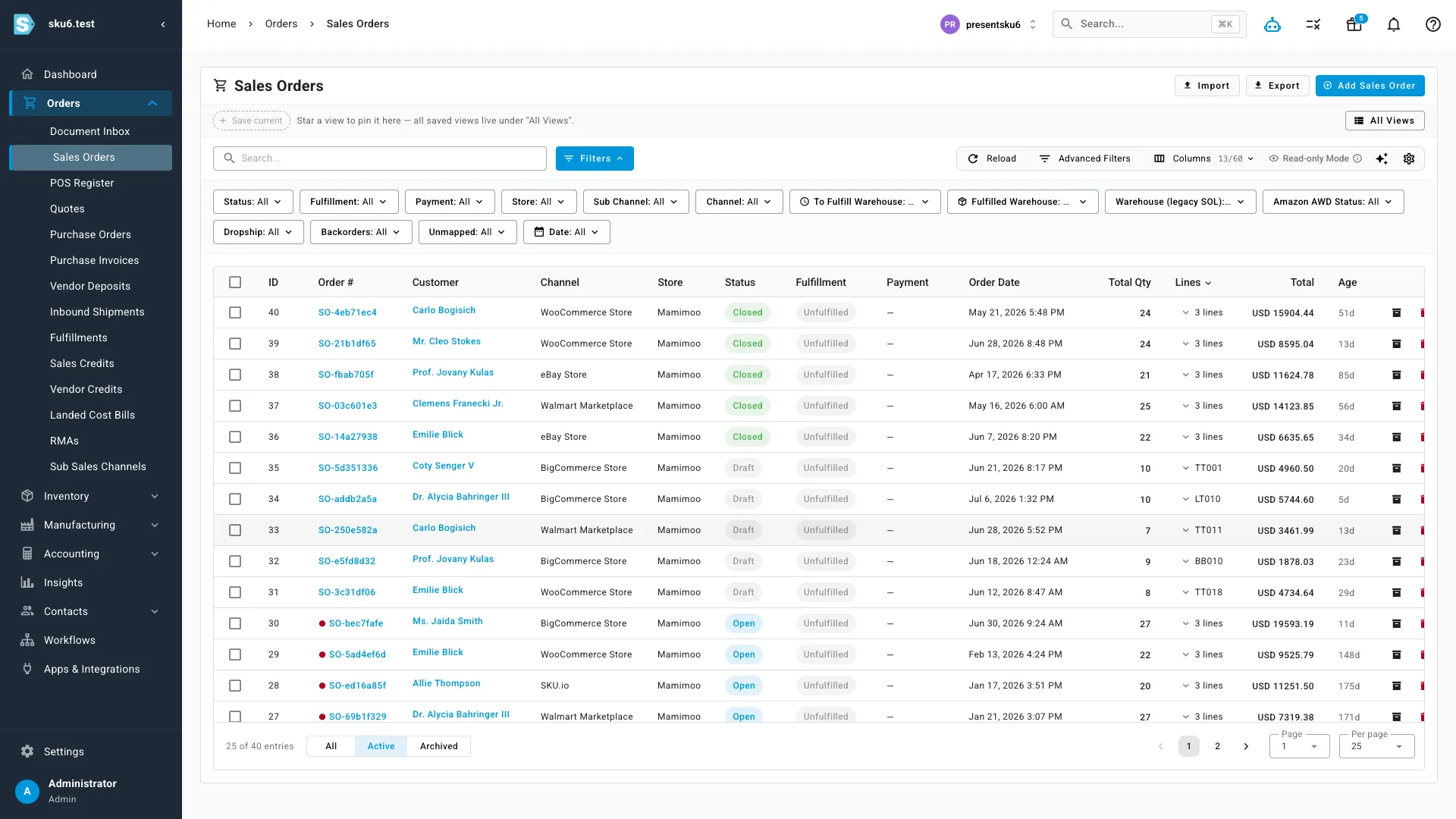
Where you shouldn’t pick us, plainly. A manufacturer whose complexity lives in production runs and trade orders should look at Katana before either of us. Under about $1M on one or two channels, Zoho Inventory or inFlow will do the job for a fraction of the price. And a wholesale operation comfortably inside Unleashed’s 100-order base tier has nothing for us to solve. Stay, and spend the migration money on stock.
Pricing starts around $1,000 a month with no onboarding fees. Every demo is given by me, and onboarding runs hands-on in days. I’d rather show the product live against your data than talk about it in the abstract, which is most of why this page keeps telling you to get on a screen share.
Where to go from here
If Cin7 is on your shortlist next to us, the Cin7 alternatives page applies the same recorded-call evidence to that decision. If you’d rather judge vendors on architecture than on feature grids, run the six checks in inventory management API: what to check first against both of us. Unleashed publishes an API; so do we, and the difference shows up in a demo within minutes.
Or skip the reading. Bring your real order counts and your messiest bundle, and I will show you what the shape argument looks like on your own data. Book a demo.