
SkuVault in 2026: Where It Went and What It Costs
Linnworks completed its acquisition of SkuVault on 1 September 2022. The product is now sold as SkuVault Core, described on Linnworks’ own homepage as “streamlined warehouse inventory for growing retailers.” It has not been shut down, it is not being sunset as far as anything published says, and if it is working for you the correct action is to keep using it.
First, a disclosure, because you may have searched a brand name and landed on a company with a confusingly similar one. We are SKU.io. We are not SkuVault, we never were, and we compete with them. An e-commerce systems consultant I talk to regularly opened a call by roasting me for exactly this:
“For 10, 12 years I’ve been saying every product with SKU in the name sucks. Okay? Like I’ve been saying that before — SKU Tools, SKU App, SkuVault, Skubana.”
My answer at the time: I don’t have SKU in the name. SKU is the name. He was not impressed. Take the rest of this page with that context — I have a commercial interest in your answer, so everything below is either a dated fact you can check yourself or a verbatim quote from a recorded call.
Vendor facts checked 19 August 2026.
What happened to SkuVault?
SkuVault was a Louisville, Kentucky warehouse management system. Linnworks — a UK inventory and order management platform, then a Marlin Equity portfolio company — announced the completed acquisition on 1 September 2022. Today Linnworks sells two plan lines: Linnworks Advanced and SkuVault Core, plus add-ons including SkuVault Enhanced Warehouse.
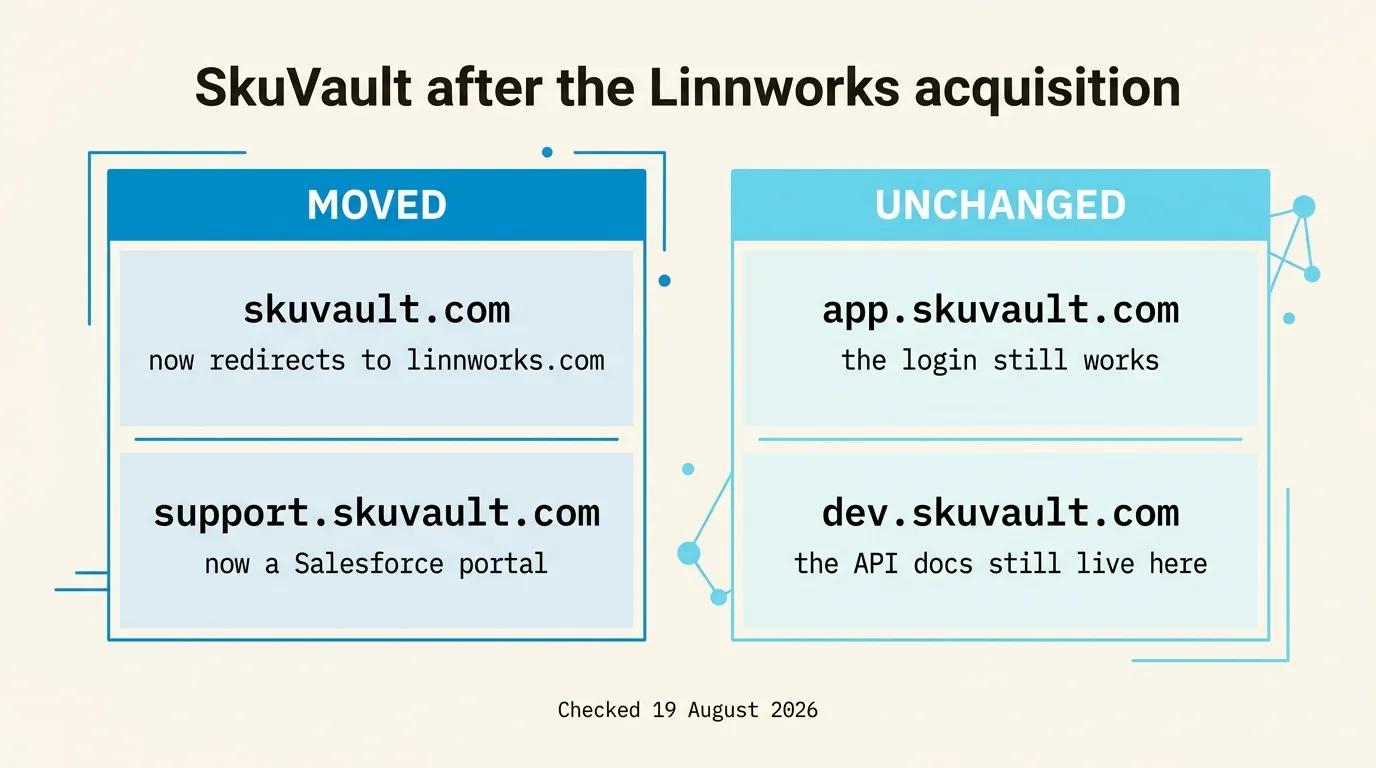
The interesting part is what didn’t move. skuvault.com now redirects to linnworks.com/?skuvault=true. Support went to a Salesforce portal at skuvault.force.com. But dev.skuvault.com is still live and still serving the SkuVault API reference under the old brand, four years after the company was bought.
I noticed this because I had just seen the identical pattern somewhere else. Skubana was acquired in 2021 and renamed Extensiv Order Manager in 2022, and its API documentation still sits at documentation.skubana.com today. Its Shopify App Store listing is still at apps.shopify.com/skubana too, four years on, with the app named Extensiv Order Management on the page. Two acquisitions, two companies, same outcome: the marketing site gets renamed in a quarter and everything a developer or an installer actually touches keeps the dead brand. If you are evaluating any platform that has been through an acquisition, go look at where its API docs and its app listings actually live. It tells you which parts of the company got attention. TradeGecko is the version of this with nothing left over: Intuit bought it, shut it twice, and today tradegecko.com does not even redirect — the domain has changed hands and serves an unrelated site. Finale Inventory is the fourth version, and so far the mildest: Descartes bought it in August 2025 and it is still sold under its own name, with the help center moved to a descartesservices.com address and the price list rebuilt around two “starting at” figures. What changed at Finale is the same check applied there.
Where do I log in to SkuVault now?
The app itself did not move: app.skuvault.com/account/login still works, and Linnworks links to it as “SkuVault Login” from its own homepage. What moved is support. The old support.skuvault.com address no longer resolves to a support site; it redirects to a Salesforce-hosted portal at skuvault.force.com. This is the second most common SkuVault question we see in our own search data, which tells you how much of this transition landed on users to figure out.
What does SkuVault Core cost?
Linnworks does not publish a price. I checked their pricing page on 19 August 2026: it names the plans, it says “plans are priced on order volume, not revenue — no percentage fees, ever,” and it says pricing is tiered by monthly orders with overages if you exceed the tier. There is no dollar figure anywhere on it, and no order thresholds. Every path ends at “request your quote.”
I have a weak signal that this is the most-searched thing about SkuVault, and I’ll show you how weak it is. Our own Google Search Console recorded 30 distinct SkuVault-related queries putting our site in front of somebody over the last 90 days — 135 impressions in total, of which “skuvault pricing” is 41 and “skuvault cost” is 14. That is a weathervane, not a study; we rank in the forties and sixties for those terms, so we are seeing the tail of it at best. It matches what happens on demo calls, though. People arriving from SkuVault open with the price question, because they could not find out on their own.
I publish ours: SKU.io starts around $1,000 a month and scales with orders and SKUs, with no onboarding fees. You can disagree that we are worth it. You cannot say you had to book a call to find out.
Does the SkuVault API still work?
Yes. dev.skuvault.com serves a live API reference with endpoints documented in public and no login wall. Whatever else the acquisition did, it did not take the docs down, and that is worth crediting.
If you are weighing platforms on this dimension, the API is a better tell than the demo — read the vendor’s docs before you watch a screen share. We wrote the six checks we would run in inventory management API: what to check first, and they apply to SkuVault Core, to us, and to everyone else.
Is SkuVault Core a good fit for multichannel retailers?
For pure warehouse work — receiving, picking, cycle counts, barcode scanning across locations — it is a real WMS and it has been for a long time. The complaints I hear are not that it fails at that. They are about everything around it.
The owner of a firearms-and-accessories retailer, on a demo call this May, giving his verdict after using it for years:
“We just use it as a basic inventory tool… they’re kind of light on their bundling capabilities. It works, but it’s a little clunky. So we just don’t do it.”
The feature existed, and the workflow was awkward enough that the business simply stopped doing the thing. That is the most expensive kind of software problem, and it never shows up in a feature comparison, because the row says “yes.”
The person leading a systems evaluation at a packaging supplier described their stack this way at the top of a discovery call:
“Those three systems are not very well integrated between each other… SkuVault has kind of been hot wired, so our fulfillment process is very manual.”
Shopify in one window, SkuVault in another, ShipStation in a third, a human checking inventory and deducting it by hand for each order. When I asked whether that was their complicated scenario, he said: “That’s probably our easiest scenario. Even though it doesn’t sound like it as I say it out loud.” I have thought about that line more than any other quote in this archive. He knew. He just hadn’t heard himself say it before.
And a sneaker reseller running wholesale plus four Amazon FBA accounts, on his earlier attempt:
“I actually think we’ve tried SkuVault in the past… we went as far as buying the scanners and all that, even, and we just didn’t have an organizational method to putting it all together. It was like a giant mess.”
That one is worth being fair about. He is describing a failure of implementation and of his own process, not a defect in the software. Buying scanners is the easy half. Nobody sells you the organizational method, and most vendors — including plenty who would happily take his money — do not have a good answer for that either.
Should you switch, and to what?
Stay if SkuVault Core is doing your warehouse work and you are not fighting it. A rename under a new parent is not a reason to migrate, and migrations are expensive in ways that don’t appear in the quote — duplicate SKU records nobody has reconciled in years, historical cost layers, a 3PL integration that has to be rebuilt and tested against real orders.
Start looking if the pattern above sounds like yours: the WMS is fine, and everything between your channels, your orders and your accounting is held together by hand. That is a different product category from a warehouse tool, and no amount of bolting on fixes it.
Public list pricing checked 19 August 2026. The last column says how I know what I know, because I have not used all of these and there is no point pretending otherwise.
| Platform | Best fit | Published starting price | How I know |
|---|---|---|---|
| SkuVault Core (stay) | Warehouse-first operations that need receiving, picking, counts and barcode scanning, and are content to run channels and accounting elsewhere | Not published — quote only | Read the docs and the pricing page; verdicts above are from operators who ran it |
| Linnworks Advanced | Listing-heavy multichannel sellers who want channel management and the warehouse product from one vendor | Not published — quote only | Read the docs and the pricing page |
| SKU.io | $1M–$50M multichannel — Shopify + Amazon FBA plus Walmart, TikTok Shop, wholesale; bundles and kits, 3PLs, multi-warehouse; operators who want one audited inventory ledger and order-level profit including marketplace fees | ~$1,000/mo, no onboarding fees | Ours. I also run my own e-commerce business on it |
| Extensiv Order Manager | Brands already inside the Extensiv ecosystem, or whose 3PL runs Extensiv's warehouse product | Nothing on extensiv.com; $400/mo on its Shopify listing | Seen inside a live account — migrated a customer off it in January 2026. See what happened to Skubana |
| Cin7 Core / Omni | Mid-market multichannel wanting a large integration catalogue | Core Standard $349/mo, Pro $599/mo, Advanced $1,199/mo; Omni quote-only | Seen inside live accounts via switchers mid-evaluation — see why operators leave Cin7 |
| Zoho Inventory / inFlow | Sub-$1M or effectively single-channel sellers | From free / low monthly | Read the pricing pages. I recommend these more often than I demo against them |
Is SKU.io the right SkuVault alternative for you?
We fit the packaging-supplier problem, not the pure-WMS one. If your channels, orders, inventory and accounting are four systems taped together and a person is the integration, that is the thing we replace. Hundreds to thousands of SKUs across Shopify, Amazon including FBA, Walmart, TikTok Shop or wholesale; bundles and kits; a 3PL or several warehouses. Every movement lands in one perpetual, auditable ledger, and order-level profit includes the marketplace fees. Every demo is given by me.
That ledger is the part worth looking at, because it is the thing a hot-wired stack cannot produce. Every unit of stock sits in a cost layer, and every layer names the document that created it:
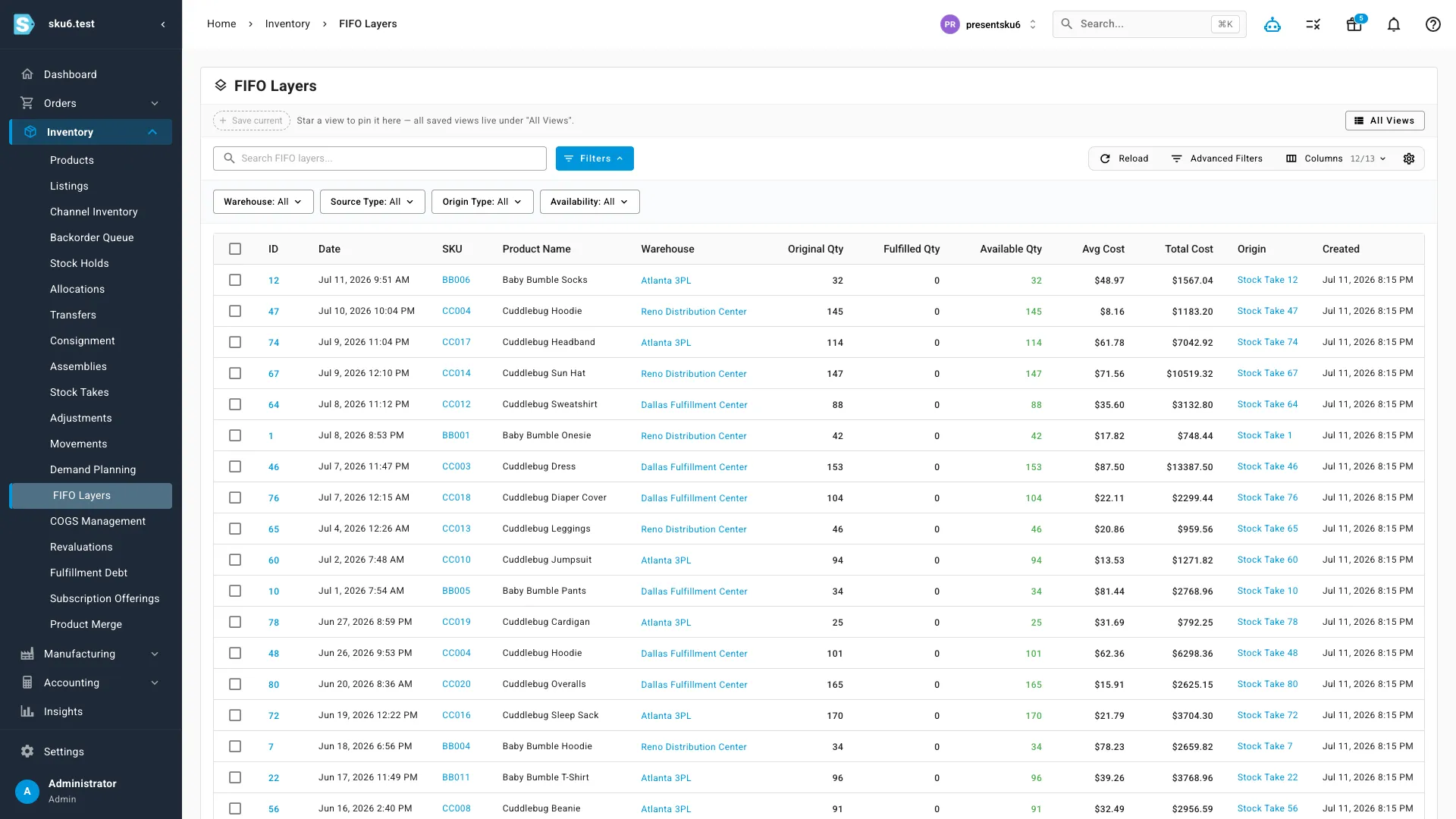
When somebody asks why a margin moved, that Origin column is the answer, and nobody has to reconstruct it from a spreadsheet.
We are the wrong answer if what you actually want is a better warehouse execution tool bolted onto systems you like. Manufacturing-first operations are better served by Katana. Under about $1M on one channel, start with Zoho or inFlow — you will get further faster and pay less doing it.
Where to go from here
If SkuVault is one of several names on your shortlist, what Cin7 switchers choose and what happened to Skubana apply the same recorded-call evidence to the other two common evaluation paths. DEAR Systems is now Cin7 Core is the same rename story a third time, with the twist that every address still says DEAR. If you would rather judge platforms on architecture than on feature grids, start with inventory management API: what to check first.
Or send me the spreadsheet that currently sits between your systems and I will show you what replaces it. Book a demo.