
Pre-Orders Against Your Next Purchase Order
To take pre-orders for a new piece in SKU.io, you give the product a release date. Until that day its orders are allocated stock as usual, but nothing is sent to your warehouse or 3PL. SKU.io checks release dates every hour, and once the day arrives the orders are released and ship like any other order. Orders the stock on hand can’t cover are backordered against your next purchase order, exactly as they would be for a piece that’s already on sale.
It’s one part of keeping stock straight across online and wholesale.
Backorder or pre-order?
A backorder is a piece that’s on sale and ran out. A pre-order is a piece that isn’t on sale yet. With a backorder you ship the moment stock arrives. With a pre-order you don’t ship before launch day, even if the stock is sitting on the shelf.
One line can be both. A pre-order whose stock hasn’t arrived is a backorder on a product with a release date. It waits for the PO like any backorder, takes its units when they come in, and then keeps waiting for launch day.
If you make each piece after it’s ordered, there’s no launch day to hold for. And a maker selling only on her own site, under about $1M a year, can run pre-orders with a Shopify app and track stock in Craftybase or inFlow. This is for brands with a warehouse or 3PL, stockists, and a PO on the water.
One launch, start to finish
Made-up numbers for a made-up brand. Wrenmere Jewelry is launching Fern, a gold vermeil ear climber, on a Thursday.
Three weeks out. Someone sets Fern’s release date, then opens pre-orders on the site. That order matters. Setting the date holds anything that hasn’t been sent to the warehouse yet, so an order that already went to the 3PL before the date was set has gone. Set the date first. A single product’s open orders update within seconds. If you set dates for a whole collection by bulk edit or import, give it an hour.
The week before. The first 60 arrive early. Every pre-order placed so far takes a unit from them and is held. The units can’t be sold twice, and the orders don’t reach the warehouse even though it dispatches automatically. Without the date, the first customers would get the piece before the launch email goes out.
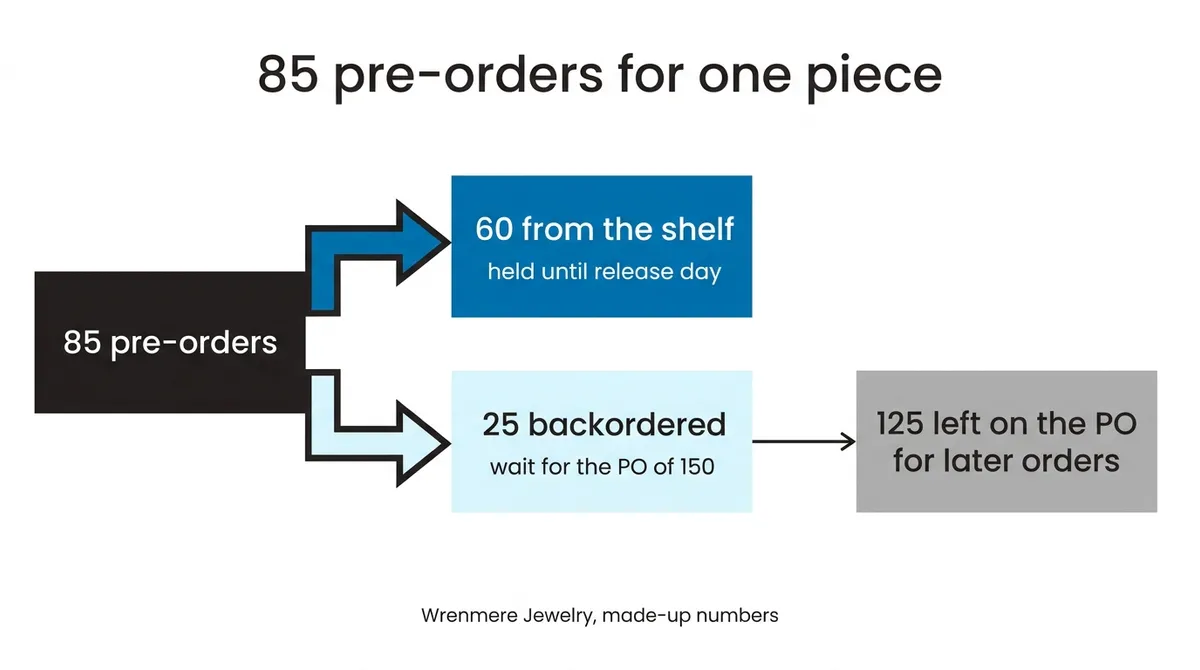
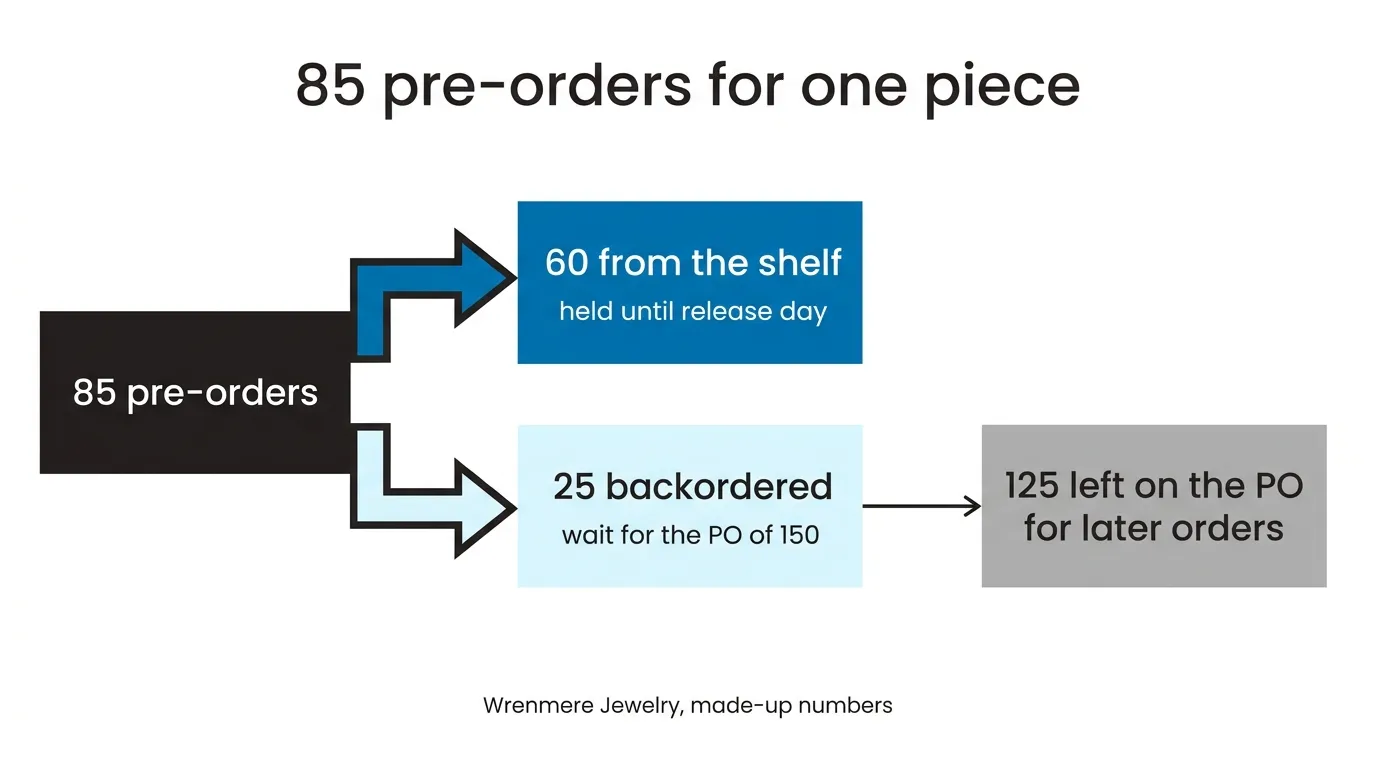
Launch Thursday. By now the site has taken 85 pre-orders.
| Units | |
|---|---|
| Pre-orders taken | 85 |
| Held from the 60 on the shelf, ship today | 60 |
| Backordered against the PO for 150 | 25 |
| Left on that PO for later orders | 125 |
The release happens on the first hourly check once it’s Thursday in your account’s time zone. The 60 orders for the automatic warehouse are sent on that check. If a warehouse isn’t set to dispatch automatically, its orders are just ready to fulfill. The 25 backordered orders don’t ship, because there’s nothing to ship them with.
Three weeks after. The PO for 150 is received. The 25 waiting orders are filled oldest first, and since launch day has passed, they go out like any other order. 125 are left for whoever orders next.
Pick the date from the PO, not the calendar
The launch date usually comes from marketing: a holiday, a press date, a collaboration. The stock date comes from the supplier. When they disagree, the supplier wins, so I’d set the release date a week or more after the PO’s arrival date, not on it. Fern’s first 60 arrived a week early, which is the good case. If they’d arrived a week late, every pre-order would have been released on Thursday with nothing to ship.
If the PO slips, move the release date to match. Orders that haven’t gone to the warehouse stay held, and the date on each order changes with it, so the customer service answer is the same for everyone who asks.
The customer who adds a chain
A customer pre-orders the ear climber and adds a chain that’s in stock. What happens follows your partial dispatch settings. With partial dispatch on, the chain ships now and the ear climber follows on launch day as a second parcel. With it off, nothing ships until launch day, and then it all goes together. If one warehouse has it off, that warehouse’s pieces wait together.
For a launch week I’d turn it off. Two parcels means paying postage twice on an order you priced for one, to get a chain to someone a few days early. Decide before pre-orders open, not when the first split order shows up.
Stockists get the same date
The release date belongs to the product, so every open order for it is held, wholesale included. A stockist’s order for 24 Fern ear climbers waits for Thursday along with the site’s orders.
That’s what I’d want for almost every launch. Your site and your stockists go live the same day, and nobody gets the piece a week before your own customers. But if a stockist needs the pieces early to fill its case for launch day, a release date is the wrong tool for that piece. It holds every order, and it isn’t built for shipping one account early.
For one order that shouldn’t ship before a date, put a Hold Until date on that order. A co-founder at a wholesale brand asked about this for orders a wholesale marketplace sends with a future ship date: “Does SKU allocate the inventory?” It does. The order keeps its stock and can’t be fulfilled until the date passes.
How far to sell ahead
Pre-orders mean selling more than the shelf holds. Whether Shopify takes an order once its count reaches zero is a setting on the Shopify variant, “Continue selling when out of stock”. A release date doesn’t change that, and it doesn’t change when the customer is charged.
The harder question is how many. An e-commerce lead described what happens when nobody decides, asked when to cut off pre-sales across each channel: “we’ve just opened up the taps and then each channel sells as much as it can. And unless somebody’s watching it like a hawk… It’s very common that we end up overselling by, you know, a thousand units on a channel.” My rule is to stop at what’s on the shelf plus the next PO, minus whatever you’ve promised stockists. For Fern before any wholesale, that’s 60 + 150 = 210. Past that you’re pre-selling a PO you haven’t placed, and the release date can’t help with a delivery that doesn’t exist.
Moving the date
To launch early, clear the release date or set it to today, and the orders are released straight away. To postpone, move it later. Orders that haven’t been sent stay held, and the chips on the order and the product show the new date. Drop-ship lines and lines filled from a channel’s own stock, like Amazon FBA, are never held. They ship on the supplier’s or the channel’s schedule.
To see what’s coming, the Release Schedule report groups held orders under the day they release, with the days left. The steps, including bulk edits and the release date column on a product import, are in take pre-orders with a release date.
When a launch’s pre-orders and your stockists’ orders are all waiting on one PO, someone has to decide who’s first. That’s backorders across online and wholesale.
If your next launch has pre-orders on it, book a demo. Bring the launch date and the PO, and we’ll set it up against both.