
Finale Inventory Alternatives (2026): Who Should Move
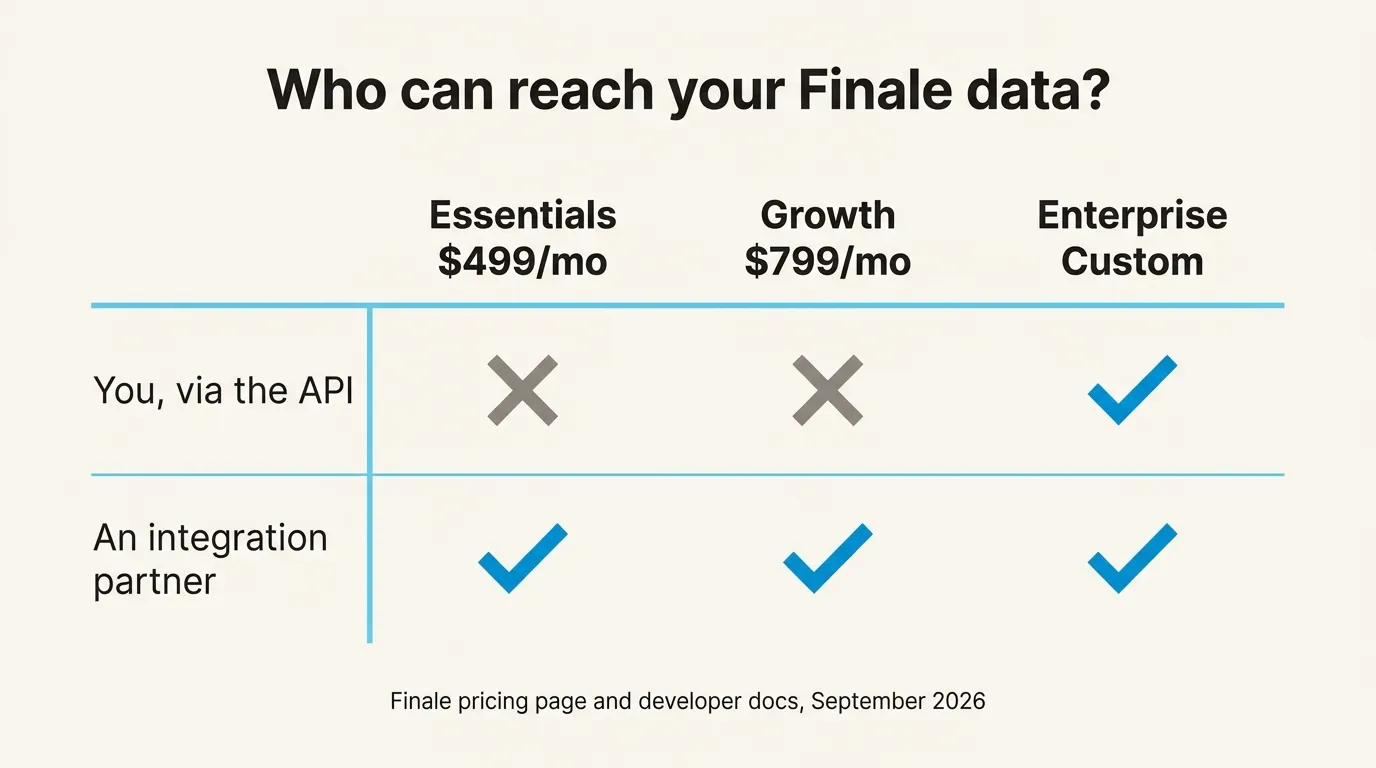
Finale Inventory changed owners a year ago. Descartes Systems Group bought it on August 4, 2025, for about $40 million up front, and placed it next to Sellercloud in its e-commerce line. Since then the pricing page has been rebuilt: Essentials from $499 a month, Growth from $799, Enterprise on request. It has also grown a line most “Finale alternatives” pages skip. API and EDI access is listed under one plan, and that plan is Enterprise.
I heard about the sale on a demo call. Four days after the announcement I was walking an inventory lead at a pet-products brand through our product, he mentioned he was on Finale, and I told him I had just been reading a thread about people worrying what the acquisition would do to support. That call is one of three recorded conversations I have with operators who ran Finale and wanted out, and those three calls are why this page exists. The other pages ranking for this question are vendor listicles. Nobody on them mentions the sale, the new prices, or the API gate.
We compete with Finale, so read this accordingly. I will also admit the same limit I admitted about Unleashed. Finale is not the system people arrive from most often. I had an agent count mentions across our 1,435 recorded calls: Cin7 comes up in 82 of them, Finale in 32, and a fair share of those 32 are a consultant and me talking shop. On a call this March with a former Finale customer I said out loud that I had never seriously looked at the product. What I have instead is what its users told me, on tape, and what Finale publishes about itself.
Finale prices, plan contents and API terms below are from finaleinventory.com/pricing and developer.finaleinventory.com, read September 7, 2026. Acquisition figures are from Descartes’ own announcement. All figures USD.
What changed at Finale?
Ownership first. Descartes announced the acquisition on August 4, 2025: roughly $40 million in cash up front, plus an earn-out of up to $15 million if the combined business hits revenue targets in each of the first two years. Descartes’ CEO framed Finale as the companion to Sellercloud, which Descartes already owned. Finale is still sold under its own name, which makes it a different case from SkuVault, Skubana and TradeGecko, the three other acquired brands I have written about. Those three were renamed, folded in, or shut down. Finale so far has been repriced.
The signs are small but real. The help center now lives at a descartesservices.com address and calls the product “Descartes Finale”. The pricing page footer is Descartes’. And the pricing itself is a different shape. Before the sale Finale published five priced tiers built on order volume, plus a custom one above them, and the review sites still list them: Starter at $99 a month for one user and 500 orders, up through Platinum at $949 for 16 users, 20,000 orders, unlimited integrations and API access. That record also has plans changeable at any time and a 14-day trial, with no multi-year term mentioned. I could not find an archived copy of Finale’s own old page, so those figures are the review sites’ record rather than mine. Today’s page shows two “starting at” prices, a custom Enterprise tier, and an FAQ that says most customers sign for one to three years. The entry price moved from $99 to $499, the order-volume ladder is gone, and the API moved from a published $949 tier to a quote.
A consultant who implements Finale and Cin7 for clients, and who refers some of them to us, told me in August that Finale’s support was slipping and that it was “charging $400 a month, last I saw, for an API connect.” He has a stake in that opinion and so do I, so I went and checked rather than repeat it. The support claim I cannot verify either way. The API claim turned out to be wrong in an interesting way, covered below.
What does Finale cost now?
Here is the pricing page as it read on September 7, 2026.
| Plan | Published price | What the pricing page lists |
|---|---|---|
| Essentials | Starting at $499/mo | 1 to 2 warehouses; inventory, multi-warehouse, 40+ sales channel integrations, procurement and replenishment, financial reporting, report and document customization |
| Growth | Starting at $799/mo | Everything in Essentials, plus the mobile barcode WMS module and email, phone and Zoom support |
| Enterprise | Custom pricing | Everything in Growth, plus API and EDI access, premium support with SLAs, and a dedicated account manager |
The words “starting at” are doing work. The FAQ says overage fees or a plan upgrade “may apply” if you grow past your plan’s limits, and that the thresholds will be in your agreement. It also says most customers sign 12, 24 or 36-month terms. Standard onboarding is included.
SKU.io starts around $1,000 a month with no onboarding fees, and API access is in every plan. Two years ago Finale was the cheap answer in this category and we were the expensive one. At $799 against $1,000 that framing is gone. You are now choosing between two systems in the same bracket, and the question becomes what each one does with your numbers.
Why do operators actually leave Finale?
The three calls tell the same story from different angles: the numbers stopped being decision-grade once the business got bigger than the tool.
The cost never settled. The owner of two e-commerce brands ran Finale for years and described it fairly: “Overall it worked decent. It was a little clunky but it worked decent. It’s definitely a very ugly UI.” His problem was purchasing. “We create a purchase order for a thousand units and we received 500 of them. And so our landed cost would never be really accurate.” Four years later, on a second call, he told me what finally moved him off it: “I was very frustrated with Finale not having FIFO because of how much one of my businesses, the costs fluctuate so much. Then it made it really hard to make present day decisions. What is my CAC? I can afford this CAC this week because we just did this buy.”
That is not a configuration problem. Finale’s own API documents its costing as average cost; the journal type is literally named AVERAGE_COST_CHANGE. Average cost is a defensible method for a warehouse. It is a poor one for a brand whose unit cost swings between purchase orders and who needs to know, this week, what margin this week’s ad spend is buying.
The volume became noise. The pet-products inventory lead from the opening paragraph runs about 10,000 orders a month on a short SKU list. “Why am I seeing every single order?” he asked, describing Finale’s product screens. “Every single order stacks every single day and just overwhelms all the data.” What he needed was a per-product total across Amazon, Walmart and his own store that he could hand to the owner without editing a spreadsheet first. “The reports they produce are absolutely terrible looking.” His receiving complaint was more specific: “It recognizes 3,000 units at this price and I receive 3,050. It won’t update the price. I have to adjust my original PO to reflect the received amount, which I don’t want. I want to have record of what I ordered, what I received.”
Finale sat inside a stack, and the seams leaked. The brand owner above ran Xero plus A2X plus Finale plus ShipStation, and his line about it was the least glamorous complaint in my archive: “It’s also a lot of manual processes: go and do it in Finale, but then do the same thing over here in this software and then make sure you update all the SKUs in Shopify.” The consultant put the same thing in four words: export the CSV, copy it over. In 2023 a made-to-order team asked me to run their orders in SKU.io while inventory stayed in Finale. I said no on the call, and I still would: “If SKU’s not doing inventory, then what is SKU really doing? How do we know what’s in stock? How do we know whether to route your orders or not?”
The least flattering answer to “where did they go” is also on tape. A software-minded operator first found us years ago as, in his words, “a Finale replacement, right?” When we spoke again this August he had built a complete ERP of his own, pulling orders out of WooCommerce on a five-minute cron. Some people leave Finale and conclude that nothing on the market fits. That is a real outcome and vendor pages should say so.
Does Finale have an API, and can you use it?
Finale has a real API, and most Finale customers are not allowed to call it.
The API itself is well documented. REST and GraphQL, public docs, a rate-limits page, and even an llms.txt index so an AI agent can read every endpoint without a login. The docs say the Finale user interface itself runs on the API, which is the same architectural claim we make and the right one. I would grade the documentation above most of this category.
Being allowed to call it is a different question. The pricing page lists API and EDI access under Enterprise only. The developer site’s Partners page says it plainly: “Finale customers are limited on using our API directly based on their subscription tier. For integration partners, however, we allow usage of our API for all Finale customers, regardless of their subscription tier.” A software vendor that has partnered with Finale can reach your data on any plan. You can reach your own data on the top plan. That is the verified form of the $400-a-month rumor. It is not a price. It is a gate, and it opens outward before it opens toward you. The gate is not new, either. Under the old tiers API access sat on Platinum at $949 a month. What changed is that the number came off the page.
The published limits, once you are through the gate: 120 updates a minute, 120 single-record reads a minute, and 300 collection requests or reports per hour, with a 429 when you exceed them. Three hundred list calls an hour is five a minute. A sync that checks orders across a few channels every minute is at the ceiling before it does anything useful, and Finale’s docs ask you to contact them if you expect to get close.
For comparison, SKU.io publishes 5,269 documented operations at developer.sku.io, counted from the live spec on August 31, 2026, with a platform limit of 1,000 requests a minute and tokens you issue yourself in settings. Inventory management API: what to check first is the six-check list I use for any vendor, and “is API access in your plan or a higher tier” is check three. Finale answers it on its own pricing page, which most vendors do not. I ran the same six checks against Cin7 three days ago and it fails check three too, in a less honest shape: API is an unpriced add-on on all four of its tiers, listed halfway down the pricing page rather than on the plan cards. That page is also where I said I would not repeat my consultant’s $400 figure because he had named it about a different vendor and I had not checked there yet. This is that vendor, and this is the check. The comparison is Cin7 API vs SKU.io API.
Is Cin7 Core the right Finale alternative?
Cin7 Core is the one the machines recommend. When I asked Perplexity for a Finale alternative for a Shopify-and-Amazon brand on September 2, 2026, it led with Cin7 Core, then Inventory Planner, Veeqo, Ordoro and Sumtracker, and every citation was a vendor blog or a review-site listicle. Finale and Cin7 get shopped together constantly. An operations lead at a physical-therapy tools brand who came to us last December had been handed exactly that pair by a consultant six months earlier.
Our archive holds 71 curated quotes about Cin7 and they cluster on one theme: stock numbers that could not be trusted after sync failures, and support that could not explain them. Cin7 is the largest single source of switchers to us. If it is on your list, read what Cin7 switchers actually say before signing a multi-year term with anyone. Trading a costing problem for a trust problem is not an upgrade.
Who should stay on Finale?
More people than a page like this usually admits, starting with anyone whose stock numbers are believed. If you run one or two warehouses on Essentials and your team knows the screens, stay. “Clunky but it worked decent” is a compliment in this category. The brand owner above also said he “really struggled to get my team to fully understand it”, and a migration means teaching everyone a new system with its own quirks. Switch when one of the three complaints above is yours.
If your complexity is production runs and bills of materials rather than channels, look at Katana before either of us. Under about $1 million on one or two channels, Zoho Inventory or inFlow will do the job for a fraction of the price. And if you just bought into the Descartes ecosystem on purpose, with Sellercloud or their shipping tools, the integration story there is one I cannot judge from outside.
Is SKU.io the right fit after Finale?
The fit test is the three complaints above, so here is what each one looks like on our side.
Cost: every receipt creates its own FIFO cost layer, and a landed cost bill attaches the freight, duty or brokerage invoice to the purchase order after the fact, prorates it across the order’s lines by cost, weight, volume or quantity, and revalues the layers it touches. Receive 500 of 1,000 and the 500 carry their real cost; the next 500 carry theirs. The CAC question gets an answer per unit, this week.
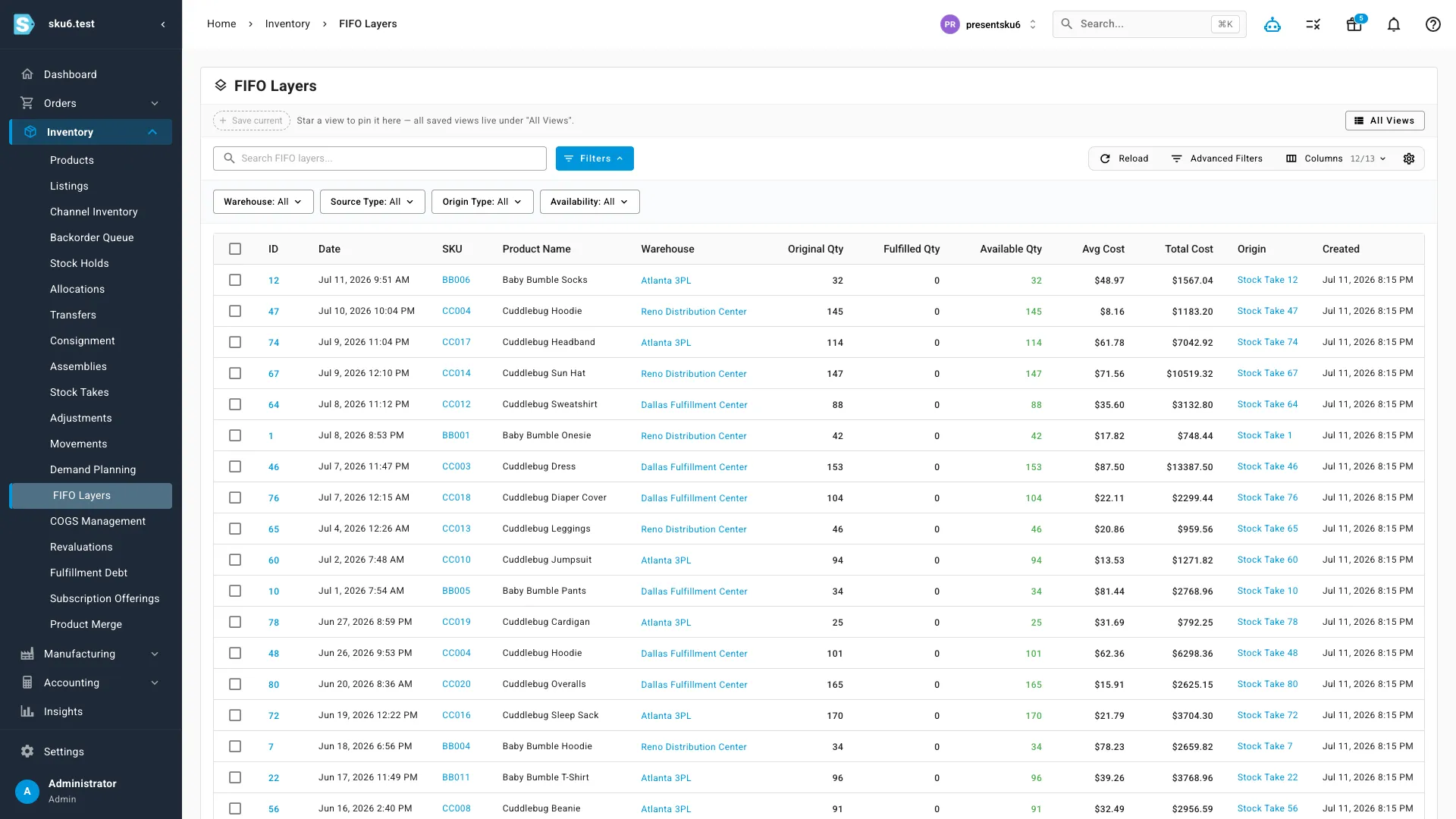
Receiving: order 3,000, receive 3,050, and the order stays as ordered and the receipt stays as received. The 50 extra units are booked as a receiving discrepancy against accrued purchases, a separate accounting entry with its own line, so what you owe follows what arrived without anyone editing the original PO.
Volume: a physical SKU carries its listings on Amazon, Walmart and your store as mappings, so the per-product view is one screen, and every report exports as raw data your team can shape. The inventory lead who asked me for that view watched me pull it up live; his verdict at the end of the call was “This is way beyond Finale as it is already.” He did not sign. His company got busy, he moved on, and the deal is still open in my CRM, which is a more honest ending than most testimonials get.
The order-book test still applies. Hundreds to thousands of SKUs, thousands of orders a month across Shopify and Amazon plus whatever else, bundles and kits, a 3PL or several warehouses, and Xero or QuickBooks on the books. Pricing starts around $1,000 a month with no onboarding fees. Every demo is given by me, and onboarding runs hands-on in days.
Where to go from here
If Cin7 is the other name on your shortlist, the Cin7 alternatives page applies the same recorded-call evidence to that choice. If what you are leaving is an older desktop-era install rather than a cloud one, Fishbowl alternatives is the same exercise run on that decision. If you want to judge vendors on how they are built rather than on feature grids, run the six API checks against Finale, us, and whoever else is in the room. Finale’s documentation makes that unusually easy, and its pricing page tells you the answer to check three before you start.
Or bring the messiest purchase order you received short and the product whose cost moved most this year, and I will show you what both look like in a system built to hold the difference. Book a demo.