
Product Information Management
Jewelry Sets as Kits: One Stock Count for the Set and Every Piece
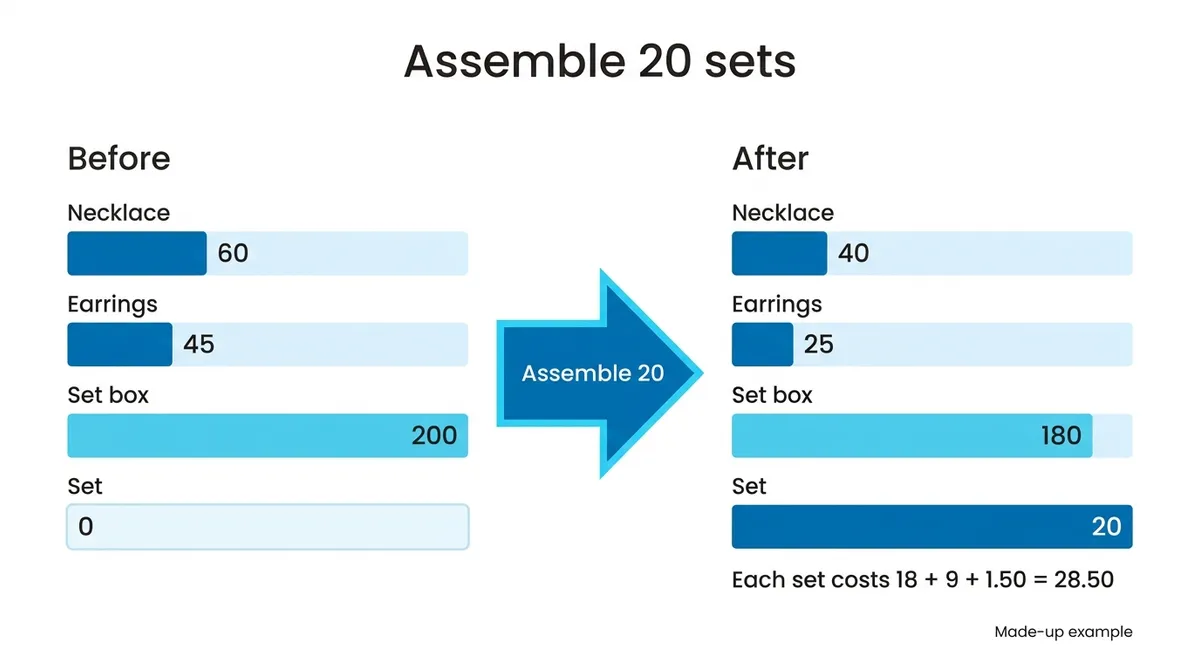
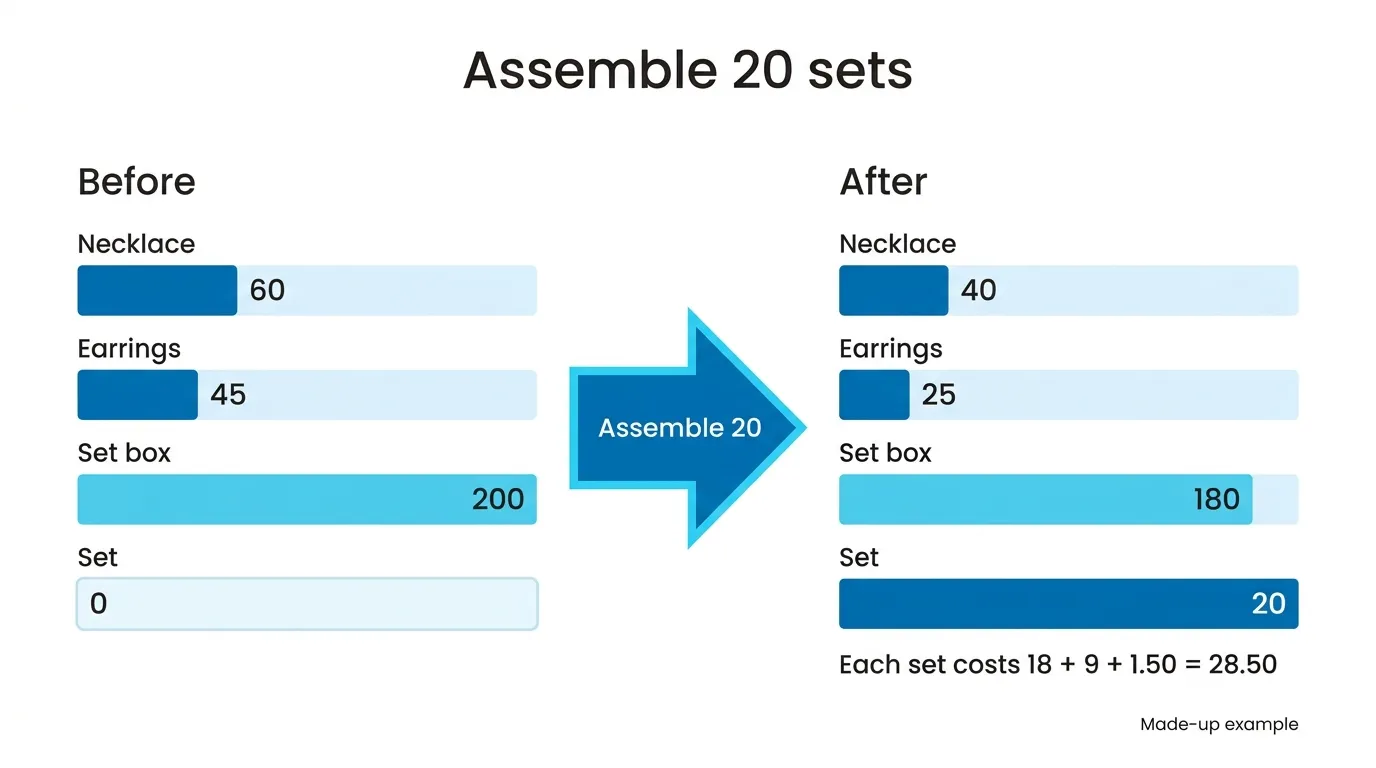
A jewelry set that you also sell as separate pieces should be a kit: a product with its own stock, made of components. Assemble 20 necklace-and-earring sets and SKU.io takes 20 necklaces and 20 pairs of earrings out of loose stock and adds 20 sets, at the cost of the pieces it used. Your Shopify store then shows 20 sets, and the necklace and earring listings show what’s left loose.
It’s one part of running the catalog for a jewelry brand that sells online and wholesale. The set is where a stock count stops being true, because the same earrings are for sale in two places.
Not every set needs this. If you never sell the pieces separately and the supplier ships the set already boxed, it’s one ordinary product. If you’re a one-person studio on one channel under about $1M a year, Craftybase, Zoho Inventory or inFlow will hold a few sets fine, and a jewelry store with repairs and a counter wants store software with a point of sale.
A worked set
Wrenmere Jewelry is invented, and so are these numbers. The Arc set is one Arc pendant necklace and one pair of Arc stud earrings in a set box.
| Item | On hand before | Unit cost |
|---|---|---|
| Arc pendant necklace | 60 | 18 |
| Arc stud earrings (pair) | 45 | 9 |
| Set box | 200 | 1.50 |
The kit has three components, one of each. You could build 45 sets right now: the smallest of 60, 45 and 200. The earrings are the bottleneck, and SKU.io names the bottleneck component, so you know which piece to reorder before the next batch.
You assemble 20.
| Item | On hand after |
|---|---|
| Arc set | 20 |
| Arc pendant necklace | 40 |
| Arc stud earrings | 25 |
| Set box | 180 |
The 20 sets go into stock as their own cost layer, at the cost of the pieces they used: 18 + 9 + 1.50 = 28.50 a set. When one sells, its cost of goods is 28.50.
What Shopify sees
A kit’s listing is sent the sets you have built, not the sets you could build. So a set you haven’t assembled can’t be bought online.
The Arc set listing shows 20 and the earrings listing shows 25. A shopper buys a set and the set listing drops to 19. The earrings stay at 25, because the pair in that set left loose stock when it was assembled. Nobody can buy the same pair of earrings twice, once loose and once in a box.
It also means that with 45 pairs of earrings and 60 necklaces on the shelf and no sets built, the set listing shows zero.
When a set sells through its own listing, the order has one line for the set at the set’s price. A kit isn’t broken into its pieces on a sales order, so the sale carries the set’s price and the set’s own cost, which after an assembly is the cost of the pieces that went into it. The order’s Profit tab shows the margin on that sale. There’s no separate screen for a set’s margin, so to price a set before it sells, compare that assembled cost with the set’s price.
How many sets to build
Build sets in small batches and keep most of the stock loose. That’s my view, and a brand that sells mostly sets would reasonably do the opposite.
Build too few and the set reads sold out online while its pieces sit in a drawer. Build too many and the pieces disappear into boxes. In the example, building all 45 uses every pair of earrings, so the earrings listing goes to zero and a boutique that wants loose studs gets none.
Thin stock makes it worse. The owner of a watch and jewelry reseller described his: “we have a low inventory on almost every item. Not more than two, three.” At two or three of a piece, one assembly can take every unit you have. If that’s your catalog, build sets one or two at a time, close to when they sell.
Assembly can be undone. A stockist orders 30 pairs of earrings and you have 25 loose: disassemble 5 sets. Sets go to 15, earrings to 30, necklaces to 45, boxes to 185, and the set’s cost is split back across the pieces.
One limit to plan around: a set can only be built from pieces in the same warehouse. Necklaces at your 3PL and earrings in the studio means zero buildable at both.
Sets that aren’t for sale
Some sets never get sold at all. The co-founder of a ring brand that mails out home try-on sets described what goes in them: “we don’t actually send gold out in our home try on. Those are plated, electroplated. They have their own sku.”
That’s a kit too. The replicas are real stock with their own counts, and a try-on set is something you build from them and ship. Set it up the same way and building ten try-on sets takes the replicas off the shelf, so you can see how many you have left to build more, and which replica runs out first.
Put the box in the set
If a kit has a single component at a quantity of 1, SKU.io warns you: This kit has only one component. The usual cause is that the box or packaging the kit exists for was left out.
I’d go further than the warning. Make the set box a component of every set, even though nobody thinks of a box as part of the product. A box that isn’t a component never goes down, never reaches its reorder point and never shows in a forecast. You find out you’re out of set boxes when you go to pack them, with necklaces ready and nothing to put them in.
Gold sets and silver sets
When a set comes in two metals, the sets are variants of one matrix product, each one a kit. (Generating variants is covered here.)
Set the components on the gold set, then copy them to the other variants. A component that is itself a variant follows the target’s option, so the silver set gets the silver necklace and the silver studs, not the gold ones. The box has no metal, so it’s copied as it is. You see what each variant will get before anything is saved.
Setting it up
The set must be a kit before it sells. Once a product has sales or assembly history its type can’t change, so a set that started life as an ordinary product needs a new SKU to become a kit.
Components go in the Workshop, off the Products list. Search for each piece, or paste SKUs and quantities from a spreadsheet one per line. A component can be an ordinary product or another kit. Underneath, the Workshop shows how many you could build and what one set costs, so you can check the 28.50 before you build any.
The guide to setting up kit components in the Workshop lists every rule it enforces. If your sets live in a spreadsheet today, book a demo and bring it.