
Do You Need NetSuite for EDI With SPS Commerce? A Small Brand's Answer
No. A retailer trading with you through SPS Commerce needs five electronic documents to move: its purchase order in, and your acknowledgment, ship notice, invoice and inventory count back out. Any inventory system that reads and writes those five on its own does the job NetSuite’s SPS connector does. What decides your go-live date is SPS’s onboarding, which its partnership team quoted us at six to ten weeks once the automation is signed.
Which should you choose?
- Stay on SPS’s web portal if you have one or two retailers and a few orders a month. You key orders and ship notices into SPS by hand, which is fine at that volume. SPS’s own team told us this is where they start a brand expecting 10 to 20 retailer orders a month.
- Choose SPS’s Shopify app if Shopify is your only system and you have no separate inventory or warehouse software. SPS sells it as EDI orders, fulfillment and inventory inside Shopify.
- Choose an inventory system with an SPS integration (that is us) if you sell DTC and wholesale from the same stock, more than one channel or warehouse is involved, and your retailers receive by scanning carton labels.
- Choose NetSuite with SPS’s connector if you already run NetSuite. SPS’s connector runs inside it and SPS maintains the retailer maps for you.
- Switching probably isn’t worth it if your current system already has a working SPS connection and your retailers are live on it. Moving EDI is a fresh round of retailer testing for no new capability.
The sources for every fact here, including SPS’s own pages and the calls I quote, are at the bottom with the date each was checked.
Why I wrote this
On sales calls, EDI almost never comes up as the main reason a brand is talking to me. It comes up at the end, as a worry about later. A founder whose biggest customer was an off-price chain asked me in August: “if we were to require the use of an EDI system down the road, would you guys plug into like an SPS Commerce or another solution?” An operations lead at a beauty brand selling to department stores put it more bluntly in 2023, before we had built it. SPS, they told me, “is not an easy platform to integrate with”, and their test for any new system was whether the vendor had already done it once.
We had not, and I told them so. The integration shipped on 9 October 2026, three years after that call.
A week later I asked ChatGPT and Gemini six questions brands had asked us about EDI, including “does any small-brand inventory system support EDI with retailers without paying for NetSuite?” Neither named us. Both gave a list of vendors. Neither said what actually runs on its own once you connect, what you still do by hand, or where the timeline comes from. That is what this page is for.
The five documents, and what each one asks of you
EDI documents go by three-digit codes. You will see them in every retailer’s vendor guide, so it helps to know them by number.
| Code | Document | Direction | When SKU.io sends it |
|---|---|---|---|
| 850 | Purchase order | Retailer to you | Checked every five minutes, or on demand |
| 855 | Acknowledgment | You to retailer | As soon as the sales order exists |
| 856 | Ship notice | You to retailer | When the shipment is recorded, or once its cartons are packed |
| 810 | Invoice (optional) | You to retailer | One per shipment, right after its ship notice |
| 846 | Inventory advice (optional) | You to retailer | Once a day, at 5:00 UTC |
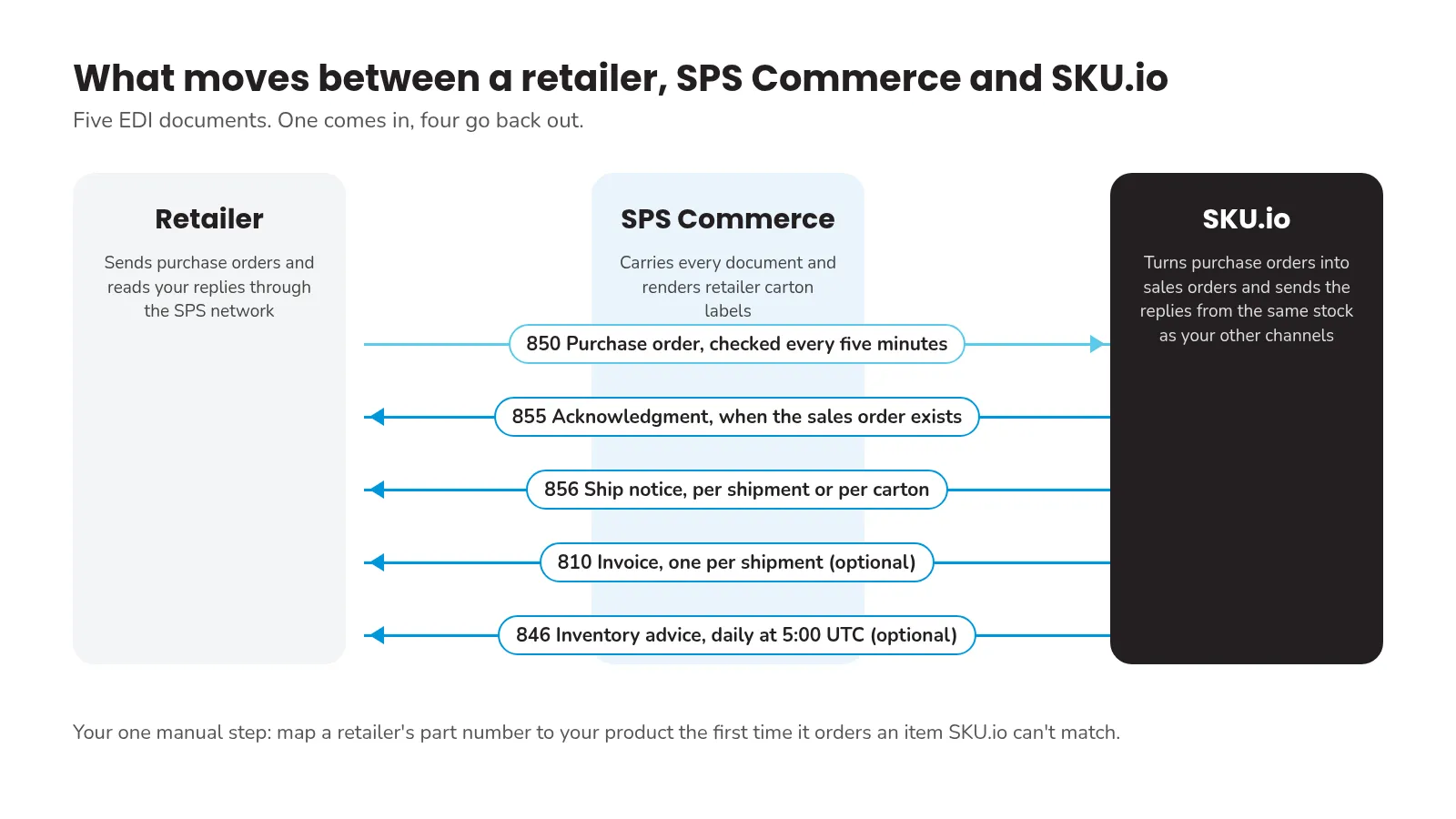
The invoice goes one per shipment, not one per order. When a retailer’s order ships in two loads, it gets two ship notices and two invoices, each tied to the purchase order it came from. We number the invoice with the shipment number (PO481214-1.1 for the first load of PO481214-1) so a buyer’s accounts payable team can match each one to what arrived.
The inventory advice is the one brands forget to ask about. Once a day it tells each retailer how many of each item you can sell them. You choose which warehouses count and how many units to hold back, so a wholesale buyer never sees the last few units your Shopify store needs.
What runs on its own, and the one thing you do by hand
Once you connect, purchase orders arrive and become sales orders without anyone typing them. The retailer’s PO number becomes the order number, and the ship-to address and requested dates come across. The order is then allocated from the same stock as your Shopify and marketplace orders.
The thing you do by hand is map items, once. Retailers order by their own part numbers, and those rarely match your SKUs. The first time a retailer orders an item SKU.io can’t match, that purchase order waits under Need attention. You click Map product, pick the product they mean, and the sales order is created. The match is saved, so that item never stops an order again.
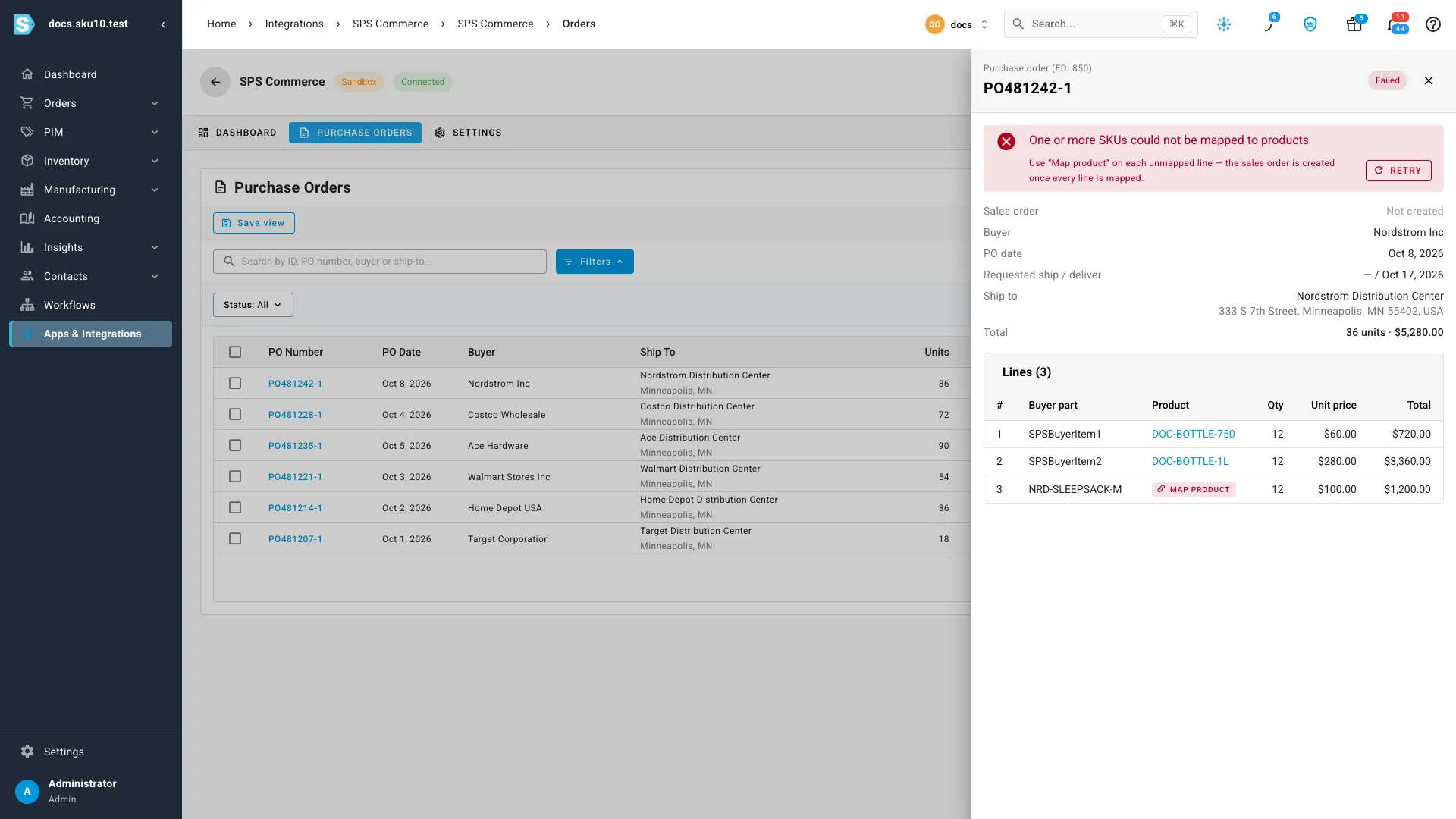
In our own test account the first order to fail was exactly this case: one line came in under the retailer’s part number for a sleep sack we stock under a different SKU, and the other two lines went through fine. We could have guessed the match from the description. I chose not to, because a wrong guess sends the wrong product to a distribution center and the retailer can charge you back for it, so the order waits for a person.
Carton labels are where the real decision gets made
Big retailers receive at a distribution center by scanning a label on every carton. Each carton carries an SSCC-18 number, and the ship notice has to list every carton by that number. If your system can only send an item-level ship notice, you cannot meet that requirement from it.
SPS’s pre-sales engineer was direct with me about the fallback on an October 2026 call. The brand sends its other documents from its own system and does the ship notice in SPS’s portal. I asked whether our system could send part of a shipment and the portal finish it. “It would be one or the other.” So the whole shipment gets entered in the portal, and because your inventory system still has to hold it, someone enters it twice.
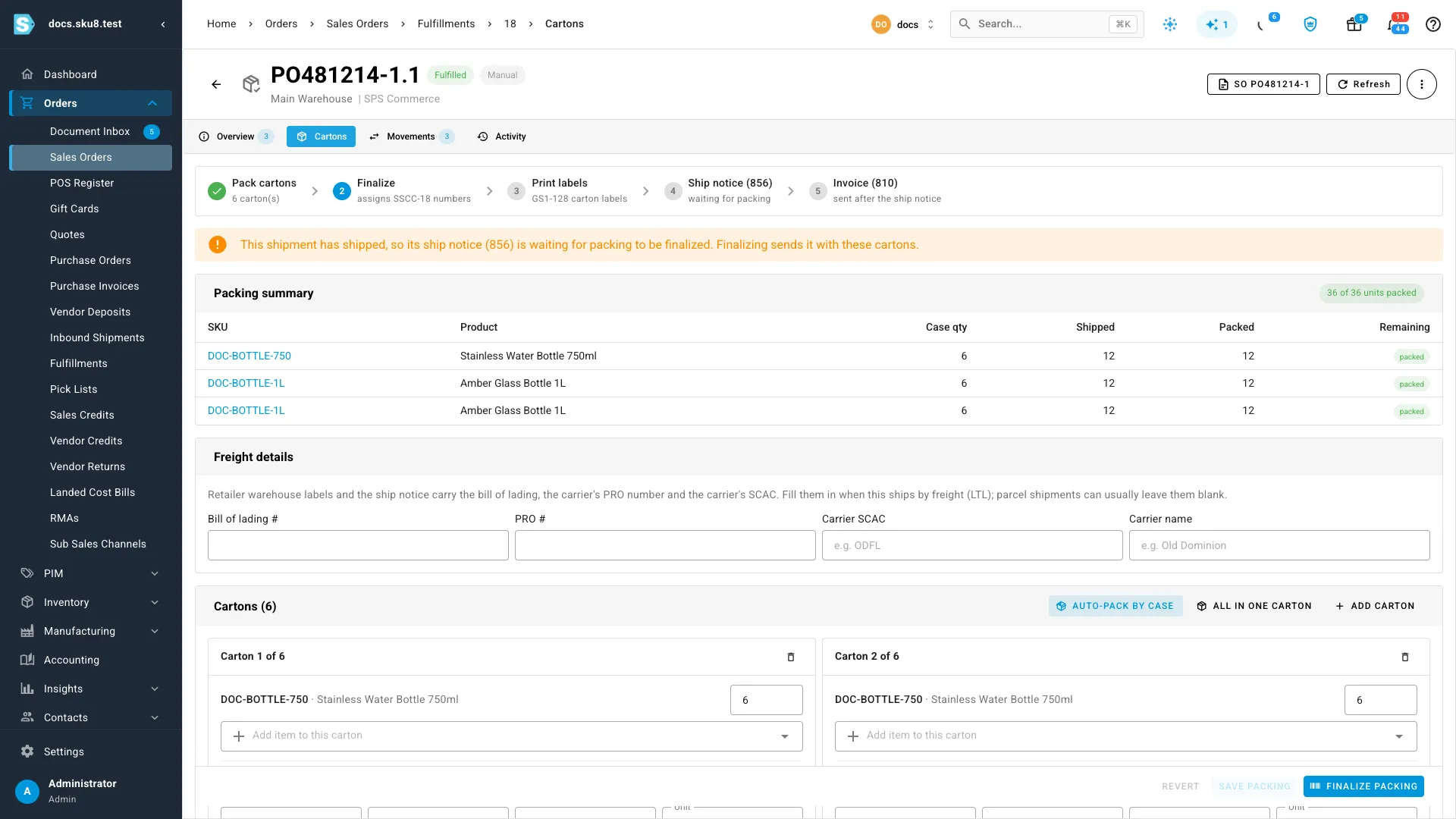
So before you pick software, check whether your retailers’ vendor guides ask for carton-level ship notices. In SKU.io, you pack a shipment into cartons on its Cartons tab, or auto-pack it by case quantity. Each carton gets its SSCC-18 number when you finalize, SPS renders the retailer’s label in its own format, and the ship notice goes out with exactly those cartons. The invoice follows.
Where the timeline actually comes from
In my experience it is the network, not the software, that sets the date.
When I started building this, SPS’s position was that it would not put me in front of its developers without a committed brand behind the project. Until you have a client you are bringing in, the message was, we can’t really talk to you about this. Once we had one, I still couldn’t get on a call with their development team to ask what I needed to ask. It was a chicken and egg problem, and the work sat waiting for months.
On the other side, brands want EDI live fast. An implementation consultant I work with described a brand that wanted to start in January and be “fully live in two weeks, which is impossible.” Their worry was the part that gets squeezed: testing the brand’s real data against each retailer’s connection.
SPS’s own estimate, from its partnership team in October 2026, is six to ten weeks to go live once a brand signs for the automation. That is one vendor’s quote to us, on one call. It still beats any software demo as a planning number. If a retailer wants you shipping in November, the EDI conversation starts now, and the inventory system is the smaller part of it.
What SPS charges is a separate bill
Whatever system you connect, you pay SPS for its network and for the automation directly. SPS’s team said so plainly on the same call, whether the brand runs SKU.io, NetSuite or SAP. Get SPS’s quote before you compare inventory systems on price. Otherwise you will compare one system’s price with EDI included against another’s price without it.
Who this isn’t for
If you are on one or two retailers with a handful of orders a month, stay on SPS’s portal and spend the money elsewhere. SPS’s partnership team described the usual path to me: a brand starts on the portal, its volume goes from about 20 documents a month to 300, and that is when typing them stops making sense.
If you are under about $1M a year and sell on one channel, you do not need an inventory system for EDI at all. Start with SPS’s own tools, and look at Zoho Inventory or inFlow when you outgrow spreadsheets.
And if your retailer needs a document beyond these five, check its vendor guide against the list above before you sign anything with anyone, us included.
Where to go from here
The SPS Commerce guides show every screen: how SPS Commerce EDI works, connecting your account, handling purchase orders and packing and labeling cartons. If wholesale is a bigger part of your business than EDI alone, direct sales and B2B covers quotes, pricing tiers and reps’ orders from the same stock. If NetSuite is still on your list for other reasons, SKU.io vs NetSuite is the honest comparison.
Or bring me your retailer’s vendor guide, and I will walk through which documents it needs and what your first month on EDI would look like. Book a demo.
How we checked this page
These are the facts on this page that you can open and check, plus the recorded calls the quotes come from. Prepared by Kalvin Mizzi, founder, SKU.io. Last checked . Each page was loaded on the date shown and the fact read off it. Call quotes were read from the recorded transcript, with speakers anonymized.
| Claim | Source | Plan or version | Checked | How we know |
|---|---|---|---|---|
| SKU.io's SPS Commerce integration exchanges the purchase order (850), acknowledgment (855), ship notice (856), invoice (810) and inventory advice (846), with the invoice and inventory advice optional. | sku.io | — | Vendor documented | |
| SKU.io checks SPS Commerce for new purchase orders every five minutes, or on demand, and creates the sales order with the PO number, ship-to address and requested delivery date once every line matches a product. | sku.io | — | Vendor documented | |
| A purchase order line that matches no product waits under Need attention until it is mapped with Map product, and the mapping is saved for that retailer's later orders. | sku.io | — | Vendor documented | |
| Invoices go one per shipment, right after the ship notice, numbered with the shipment number; inventory advice goes once a day at 5:00 UTC with chosen warehouses and a buffer held back. | sku.io | — | Vendor documented | |
| Carton-level ship notices: cartons are packed on the shipment's Cartons tab or auto-packed by case, each gets an SSCC-18 number on finalize, SPS renders the retailer's GS1-128 label, and the ship notice lists those cartons. | sku.io | — | Vendor documented | |
| The SPS Commerce integration was released on 9 October 2026. | sku.io | — | Vendor documented | |
| SPS Commerce's Shopify app is listed as integrating Shopify orders, fulfillment and inventory into SPS, free to install with additional charges billed by SPS. | apps.shopify.com | — | Vendor documented | |
| SPS Commerce's Fulfillment web account lets a supplier add orders by hand on its Dashboard or Transactions tab. | intercom.help | — | Vendor documented | |
| SPS's NetSuite connection lets brands manage orders from within NetSuite, and SPS manages EDI maps and spec changes when trading partners update requirements. | spscommerce.com | — | Vendor documented | |
| SPS's partnership team quoted six to ten weeks to go live once a brand signs for an automation, said the brand pays SPS directly whatever system it uses, and described starting low-volume brands (10 to 20 orders a month) on its portal until volume grows from about 20 documents a month to 300. | Recorded call with SPS Commerce's partnership and pre-sales team, October 2026 (internal archive) | Speakers anonymized; one vendor's statements on one call | Recorded call | |
| On the same call, SPS's pre-sales engineer said a shipment's ship notice is sent either from the brand's system or from SPS's portal, "one or the other." | Recorded call with SPS Commerce's partnership and pre-sales team, October 2026 (internal archive) | Speaker anonymized; quoted as spoken | Recorded call | |
| Quotes from an August 2026 founder demo, a 2023 beauty-brand demo, and an October 2026 planning call with an implementation consultant. | Recorded sales and planning calls (internal archive) | Speakers anonymized; quoted as spoken | Recorded call | |
| Asked six EDI buyer questions on 17 October 2026, neither ChatGPT nor Gemini named SKU.io. | Our own AI-answer tracking (one answer per engine per question, OpenAI with web search and Gemini with Google Search grounding) | — | Our own data |