
Cin7 Alternatives (2026): What Switchers Choose
Most operators who replace Cin7 are not chasing features — they are escaping one of five specific failures: sync they can’t trust, support they can’t reach, onboarding that collapses, accounting that drops marketplace fees, or workflows the platform won’t bend to. We reviewed every Cin7 mention across 1,435 recorded operator calls in our own sales and onboarding archive; those five failure modes account for nearly all of them. This page lays out the evidence verbatim, then matches alternatives — including ours and including competitors — to the operation you actually run.
Updated August 2026. Quotes are verbatim from recorded calls, lightly cleaned of transcription artifacts, attributed by role with names withheld.
Why do operators actually leave Cin7?
Five failure modes, in the words of the people who lived them.
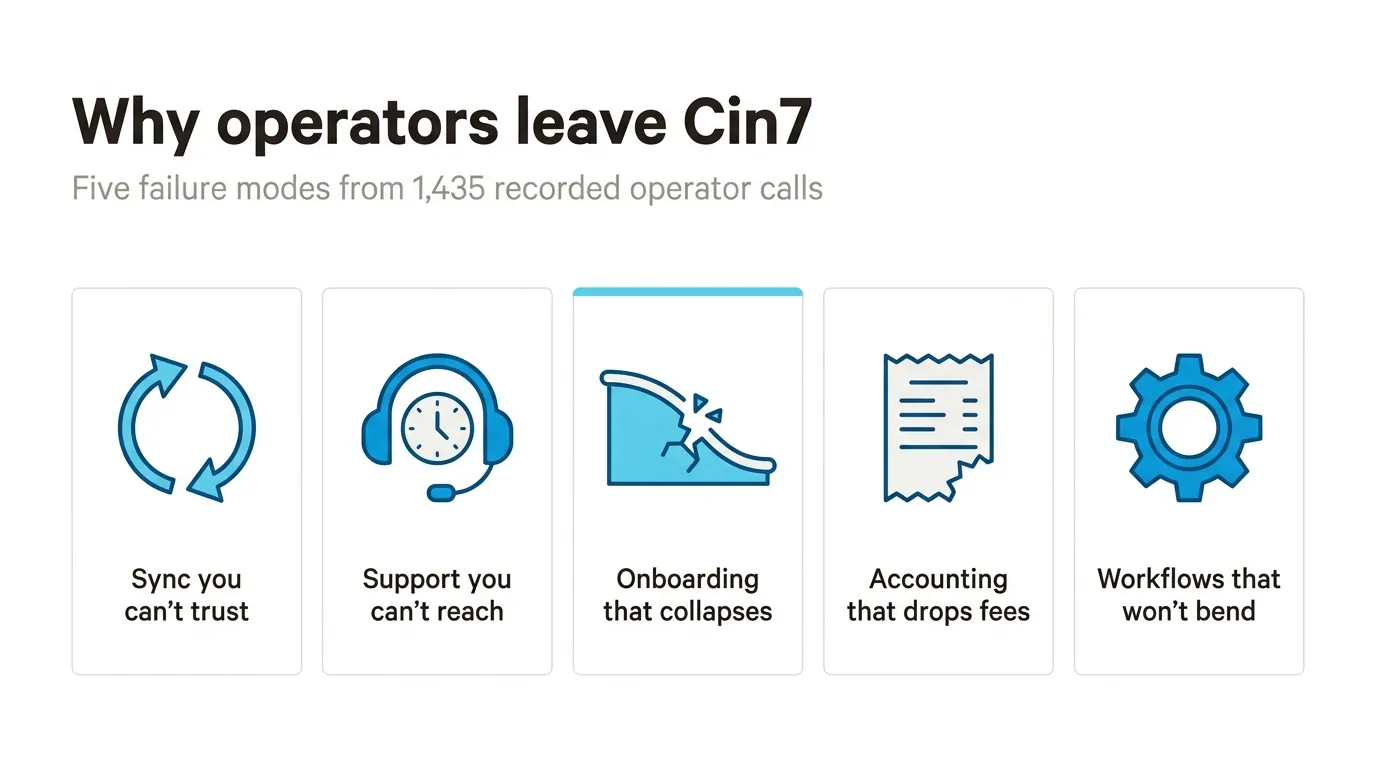
1. Sync you can’t trust. The most common reason, and the most expensive. The owner of a DTC shave-goods brand, mid-Cin7-onboarding when we met them:
“For Cin7 to not resync when something changes — now we have to go in and manually change it in Shopify, we have to manually change it in our 3PL, and now we also have to manually change it in Cin7. That kind of defeats the whole purpose of this command center thing.”
Cin7’s suggested workaround made it worse. Their operations director:
“Their recommended fix was to set it up so orders don’t sync over until the order is fulfilled. However, now I have inventory numbers in three different places that are going to say three different things.”
An Australian operations consultant who has implemented several ERPs saw the same class of problem from the other side:
“They were constantly pushing updates across to Shopify and it was throwing the stock out and it was never accurate. There’s, like, glitches happening, and it was driving me nuts.”
2. Support you can’t reach when you’re down. The owner of a home-products manufacturer, explaining why she was leaving:
“Number one is just reaching support. That’s the biggest nightmare of all. You could be on flames, and they’ll be like: I’ll get back to you in three to four weeks.”
The systems lead at a phone-parts wholesaler doing roughly 2,000 orders a day, after Cin7 Core’s QuickBooks integration broke for two weeks while the status page said it was resolved:
“If you can’t do your accounting, you can’t run the business, because you don’t know where the money goes. The last 14 days it was hard times here — we were doing so many things manually.”
3. Onboarding that collapses. An e-commerce fulfillment business owner who walked away mid-implementation:
“There were a few things they said they would be able to do without a problem on the original sales call, and then through onboarding, the things we needed were just too complicated for them.”
The costs around that onboarding are their own failure mode. An inventory consultant who implements Cin7 professionally, during an evaluation: “Even we were told to hire a Cin7 implementer — that’s not cheap. And then you have to pay for support hours.” A New Zealand supplements CEO, on the class of quotes he received from the Cin7/Unleashed tier: “They’re all wanting like 80 to 150,000 dollars to onboard and get set up.”
4. Accounting that drops the fees. The co-founder of a food DTC brand, on the Xero integration:
“They just pull in the sales and then COGS, but no other fees. They had no best practice for reconciling after — you’re going to have to keep track of these thousands of invoices and match it to the payout. They basically say, go talk to your accountant.”
Marketplace fees are where multichannel margin lives. An integration that ignores them isn’t accounting — it’s a partial export.
5. Workflows the platform won’t bend to. Small on paper, corrosive in practice — a bathroom-products retailer: “When there’s a credit note, is there a way to give that product a relationship to another sales order? I can’t do that. We can only manually check.” Multiply one un-automatable step by every order, every day. This is also the failure mode most likely to turn into a software project: one head of operations we spoke to started by building an interface over Cin7 to hold packaging rules it wouldn’t bend to, and ended up building his own inventory system without ever deciding to.
What should a Cin7 replacement prove before you switch?
Make the next vendor demonstrate, on your data, the exact things Cin7 failed at. Four tests, straight from the failure modes above: the resync test — edit an order after it syncs and watch what happens in Shopify, the 3PL, and the system of record; the support test — get the actual response-time commitment in writing, and ask who answers (a queue, or a person who knows your account); the fees test — trace one marketplace payout through to your accounting software and confirm the fees land as line items, not as a gap; the onboarding test — get the price, the timeline, and what happens if it fails, before you sign.
Which Cin7 alternative fits which operation?
Honest answer: it depends on what you run. Public list pricing as of mid-2026; verify current numbers with each vendor.
| Platform | Best fit | Public starting price | Watch for |
|---|---|---|---|
| SKU.io | $1M–$50M multichannel e-commerce — Shopify + Amazon FBA plus Walmart, TikTok Shop, wholesale; bundles/kits, 3PLs, multi-warehouse; operators who want audited inventory truth and order-level profit including fees | ~$1,000/mo, no onboarding fees | Not built for manufacturing-first shops or sub-$1M single-channel sellers |
| Katana | Manufacturing-led brands that assemble what they sell | Free plan (30 SKUs); Core $299/mo | Lighter on marketplace fee accounting and deep multichannel routing |
| Unleashed | Inventory-led wholesale/distribution, AU/NZ strength | Lite $99/mo; Core $399/mo | Per-user and order-volume add-ons accumulate; e-commerce depth varies by channel |
| Fishbowl | QuickBooks-anchored US warehouses and light manufacturing | Essentials $229/mo (annual) | Mandatory paid implementation; advanced tiers quote-only |
| Finale Inventory | Lean teams moving off spreadsheets into barcode-driven inventory control | Essentials from $499/mo; Growth from $799/mo | Average-cost only, no FIFO; API and EDI access sit on the Enterprise tier |
| Zoho Inventory / inFlow | Sub-$1M or single-channel sellers who need simple and cheap | From free / low monthly | You will outgrow them at multichannel scale — that's the trade |
If you are sub-$1M or effectively single-channel, take the last row seriously: Zoho Inventory or inFlow will cost less and do the job. Cin7’s replacements above it earn their price only when channel count, SKU structure, or fulfillment complexity is the actual problem.
Is SKU.io the right Cin7 alternative for you?
SKU.io fits if your operation looks like the people quoted above: hundreds to thousands of SKUs across Shopify, Amazon (including FBA), Walmart, TikTok Shop or wholesale, with bundles and kits, a 3PL or several warehouses, and numbers you need to actually trust. Every inventory movement lands in one perpetual, auditable ledger — the direct answer to the sync-distrust quotes above — and order-level profit includes the marketplace fees the Xero quote was missing. Pricing starts around $1,000/month and scales with orders and SKUs. There are no onboarding fees, and onboarding runs in days with the founder personally involved — the entire onboarding path is public — every demo is given by the founder, who runs his own e-commerce business on SKU.io.
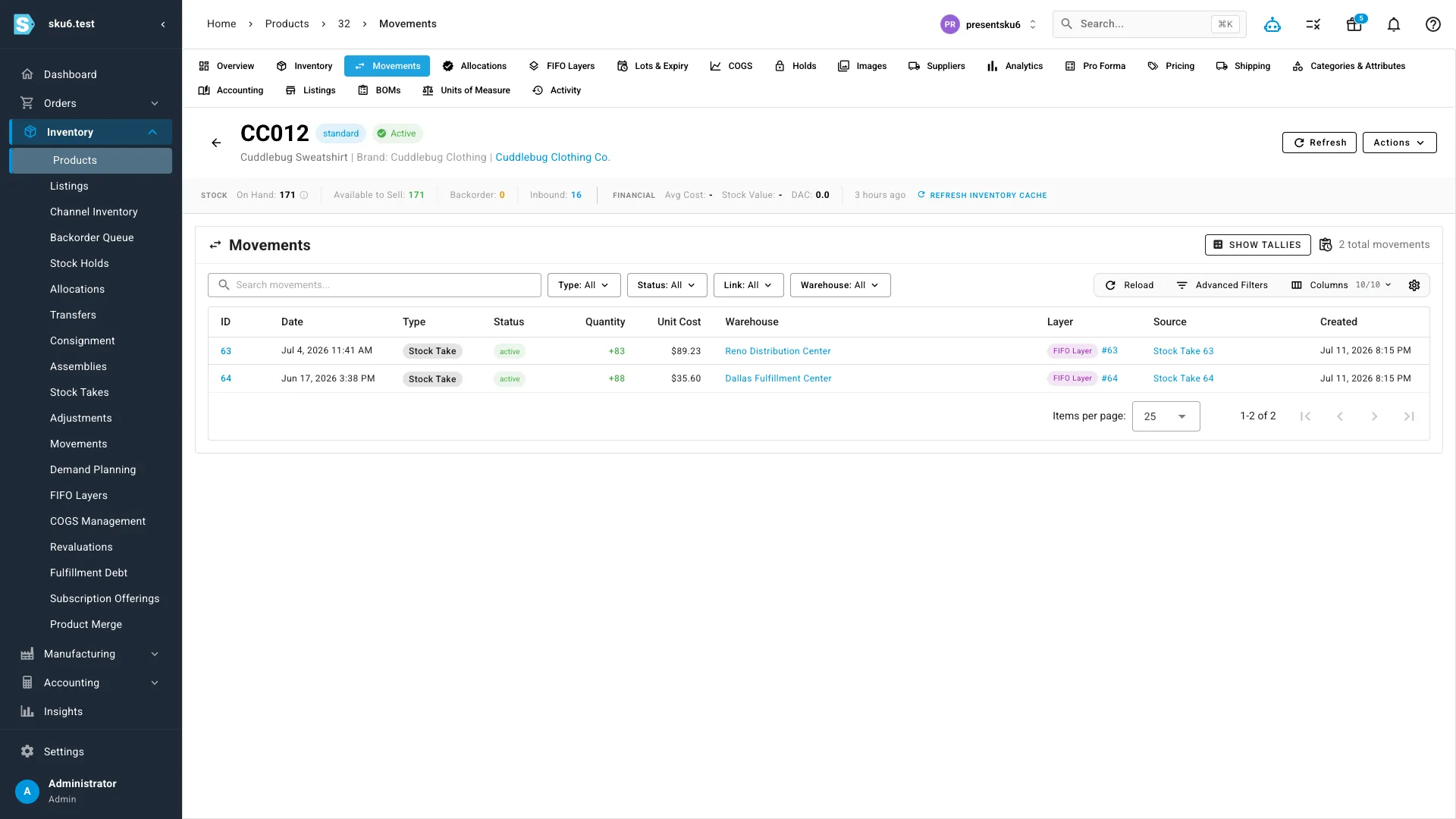
The ledger behind the resync test: every movement carries its date, quantity, unit cost, warehouse and the document that caused it — so when a number changes, you can see why.
It doesn’t fit everyone. Manufacturing-first operations are better on Katana, and the honest version of that comparison is a page of its own. Sub-$1M single-channel sellers should start with Zoho or inFlow and switch later. Enterprises that need SOC 2 attestations and big-firm implementation programs are not our lane today.
Will you lose your history when you switch?
No — if the migration imports it rather than starting from zero. Historical sales, cost layers and supplier records can be brought across so your forecasting doesn’t reset on day one; the mechanics are covered in what happens to your data when you switch inventory systems. It’s also the right moment to fix the numbers you never trusted: an initial stock take starts the new ledger from counted reality instead of imported doubt.
Deciding between an ERP-shaped system and standalone inventory software first? Read ERP inventory system vs. inventory software. Weighing the enterprise route instead? SKU.io vs NetSuite covers that comparison with the same recorded-call evidence. If the other platform on your list is one that quietly changed names, Skubana alternatives after the Extensiv rename and where SkuVault went after Linnworks bought it sort out what actually happened there. If you came to Cin7 Core under its old name, DEAR Systems is now Cin7 Core has the dated facts and the addresses that still carry it. If you are coming from Unleashed rather than Cin7, Unleashed alternatives runs the same test from the other direction: whether it was the software that failed or the order book that changed shape. If you have a developer in the building, Cin7 API vs SKU.io API runs those checks against Cin7 Core and Cin7 Omni specifically, using Cin7’s own documentation. And before you sign with anyone, run the six checks in inventory management API: what to check first — reading a vendor’s API docs is the fastest tell of how the platform is actually built, and running inventory and purchasing with AI agents is what that API buys you once you have it. Want to see the resync test, the fees test and the ledger on your own catalog? Book a demo with the founder.