
Skubana Alternatives (2026): After the Extensiv Rename
Skubana has not been a product name since 23 May 2022. 3PL Central bought it on 7 April 2021, renamed itself Extensiv thirteen months later, and the software is now Extensiv Order Manager. Then on 1 September 2026, Extensiv itself was sold: Descartes Systems Group bought it for about $120 million in cash. Order Manager is still sold, still supported, and its API documentation is still public. If you got here by searching a brand name and landing on a different company, that is the whole story. A rename on its own is a bad reason to move.
Updated September 2026. Quotes are verbatim from recorded calls in our own archive, lightly cleaned of transcription artifacts, attributed by role with names withheld. Vendor facts were checked on 14 August 2026; the Descartes acquisitions were checked against Descartes’ own announcements on 28 September 2026.
What happened to Skubana?
On 7 April 2021, 3PL Central announced it had acquired Skubana. On 23 May 2022, 3PL Central announced it was rebranding the company as Extensiv; Skubana became Extensiv Order Manager and CartRover became Extensiv Integration Manager in the same release.
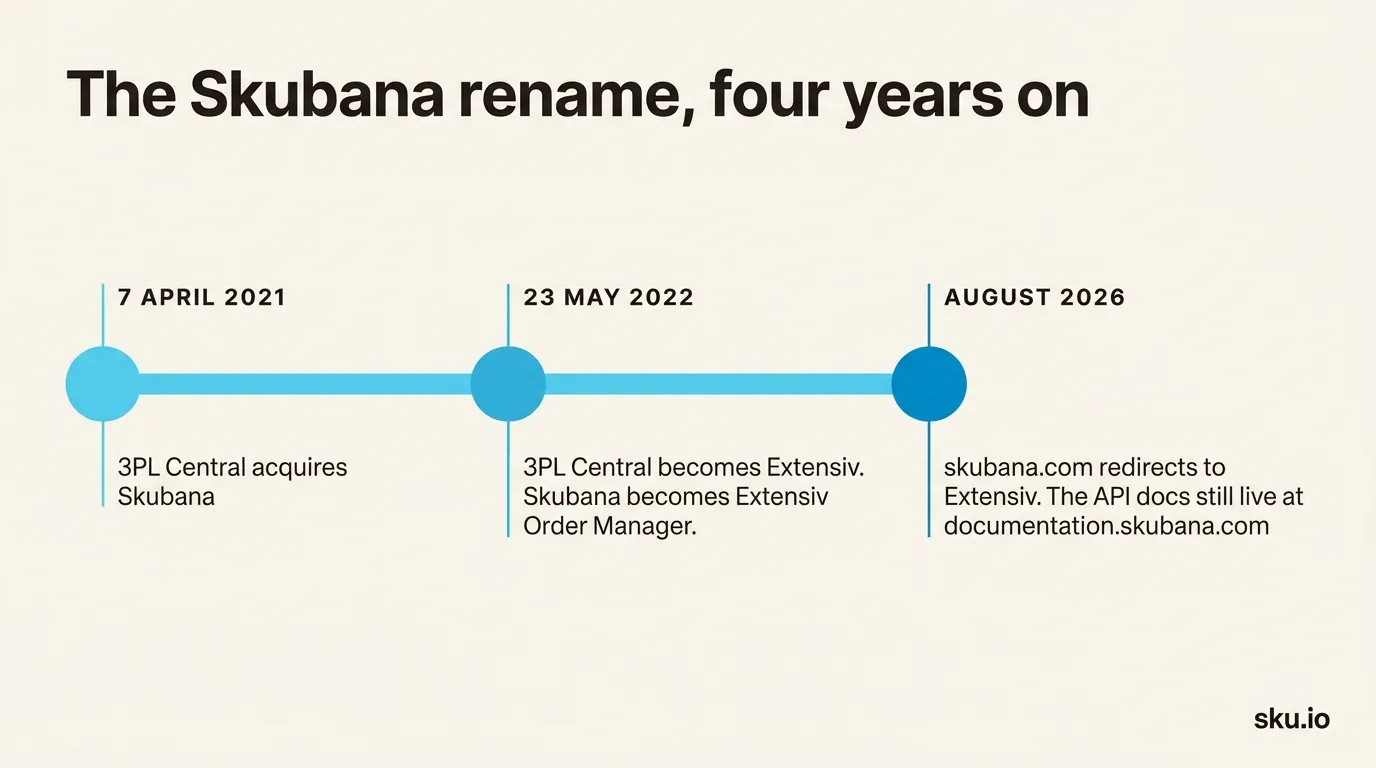
Four years on, the rename is still half done. skubana.com sends you to Extensiv’s homepage with ?redirect=skubanahome stuck on the end of the URL. The Order Manager API documentation still lives at documentation.skubana.com. The old brand is dead in the marketing and still holding up the developer docs.
Who owns Extensiv now?
Descartes Systems Group, a Canadian logistics software company, announced on 1 September 2026 that it had acquired Extensiv for approximately US $120 million, paid from cash on hand. It is the third inventory or order platform Descartes has bought in two years: Sellercloud in October 2024 (about $110 million) and Finale Inventory in August 2025 (about $40 million) came first.
Read the announcement closely if you run on Order Manager. Descartes describes Extensiv entirely as software for third-party logistics providers, and talks about combining it with its transportation, customs and last-mile products so a 3PL can buy everything from one vendor. Order Manager, the brand-side product that used to be Skubana, is not mentioned once.
That does not mean anything will happen to it. Acquirers keep products running for years, and I have no inside knowledge of Descartes’ plans. It does mean the product you rely on now belongs to a company that bought the business for the warehouse side, and already owns two other order platforms that overlap with it. If you’re staying, that is worth a direct question to your account manager, with the answer in writing.
I have my own evidence for how confusing this is. In April 2025 I recorded myself dictating a list of every competitor I could think of, in the car, for internal use. Word for word:
“Skubana was pretty good but, you know, their user interface wasn’t the best and accounting wasn’t the best. Skubana I think got bought out and they may be part of something called Extensiv. I can’t remember. I always forget the name of what they become.”
I run a competing platform. I sell against these people for a living. I could not remember what Skubana had turned into, four years after it happened. Your new ops hire searching for training material has no chance.
Is Extensiv Order Manager still worth staying on?
Sometimes. Most alternatives pages skip this part, so here is what Order Manager still does well.
It publishes real API documentation, in public, without a sales call, at developer.extensiv.com. That tells you something good about how a platform was built, and plenty of vendors at this price point fail it. If your 3PL runs Extensiv’s warehouse product, staying inside one vendor’s ecosystem is worth something a feature comparison won’t show. And Order Manager has been routing multichannel orders for over a decade. The bugs it has are old bugs, which are the survivable kind.
Stay if that’s you, and ask one question before your next renewal: what the Descartes deal means for Order Manager’s roadmap, and whether your contract terms carry over. The rest of this page is for everyone else.
Why do operators leave?
Allocation. That is the one that dominates — it accounts for most of what I hear, and the two complaints below are partly downstream of it. The operations lead at a baby-products brand, five years into Skubana, on a call while they shopped for a replacement:
“I do think there are some technological aspects there that are causing us to not have inventory allocated in the correct way, which leads to overselling… that inventory is essentially in limbo. It’s not assigned to any warehouse and then we just keep overselling.”
Same call, on why they couldn’t audit their way out:
“We don’t have barcoding integrated with our inventory. So everything in that realm would have to be done with a hand count. But the quantities that we have, that is just not a realistic proposition.”
Five years in, and both of the things that would have fixed it — accurate allocation, a countable shelf — were out of reach. When I asked whether the accounting made up for it, the answer was three words: “It’s been underwhelming.”
Then pricing. The owner of an irrigation drop-ship business, on what he paid and how he came to pay it:
“Skubana was 1500. I feel like I was overpaying for Skubana, but that’s because… the sales process they put me through was terrible. It was negotiable. Don’t display prices. They’re like, tell me how much you’re doing. I felt like I got had.”
That was 2022 and the model has not changed. As of 14 August 2026 there is no price anywhere on extensiv.com; the pricing URL returns a 404. The only first-party number I can find is Extensiv’s own Shopify App Store listing, which says pricing starts at $400 a month. Third-party review sites list starting figures from $399 up to a $1,199 minimum and disagree with each other, which is what always happens when a vendor won’t publish. Same operator, on performance, in four words: “Theirs is very slow.”
And the 3PL loop, which is really the allocation problem wearing a different hat. The co-founder of a bar-tools brand, describing her actual weekly routine before she moved:
“We get an error in Extensiv and I go, oh, that’s weird. And I email [our 3PL] and they go, well, yeah, we don’t have that SKU yet. Let me create it for you. And then once they say they create it, I go back to Extensiv and push it again.”
By January of this year she had given up on it:
“A handful of our FBM SKUs… haven’t been syncing for a couple of months… I just was like, I’m not going to bother because SKU is going to fix it. Why troubleshoot Extensiv?”
She is a customer of ours, so weigh that one accordingly. The part worth your attention is the middle, not the ending: a routine SKU mismatch costing three emails and a manual re-push, every week, forever.
What should a Skubana replacement prove before you switch?
Take one SKU that lives in two places — a 3PL and FBA, say — and oversell it on purpose during the demo. Watch where the units go. Every unit should be assigned to a specific warehouse at every moment, with an audit trail saying why. “In limbo” is not a state a real ledger has.
Then ask how you would run a physical count next quarter. If the answer involves exporting to a spreadsheet and hand-typing the result back in, you are buying the same problem from a different vendor.
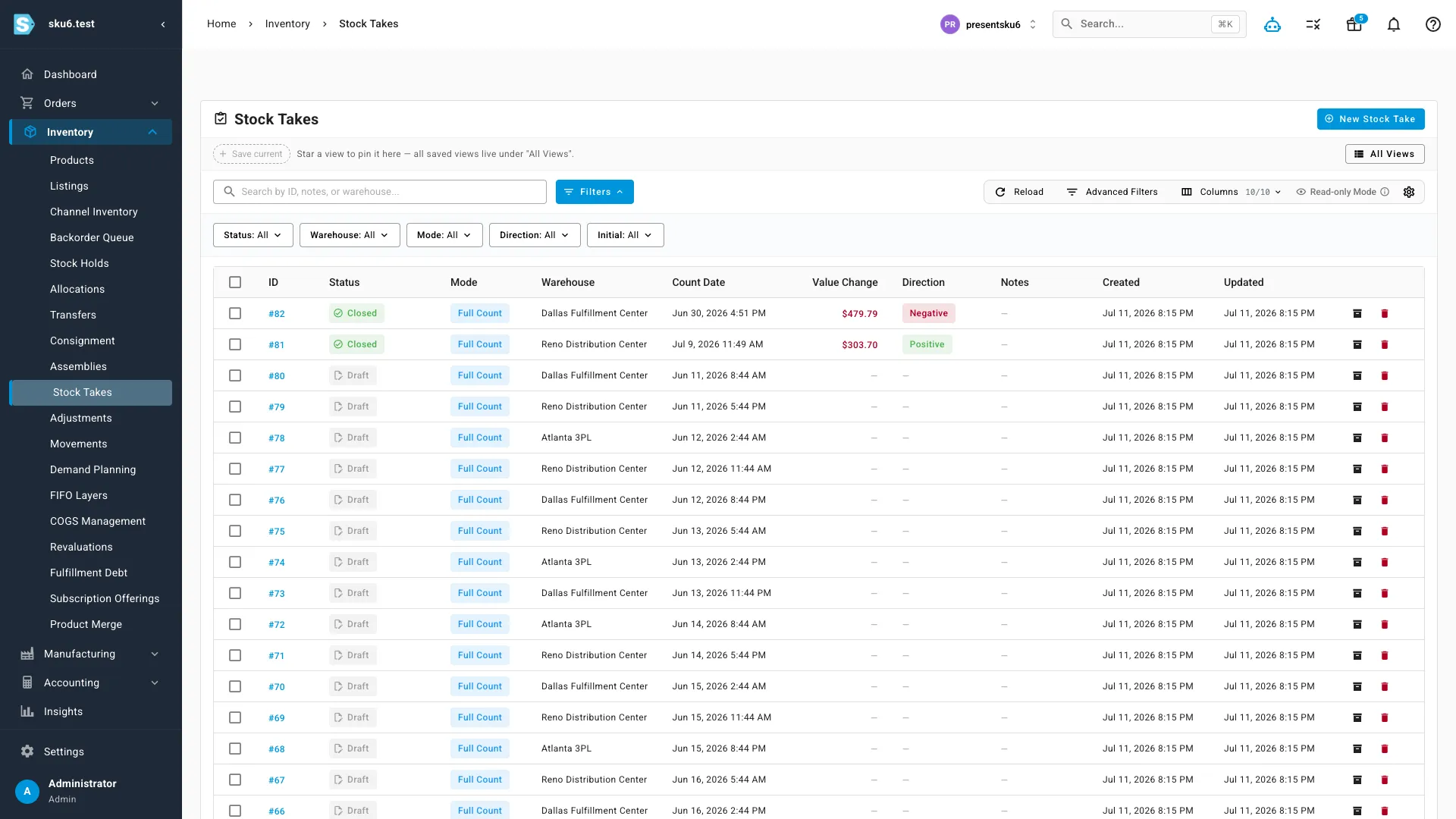
The count test from the other side: a stock take here is a record, not a spreadsheet — scoped to one warehouse, counted in the app, then closed with the value change it produced and the direction it moved. That is the thing the baby-products team above could not do after five years.
Then ask for the price in writing before discovery rather than after. A vendor who needs your revenue figure before quoting is not pricing their software.
I don’t have a good test for support quality, and I’m suspicious of anyone who says they do. Reference calls are selected for you. The best I’ve got is to ask who answers when you’re down — a queue, or a person who knows your account — and get the response-time commitment in writing.
What switching actually costs you
Nobody selling you a replacement wants to describe this part, so here it is from a migration I personally ran this January, moving a bar-tools brand off Extensiv.
Their SKU list had duplicates with real stock sitting behind both records. That is not a bug in anybody’s software. It is what happens over years, and somebody — in this case the customer, over several sessions — has to decide which record survives and where the stock consolidates. No import tool decides that for you.
Their 3PL’s API was the other cost. I spent part of a working session live-debugging it on a screen share: no pagination on the orders endpoint, so pulling history took forever, and error responses that told me nothing. My note to the customer at the time was that I couldn’t tell what was wrong, because the API wouldn’t say. We got through it. It was not the clean two-week cutover a sales page implies.
And one about us specifically: we ship API changes weekly, and moving fast has occasionally broken an integration at the worst possible time. That is the trade you make with a vendor that ships your requests in days instead of quarters. It is why our docs carry a mechanical changelog and a breaking-changes-only feed.
Which Skubana alternative fits which operation?
I have not used all of these, and I’m not going to pretend otherwise. The last column says how I know what I know: seen inside a live account means I have watched an operator work in it or debugged against it; read the docs means exactly that. Public list pricing checked 14 August 2026 — verify with each vendor before you decide anything.
| Platform | Best fit | Published starting price | How I know |
|---|---|---|---|
| Extensiv Order Manager (stay) | Owned by Descartes since September 2026. Brands already inside the Extensiv ecosystem, or whose 3PL runs Extensiv's warehouse product; teams happy with routing who don't lean on the accounting | Nothing on extensiv.com; $400/mo on its Shopify listing | Seen inside a live account — migrated a customer off it in January 2026 |
| SKU.io | $1M–$50M multichannel — Shopify + Amazon FBA plus Walmart, TikTok Shop, wholesale; bundles and kits, 3PLs, multi-warehouse; operators who want an audited inventory ledger and order-level profit including marketplace fees | ~$1,000/mo, no onboarding fees | Ours. I also run my own e-commerce business on it |
| Cin7 Core / Omni | Mid-market multichannel wanting a large integration catalogue | Core Standard $349/mo, Pro $599/mo, Advanced $1,199/mo; Omni quote-only | Seen inside live accounts, via switchers mid-evaluation — see why operators leave Cin7 |
| Linnworks / SkuVault Core | Listing-heavy multichannel sellers, strong UK presence | Not published — quote only | Read the docs and the pricing page. Also a post-acquisition brand mid-consolidation |
| Katana | Manufacturing-led brands that assemble what they sell | Free plan (30 SKUs); Core $299/mo | Read the docs. I send manufacturing-first operators here and they don't come back, which I take as a good sign for them |
| Zoho Inventory / inFlow | Sub-$1M or effectively single-channel sellers | From free / low monthly | Read the pricing pages. I recommend these more often than I demo against them |
If you’re under about $1M on one channel, take the last row seriously. Skubana was priced for operations more complex than that, and so are its replacements, mine included.
Is SKU.io the right Skubana alternative for you?
We fit if your operation looks like the calls quoted above: hundreds to thousands of SKUs across Shopify, Amazon including FBA, Walmart, TikTok Shop or wholesale, with bundles and kits, a 3PL or several warehouses, and inventory numbers you have stopped trusting. Every movement lands in one perpetual, auditable ledger, which answers the allocation-limbo quote directly — a unit is always somewhere, and you can open the document that put it there. Order-level profit includes the marketplace fees. Pricing starts around $1,000 a month and scales with orders and SKUs, with no onboarding fees. Every demo is given by me.
We don’t fit everyone. Manufacturing-first operations are better served by Katana. Sub-$1M single-channel sellers should start with Zoho or inFlow and switch when the second channel arrives. If your requirement list opens with SOC 2 attestations and a big-firm implementation program, we are not your lane today.
Where to go from here
If you evaluate on architecture rather than feature lists, run the six checks in inventory management API: what to check first against Extensiv and against us. Both of us publish real docs, so it is a fair fight and it takes twenty minutes. If Cin7 is the other name on your shortlist, what Cin7 switchers choose applies the same recorded-call evidence to that decision. SkuVault went through a near-identical transition under Linnworks, down to the stranded developer docs — where SkuVault went and what it costs covers that one. And if you’d rather drive the ops layer with an agent than by clicking, running inventory and purchasing with AI agents is how I do it on my own business.
Or bring me the SKU that oversells and I’ll run the allocation test on it live. Book a demo.