
SKU.io Features
Control inventory on a centralized hub
A perpetual event ledger for every unit you own — across FBA, AWD, 3PLs, and your own warehouses — with an audit trail behind every number.
Book a Demo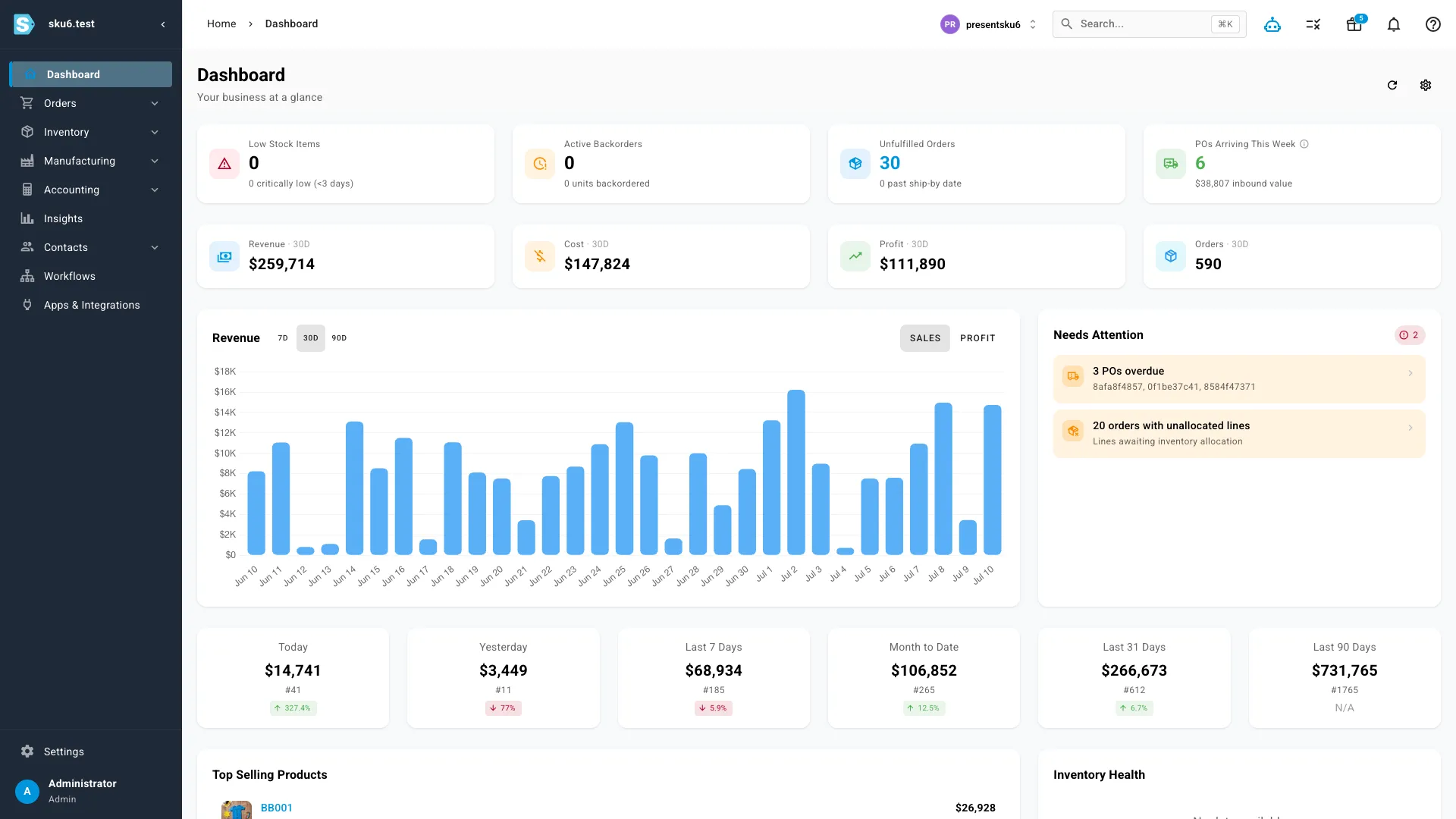
What sets this apart
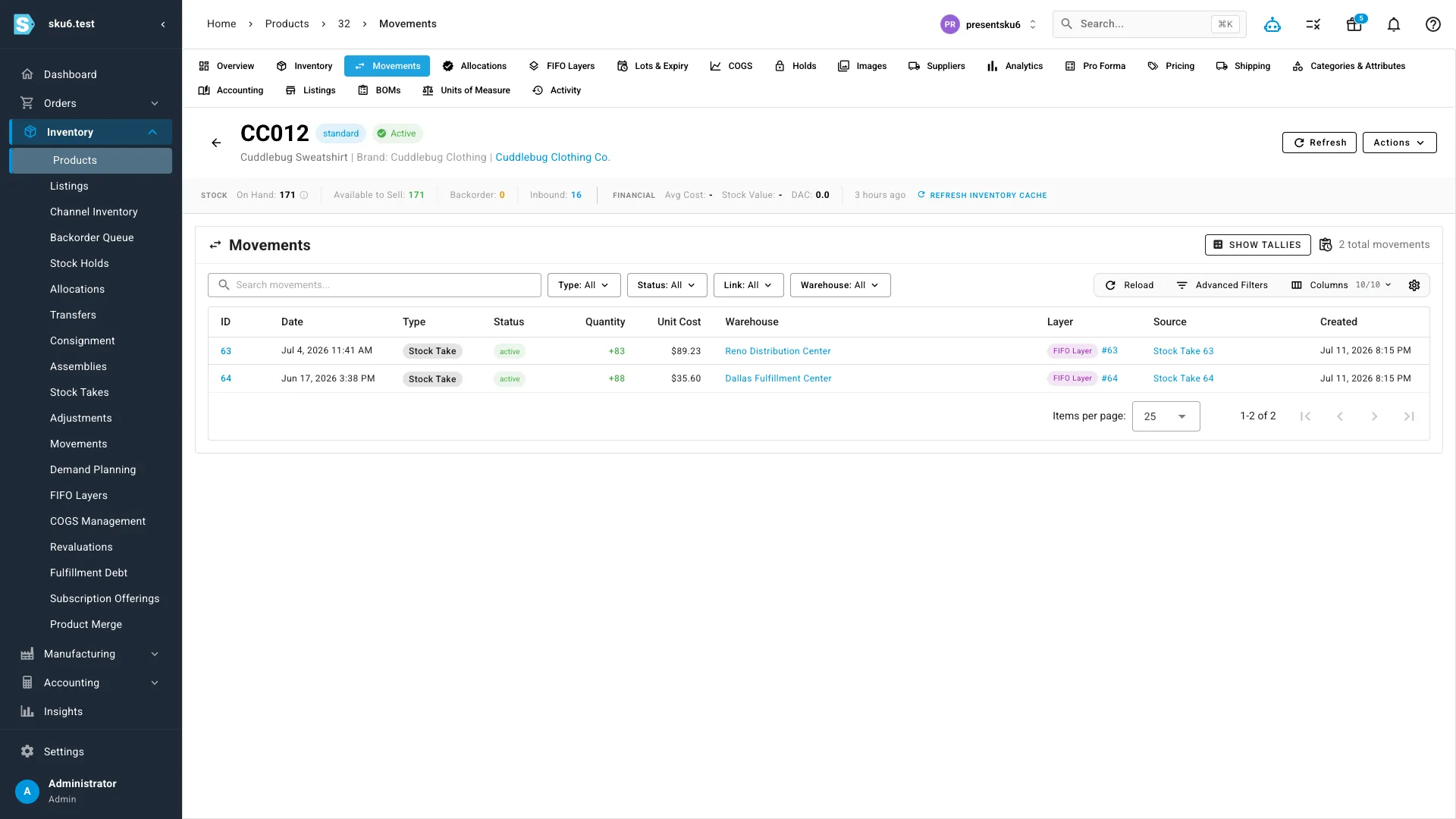
Every unit has a paper trail
Open any product and read its movement history: receipts, transfers, fulfillments, adjustments — each tied to the FIFO layer and source document that created it. When a count looks wrong, you watch what happened instead of scheduling a reconciliation meeting.
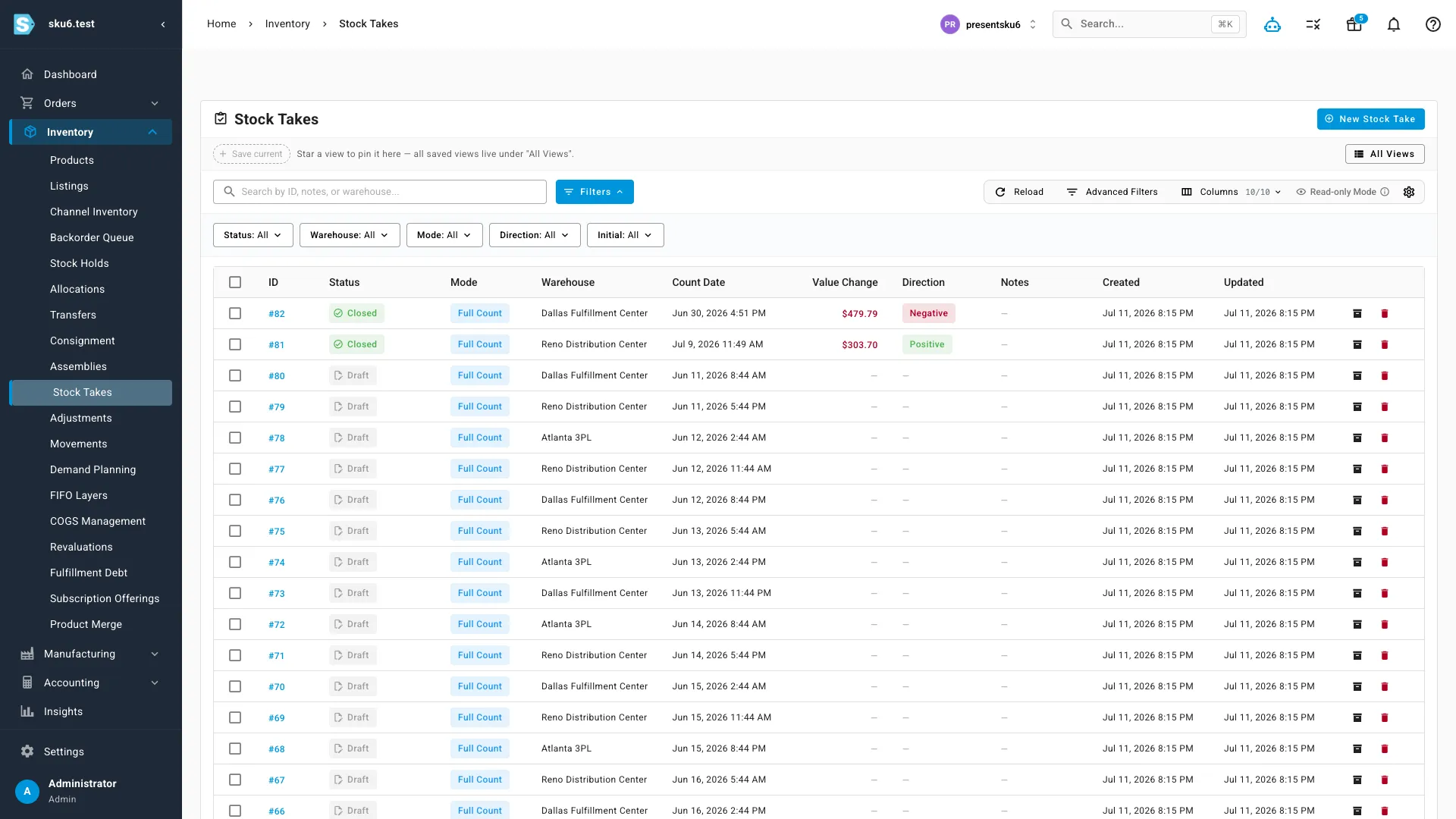
Cycle counts that write the ledger
Stock takes post their own value changes — positive or negative, priced from the affected layers — and create the movements and FIFO layers to match. Counting stops being a spreadsheet event and becomes part of the record.
One pool of truth across FBA, AWD, 3PLs, and your own shelves
Replenishment sees every location at once and flags the warehouse transfer before the stockout, not after. Low at Amazon while a pallet sits at your 3PL stops being a surprise you discover from a sales dip.
Most multi-channel sellers have never totally trusted their inventory numbers. sku.io is built so you can: every movement is recorded as an event, and every number traces back to a source document.
Every number traces back to a source document
sku.io keeps inventory as a perpetual event ledger, not a running total someone can quietly overwrite. Every receipt, sale, transfer, and adjustment is a recorded event with a timestamp and a cause. When a count looks wrong, you click through the audit trail — from the on-hand number to the movement to the purchase order or sales order behind it — and find out what actually happened, instead of posting a mystery adjustment and hoping.
Twenty seconds of the real thing
One number, traced to its source
A scripted pass through the live product: a stock count's movement, the FIFO cost layer behind it ($89.23 a unit), and the origin record behind that. It runs faster than you can check it — which is what the walkthrough below is for.
One product record, three screens
It says 171 on hand. What did they cost?
The same three screens, stopped. The sweatshirt above was received twice at two very different prices — a single blended average cost would report one number and hide both. Every figure below is on the screen, not in our copy.
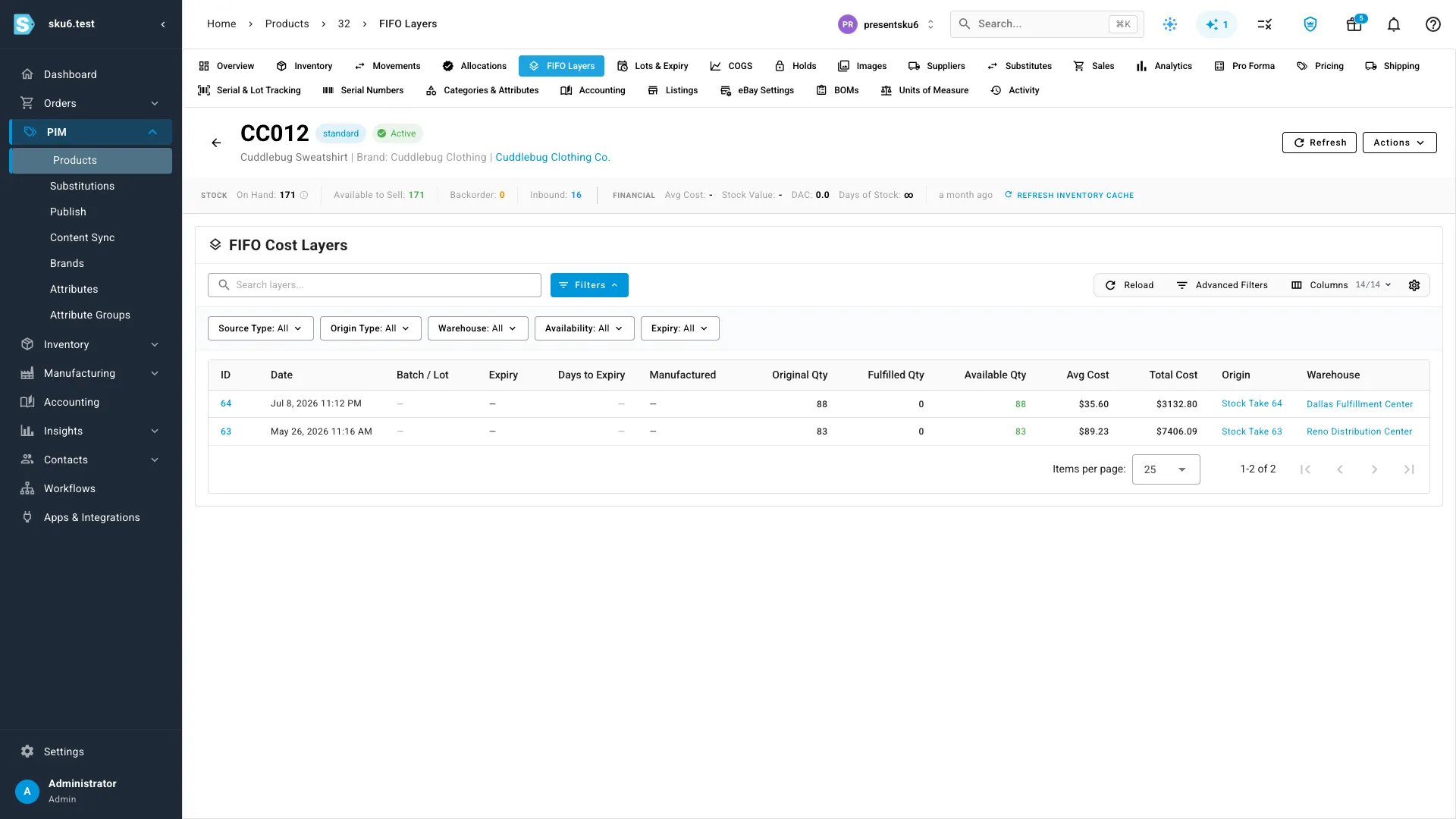
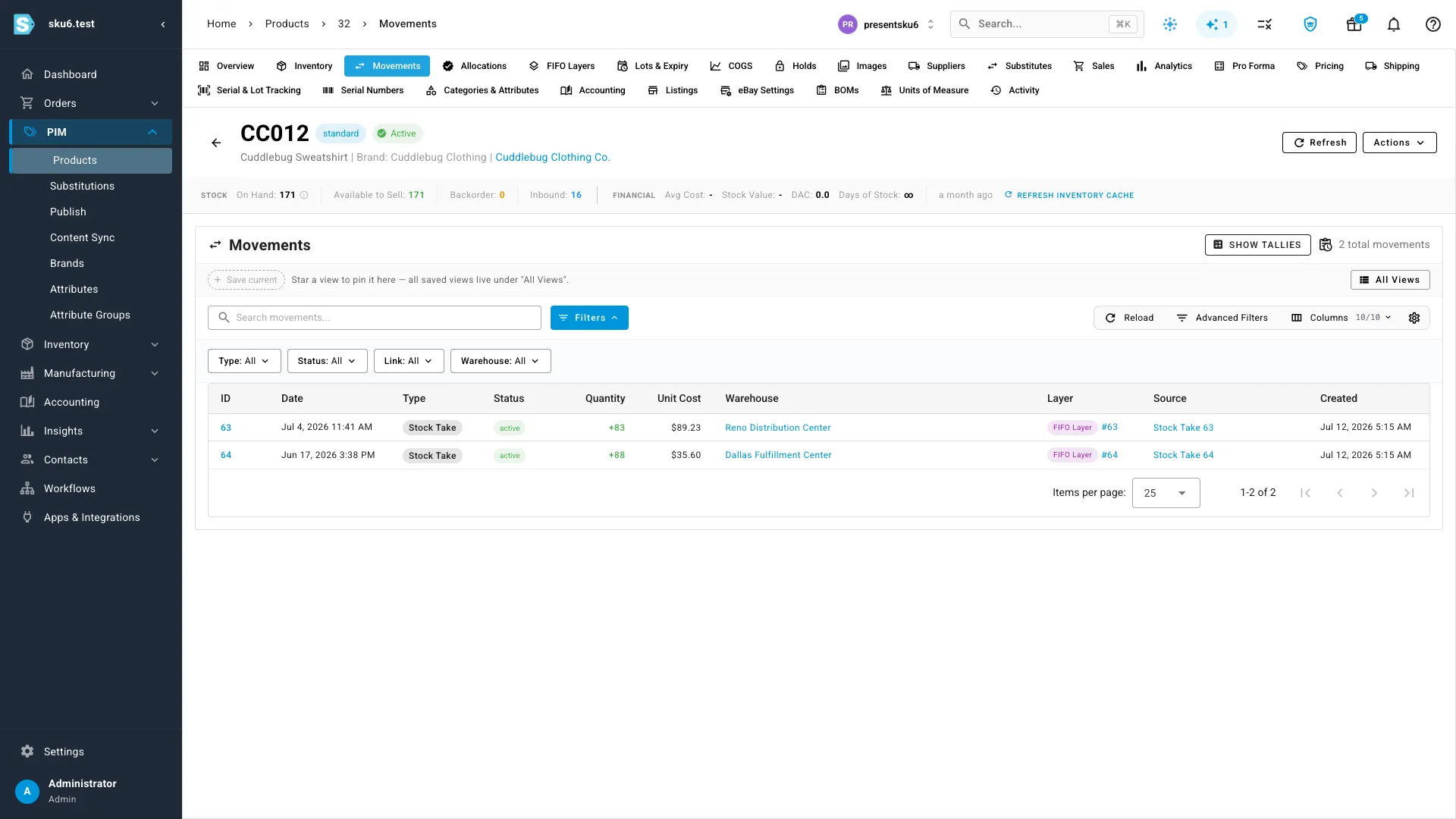
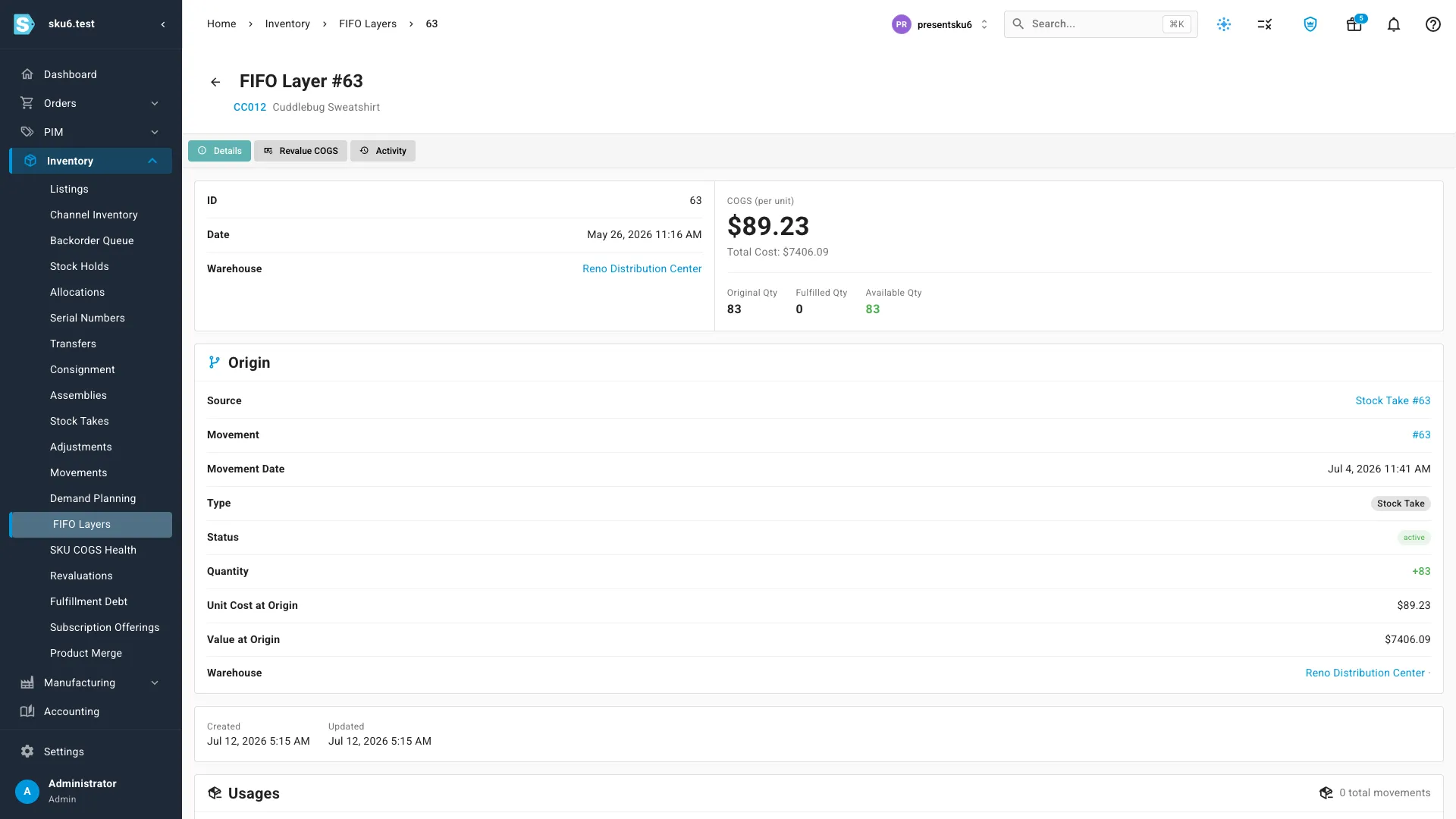
Three unretouched captures of one product record, in the order you would click them. The highlight is ours; the pixels underneath are not. Click any frame to inspect it full size, without the highlight. How these layers become each order's margin
One stock pool across FBA, AWD, 3PLs, and your own shelves
Running low at Amazon while pallets sit at your 3PL shouldn’t go unflagged. sku.io tracks stock in every location — FBA, AWD, third-party warehouses, your own buildings — as one pool, so availability, replenishment, and transfer planning all see the full picture. Warehouse transfers carry in-transit quantities the whole way, so units between buildings are never invisible.
Sync that doesn’t oversell your channels
If you’ve been burnt by a sync engine before, this is the part to test hardest in a demo. sku.io acts as the master of stock and publishes availability to every channel, with safety-stock buffer rules you set per product, per channel. Kits and bundles decrement their components correctly, so selling a 3-pack on Amazon adjusts the same units a single-unit sale on Shopify would. Marketplaces penalize sellers who repeatedly cancel oversold orders — keeping the published number honest is the whole job.
FIFO layers and landed cost, down to each order’s margin
Each receipt creates a FIFO layer with its own unit cost, including landed costs like freight and duties. Every sale pulls from those layers, so COGS reflects what those exact units cost — which is how sku.io can show the contribution margin of every single order rather than a blended monthly guess. Open any layer and see its unit cost, remaining quantity, and exactly which transactions drew from it. There’s more depth on the accounting page.
Demand planning that shows its math
The planning grid lays out sales history, current stock across locations, inbound purchase orders, supplier lead times, and the resulting buy suggestion — with the arithmetic visible, like the spreadsheet you used to maintain by hand, minus the maintenance. When the numbers look right, turn them into purchase orders in one click. See purchasing and replenishment for the full workflow.
Connected to everywhere you sell
Core integrations include Shopify, Amazon, Walmart, eBay, WooCommerce, BigCommerce, Magento, ShipStation, Starshipit, ShipMyOrders, Xero, and QuickBooks. Everything the UI does, the API does — around 4,900 documented endpoints, plus an MCP server so AI agents can work with your inventory too. If your platform isn’t on the list, we build custom integrations; the architecture has been API-first since day one.
Keep looking
The rest of the platform
Every part of the platform runs on the same ledger as this one — the same stock, the same costs, the same events.
- Inventory Management Every unit, every warehouse, on one auditable ledgerYou're reading this one
- Product Information Management One product record, mapped to every channel listing
- Sales Channel Management Shopify, Amazon, Walmart, eBay — no per-channel fee
- Order Management One queue, routed to your warehouse, 3PL, or MCF
- Direct Sales & B2B Wholesale and DTC from one pool of stock
- Supply Chain Management Forecast, purchase, receive, assemble, handle returns
- Business Intelligence Drill from any number to the records behind it
- Purchasing Optimization Demand planning that shows its math
- Accounting FIFO COGS and clean journals to Xero or QuickBooks
Ready to see SKU.io in action?
Bring your real numbers and the messy questions — we'll walk the system against an operation like yours, not a slide deck.
Book a DemoFounder-led demo · 2-day onboarding · no onboarding fees