
How to Track Supplier Deposits, Payment Terms and the Three-Way Match
You need three things, and the order matters. Record the deposit as its own document tied to the purchase order, and book it as cash you still own at the supplier, not as inventory. Write the payment terms down as dated milestones, so “30% now, 70% when it ships” becomes two due dates you can plan cash around. Then, before the balance goes out, match the supplier’s bill against what you ordered and what actually arrived. That last check is called a three-way match.
Which should you choose?
- Stay on QuickBooks Online if you place a few overseas orders a year. Intuit’s own help has you record the prepayment as a payment to the supplier and apply it as a credit when you pay the bill. You keep the schedule and the matching in your head or a sheet, which is fine at that volume.
- Choose Cin7 Core if you want the deposit attached to the purchase order inside an inventory system, and one deposit per order covers your terms. Its help describes adding a supplier deposit on an authorized order, held in a current asset account and used as payment on later bills.
- Choose an accounts payable tool such as Settle if your problem is paying and financing suppliers more than running stock. Settle’s procurement page says it lets you pay vendors upfront, reconcile later, and compare what you ordered, received and billed before payments go out.
- Choose SKU.io if your terms have more than one trigger (a deposit on the order, a payment when it ships, net 30 from the bill), you sell on more than one channel, and you want the deposit, the schedule, the match and your inventory cost in one place.
- Switching probably isn’t worth it if your suppliers bill you net 30 with no deposits. Bills with due dates in any accounting system cover that.
The sources for every fact here, including the vendors’ own help pages and the calls I quote, are at the bottom with the date each was checked.
Why I wrote this
I run my own e-commerce business on SKU.io, and I had this problem before we built anything for it. My operations manager would email me that a supplier needed paying. I’m not in the day-to-day of ops, so I’d scroll back through the thread trying to work out which purchase order it was, how much we had already sent, and whether the number was right.
Customers had the same problem at a larger scale. A founder who buys mostly from one overseas manufacturer described his terms to me in April 2026: 20% when the PO goes out, 40% when the goods ship, and the last 40% net 30 after they arrive. Every system he had looked at asked for his terms and offered two choices. “Do you pay all up front or you pay like net 30 and it’s like, well, none of those.”
In October 2026 I asked ChatGPT and Gemini four questions buyers had asked us about this, including “inventory software that handles supplier deposits and split payment terms like 20 percent down and net 30?” Across the eight answers, neither named us. Both answered with lists of accounts payable tools and large ERPs. A list doesn’t tell a brand buying from a factory where the deposit sits in the books, when each payment falls due, or what to check before the balance goes out, so below is how I set that up for my own orders.
A deposit is cash you still own, not stock you’ve bought
When you wire a factory 30% before production starts, nothing has arrived. The money has moved from your bank to the supplier, and it is still yours until goods come back for it. In accounting terms it is a current asset, a prepayment, not inventory and not cost of goods.
The usual mistake is booking the deposit as inventory, which overstates the business. A consumer-brand founder put it to me plainly in 2021, describing a $100,000 order with half paid in advance. If the system books the whole order as inventory in transit while only $50,000 has left the bank, “you’re counting double the value of your business, those 50k because you’ll show that you have actually the value is 150k.”
In SKU.io a vendor deposit is its own document, linked to the purchase order. It posts to Other Current Assets and never touches your FIFO cost layers or inventory value. When the supplier’s bill is posted against that order, the deposit is applied to it automatically, so the bill shows only what is still owed. If your goods become yours at a specific point, say when they leave the factory, you mark that milestone and the paid deposit counts as goods bought from then on.
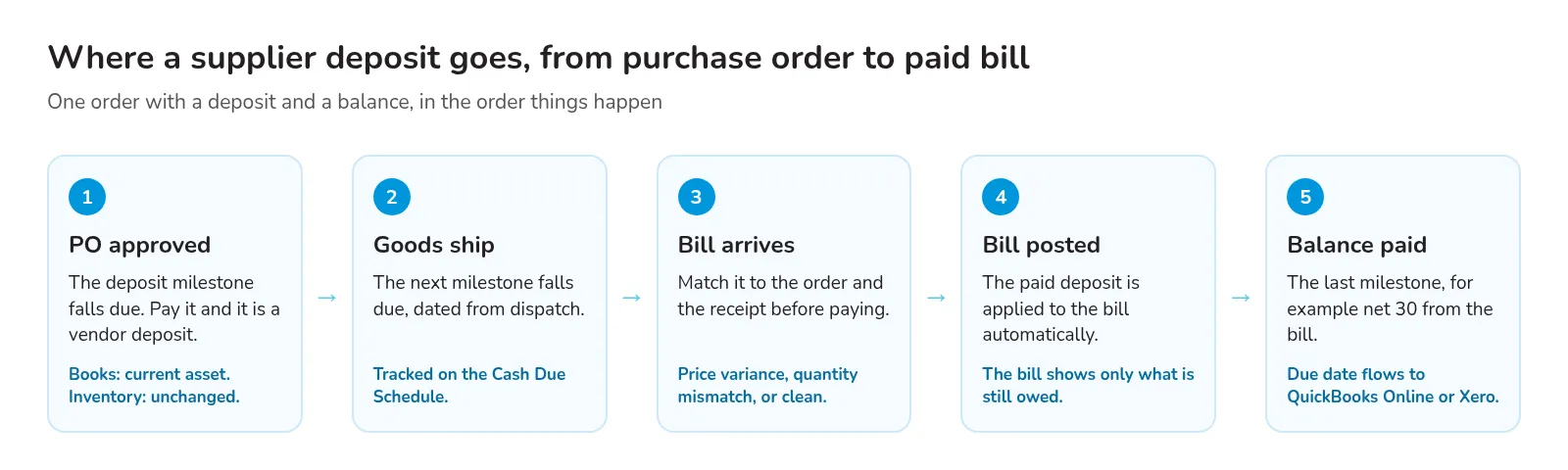
Write the terms down as dates
Payment terms with a deposit are not one due date. They are a list of dates that depend on things that haven’t happened yet: the order being approved, the container leaving, the goods arriving, the bill being issued. A spreadsheet can hold the list, but someone has to update every date by hand as each event happens.
A private-label Amazon seller showed me his version in February 2025. For each order he tracked “the 30% deposit or the 70% balance”, and when each fell due, because “for the next month, what balances do we have due to our suppliers and do we have enough money to do that?” His sheet had a production schedule keyed by the Alibaba order number, and he typed every date into it himself.
That 30/70 split is the most common one you will see. Alibaba’s own seller blog calls 30% before production and 70% before shipment the most common structure for apparel orders between $5,000 and $50,000. Here is how three common shapes become milestones in SKU.io.
| The terms the supplier gives you | Milestones | What happens on each |
|---|---|---|
| 30% deposit, 70% when it ships | 30% on PO approval; 70% on each shipment | The 30% raises a vendor deposit the day the order is approved. The 70% is paid through the bill, prorated per shipment. |
| 20% down, balance net 30 from the bill | 20% on PO approval; 80% on the bill date, offset 30 days | Each bill is due 30 days after its own date, so it doesn't wait for a linked shipment. |
| 20% on the PO, 40% when it ships, 40% net 30 after receipt | 20% on PO approval; 40% on each shipment; 40% on each receipt, offset 30 days | Three dates per shipment, each one moving when its event happens. |
You set this up once on the payment term, and every purchase order that uses the term gets its dates worked out. The schedule won’t save until the milestones add up to 100%, and the editor works the plan through on a sample order so you can see the dates before you rely on them.
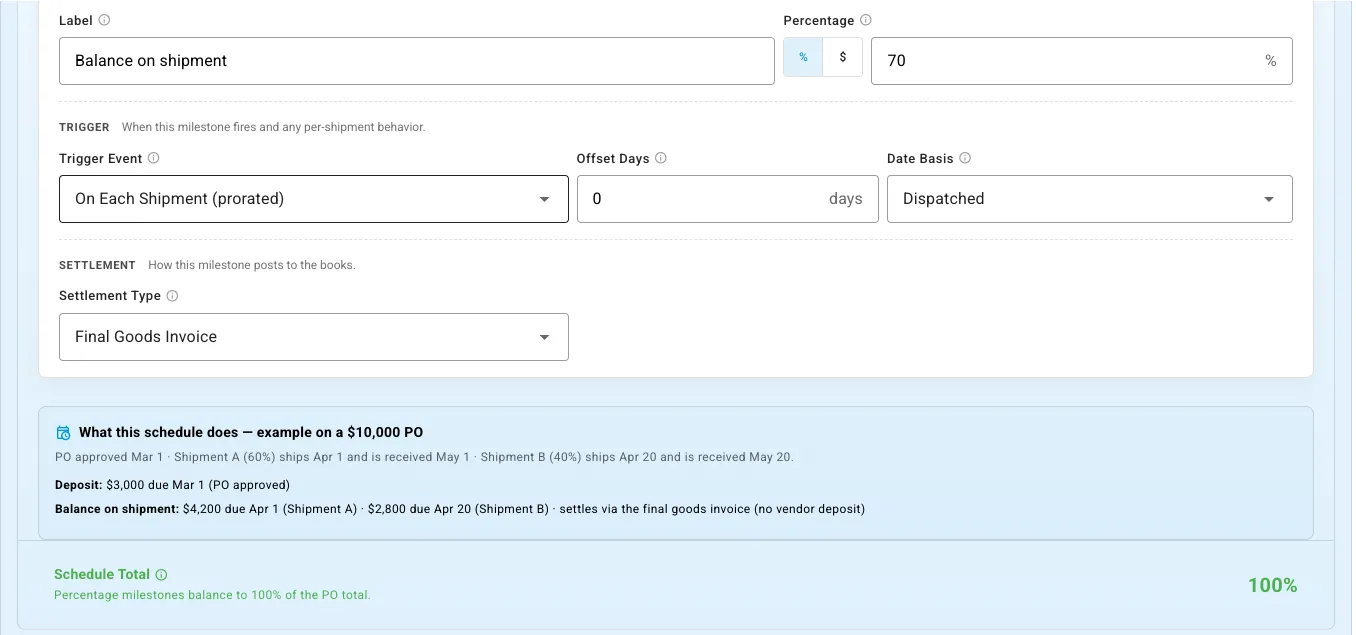
The dates then feed one view, the Cash Due Schedule. It groups everything you owe suppliers into due now, due within 30 days, and awaiting a trigger. A milestone whose event hasn’t happened yet, like a balance due on a shipment that hasn’t left, sits under awaiting a trigger.
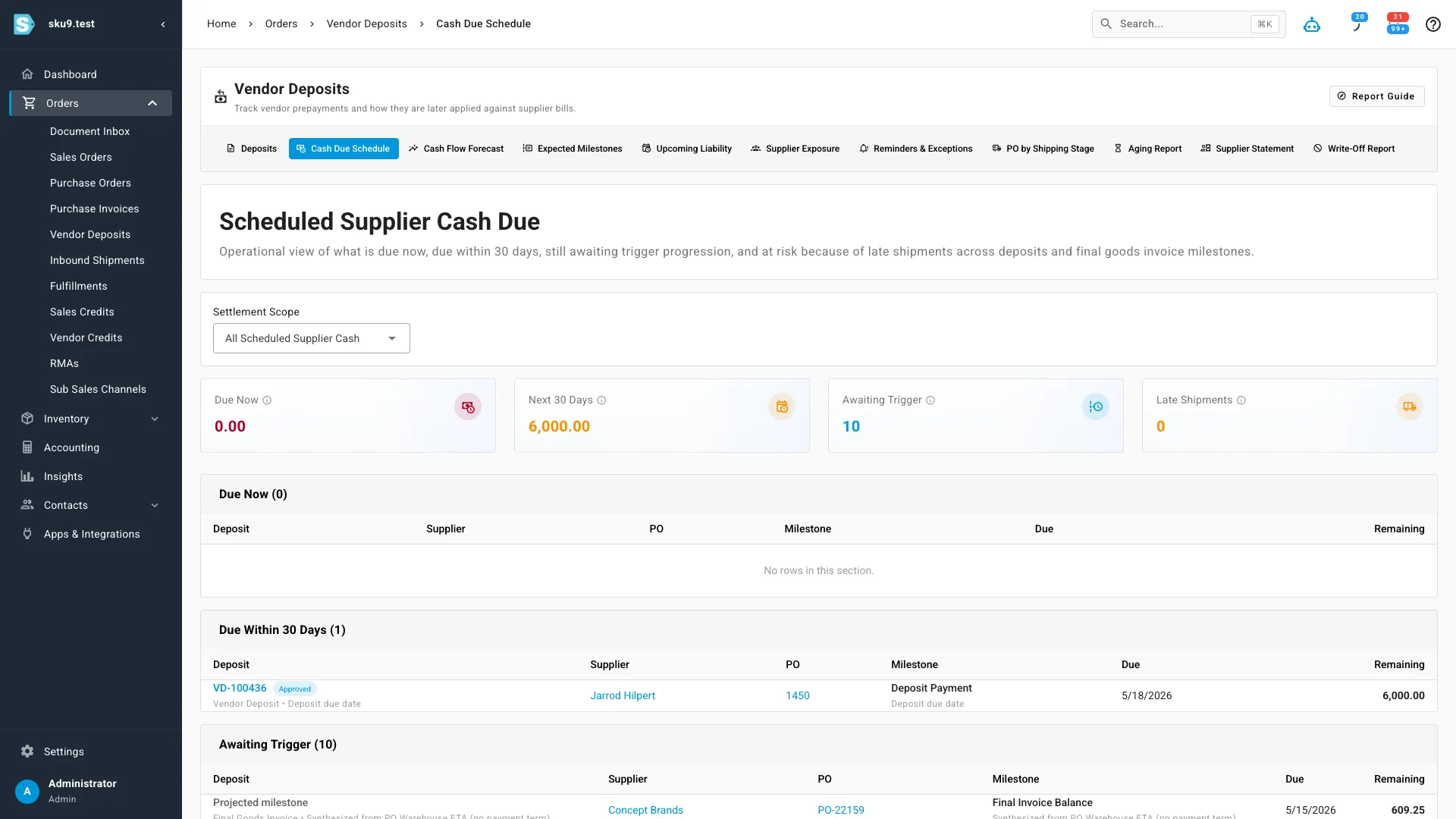
Match the bill before the balance goes out
A three-way match compares three records for the same goods: your purchase order (what you ordered and the price you agreed), your receipt (what arrived), and the supplier’s invoice (what you are being asked to pay). When all three agree on quantity and price, you pay. When they don’t, the difference is the conversation you have with the supplier before the money leaves, not after.
Here is the arithmetic on a small order. You order 100 bottles at $8.50 and receive all 100.
- The supplier bills 100 at $8.75. That is $0.25 a unit over, $25.00 on the line, a 2.9% price variance. If you agreed the increase, you copy the invoice price onto the PO. If you didn’t, you query it.
- The supplier bills 105. You received 100. The extra 5 units are a $42.50 over-bill, and you settle it with a vendor credit against the same order.
In SKU.io the 3-Way Match tab on a supplier invoice lays the three documents side by side and counts the lines that match, the ones with a price variance, and the ones with a quantity mismatch. Before the goods arrive it can only compare the order and the bill, and it says so by calling it a 2-way match. Copying invoice prices onto the PO is blocked once the invoice is paid, so a settled record is never rewritten.
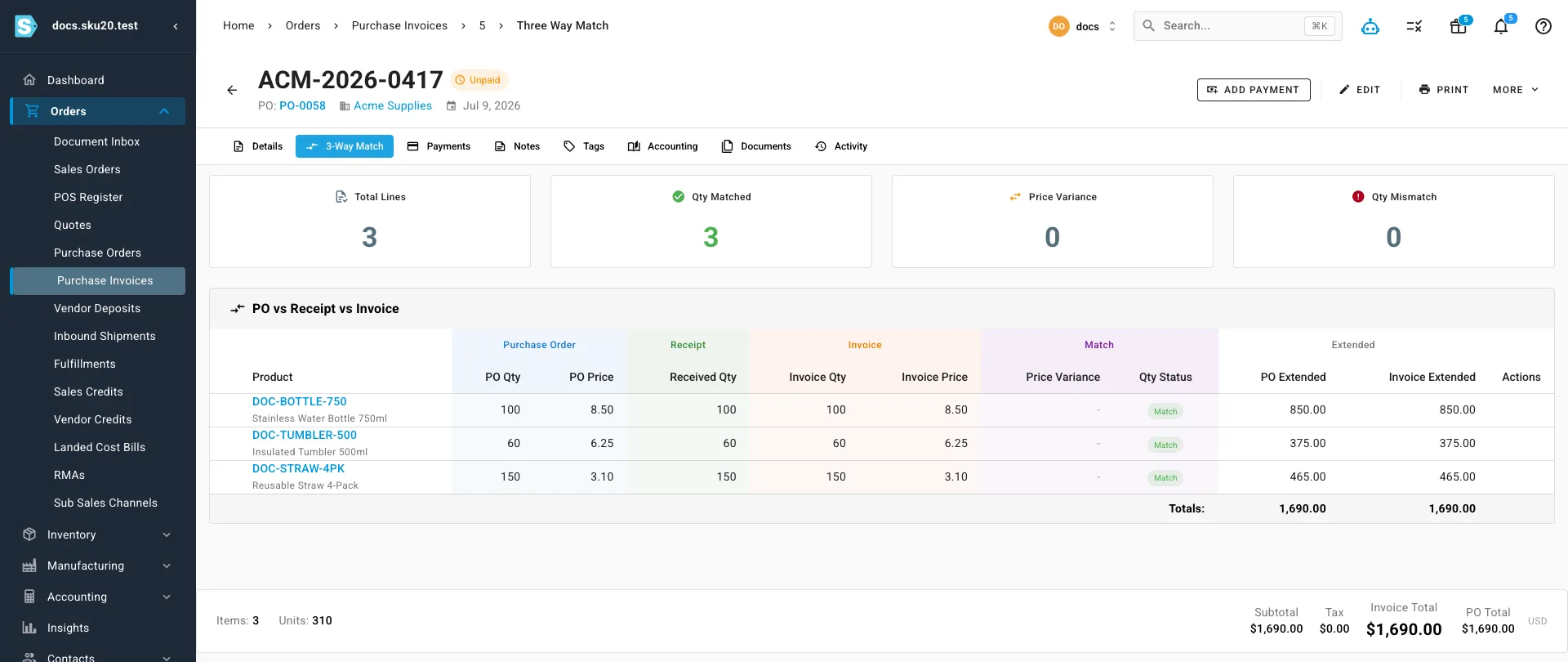
This matters most with the supplier who bills late and all at once. When three months of shipments arrive as one stack of invoices, the match lets you answer “do we really owe this?” one line at a time.
When the bill doesn’t come, or comes as a PDF
Some suppliers don’t invoice until you ask. A couple of the ones I buy from still print their invoices on a dot matrix printer.
Every submitted purchase order still waiting on its invoice sits on an Awaiting Invoices list, with the orders you have already paid a deposit on flagged first. You can select several of one supplier’s orders and send a single request listing them all, from your store’s name, with replies coming back to you.
When the PDF does arrive, you upload it to the supplier invoice. SKU.io reads the header and the line items and runs the three-way match before anything is applied, so you review a list of differences instead of typing the invoice in. It remembers how each supplier’s line descriptions map to your products, so the second invoice from that supplier needs less checking than the first.
Changed bank details are how wires get stolen
Overseas deposits are wires, and the most common way they go wrong is a reply in the email thread with “updated” bank details. When a deposit is ready to pay in SKU.io, the payee’s bank details fill in from the supplier’s saved profile. If they differ, the payment can’t be requested until someone confirms they checked the new details another way, such as a phone call to a number you already have. That fixed my own version of the problem too: the request now comes to me with the PO, the amount and the wire details in one place, and I paste the wire confirmation in when it’s sent.
Who this isn’t for
If your suppliers bill net 30 with no deposits, you don’t need any of this. The bills in QuickBooks Online or Xero already carry a due date.
If you are under about $1M a year and sell on one channel, a prepayment entry in your accounting system and a calendar reminder will do. Look at Zoho Inventory or inFlow when you outgrow spreadsheets for stock.
And if your terms involve letters of credit or supply-chain financing, start with your bank or a financing provider. What I’ve described here tracks deposits and bills you pay yourself.
Where to go from here
The guides show every screen: how vendor deposits work, setting up a payment schedule, the three-way match and recording a supplier invoice. If the question behind your deposits is which supplier deserves the next one, which product deserves your next inventory dollar works it through on cash flow dates. For the rest of purchasing, see purchasing optimization.
Or bring me your supplier’s terms as they actually read, and I will show you the schedule they turn into. Book a demo.
How we checked this page
These are the facts on this page that you can open and check, plus the recorded calls the quotes come from. Prepared by Kalvin Mizzi, founder, SKU.io. Last checked . Each page was loaded on the date shown and the fact read off it. Call quotes were read from the recorded transcript, with speakers anonymized.
| Claim | Source | Plan or version | Checked | How we know |
|---|---|---|---|---|
| SKU.io records a vendor deposit as its own document linked to the purchase order, posts it to Other Current Assets so it never touches FIFO cost or inventory value, and applies it to the supplier's bill automatically when the bill is posted against that order. | sku.io | Released 13 May 2026 | Vendor documented | |
| A payment schedule on a payment term splits it into milestones, each a percentage or fixed amount with a trigger (on PO approval, on first or each shipment or receipt, on full shipment or receipt, on a logistics milestone, on the bill date, or manual) and an offset in days; deposit milestones raise vendor deposits, and one milestone can mark when legal ownership of the goods transfers. | sku.io | — | Vendor documented | |
| The Cash Due Schedule groups supplier obligations into due now, due within 30 days and awaiting trigger. | sku.io | — | Vendor documented | |
| Worked 3-way match example: 100 bottles ordered at $8.50 and received; an invoice at $8.75 is a +$0.25 per unit, +$25.00, +2.9% price variance; an invoice for 105 is a 5-unit, $42.50 over-bill resolved with a vendor credit. Without a receipt the check is a 2-way match. Update PO prices copies invoice prices to the PO and is blocked once the invoice is paid. | sku.io | — | Vendor documented | |
| Uploading a supplier invoice PDF runs OCR on the header and line items, then a three-way match against the purchase order and receipts, and remembers how a supplier's line descriptions map to your products. | sku.io | Released 1 May 2026 | Vendor documented | |
| The Awaiting Invoices worklist lists every submitted purchase order still waiting on its invoice, flags prepaid orders, and sends one consolidated invoice request per supplier. | sku.io | Released 3 July 2026 | Vendor documented | |
| Payee bank details that differ from the supplier's saved profile cannot be paid until someone confirms they verified them out of band; payment proof can be captured and a remittance advice sent to the supplier. | sku.io | Released 2 July 2026 | Vendor documented | |
| Bill due dates derive from the payment term, a payables aging report groups what you owe by supplier into Current, 1-30, 31-60, 61-90 and 90+ day buckets, and the due date flows to Xero and QuickBooks Online. | sku.io | Released 11 July 2026 | Vendor documented | |
| Intuit's help for QuickBooks Online records a supplier prepayment as a cheque to the supplier and applies it as a credit when paying the bill; on a cash basis it is held in an Other Current Asset account and entered on the bill as a negative amount. | quickbooks.intuit.com | QuickBooks Online, UK help article | Vendor documented | |
| Cin7 Core adds a supplier deposit on an authorized purchase order with an amount, payment date and bank account, holds it in a current asset account, and lets it be used as payment on later purchases from that supplier. | help.core.cin7.com | Article updated 15 October 2026 | Vendor documented | |
| Settle's procurement page says you can pay vendors upfront and reconcile automatically later, and compare what you ordered, received and billed before payments go out. | settle.com | — | Vendor documented | |
| Alibaba's seller blog calls 30% before production and 70% after inspection, before shipment, the most common payment structure for apparel orders between $5,000 and $50,000. | seller.alibaba.com | — | Vendor documented | |
| Quotes from three recorded calls: a founder buying from one overseas manufacturer on 20/40/40 terms (April 2026), a private-label Amazon seller tracking 30% deposits and 70% balances in a spreadsheet (February 2025), and a consumer-brand founder paying 50% in advance (November 2021). | Recorded sales calls (internal archive) | — | Recorded call |