
HTS Codes and Duty Rates on Every Purchase Order Line
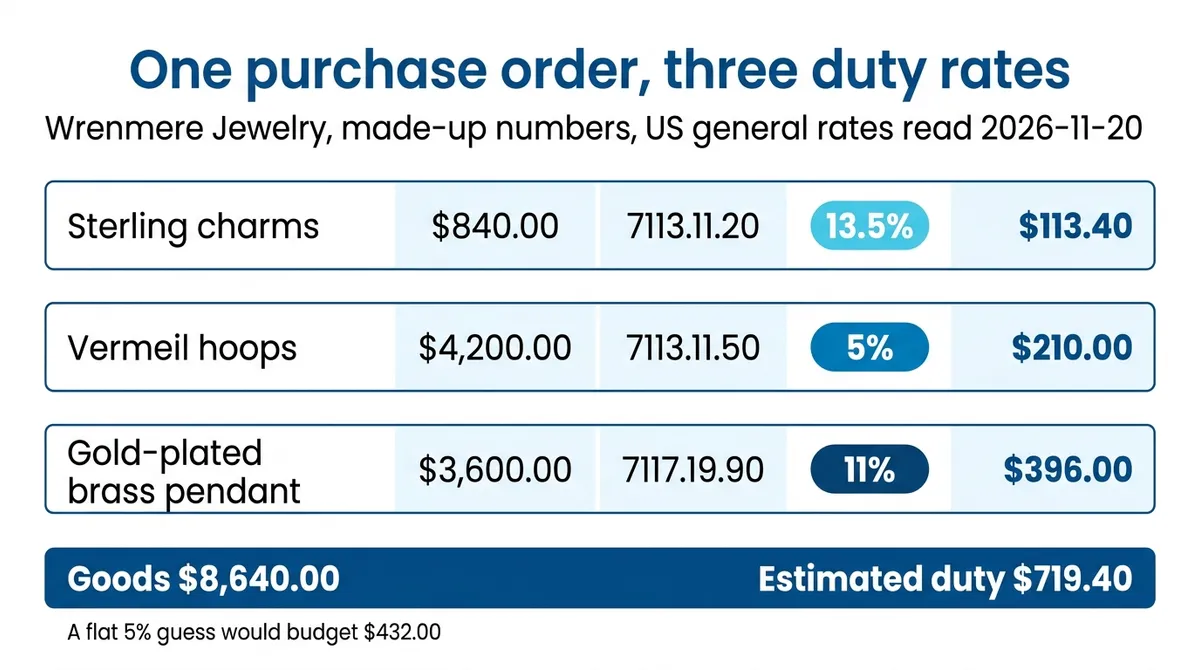
The HTS code and the duty rate belong on the purchase order line, beside the quantity and the price, because that’s the last point where you can still change the supplier, the origin or the price. For silver jewelry the price can even decide the code: under the US general rates, a sterling charm worth $18 a dozen or less pays 13.5%, and one worth more pays 5%. One average duty figure kept in a spreadsheet next to the PO can’t hold that.
This is part of costing, duty and margin for jewelry brands.
Duty that isn’t on the order gets forgotten
In March 2025, with the new tariffs pushing costs up, I went back through a shipment for my other company. I’d added the inbound freight to the order and forgotten the customs fees, and the products on it were showing more margin than they had any right to. Once the customs invoice went onto the order, every sale already taken from that stock got its cost corrected, and the margin dropped back to what it really was.
Nothing was wrong with the arithmetic. The duty just wasn’t anywhere I’d see it while I was looking at the order. That’s the case for the PO line: if the code and the rate sit on the line, a missing duty shows up as a blank before the goods ship, not as a margin that looks too good months later.
An accounting consultant who works with importers gave me the standard in his own words: “for every product, you have the customs code for every product. And then when you get your customs invoice, when you receive it, you allocate all the tariffs appropriately.” Most brands have the second half. The code per product is the part they skip.
Jewelry makes it worse
Jewelry sits in chapter 71 of the Harmonized Tariff Schedule, and the lines that matter to a brand selling on Shopify and to boutiques are close together but priced far apart. These are the general rates on hts.usitc.gov in November 2026:
| Line | What it covers | General rate |
|---|---|---|
| 7113.11.10 | Silver rope, curb, cable, chain and similar articles in continuous lengths, suitable for making jewelry | 6.3% |
| 7113.11.20 | Other silver jewelry, valued not over $18 per dozen pieces or parts | 13.5% |
| 7113.11.50 | Other silver jewelry | 5% |
| 7113.19.50 | Other precious-metal jewelry, which takes in most gold rings and earrings | 5.5% |
| 7117.19.90 | Imitation jewelry of base metal, plated or not, other | 11% |
Some trade-agreement origins enter free. Additional duties for some countries stack on top, so for those origins the general rate is the floor, not the bill. Rates also change. Treat the table as the reason the code matters, and get each product’s code from your broker.
Three things in it catch brands out. Vermeil is sterling silver plated with gold, so it normally stays in the silver lines, while gold-plated brass looks the same in a photo and is imitation jewelry at 11%. Chain in continuous lengths, bought to make jewelry from, has its own line. And the silver split runs on value per dozen pieces, so price changes the code. Customs value is usually the invoice price, but packing and some other charges can be added to it, which is another question for the broker.
One order, three rates
Made-up numbers for a fictional brand, Wrenmere Jewelry, on one order with a US warehouse, buyer clearing import:
| Line | Units | Unit cost | Line value | Code | Rate | Est. duty |
|---|---|---|---|---|---|---|
| Sterling charms | 600 | $1.40 | $840.00 | 7113.11.20 | 13.5% | $113.40 |
| Vermeil hoops | 300 | $14.00 | $4,200.00 | 7113.11.50 | 5% | $210.00 |
| Gold-plated brass pendant | 400 | $9.00 | $3,600.00 | 7117.19.90 | 11% | $396.00 |
| Total | $8,640.00 | $719.40 |
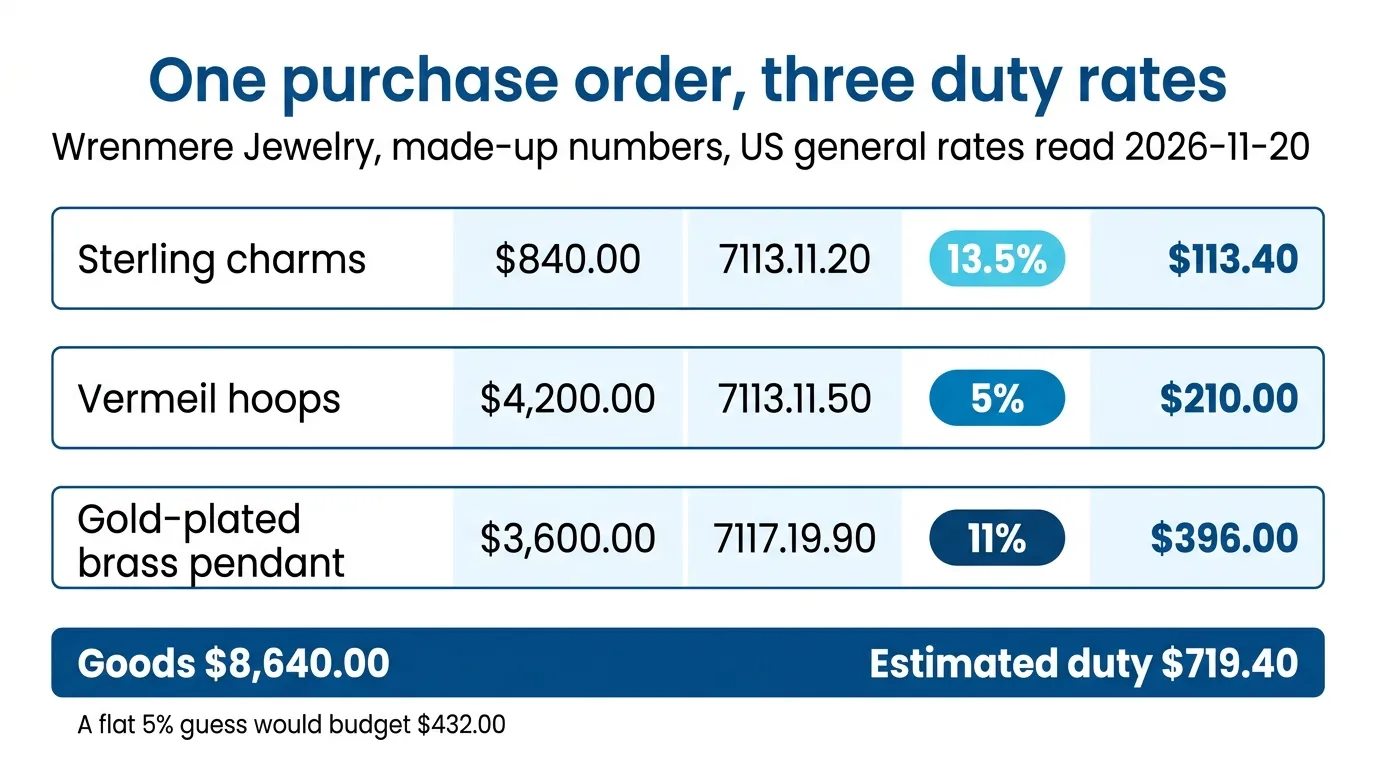
$719.40 is 8.3% of the goods. Plan on a flat 5% for “jewelry” and you’d have budgeted $432.00, short by $287.40. The pendant makes $216.00 of that gap and the charms $71.40.
Now the charm supplier raises the price from $1.40 to $1.55. That’s $18.60 a dozen, so the charms move to the 5% line. The goods go up $90.00 to $930.00, the duty falls from $113.40 to $46.50, and the line costs $23.10 more in all. Nothing reclassifies the charm by itself when its price crosses $18 a dozen, at least not in SKU.io. Someone has to change the code. The order is the one place the new price and the old code sit side by side, which is why I’d want the code on the line where I’ll see it.
Entry fees and any additional duty for the origin are left out of all of this, and they only push the totals up.
Where SKU.io puts the code
A jewelry catalog shares a handful of codes, so the code goes on the product type. Each product type carries a default HTS code and a default country of origin, and a product with no code of its own inherits them. A product’s own code wins, which is what a cheap charm needs. The type sets the code, not a percentage: the rate follows from the code, the origin and the destination through the duty rates you keep. I’d build product types the way customs sees the piece. “Vermeil”, “Gold-plated brass” and “Solid 14k” are types. “Earrings” is a collection.
Each PO line can show its HTS code and Duty % next to the estimated duty, and a line with no code says so instead of adding nothing to the total. The PO PDF prints a line like “HTS 7113.11.50 · Duty 5%” under each line’s description, which I like more than it sounds: the supplier sees the code you planned on before writing the commercial invoice, so a disagreement comes up while the order is still open. The rest is in estimate duty on purchase orders and shipments, including changing the origin for one order and what DDP orders show.
From the purchase order the estimate follows the goods to the inbound shipment and is fixed at receipt. Whether it goes into the stock’s cost then or waits for the broker’s bill is one setting, off by default. I’d turn it on from the first order, though plenty of accountants prefer to keep estimates out of the books. How the duty is then split across lines is in the landed cost guide.
If your supplier ships DDP or you buy finished pieces from a domestic wholesaler, you aren’t the importer and none of this is yours to estimate. If you make every piece yourself and sell under $1M a year on one channel, Craftybase, Zoho Inventory or inFlow will do. A jewelry store with repairs, appraisals and a point of sale needs store software. If you import from more than one country, book a demo and bring one purchase order with the codes your broker gave you.