
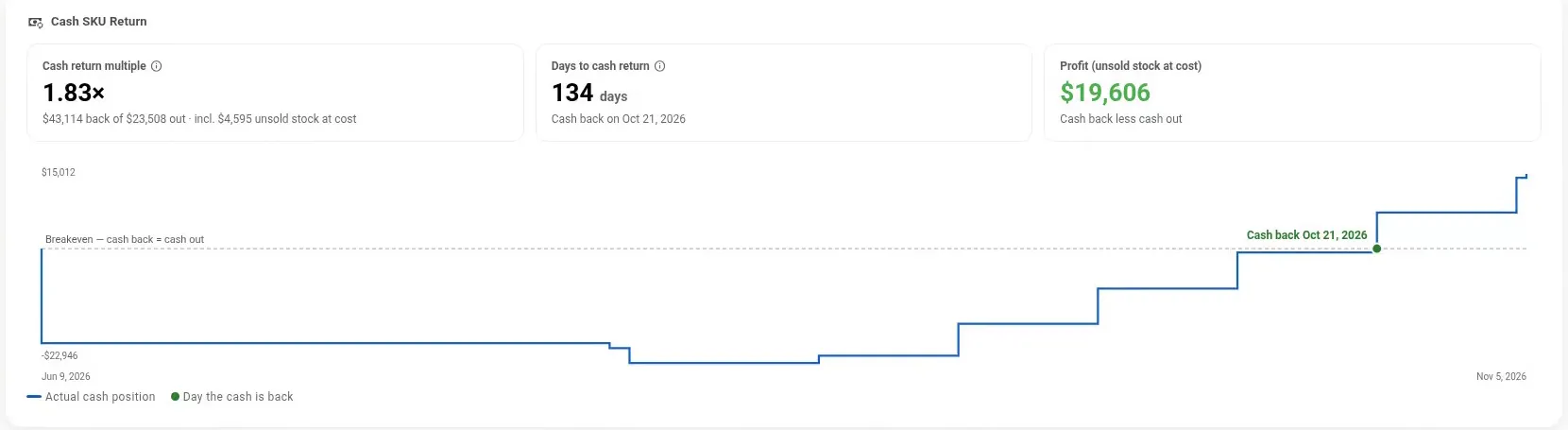
Amazon tells you how many units are in AWD. It doesn’t tell you what they cost, and it never says which purchase order a sale came from. To keep batch cost you need a record outside Amazon that follows each unit through the chain. On the fictional order below, a water bottle reaches AWD at $8.86 and FBA at $9.24, and the order returns 1.83x its cash, with the cash back in full after 134 days.
I found this out in my own business. In late 2025 my purchaser started sending goods to AWD from Seller Central, and SKU.io had no AWD support, so as far as my own software knew the stock had never moved. When a customer brought up AWD that December I had to tell her: “My purchaser just started sending goods to AWD and she didn’t tell me.” The stock would stay on our books and show up again in FBA. “So then we have 200 units in our evaluation, but we only have 100 in reality.” I said what I thought that was doing to us on the call: “we’re paying more taxes because inventory is higher, our cogs is lower, and our profits higher, even though it’s not.”
So we built it, first for me and then for the customers who’d been asking. A year on we’ve been through most of the ways this breaks, and some of them were ours. This page goes through them, with a 12-minute video that follows one order all the way.
Which should you choose?
- Stay on a spreadsheet if you place a few orders a year through AWD and one person owns the file. One row per receipt will do.
- Use a settlement tool if all you need is Amazon payouts posted cleanly to your books. Link My Books, for one, says it isn’t a warehouse inventory management platform, so expect your batch costing to live somewhere else.
- Choose SKU.io if you’re past about $1M, most of your stock goes through AWD, and you need each batch’s landed cost at AWD, at FBA and on the sale, with a dated cash return per order.
- Look at Zoho Inventory or inFlow if you’re under about $1M on one channel. We’re more system than you need.
- Not for you if you want one system to replace your accounting. SKU.io pushes transactions to QuickBooks or Xero, and bank reconciliation stays there.
The walkthrough
The brand is invented. Brightwater, its numbers and its supplier don’t exist, and the narrator is an AI voice. The screens are the real product, on a demo account.
Each section below is a chapter of the video, with what to look for and the transcript, lightly edited for reading.
The scenario (0:00)
One purchase order for 2,500 bottles, bought as 500 boxes of five. A 40% deposit goes out when the order is placed and the balance goes out just before it ships. The whole order lands in AWD, then AWD feeds FBA in about 100 small shipments over four months.
Transcript of this chapter
This is an Amazon seller that buys wholesale from an overseas supplier. Most of that stock goes first into Amazon Warehousing and Distribution, AWD. AWD then feeds FBA in small replenishment shipments, week after week. Spreadsheets lose the thread somewhere between the deposit and the last sale. So we will follow one purchase order all the way through.
It is 2,500 units of the Brightwater insulated water bottle, 32-ounce, in slate. Here is the story in five parts. First, one unit’s cost at every step, from supplier to customer. Second, the 100 shipments from AWD to FBA. Third, Amazon fees and an invoice that shows up late. Fourth, how many times the cash came back, and how fast.
And fifth, letting an AI assistant take on some of this work.
One unit, from purchase order to sale (1:03)
The cost starts on the purchase order and stays on the batch. A box is not a separate object: each line holds a box count and units per box, and quantity is always in units.
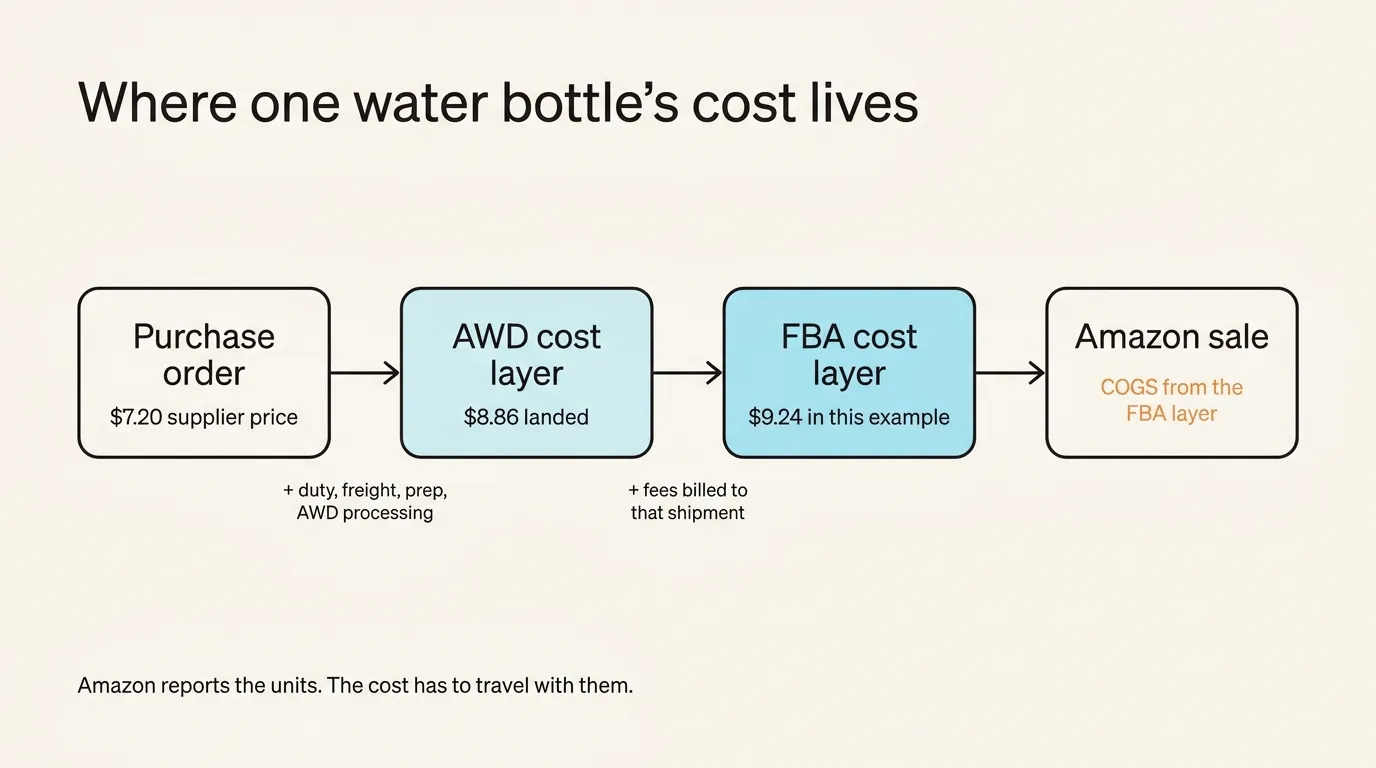
| Step | Per unit | What's in it |
|---|---|---|
| Supplier price | $7.20 | The purchase order line |
| Duty | $0.52 | Customs broker's bill |
| Freight | $0.66 | Forwarder's bill |
| Prep | $0.40 | Prep center's bill |
| AWD processing | $0.085 | Amazon's fee, matched from the settlement |
| Landed in AWD | $8.86 | The AWD cost layer |
| Fees billed to the FBA shipment | About $0.38 | Placement and partnered carrier on this fictional shipment |
| Landed in FBA | $9.24 | The FBA cost layer the sale draws from |
Lines are rounded, so they add to a cent more than the layer. And don’t copy that $0.38 into your own model. I left it in because it shows what happens when a fee names a shipment, but Amazon’s AWD page says “AWD pricing covers FBA inbound placement, so there is no separate charge for this service,” and the fees it does charge on replenishment reference no inbound shipment, so they stay expenses. On a plain auto-replenishment your FBA cost should match your AWD cost. I go through it in what happens to your cost when AWD sends units to FBA.
Transcript of this chapter
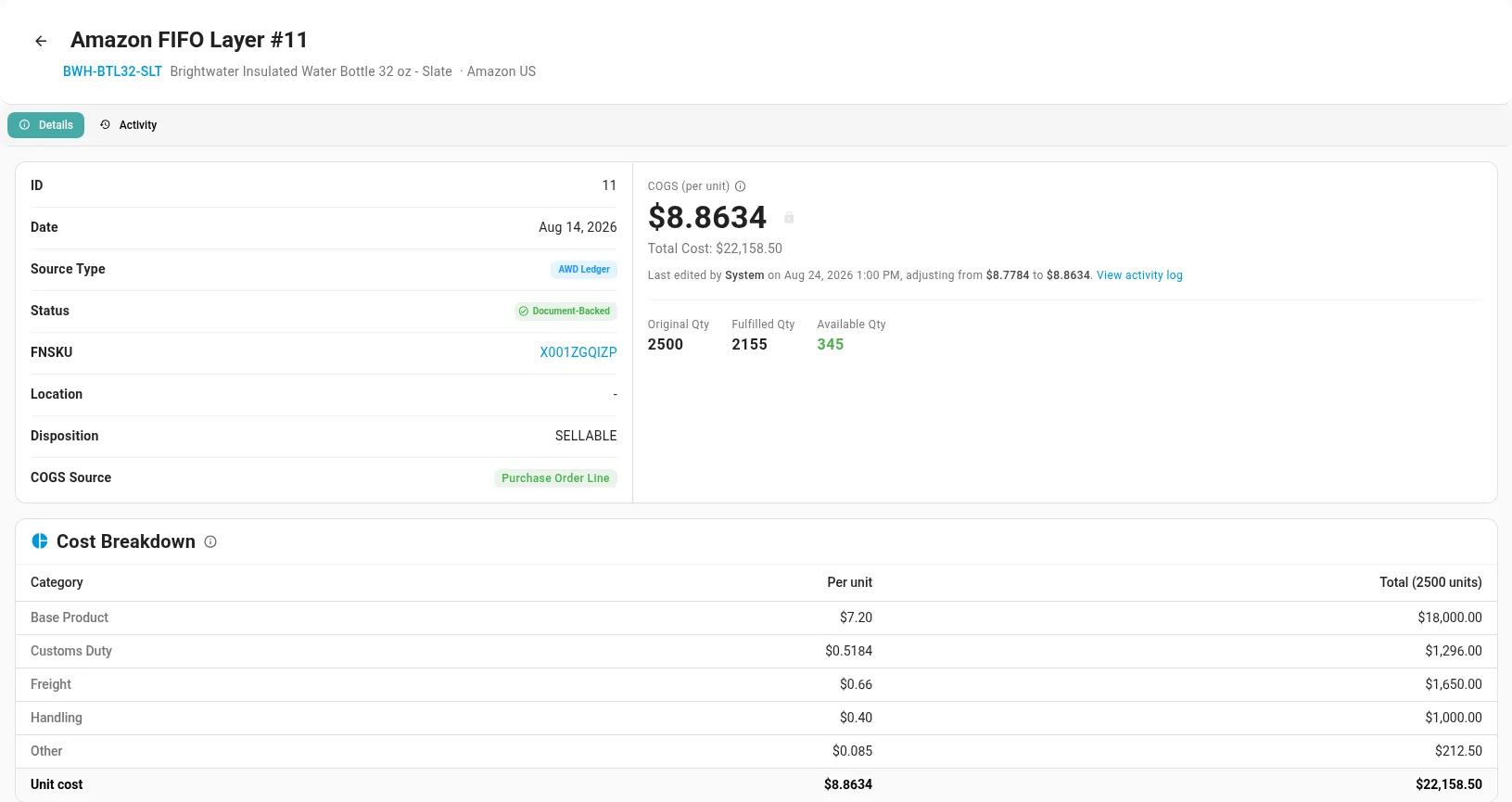
This is the purchase order. The line reads 500 boxes of five, which is 2,500 units. Quantity is always units; boxes are simply how the supplier and Amazon count stock. The supplier price is $7.20 a unit. Open the unit cost, and you see what each unit really cost on arrival. The supplier price comes first, $7.20.
Then each landed cost bill has its own line. Freight, prep, duty and Amazon’s AWD fee. Together they add $1.66, which brings the unit to $8.86. The bills themselves sit on the order. Freight from the forwarder, prep from the prep center, and duty from the customs broker. Amazon’s AWD processing fee arrived through the settlement and landed here by itself.
You can split a bill by cost, volume, weight, quantity or estimated duty. The cash went out in two steps. A 40% deposit on the day the order was placed. Then the balance, just before the goods shipped. Both payments carry their real dates, and that matters for cash return later. The whole order went to AWD as one inbound shipment of 500 boxes.
Amazon reported it received, matched to this purchase order. From here on, every unit carries the cost of this one order. When stock arrives, SKU.io records it as a cost layer. This layer is the stock that arrived at AWD. Its cost breakdown splits that into product, freight, customs duty and handling for the prep. Other is Amazon’s AWD processing fee, matched from the settlement.
Every unit in the layer carries exactly this cost: $8.86. As AWD ships units to FBA, each replenishment shipment draws its units from this layer. The usages list every one of those departures, all at the same unit cost. The layer empties out, shipment by shipment, until it is gone. Here is one of those FBA layers. It starts from the AWD cost, then adds the fees billed to that shipment.
Those fees come from Amazon’s settlement, matched to the shipment they were billed to. So the FBA cost is the AWD cost plus the transfer fees. Here that comes to $9.24 a unit. On auto-replenishment, Amazon says AWD pricing covers inbound placement, so you may see no fee at all, and the two costs match. Then a customer buys one on Amazon. The order’s profit tab shows the unit’s revenue, Amazon fees and cost, side by side. Expand the line, and it names the exact cost layer behind that unit.
That is one unit, traced from the supplier’s invoice to a customer’s doorstep.
From AWD to FBA, shipment by shipment (4:11)
Each replenishment is its own record of shipped, received and short, and in the video three arrive short and four are still in transit. Shipments refresh every 15 minutes, settlements hourly, and departures are matched once a day.
This chapter looks calm and it’s the one that took the longest. In January 2026 the AWD ledger was a file customers downloaded and uploaded by hand. I told them “there’s no API for that,” and someone on the call asked the obvious thing: “are we going to do this every month or what is the plan?” Amazon’s file has no unique ID on its lines, so we had to fingerprint whole files to stop the same rows landing twice. A scheduled sync pulls it now and the upload is the fallback.
That still doesn’t close it. Amazon describes one trip out of AWD with two unrelated IDs, and on one customer’s account in October 2026 the ledger stopped listing outbound orders altogether. Those units wait on a list until someone picks where they went. Before you trust any system with this, ask it these six questions, ours included.
Transcript of this chapter
Now the middle of the story, where most of the work hides. AWD replenished FBA in about 100 small shipments over four months. Each one shows what was expected and what Amazon received. SKU.io checks Amazon for new AWD and FBA shipments every 15 minutes. Settlements come in hourly, and AWD departures are matched once a day. If you want it now, refresh from Amazon yourself.
On the inbound shipment itself, Amazon counts in boxes as well as units. 500 boxes expected, 500 received, nothing pending. The last sync time shows exactly how fresh the numbers are. Across all 100 replenishment shipments, this one view lines up shipped, received and short. Most arrived complete. Three arrived short, and four are still in transit.
Short units stay on the books until Amazon finds the stock or pays for it. Here Amazon reimbursed one short shipment, $64.25. That payment counts as cash back on the original purchase order. Sometimes Amazon moves stock out of AWD without saying where it went. Those departures land here, unattributed. Here two shipments match exactly, so SKU.io asks instead of guessing.
Pick the FBA shipment each one fed, and its cost follows the units exactly. One click, and the departure drops off this list with its cost attached.
Amazon fees and late invoices (5:51)
A fee that names its inbound shipment on the settlement line joins the batch by itself, and one that doesn’t stays an expense. Last year I was telling a customer to leave AGL costs out of COGS, because that’s all the software could do. Here’s the table, fee by fee, including AWD storage, which Amazon gives us no API report for.
Then the $1,000 freight bill that shows up late: $821.20 for sold units, $178.80 for stock on hand, 40 cents a unit. When we recorded this on November 4th, late bills on AWD stock skipped review entirely, and we fixed that the same day. You can restate or book it going forward. SKU.io won’t load it all onto remaining stock, and here’s why.
Transcript of this chapter
Amazon charges to move stock: freight and duty, AWD processing, placement and carrier fees. SKU.io reads those fees from the settlement report. When a fee names its shipment, SKU.io adds it to that batch’s cost by itself. The status tells you what happened. Created new bill means SKU.io found the shipment and booked the fee by itself. The link beside it opens that exact FBA shipment.
If it cannot match one, the fee waits in this column as awaiting a manual bill. Fees that name no shipment never get a link here. They are booked as Amazon fees, not batch cost, so nothing is counted twice. Now the hard case: the freight invoice that arrives after most units have sold. Enter it like any landed cost bill, straight from this purchase order. Before anything is applied, SKU.io shows you exactly where the money goes.
Pick the carrier, and add its invoice number. Describe the charge, and enter $1,000. File it under the freight category, so it lands in the batch as freight. The preview shows how the bill will be split across the order. Save it, and SKU.io checks your rule before it touches any cost. Your rule says landed cost bills wait for review, so SKU.io holds this one.
Open it, and the split is right there. The review shows the total, and where every dollar lands. $821.20 belongs to units that already sold. $178.80 belongs to stock still on hand. Every unit gets its true share: 40 cents each, across all 104 layers. Then you choose how to book it.
Restate puts each sold unit’s share back in the month it shipped. Prior periods are corrected, and every change is recorded. The impact tree shows the same bill, one cost layer at a time. Pick a layer, and you see its old and new unit cost. Every Amazon order that drew from it is listed, with its share of the bill. Under restate, each share lands in the month those units shipped.
Going forward still gives every single unit its true share of the bill. But the sold units’ share posts as one catch-up line this month. Closed months stay exactly as they were. It is what people usually mean by putting the bill on remaining stock. Loading it all onto stock on hand would cost about $2.24 a unit, not 40 cents. Their margins would look worse, and inventory would be overstated.
Here we choose going forward, apply it, and confirm the change. SKU.io re-costs every layer, sold and unsold, in a few seconds. Or set a rule once, per type of cost change. Restate while the grace window is open, then book later bills going forward. For most sellers, that rule is the right default. One more thing.
None of these choices changes the cash return on the purchase order. It counts cash, and the freight left the bank on the same date either way. Only the month the profit lands in moves.
Cash return on the purchase order (9:22)
On November 4th this order read 0 units sold and 1.00x, because our trace dropped every unit Amazon had moved under its own reference. Fixed, it reads 1.83x, with the cash back in 134 days. That’s on Amazon payouts, with unsold stock at cost. Our own IRR Analytics screen reads the same order at 2.86x because it ranks on revenue. Amazon pools a product’s units, so SKU.io attributes sales first in, first out, like cost of goods, and you can’t change that today. More in how many times did this purchase order pay you back.
Transcript of this chapter
Now the question that matters most. How many times did the cash in this order come back, and how fast? The cash flow tab answers both, under Cash SKU Return. The cash return multiple is 1.83x. The cash came back in full after 134 days. The chart marks the exact day the cash was back in full.
Where did the units go? 1,994 sold, 496 still owned, a handful lost. Unsold stock counts at cost, so the multiple never assumes sales that have not happened. Every dollar out and back has a date. Deposit, balance, freight and duty go out. Amazon payouts come back as each settlement is paid.
Amazon pools a product’s units, so it never names the batch behind a sale. SKU.io attributes each sale first in, first out, like its cost of goods. Before the next order, switch to forecast. Enter when you pay, how long production and transit take, and sales per day. Add the payout per unit and how long Amazon holds the money. SKU.io fills these in from this order’s history, so you start from real numbers.
Adjust any of them, and save the forecast with the order. Out comes a projected cash return multiple and projected days to cash return. Change sales per day or the payout per unit, and the projection moves with it. That is the number to decide on before you send the deposit. Across every purchase order, IRR Analytics ranks suppliers and products. Switch off realized only to include orders that are still selling.
Sort by multiple or by days to see where your cash works hardest. This is the list to read before the next reorder.
Ask an AI assistant (11:19)
The MCP server is at mcp.sku.io/mcp. Each person connects as themselves, writes are off until someone turns them on, and every call is logged. Nothing connected this way can delete, void, cancel or make a payment. An assistant can draft a supplier deposit, and a person pays it. For anything that runs every day, I’d still use the API or agent skills over MCP.
Transcript of this chapter
Everything you just saw is also available to an AI assistant, through our MCP server. Copy the URL into Claude, ChatGPT or Cursor, and sign in with OAuth. Each person connects as themselves, and sees only what their role allows. There are 39 tools, and most of them look things up. Assistants can look things up by default. Turn on changes only when you want them to write.
Even then, nothing can be deleted, voided or canceled through an assistant. Every call is logged: who asked, which app, which tool, and what it touched. Ask it to record a receipt, a landed cost bill or a supplier deposit. Then check its work here, line by line. One purchase order, followed from the first deposit to the last payout. Every unit’s cost, every shipment and every fee on the record.
That is SKU.io for Amazon sellers who ship through AWD. To see it with your own products, book a call.
What it doesn’t do
AWD storage per product isn’t automatic, because Amazon offers no API report for it. SKU.io opens a recovery case when a shipment closes short, but you file the claim in Seller Central. FIFO is the only attribution rule. And it isn’t full accounting software: it doesn’t handle overhead like rent or payroll, and your bank reconciliation stays in QuickBooks or Xero.
If you also sell on Shopify, the Shopify and Amazon FBA page covers the wider problem of Amazon’s ledger and summary disagreeing.
If most of your stock goes through AWD, book a demo and bring one real purchase order. You’ll talk to me.
How we checked this page
This lists the facts on this page about other companies, and the facts about SKU.io you can open and check yourself. The Brightwater order is invented. Prepared by Kalvin Mizzi, founder, SKU.io. Last checked . Pages were loaded on the date shown and the quoted text was read off the page. Worked numbers come from a fictional demo account.
| Claim | Source | Plan or version | Checked | How we know |
|---|---|---|---|---|
| Amazon states that AWD pricing covers FBA inbound placement, with no separate charge. | sell.amazon.com | US, read off the page | Vendor documented | |
| Link My Books says it is not a warehouse inventory management platform. | linkmybooks.com | Post dated 3 July 2026 | Vendor documented | |
| AWD stock carries FIFO cost layers, and units reach FBA at the AWD cost they left with, plus their share of bills on that transfer. | sku.io | — | Vendor documented | |
| Departures Amazon doesn't tie to a destination wait for a person, and a warehouse is never chosen automatically. | sku.io | — | Vendor documented | |
| A fee line that names an inbound shipment becomes a landed cost bill, and one that doesn't posts as an expense. | sku.io | — | Vendor documented | |
| Amazon offers no API report for AWD fees, so per-product AWD storage is a file import or a script. | sku.io | — | Vendor documented | |
| A late cost can be restated or booked going forward, and a rule can hold it for review. | sku.io | — | Vendor documented |