
I’m Kalvin, the founder of SKU.io. I built our own ERP for my e-commerce business in 2008 and ran on it for eleven years. Today I run my own store on SKU.io, and part of what we sell goes to Amazon FBA through a 3PL. At $5M the ERP question is really a question about your general ledger: whether it lives inside the system that runs your stock, or beside it.
Which should you choose?
- Choose NetSuite if you have more than one legal entity to consolidate, an accounting team that works in the ledger all day, or a board or lender that wants one vendor for finance and operations. Budget for an implementation partner too, because that is part of the purchase.
- Business Central or Odoo fit if you want your accounting inside the same system as your inventory, you have a partner you trust, and most of your sales come through Shopify and wholesale rather than marketplaces.
- An operations platform beside QuickBooks or Xero, such as SKU.io, fits $1M–$50M brands selling across Shopify, Amazon FBA, Walmart, TikTok Shop or wholesale, with bundles, 3PLs or more than one warehouse, where the hard problem is the warehouse and the marketplace money.
- Cin7 Core works if your yearly order count fits under its published tier limits and you want a price you can read off a page.
- Under about $1M on one simple channel, don’t buy an ERP yet. Zoho Inventory or inFlow will cost less.
- If QuickBooks or Xero and your store already agree at month end and your close finishes on time, don’t switch anything.
Every price and limit below is in how we checked this page, with the date we loaded it.
Ledger inside, or ledger beside
A brand group on a demo in June 2026 said it was shopping for “a full ERP”. Before I showed anything, I asked what they meant by it:
“…to me a full on ERP is like incorporating payroll and does its own accounting and doesn’t integrate with QBO or Xero. It does its own. So like, are you looking for like full ERP or kind of e-commerce ERP where it just handles like the e-comm part and, you know, still integrates with an accounting software[?]”
Every product on a $5M shortlist lands on one side of that question or the other.
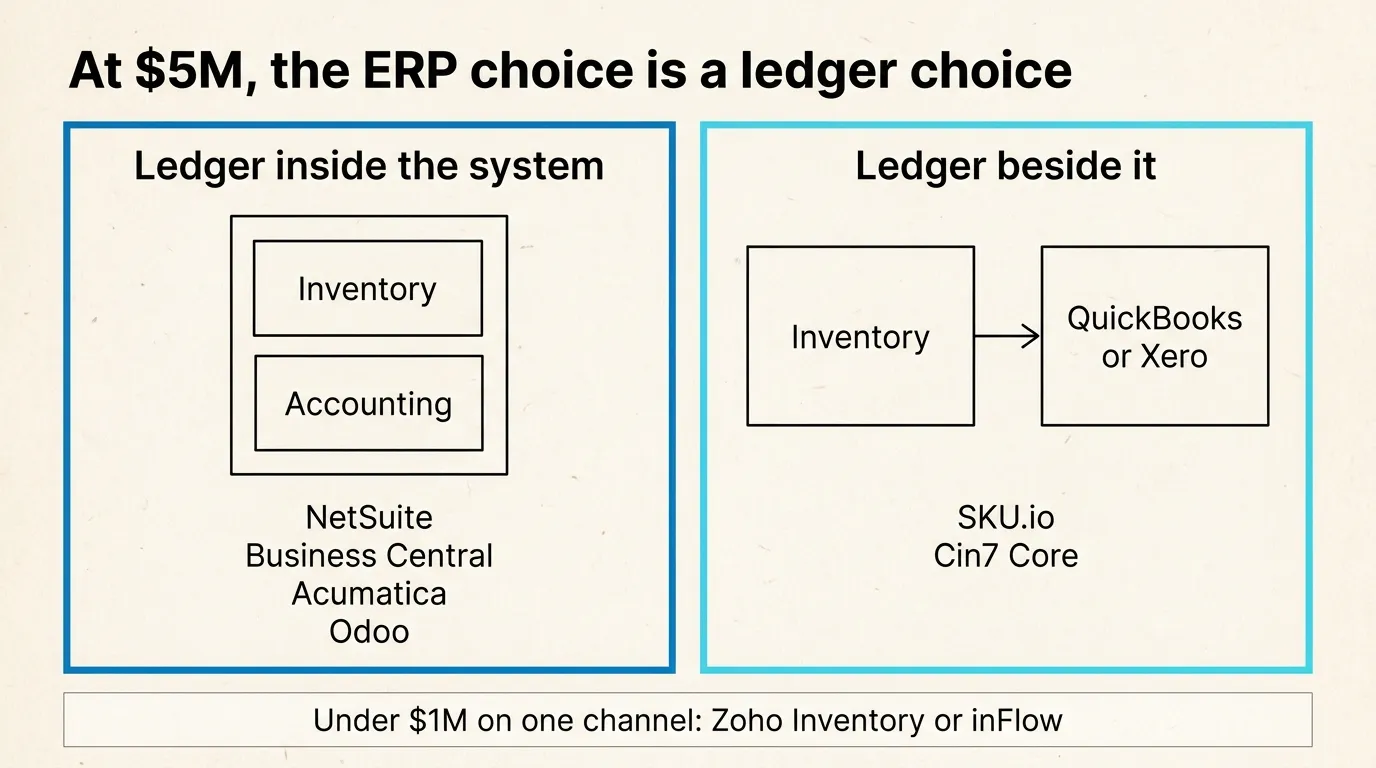
Ledger inside. NetSuite, Business Central, Acumatica and Odoo sell the accounting and the inventory as one product. A receipt, a sale and a journal entry are records in one system, and the accountant works in the same place as the warehouse. One system has to be set up for both jobs, and at this size a partner usually does that setup.
Ledger beside. SKU.io and Cin7 Core run inventory, purchasing and orders, and send the accounting to QuickBooks Online or Xero. Your accountant keeps the books they already know.
The case for the inside pile is that two systems drift apart. I had that drift for years. The system I built didn’t show the same profit as our accounting software, and on a call in December 2025 I said it “drove me crazy.” In my own business we had helmets that looked like a 75% margin until the returns from sizing and colors were counted against them, and two systems that count different things will never agree.
So when I built SKU.io, I had the operations side write the cost, and the accounting software receive it. When an order ships, SKU.io debits cost of goods sold and credits inventory for the cost of the units that left, and that goes to QuickBooks or Xero as a journal. Bills go over as bills and invoices as invoices. Payments and lock dates come back.
A shipping and supply chain lead I spoke with in April 2025 had already backed away from NetSuite and Acumatica as too expensive and “too customizable” for his company’s size. He asked how we’d “fit in with a QuickBooks or a Zoho or a separate accounting package.” I told him I’d like to challenge the thinking on the all-in-one, “because if it’s too all in one, then you’re not going to be like a great software. It’s not going to fill its role very well in each of those categories.” A CFO who wants one database would push back on that, and for a company with several entities they’d be right.
Prices, from each vendor’s own page
Where a vendor publishes nothing, the table says so. Oracle publishes no NetSuite prices, so NetSuite’s figures are from BrokenRubik’s NetSuite pricing guide, a NetSuite implementer, last reviewed October 27, 2026. The ten-user column is my arithmetic from the published per-user prices, not a vendor quote.
| Ledger | Published price | Ten users, per month | Implementation | |
|---|---|---|---|---|
| NetSuite | Inside | None from Oracle. Implementer's guide: ~$999/mo base plus $129–$199 per full user | $2,289–$2,989 before SuiteCommerce | $25,000–$50,000 for 5 to 20 users, 8 to 12 weeks (same guide) |
| Business Central | Inside | Essentials $80, Premium $110 per user/mo, paid yearly | $800 on Essentials | Through a partner; no price published |
| Odoo | Inside | Standard US$31.10–$38.90, Custom US$61.00–$76.20 per user/mo, by billing | $311–$389 on Standard | Not included in any plan; over 50 employees usually use a partner |
| Acumatica | Inside | None. Priced by applications and resources, unlimited users | Quote only | Quote, through a pricing review or a partner |
| Brightpearl | Not on its pricing page | None. Users included | Quote only | Scoped before signing; go-live 90–120 days on average |
| Fulfil | Not on its pricing page | From $4,000/mo, paid annually, priced on order volume | From $4,000 | $10,000–$20,000 one-time, 4 to 8 weeks |
| Cin7 Core | Beside | $349 / $599 / $1,199 per month, with 5 / 10 / 15 users and 6,000 / 24,000 / 120,000 orders a year | $599 on Pro, up to 24,000 orders a year | Group, 1-to-1 or partner-led; no price published |
| SKU.io | Beside | Starting at $1,000/mo; no per-user fees, price moves on order volume and SKU count | From $1,000 | No onboarding fee |
Read down the ten-user column and the suites look cheap. Ten Odoo users cost less a month than SKU.io’s starting price, and Business Central isn’t far off. The money goes into implementation instead. Odoo’s own pricing page lists implementation under “not included”, and Microsoft sends you to a partner for it, so the number to compare is the partner’s quote, which arrives after a scoping project.
Cin7’s entry price misleads in a different way. Its $349 plan covers 6,000 sales orders a year. A $5M brand with a $50 average order ships 100,000 orders a year, and at a $150 average order it’s about 33,000. Both are past Pro’s 24,000, so a $5M brand on Cin7 Core is on Advanced at $1,199 a month or buying more volume.
Implementation
A founder of a supplement brand told me in 2025 that he’d had calls with 10 to 15 vendors and “only maybe like two or three are able to meet most of our capabilities, one of which is NetSuite. But … for us they’re too big and … it’s too expensive.” NetSuite met his requirements and lost on price. BrokenRubik’s guide puts a basic 5-to-20-user NetSuite rollout at $25,000–$50,000, before anything custom.
A partner at a brand shopping Brightpearl the same year told me Brightpearl had warned of a long implementation and suggested they set up Cin7 first and move over later. Brightpearl’s pricing page says go-live takes 90–120 days on average. Fulfil publishes 4 to 8 weeks and a fixed one-time fee. SKU.io charges no onboarding fee, and the whole onboarding path is public.
Why channel mix matters more than revenue
Two $5M brands can need different systems. One sells everything through Shopify and ships from one warehouse. The other splits sales across Shopify, Amazon FBA, Walmart and wholesale, keeps stock at a 3PL and in Amazon, and sells bundles.
The first brand’s hard problems are accounting problems. A ledger-inside suite with a good Shopify connector and a partner who has done it before will serve it well.
The second brand’s hard problems are about where things are and what each marketplace kept. In my own store, before anything goes to FBA I want to know the units are really on the 3PL’s shelf, because building boxes for a shipment that turns out short is a day thrown away. Then the money comes back as one Amazon settlement holding sales, refunds, referral fees, FBA fulfillment fees, storage fees and reimbursements, and each of those belongs in a different account. In SKU.io, Amazon settlements are imported and posted to your books once you map them, and each one shows what happened to the money. In a suite, that job falls to whichever marketplace connector you use.
When QuickBooks or Xero is still enough
A founder said this to me on a call in 2024, about every ERP vendor he’d talked to:
“…just, guys, slow down. I’m not complicated. I have less than 500 skus. I have, you know, one sales channel really that does 95% of my business…”
If that’s you, you don’t need an ERP yet, and you may not need us yet either. Under about $1M on one simple channel, Zoho Inventory or inFlow next to QuickBooks or Xero will do the job for less. The signal to move is usually the second channel, the first bundle, the first 3PL, or the month your store and your books stop agreeing and nobody can say why. ERP vs inventory software goes through those signs one at a time.
When is NetSuite the right answer?
When the ledger is the hard part. If you have several legal entities to consolidate, NetSuite OneWorld reports consolidated data across subsidiaries in the parent’s currency. Add an accounting team that lives in the general ledger, a one-vendor mandate from a board, or auditors who expect a big-firm implementation, and NetSuite belongs on your list. SKU.io doesn’t belong on that one. It doesn’t consolidate entities or run payroll, rent or depreciation, and your books stay in QuickBooks or Xero.
If NetSuite is on your list only for EDI with a retailer, read EDI with SPS Commerce without NetSuite first. It walks through the five documents SPS asks for, none of which need an ERP.
What to bring to each demo
- Your yearly order count, to hold against any tier limit.
- One real Amazon payout from last month. Ask the vendor to show where each fee in it lands in the books. A single “Amazon fees” line, or a spreadsheet, is what month end will look like.
- A request for three numbers in writing: the implementation fee, the go-live date, and the monthly cost in month twelve.
- If the vendor uses a marketplace connector, who wrote it and who you call when it breaks.
Related comparisons
SKU.io vs NetSuite goes line by line, with buyers’ reasons for walking away. NetSuite API vs SKU.io API covers what each charges for API throughput. Odoo vs SKU.io shows where Odoo’s real cost sits. Leaving Cin7 rather than NetSuite? Start with Cin7 alternatives. And if someone on your team wants to build it yourselves, should you build your own ERP? is what happened when I did.
If you want a second opinion on which side of the ledger line you’re on, book a call with me.
How we checked this page
These are the vendor prices and limits on this page, the buyer quotes, and the facts about SKU.io that you can open and check yourself. Prepared by Kalvin Mizzi, founder, SKU.io. Last checked . Each vendor's own pricing page was loaded on the date shown and the figure read off the page. Oracle publishes no NetSuite prices, so NetSuite's figures come from a NetSuite implementer's published guide and are labelled as that firm's numbers. The ten-user monthly totals on the page are our arithmetic from those published per-user prices. Our own facts link to our pricing page and public docs. Buyer quotes are from our recorded sales calls, with names and companies left off.
| Claim | Source | Plan or version | Checked | How we know |
|---|---|---|---|---|
| Oracle does not publish NetSuite prices. A NetSuite implementer's guide puts the base platform at about $999 a month and full users at $129–$199 each a month; it says its license figures are what clients reported paying. | brokenrubik.com | Guide last reviewed 2026-10-27 | Vendor documented | |
| The same guide puts a NetSuite implementation for 5 to 20 users at $25,000–$50,000 over 8 to 12 weeks, from the firm's own project data. | brokenrubik.com | Guide last reviewed 2026-10-27 | Vendor documented | |
| NetSuite OneWorld consolidates data from multiple subsidiaries on many reports, with amounts in the parent subsidiary's base currency. | docs.oracle.com | Consolidated Reporting in OneWorld (NetSuite help) | Vendor documented | |
| Business Central's Essentials plan includes finance management, inventory, purchasing and payables, warehouse management and multiple companies. | microsoft.com | Essentials plan | Vendor documented | |
| Microsoft Dynamics 365 Business Central lists Essentials at $80.00 and Premium at $110.00 per user per month, paid yearly, with Team Members at $8.00, and sends buyers to a partner for consulting and implementation. | microsoft.com | US list prices | Vendor documented | |
| Acumatica publishes no dollar prices. It prices by the applications you implement and the resources your transaction volume needs, advertises unlimited users, and quotes through a pricing review or a partner. | acumatica.com | — | Vendor documented | |
| Odoo's Standard plan lists US$31.10 and US$38.90 per user per month and the Custom plan US$61.00 and US$76.20, depending on billing; implementation services are not included in any plan, and companies over 50 employees usually work with a partner. | odoo.com | Standard and Custom plans, US$ | Vendor documented | |
| Acumatica lists general ledger among the financial management applications connected within its Cloud ERP platform. | acumatica.com | — | Vendor documented | |
| Odoo describes itself as a suite of fully integrated business apps, with Accounting as one app and Inventory ("real-time valuation") as another. | odoo.com | — | Vendor documented | |
| Brightpearl publishes no dollar prices, includes users at no extra charge, and says customers go live in 90–120 days on average. | brightpearl.com | — | Vendor documented | |
| Fulfil's subscription starts from $4,000 a month, paid annually and priced on order volume, with a one-time implementation of $10,000–$20,000 and a go-live of 4 to 8 weeks. | fulfil.io | — | Vendor documented | |
| Cin7 Core lists Standard at $349 a month (5 users, 6,000 sales orders a year, 2 integrations), Pro at $599 (10 users, 24,000 orders, 4 integrations) and Advanced at $1,199 (15 users, 120,000 orders, 6 integrations). Onboarding and professional services are listed without prices. | cin7.com | Prices for new customers, USD, excluding taxes | Vendor documented | |
| Cin7 says it syncs sales, purchases and stock movements into your accounting software, with QuickBooks and Xero among its accounting integrations. | cin7.com | — | Vendor documented | |
| Buyers at this size on why they backed away from NetSuite and Acumatica: too expensive, too large and too customizable for where they were (2025), and NetSuite as one of the two or three vendors out of 10 to 15 that met their needs, but too big and too expensive (2025). | Recorded sales calls (internal archive) | — | Recorded call | |
| A brand partner shopping Brightpearl in 2025 was told the implementation would take a long time and to set up Cin7 first and move over later; a founder in 2024 with under 500 SKUs and one channel doing 95% of sales asked ERP vendors to slow down. | Recorded sales calls (internal archive) | — | Recorded call | |
| Kalvin, on a 2025 call, about the system he built and ran his own store on: he never understood why its profit did not match the accounting software's, because operations software counts margin differently from accounting rules. | Recorded sales calls (internal archive) | — | Recorded call | |
| SKU.io starts at $1,000 a month, with personalized pricing scaled to the business. | sku.io | — | Vendor documented | |
| SKU.io sends the entries it generates to Xero or QuickBooks Online as native invoices, bills, credit notes and journals, including fulfillment COGS, receipts, adjustments and FBA, and reads back payments, edits and lock dates. | sku.io | — | Vendor documented | |
| SKU.io's accounting entries are generated from operational documents: fulfilling a sale debits Cost of Goods Sold and credits Inventory Control for the cost of what shipped. | sku.io | — | Vendor documented | |
| SKU.io imports Amazon settlements, posts them to your books once mapped, and shows what happened to the money in each settlement. | sku.io | — | Vendor documented |