
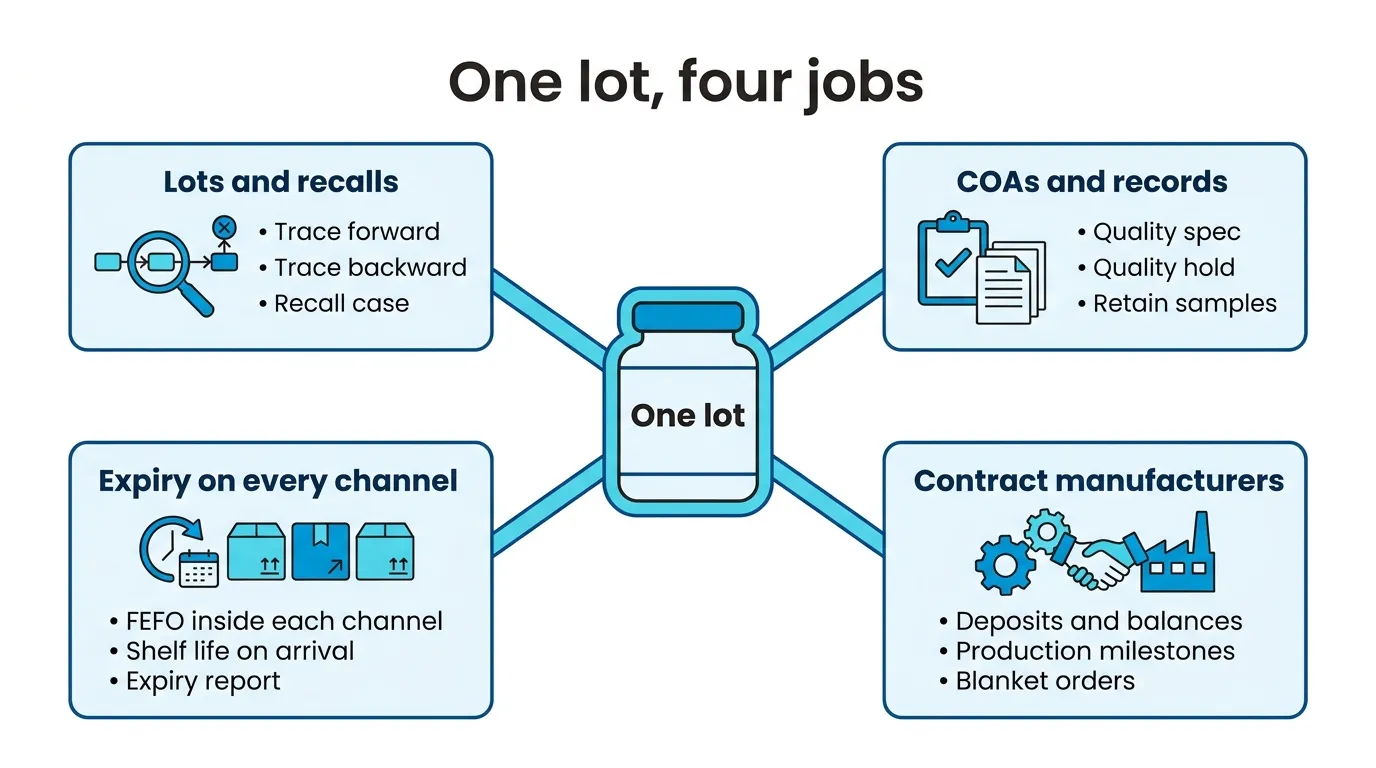
A supplement brand that uses contract manufacturers runs four jobs, and every one of them hangs off the lot number. It traces each lot from the manufacturer to the customers and marketplace warehouses it was shipped to. It keeps the certificate of analysis and the quality records on that lot, and holds stock that fails. It ships the soonest-dated lot first without breaking a marketplace’s expiry rule, such as Amazon’s rule that a supplement must arrive with enough life left for a customer to finish it, plus 90 days. And it buys from the manufacturer on deposits, production dates and blanket orders. Most “supplement software” lists are written for the manufacturer’s plant floor. A brand that doesn’t own the plant needs a different list.
A disclosure first. I founded SKU.io, so weigh what I say about it accordingly. I don’t sell supplements. My other company resells other brands’ products on Amazon and elsewhere, which is where my opinions about expiry dates, prep centers and certificates come from. What follows is what I’d check if I were choosing software for a supplement brand, and where I think SKU.io fits and where it doesn’t. None of it is regulatory advice. Your QA lead or counsel decides what your records have to show. Software keeps them, and it doesn’t make anyone compliant.
Written November 2026. Product behavior is checked against our own user documentation, and vendor facts against each vendor’s own site, linked in “How we checked this page” at the bottom.
Which should you choose?
- Choose SKU.io if a contract manufacturer makes your product, you sell it on your own website and on Amazon (FBA, maybe AWD), and probably on Walmart, TikTok Shop or to retailers too. Your hard problems are which lot went where, what’s about to expire on which channel, and what you’ve paid a manufacturer for that hasn’t arrived.
- Choose a process-manufacturing ERP if you run your own blending, encapsulation or bottling floor. Your hard problems are batch production records, scales, yields and the plant. Wherefour describes itself as discrete and process manufacturing ERP and traceability software, and Katana as one live system for stock, orders and production. Those are built around making the product. SKU.io is built around selling it on many channels.
- Choose Zoho Inventory or inFlow if you sell under about $1M a year on one channel. They’re general inventory apps for small teams, and SKU.io is more system than you need.
- Switching probably isn’t worth it if you have one product, one manufacturer and one channel, and a spreadsheet of lot numbers still answers “who got lot X” in a few minutes.
What makes a supplement brand different
Most brands can treat a product as one thing with one stock count. A supplement brand can’t, because two bottles with the same SKU can have different expiry dates, different test results and different recall exposure. The lot is the real unit. An operations manager at a supplement brand put it this way: “A single purchase order may contain multiple production lot. Each lot may have a … different manufacturing date, expiration date.”
The other difference is that the brand doesn’t own the places its stock sits. The manufacturer makes it. A 3PL ships the website orders. Amazon, Walmart and TikTok Shop ship from their own warehouses, and none of them tells you which lot went in which box. So the lot record has to be built from what you do know: which lots you received, which lots you shipped yourself and to whom, and how many units of each lot you sent to each network. Most of the software that ranks for this topic assumes the opposite, that you run the floor and see every pick.
Four jobs come out of that, and in most brands a different person owns each one. The sections below take them in turn.
Lots, traceability and recalls
This one belongs to whoever answers the phone when something goes wrong. The question is always the same pair. Which customers got this lot? And which manufacturer lot, and which ingredient lots, are behind it?
Answering it starts at receipt, and it’s worth walking one lot through to see where the answer gets thin. Take Northvale Nutrition, a brand I made up. Its capsule manufacturer ships one purchase order carrying three lots, each with its own manufacture and expiry date. Each lot is recorded on the receipt. Over the next two months, lot NV-2210 goes out on 1,100 website orders through the 3PL, 40 cases to two retailers, and 2,000 units on an FBA shipment.
Then a customer reports a problem with a bottle from NV-2210. A forward trace gives you the 1,100 website customers with their email addresses, the two retailers, and the FBA shipment with its 2,000 units. It does not give you the Amazon buyers, because Amazon never says which of its orders took which lot. Those buyers are reached through Amazon. In SKU.io the trace marks any marketplace buyer as a marketplace customer, so nobody fires off an email that can’t arrive. A trace backward goes the other way: NV-2210, the purchase order it came on, and, if you track them, the ingredient lots behind it.
If it does turn into a recall, I’d want it run as a case rather than a spreadsheet: the affected orders saved at the moment it opened, the FDA class, each notice sent and how, units recovered and what happened to them, and who did each of those things. That’s how SKU.io runs one, down to the closing notes. Before you ever need one, time yourself on a drill. If a mock recall on one lot takes a day, plan for the real one to take longer.
Lot tracking defines the terms, and lot tracking with a 3PL covers what happens when the 3PL picks the lot.
COAs, quality holds and GMP records
Every lot from a contract manufacturer should come with a certificate of analysis, and the certificate is the manufacturer’s claim about the lot. The brand’s job is to check it against its own limits, keep it where anyone can find it by batch number, and make sure a lot that fails can’t ship.
The failure I’d design against is the out-of-spec lot that’s already been split across three warehouses before anyone reads the PDF. In SKU.io a product has a quality spec: each analyte, its method and its limit. When you enter a lot’s results, each one is judged against the spec. One result outside its limit and the lot is quarantined automatically, a quality-control hold that keeps its units from being allocated or shipped. A corrected result that passes lifts that hold and only that hold. A lot with a missing result isn’t quarantined, which I think is right: an unfinished data entry isn’t a failed test, and holding stock over one teaches people to stop entering results.
Certificates that belong to the manufacturer, not the lot, are their own problem. A GMP certificate, an NSF registration or an insurance certificate expires on its own date. At my other company, which also sells to business buyers on Amazon, we discovered that a certification for that had already expired, and I had to sign it again so it could be uploaded. I’d want the reminder before the date, not the discovery after it. SKU.io sends them ahead of the date, and treats a missing certificate as a warning, never as a block on a purchase order. I’d rather a buyer see the warning than find a purchase order stuck over paperwork.
Then there are the records an auditor or a marketplace asks for: batch paperwork, label versions, retain samples and where they’ve been. Batch paperwork is filed on the lot, label versions on the product, and a retain sample keeps its retain-until date and every trip it makes to a lab or a marketplace. One search finds them by batch number.
Expiry on every channel
Expiry is where a supplement brand can lose money quietly. Stock doesn’t expire in one place. It expires at the 3PL, in FBA, in AWD, at a Walmart fulfillment center, and each of those has its own idea of how much life a lot needs left.
Shipping the soonest-dated lot first is called FEFO, first expired, first out. It’s the right default, with one catch I’d put ahead of everything else on this page: FEFO across the whole business is wrong. Amazon’s FBA page for expiration-dated products asks for enough shelf life at check-in to cover full consumption plus 90 days: its own example is a 240-serving supplement bottle, which needs 330 days. A table on the same page, marked as a guide only, lists 730 days for herbal or mineral supplements, so find out which one your listing is held to. Walmart won’t receive expiration-dated stock into WFS within 60 days of its date, and TikTok Shop lists 270 days on arrival for vitamins and wellness supplements. A lot with four months left may belong on your website or with a wholesale buyer who accepted the date, not at Amazon. So the rule is FEFO inside each channel, among the lots that channel will accept.
In SKU.io that’s set in two places. Each product has its lot tracking method, its shelf life and its near-expiry alert. Each fulfillment network has a shelf life on arrival that you set to the marketplace’s rule for your product. SKU.io starts FBA at 105 days and AWD at 185. Those are starting points, not Amazon’s numbers, so raise them to what your product needs, and you set WFS, TikTok’s warehouses or a 3PL the same way. A lot too short for a network is left out of its send and stays available for your own orders. The expiry report then shows the value expired and the value at risk in the next 90 days, by lot, for the stock in your own warehouses and your 3PL. The FBA feeds SKU.io reads don’t carry expiry dates, so for FBA the date to check is the one on the lot you send.
FEFO has the definition and a worked example against FIFO.
Contract manufacturers and suppliers
Usually the owner or the buyer runs this. A co-man relationship is a purchasing relationship with three things that ordinary buying doesn’t have: you may pay a deposit before anything is made, the balance falls due before the goods ship, and production slips. The same operations manager described the work of tracking it by hand: PO quantities, “deposits, outstanding balances … production statuses, completion timelines.”
What to look for:
- Payment terms that match the deal. A term split into milestones, say a deposit when the PO is approved and the balance before shipment, so what’s due and when comes from the PO and not from a separate sheet.
- Production milestones with dates you can compare. Production start, completion, shipment and arrival, each with an estimated and an actual date, a late flag, and an alert when a PO runs late.
- Money paid for stock that hasn’t arrived. Deposits and balances paid on goods still in production don’t show as inventory anywhere, and they’re real money. SKU.io’s Open Production report lists every PO line still to arrive, its value, how much deposits have already paid and what you still owe.
- Blanket orders for the year, released by the batch. If you commit to a year’s volume and draw it down in releases, only the released quantity should count as stock on the way. Otherwise every forecast thinks a year of product lands next month.
- A scorecard built from the POs. On-time delivery, fill rate, lead-time reliability and how often a manufacturer’s lots end up on hold, measured from the dates on the purchase orders rather than from memory.
If you supply the raw materials yourself and the manufacturer builds from your stock at their site, that’s an outsourced manufacturing order in SKU.io, part of the optional Manufacturing add-on. If you buy finished bottles, it’s an ordinary purchase order with lots captured at receipt, and you don’t need the add-on.
The cash timing of a split payment is worked through in stock on the water, and matching the bill in supplier deposits and the three-way match. The cost side is covered elsewhere on this site: what landed cost is, Amazon fees in landed cost, vendor deposits, and for AWD, AWD inventory and accounting. Each lot carries its own cost, so on an order you or your 3PL ship, the cost of goods is the cost of the lot that shipped. FBA sales are costed first in, first out, by the date stock was received there.
Questions to ask any vendor in a demo
Bring one of your own lots and ask them to do this on screen:
- Receive one purchase order that carries three lots with different expiry dates. Where does each date live afterwards?
- Trace one lot forward. Which website customers and wholesale accounts got it, how many units went to FBA and when, and how do you reach a marketplace buyer?
- Enter a COA with one result over its limit. Can that lot still be picked for an order?
- Enter a passing retest. Does the hold lift, and does a hold someone placed by hand stay?
- Set a 330-day minimum for FBA. Plan an FBA send when your soonest lot has 200 days left. What gets sent?
- Show what you’ve paid your manufacturer for stock that hasn’t arrived, by PO.
- Open a recall on that lot, log a notice and record units destroyed. Export the record.
Question 5 is the one I’d watch most closely. A lot of systems can store an expiry date. Fewer use it to decide what goes where.
What SKU.io doesn’t do
It isn’t a plant system. It doesn’t run batch production records, weigh-and-dispense, equipment logs or a master manufacturing record on your own floor, and if you blend in-house, a process-manufacturing ERP will serve you better. It doesn’t approve a lot for you: it judges results against the limits you set and holds what fails, but your QA lead releases product. It doesn’t know which lot Amazon, Walmart or TikTok picked for an order, because they don’t say. It knows which lots you sent to each network, how many units and when, and that’s where its trace stops. It doesn’t create the FBA removal for a short-dated lot; it opens Seller Central for you and matches the removal when it comes back. It isn’t your accounting system: it posts to QuickBooks or Xero. And it’s built for brands between about $1M and $50M a year, so a one-product startup will find it more than it needs.
If you run a supplement brand on contract manufacturers and some of this sounds like your week, book a call with me. Bring one lot, its COA and the purchase order it came on.
How we checked this page
This lists the facts on this page that you can open and check yourself, plus the recorded calls the quotes come from. Prepared by Kalvin Mizzi, founder, SKU.io. Last checked . SKU.io behavior was read off our own user documentation on the date shown. Vendor descriptions are from each vendor's own site. Call quotes are from recorded sales calls, unattributed.
| Claim | Source | Plan or version | Checked | How we know |
|---|---|---|---|---|
| Lot tracking is set per product, with FIFO or FEFO, a shelf life that works out the expiry date, a near-expiry alert and a minimum remaining shelf life. | sku.io | — | Vendor documented | |
| Each fulfillment network has a shelf life on arrival you can set; SKU.io's defaults are 105 days for Amazon FBA and 185 for Amazon AWD. Lots that expire sooner aren't sent there and stay available for self-fulfilled orders. | sku.io | — | Vendor documented | |
| The expiry report shows expired value and value at risk within 90 days for dated lots. SKU.io doesn't create an FBA removal itself; it opens Seller Central to create one. | sku.io | — | Vendor documented | |
| Amazon FBA asks for enough remaining shelf life at check-in to consume the product in full plus 90 days (its example: 240 daily servings needs 330 days). A table it calls a guide only lists 730 days for herbal or mineral supplements. | sellercentral.amazon.com | — | Vendor documented | |
| Walmart WFS won't receive expiration-dated items (its examples include food, health and beauty, pet supplements) within 60 days of their expiration or best-by date. | marketplacelearn.walmart.com | — | Vendor documented | |
| TikTok Shop lists 270 days of remaining shelf life on arrival at an FBT warehouse for Vitamins, Minerals & Wellness Supplements. | seller-us.tiktok.com | — | Vendor documented | |
| A forward trace lists the orders and customers a lot reached, marks marketplace buyers as Marketplace customer, and names each FBA shipment, Walmart WFS send or TikTok FBT send that carried it. | sku.io | — | Vendor documented | |
| A recall case keeps the affected orders, the FDA class, notices sent, units recovered and their disposition, with every change logged, and exports to CSV. | sku.io | — | Vendor documented | |
| A product's quality spec lists each analyte, its method and its limit, and COA results are judged against it. | sku.io | — | Vendor documented | |
| A COA result out of spec quarantines the lot automatically; an incomplete result does not; a passing correction releases only the hold the COA placed. | sku.io | — | Vendor documented | |
| Supplier certificates get renewal reminders at 90, 60, 30 and 15 days by default, and a missing or expired certificate never blocks a purchase order. | sku.io | — | Vendor documented | |
| A payment schedule splits a supplier payment term into dated milestones, such as a deposit when the order is placed and the rest when the goods ship. | sku.io | — | Vendor documented | |
| Logistics milestones on purchase orders carry estimated and actual dates, show which are late, and can alert you when a PO runs late. | sku.io | — | Vendor documented | |
| The Open Production report shows each PO line still to arrive, its value, how much paid deposits already cover and what is still owed. | sku.io | — | Vendor documented | |
| On a blanket purchase order, only the quantity on its releases counts as incoming stock. | sku.io | — | Vendor documented | |
| The supplier scorecard measures on-time delivery, lead-time reliability, fill rate and lot quality (units in lots that failed a COA or were quarantined for quality), among others. | sku.io | — | Vendor documented | |
| Manufacturing is one of the two optional add-ons. | sku.io | — | Vendor documented | |
| An outsourced manufacturing order, where a contractor builds from components you own at their site, needs the Manufacturing module. | sku.io | — | Vendor documented | |
| Wherefour describes itself as discrete and process manufacturing ERP and traceability software. | wherefour.com | — | Vendor documented | |
| Katana describes itself as one live system to run stock, orders and production. | katanamrp.com | — | Vendor documented | |
| Quotes from an operations manager at a supplement brand on multiple lots per purchase order and on tracking deposits, balances and production by hand. Filler words are cut and marked with an ellipsis. | Recorded sales calls (internal archive) | — | Recorded call |