
At year end, any stock that will sell for less than it cost has to come down to what it will fetch. A backpack that cost $12.40 and will now clear at $9.00, less $2.85 in fees and postage, is carried at $6.15, and the $6.25 difference is an expense this year. That is an inventory write-down. For FIFO and average-cost stock the rule is the same under US GAAP and IFRS: lower of cost and net realizable value. The two frameworks part ways later, when the price recovers.
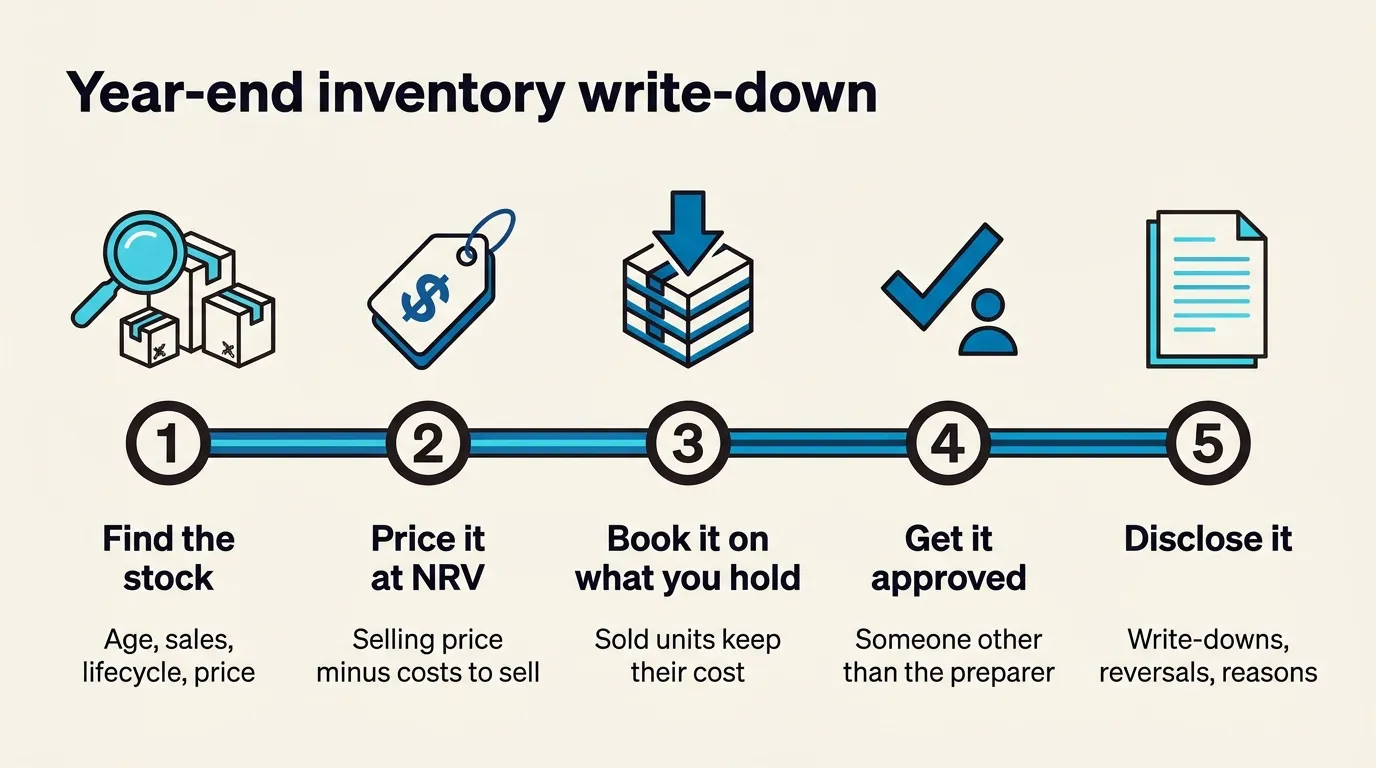
The arithmetic is easy. The hard parts are deciding which stock, pricing it honestly, booking it without rewriting the cost of units you already sold, and leaving a trail your accountant can sign. That’s what this guide covers, with one worked example from start to finish.
I founded SKU.io, so weigh what I say about it accordingly. I also run a second company that sells online, and my own view is that a write-down is the second-best answer. The best one is selling the stock. At one point we found returns from 2021 and 2022 that had never sold. We built an auction step for them, mostly on eBay, and made reviewing the aging report a standing job for the team. Old stock gets auctioned or scrapped before anyone has to argue about what it’s worth, and the auction price is a better answer to that question than anything we’d estimate. What’s left after that is what you write down.
Written November 2026. The accounting rules are checked against the standards and the firms that publish on them, and SKU.io’s behavior against our own user documentation. Both are listed in “How we checked this page” at the bottom. This is not tax or audit advice: your accountant signs off.
Which approach fits you?
- A journal in your accounting software is enough if you write down once a year, a handful of products are involved, and your inventory system doesn’t track cost by purchase layer. Lower inventory, debit a write-down expense, and keep the workpaper.
- Use an inventory system that writes down by FIFO layer if you sell on several channels, cost stock first in, first out, and need the write-down to land on the stock you still hold and in the ledger at the same time. SKU.io does this. So does Microsoft Dynamics 365 Business Central’s revaluation journal.
- Look at Zoho Inventory or inFlow if you sell under about $1M a year on one channel. We’re more system than you need.
- Skip the write-down and sell the stock if the aged stock is small next to your inventory and you can clear it this quarter. The loss shows up in the margin when it sells.
A seven-minute walkthrough of one year-end write-down, start to finish, on a home and gift brand we made up:
Watch on YouTube. Narrated with an AI voice; the brand, its people and its numbers are made up.
Chapters:
- 0:00 A merchant with old stock
- 0:40 Find the stock
- 1:31 Value it at NRV
- 2:38 Preview and journal
- 3:43 Approval
- 4:08 Posting
- 4:26 Sold units keep their cost
- 5:05 Disclosure report
- 5:34 Reversal: US GAAP vs IFRS
- 6:35 Where to start one
- 6:55 Recap
A write-down, a write-off and a recost are three different entries
A write-down lowers the value of units you still have and can still sell, because they’ll sell for less than they cost. The units stay in stock at the lower value.
A write-off removes units that have no value left: broken beyond sale, expired, lost or stolen. Quantity goes down with value. Losses like these have their own accounts, which is the subject of inventory shrinkage accounting.
A recost corrects a cost that was entered wrong, like a freight bill that never got added. It isn’t a judgment about value, and it shouldn’t sit in the same account as one.
The difference matters because an auditor reads the account. A write-down booked as a cost correction is invisible as a write-down. A write-off booked as a write-down leaves units on the books that don’t exist.
The rule: lower of cost and net realizable value
Under US GAAP, inventory costed by FIFO or average cost is carried at the lower of cost and net realizable value. That has been the rule since ASU 2015-11, effective for fiscal years beginning after December 15, 2016 (private companies’ interim periods followed a year later). Inventory on LIFO or the retail inventory method still uses the older lower of cost or market test, with its ceiling and floor. Under IFRS (IAS 2) and Canada’s ASPE (Section 3031) the rule for all inventory is lower of cost and net realisable value.
Net realizable value is the estimated selling price in the ordinary course of business, less the costs to complete and sell it. For a finished-goods seller that means the price you expect to get, minus what you’ll pay to get it sold: marketplace commission, payment fees, outbound shipping, a removal fee if it’s sitting at Amazon.
Two details catch people:
- Item by item is the safe default. IFRS requires it, or groups of similar items, so a product that’s worth more than it cost can’t cover one that’s worth less. US GAAP also allows a major category or total inventory when that most clearly reflects income, but item by item is the most common practice.
- It’s the price you expect, not the price you’d like. A product still listed at $24.99 that hasn’t sold in a year isn’t worth $24.99. An apparel brand owner who keeps her own books put the decision plainly: “So instead of $30, now we value it at $25, and we just ride that.”
Find the stock that’s worth less
Start from evidence, not from a feeling about the warehouse. Four signals do most of the work:
- Age. How long each purchase layer has sat. Our own aging report calls stock slow-moving from 181 days and dead after a year.
- Sales. No sales in a set number of days, or more days of supply than you’ll sell through before the product goes stale.
- Lifecycle. Discontinued or phasing out, especially where a replacement is already listed.
- Price. Anything you’ve already marked down below cost, or a liquidator’s offer.
Age alone misleads. A product with old stock may be selling steadily from its newest layer, and a newer product can be stuck. Weeks of cover vs inventory age is about reading both. And some stock won’t move at any price. A distributor I spoke with has lines where “selling it is not even a matter of price.” There was simply “no demand.” That stock is worth its scrap or auction value, which may be zero.
If you have a policy by age, apply it first and then look at the exceptions. One that follows those buckets would be 0% under 180 days, 25% at 181 to 365, 50% up to two years and 100% beyond. That’s a policy you choose and defend, not a standard, and the exceptions are where it earns its keep: the old layer of a product that’s still selling shouldn’t lose a quarter of its value because of a date. Dead stock: how to clear it without killing margins covers the selling side. Whether to book it as a reserve or lower the cost directly is in obsolete inventory reserve vs write-down.
Work out net realizable value, channel by channel
Take one backpack, discontinued in 2026, closing its year on December 31, 2026 with two purchase layers left:
| Layer | Bought | Units bought | Unit cost | Sold before Dec 31, 2026 | On hand Dec 31, 2026 | Value at cost |
|---|---|---|---|---|---|---|
| 1 | March 2025 | 40 | $12.40 | 10 | 30 | $372.00 |
| 2 | September 2025 | 30 | $11.90 | 0 | 30 | $357.00 |
| 60 | $729.00 |
It will clear on a marketplace at $9.00. The marketplace takes 15% ($1.35) and postage is $1.50 a unit, so net realizable value is $9.00 − $1.35 − $1.50 = $6.15.
| Layer | On hand | Cost | NRV | Write-down |
|---|---|---|---|---|
| 1 | 30 | $12.40 | $6.15 | $187.50 |
| 2 | 30 | $11.90 | $6.15 | $172.50 |
| $360.00 |
Which price you use is the real decision. If the same product sells on your own site at $14 and on a marketplace at $9, NRV comes from where you’ll actually sell the remaining units, not from the best price you’ve ever had. If you’ll split it, split the units. Then write down which price you used and why, in a sentence. That note is the first thing your accountant will ask for. How to calculate net realizable value, channel by channel works through a three-channel example.
Book it on the units you still hold
The entry itself is two lines, dated December 31, 2026:
| Account | Debit | Credit |
|---|---|---|
| Inventory write-downs (expense) | $360.00 | |
| Inventory | $360.00 |
Book it to its own account so it can be found, reported and reversed. Whether it shows on the P&L inside cost of sales or as a line of its own is a presentation choice your accountant makes, and either is easy once the amount sits in its own account. Buried in COGS with no account of its own, it can’t be told apart from a bad month of margins.
Where it goes wrong is the inventory side. Under FIFO your stock isn’t one number, it’s a set of layers, and only the units still on hand at year end get the new cost. The 10 backpacks already sold cost $12.40, and that has to stay true. If your system can only change a layer’s cost for the whole layer, it rewrites the cost of those 10 sold units too, changes the margins of months you’ve already closed, and books part of the loss as a COGS credit instead of a write-down. In QuickBooks Online, a company on moving average cost can now adjust an item’s value directly, but a FIFO company still can’t, and Intuit’s support team has suggested adjusting the original purchase instead. Under FIFO, editing the purchase moves the cost of every unit from that purchase, sold or not.
The workaround I’ve heard most often from sellers is worse: a sales order to “sell” the stock out of the FIFO queue, then a receipt that brings it back at the lower cost. It records revenue and a customer that don’t exist, puts the loss in COGS next to real sales, and resets the stock’s age to today, so next year’s aging report says it’s new.
Two more things to settle before you post:
- Sales after the date. If you post the December 31 write-down in mid-January 2027, the five backpacks you sold on January 5 were on hand at year end. Their cost of goods sold is $6.15, not $12.40. If January is already locked, those sales block the write-down until it’s opened or the date moves.
- The other year-end entries. The write-down comes after the count. Shrinkage and damage go out first, as losses, so you don’t write down units that aren’t there.
The apparel owner described her current year end: “End of the year, what I’ve been doing is just a manual transaction… So we just back out to that number. And sometimes it’s favorable, sometimes it’s unfavorable.” A plug like that hides the write-down inside whatever else was wrong with the count.
The journal entries for every case, damaged, expired, obsolete and blemished returns, are in inventory write-off vs write-down.
Who signs it off, and what they need to see
A write-down is an estimate, and it moves profit. That makes it the kind of entry that needs a second person.
- Someone other than the preparer approves it above an amount you set. The preparer picks the stock and the price, the approver checks the evidence.
- The date is part of the decision. A write-down dated December 31 is this year’s expense. Dated January 2, it’s next year’s. Don’t let a system or a person move it quietly.
- The evidence goes with it: the stock list, the price you used and where it came from, the costs to sell, and any offer or quote. An accountant who used to clean up sellers’ books described what he usually found: “invariably, the accountants never gave any work papers. It would just be, we came up with this number.”
- Then lock the period, so nothing posts into the closed year by accident. Month-end close for ecommerce covers the review and the lock.
Reversing a write-down: US GAAP vs IFRS and ASPE
Suppose in March 2027 a wholesale buyer agrees to take the remaining backpacks at a price that works out to $10.00 a unit after costs. Whether you can write the value back up depends on your framework.
| IFRS (IAS 2) and ASPE (3031) | US GAAP (ASC 330) | |
|---|---|---|
| After year end | Reverse when the reason for the write-down no longer applies | Not allowed. The written-down cost is the new cost |
| Within the same fiscal year | Yes | An interim write-down can recover in a later interim period of the same year |
| Cap | Never above original cost, never more than was written down | The same, for an interim recovery |
| Where it goes | Reduces the write-down expense in the period of the reversal | Recognized in the later interim period |
Under IFRS, the backpacks still on hand go back up to $10.00. Twenty-five from layer 1 and 30 from layer 2 are left after the January sales, so the reversal is 55 × ($10.00 − $6.15) = $211.75, credited to the write-down account. The 5 sold in January stay at $6.15. Under US GAAP, nothing reverses. The $6.15 stays as cost, and the recovery shows up as margin when they sell.
What to disclose
Under IAS 2 you disclose the amount of write-downs recognized as an expense in the period, the amount of any reversal, and the circumstances that led to the reversal. US GAAP asks for disclosure of substantial and unusual losses from the subsequent measurement of inventory. Either way, your accountant needs a schedule by period: what was written down, what was reversed, and why, with the documents behind each.
Book value is not tax value
In the US, a write-down on your books doesn’t carry over to your tax return automatically. For tax, inventory is valued at cost or, under Treasury Regulation §1.471-4, at lower of cost or market, where market normally means what it would cost to buy the goods again at the inventory date, not what they’ll sell for. Excess stock you keep offering at full price can’t be written down at all: the Supreme Court settled that in Thor Power Tool v. Commissioner (1979). And under §1.471-2(c), goods that can’t be sold at normal prices because of damage, imperfections, shop wear, style changes or odd lots can be valued at a bona fide selling price less the direct cost of disposal. “Bona fide” means an actual offering of the goods within 30 days after the inventory date.
So book and tax values can differ, and the evidence that supports the tax side is the same evidence that supports the books: what you offered the goods at, where and when. Keep it. Small businesses on simplified inventory methods have different rules, and that’s your CPA’s call, not this page’s. The rules, with worked numbers and what to keep, are in are inventory write-downs tax deductible?
How inventory and accounting tools handle it
| Tool | Value-only write-down on FIFO stock | What happens to units already sold |
|---|---|---|
| QuickBooks Online | Not on FIFO. Companies on moving average cost can adjust value directly; FIFO companies use a journal or edit the original purchase | Editing the purchase changes their cost |
| Microsoft Dynamics 365 Business Central | Yes, revaluation journal per item or per item-ledger entry, for the quantity remaining at the revaluation date | Unchanged |
| SKU.io | Yes, by filter across many products, per FIFO layer, with its own journal | Unchanged |
Whatever tool you use, check what happens to units sold earlier in the year before you post. The QuickBooks Online and Xero steps, and what each workaround breaks, are in how to write down inventory in QuickBooks Online and Xero.
A year-end write-down checklist
- Count, and post shrinkage, damage and other losses first.
- Pull the stock to review: age, sales, lifecycle, prices already below cost.
- Decide the selling price per product and channel, and the costs to sell. Write down where each came from.
- Calculate the write-down per layer, on the units on hand at the year-end date only.
- Check sales after the date, and whether any fall in a locked period.
- Book it to its own account, dated at year end.
- Have someone else approve it, with the evidence attached.
- Confirm your inventory valuation still matches the inventory account in your ledger.
- Lock the year.
- Give your accountant the schedule: write-downs, reversals, reasons, evidence. Flag any book–tax difference.
How SKU.io does it
In SKU.io a write-down is its own document. You set the date, filter the stock by warehouse, supplier, brand, category, lifecycle, layer age, days without sales or days of supply, and pick one of four methods: a percentage, a new unit cost, net realizable value from a price source and your costs to sell, or an age-bucket matrix you edit. The preview shows each layer, the units sold after the date that will be re-costed, and the journal, before anything posts. Above an approval threshold you set, someone other than the creator has to approve it.
Posting moves each layer’s on-hand units onto a new layer at the new cost, keeping the original layer’s date, lot and bins, so FIFO order and aging don’t change. Units sold before the date keep their cost. The journal debits your write-down account and credits inventory, and syncs to Xero or QuickBooks Online. Reversals follow the standard you’ve set: allowed and capped under IFRS and ASPE, blocked after year end under US GAAP. A disclosure report totals write-downs and reversals by fiscal year, reason, warehouse and supplier, and each write-down exports its line-by-line schedule with the price evidence.
The steps, with screenshots, are in write down inventory at year end.
What SKU.io doesn’t do
It doesn’t keep a separate reserve, or allowance, against inventory. The stock value is the sum of its FIFO layers, and a reserve held only in the accounting software would never reconcile with it. If you present a reserve, do it in how your accounting software reports the write-down account. It leaves out stock in transit between warehouses and Amazon-managed stock until it’s received or back in your own count. It isn’t tax software, and it doesn’t decide your selling prices: the price and the note are yours. And it’s built for operators between about $1M and $50M a year who sell on more than one channel.
If your year end is coming and last year’s write-down was a plug in a spreadsheet, book a call with me. Bring the list.
How we checked this page
This lists the facts on this page you can open and check yourself: the accounting rules, what other tools do, how SKU.io handles a write-down, and the recorded calls the quotes come from. Prepared by Kalvin Mizzi, founder, SKU.io. Last checked . Accounting rules were read off the standards' published text or the firms that quote it, and SKU.io behavior off our own user documentation, on the dates shown. Call quotes are from recorded sales calls, unattributed. The worked example's numbers are illustrative.
| Claim | Source | Plan or version | Checked | How we know |
|---|---|---|---|---|
| Under US GAAP, inventory measured by FIFO or average cost is held at the lower of cost and net realizable value; LIFO and the retail inventory method keep lower of cost or market. Effective for fiscal years beginning after December 15, 2016; for entities other than public business entities, interim periods within fiscal years beginning after December 15, 2017. | journalofaccountancy.com | ASU 2015-11 | Vendor documented | |
| IAS 2 measures inventories at the lower of cost and net realisable value, the estimated selling price in the ordinary course of business less the costs of completion and of making the sale. | ifrs.org | IAS 2 | Vendor documented | |
| Write-downs are usually made item by item, or by groups of similar items; a write-down is reversed when the circumstances that caused it no longer exist, limited to the original write-down. | standards.aasb.gov.au | AASB 102 paragraphs 29 and 33, identical to IAS 2 | Vendor documented | |
| A write-down is an expense in the period it occurs, and a reversal reduces the inventory expense in the period of the reversal. | standards.aasb.gov.au | AASB 102 paragraph 34, identical to IAS 2 | Vendor documented | |
| Disclosures include the write-downs recognized as an expense, the reversals, and the circumstances that led to a reversal. | standards.aasb.gov.au | AASB 102 paragraph 36(e)-(g), identical to IAS 2 | Vendor documented | |
| Under ASPE Section 3031 a write-down is reversed when the circumstances no longer exist, and the reversal cannot exceed the original write-down. | bdo.ca | ASPE Section 3031 | Vendor documented | |
| Under US GAAP, write-downs to NRV or market are not reversed when values recover, while IAS 2 requires the reversal, up to original cost. | kpmg.com | KPMG, June 2026 | Vendor documented | |
| Interim-period write-downs under US GAAP are restored in later interim periods of the same fiscal year if they no longer apply. | cpajournal.com | ASC 270 | Vendor documented | |
| US GAAP requires disclosure of substantial and unusual losses from the subsequent measurement of inventory. | kpmg.com | ASC 330-10-50-2, quoted in KPMG's 2026 inventory handbook | Vendor documented | |
| Under US GAAP the lower-of-cost test may be applied to each item, to total inventory, or in some cases to each major category, whichever most clearly reflects periodic income; applying it item by item is the most common practice. | kpmg.com | ASC 330-10-35-8 and 35-9, quoted in KPMG's 2026 inventory handbook | Vendor documented | |
| In Thor Power Tool v. Commissioner (1979) the IRS disallowed a write-down of excess inventory the company kept offering at its original prices, and the Supreme Court upheld it. | law.cornell.edu | 439 U.S. 522 | Vendor documented | |
| Goods unsalable at normal prices because of damage, imperfections, shop wear, style changes or odd lots are valued at bona fide selling prices less the direct cost of disposition; a bona fide selling price means an actual offering within 30 days after the inventory date. | law.cornell.edu | 26 CFR 1.471-2(c) | Vendor documented | |
| For tax, inventory may be valued at lower of cost or market, where market under ordinary circumstances means the current bid prices at the inventory date of the cost elements of goods on hand. | law.cornell.edu | 26 CFR 1.471-4 | Vendor documented | |
| QuickBooks Online's support team: only the quantity of inventory can be adjusted, not the value; a moderator suggested adjusting the purchase transaction instead. | quickbooks.intuit.com | QuickBooks Community, March 2021 | Vendor documented | |
| QuickBooks Online (Plus, Advanced): quantity adjustments post to Inventory Asset and an adjustment account such as Inventory Shrinkage; a company on Moving Average Cost can adjust inventory value on its own, without a journal entry. | quickbooks.intuit.com | Intuit help article updated 2026-11-16 | Vendor documented | |
| QuickBooks Online Advanced offers FIFO or Moving Average Cost; an item created before a method is chosen defaults to FIFO, and the method can't be changed later. | quickbooks.intuit.com | Intuit help article updated 2026-08-14 | Vendor documented | |
| Business Central's revaluation journal revalues an item or a specific item ledger entry, for the quantity remaining on the revaluation date. | learn.microsoft.com | Dynamics 365 Business Central | Vendor documented | |
| SKU.io writes down stock by filter (warehouse, supplier, brand, category, lifecycle, layer age, days without sales, days of supply) with four methods, previews the lines and journal, requires a second approver above a threshold, keeps sold units' cost, reverses by accounting standard, and reports write-downs and reversals for disclosure. | sku.io | — | Vendor documented | |
| Quotes from an apparel brand owner who keeps her own books, a distributor, and an accountant who cleaned up sellers' books, all unnamed. | Recorded sales calls (internal archive) | — | Recorded call |