
Lost in Transit: What to Do With the Purchase Order
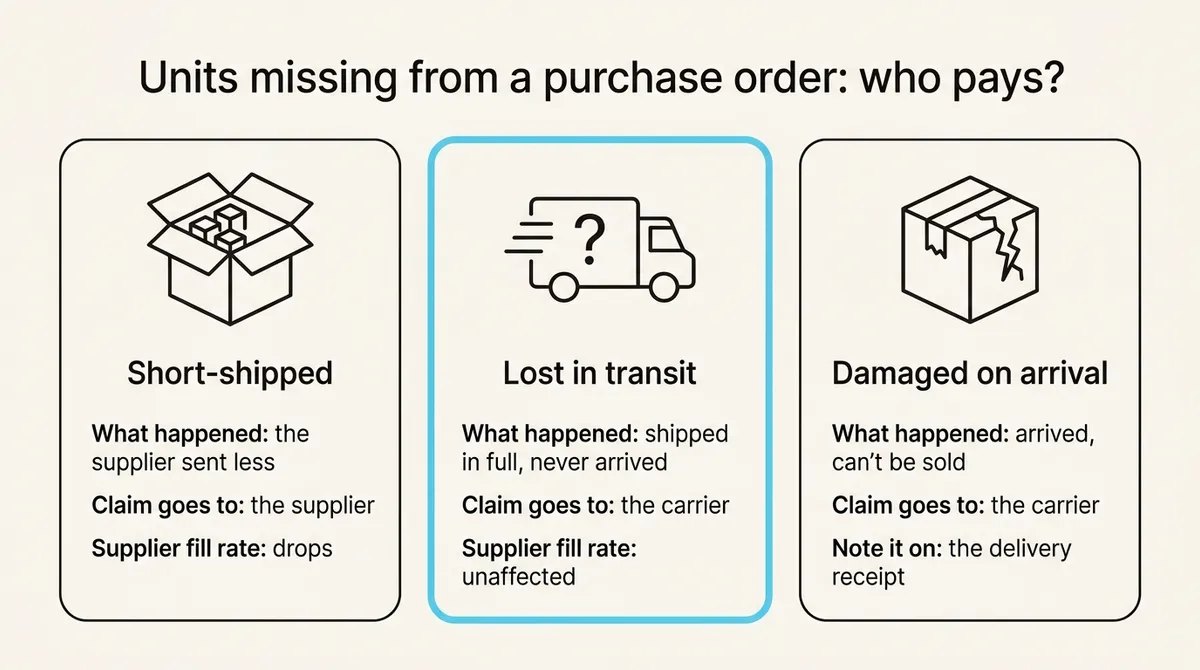
If the supplier shipped your order and it never arrived, don’t treat it as a short shipment. The supplier did its job. Close the missing units on the purchase order as lost, either written off or against a credit, file the claim with whoever had the goods when they went missing, and keep enough of a record that you can reverse it if the shipment turns up, because now and then one does.
The quick fix is to close the line short and move on. That lowers what you ordered, so the PO looks tidy. But it also tells your system the supplier sent less, which isn’t true. And it leaves the bill you got for the full quantity with nothing on the other side of it.
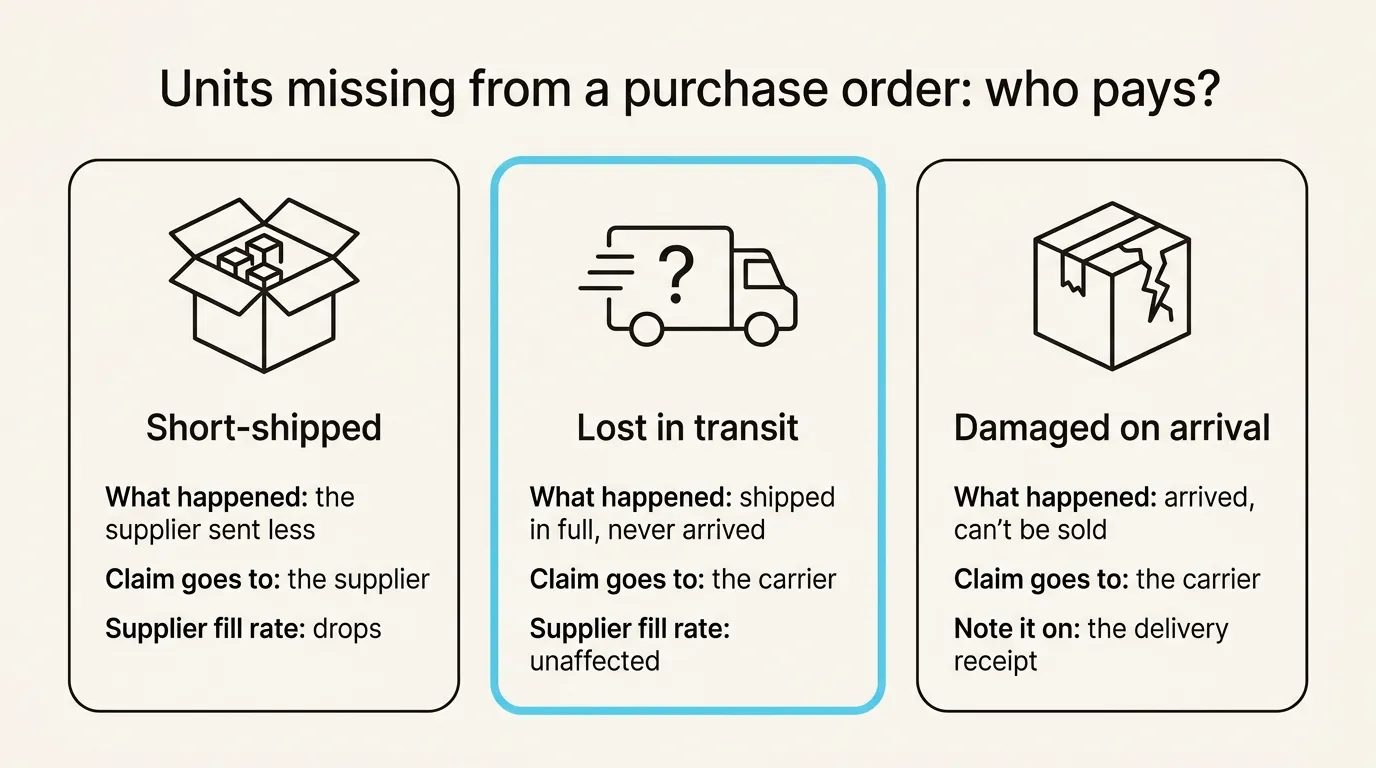
Short-shipped and lost look the same on the PO
Both leave a line with units outstanding, and the PO can’t tell you which one you have. What decides it is where the units were when they went missing.
| Supplier short-shipped | Lost in transit | |
|---|---|---|
| What happened | They packed fewer than you ordered | They shipped it all and it didn’t arrive |
| Whose problem | The supplier’s | Whoever had custody: carrier, forwarder, 3PL, marketplace |
| The bill | Ask the supplier for a credit | You probably owe it. Write it off or recover it |
| Supplier’s fill rate | Should drop | Shouldn’t move |
| The claim | Against the supplier | Against the carrier |
If you aren’t sure which, check the carton count and weight on the bill of lading against what the carrier says it delivered. If the carrier signed for 12 cartons at pickup and its delivery record shows 11, a carton went missing on the road. If it shows all 12 at the same weight, the units were never in the boxes, or they went missing after delivery. For the short-ship side, there’s a separate page on what to do when a supplier short-ships a PO.
Whose loss is it?
The shipping terms on your PO decide who owns the goods while they’re moving, and the owner is the one who files. On a domestic PO that says FOB origin, the goods were yours from pickup. The supplier is paid, and the claim is yours to make. If it says FOB destination, they were the supplier’s until they reached you. Then it’s their claim, and they owe you the goods again or a credit. Imports use Incoterms instead, and the point where risk passes is different for each: at the supplier’s door under EXW, once the goods are on board the ship under FOB. Under either of those, a container that goes missing at sea or on the road from the port is your claim.
The same rule applies to marketplaces. Say I paid a supplier $10,000 for goods sent to Amazon, and Amazon’s receipt comes to $9,800. I’m not going after the supplier for the $200. The supplier delivered. Amazon lost it, so Amazon reimburses it, and the PO should close showing the supplier sent everything.
Give it a date before you call it lost
Tracking that stops moving isn’t proof of loss, and nobody will take your claim until their own clock runs out. We had two Amazon removal returns go missing this October. Amazon said it wouldn’t accept a lost claim on one of them until 15 days after the last scan. On the other it told us that “carriers can sometimes take up to 14 days beyond the expected arrival date to complete delivery,” and to come back after that.
So set a date and write it down: the day after the carrier’s own window ends. Until then, leave the line open and move the expected date, so orders waiting on it show a later date and don’t get promised stock that may not come. On the day, either it arrived or you close it as lost. A line left open past that date keeps backorders bound to it and keeps the bill unmatched.
Close the units as lost, not short
In SKU.io, when you short-close units that are on a shipped inbound shipment, it asks what happened first. One of the answers is that they shipped and never arrived. Pick that one and it gives you two ways to close them:
- Close with a receiving discrepancy. The units come off the line, and the ledger writes off what you were billed for but didn’t receive, to an expense account you map. Use this when the money is gone or you’ll recover it from someone other than the supplier, such as a carrier or Amazon.
- Create a draft vendor credit for those units at the PO line cost. Use this when the supplier is the one paying you back, as under FOB destination terms. The credit stays a draft until you review and approve it, like any other.
Either way the shipment closes as received short and the units are recorded as lost in transit, not as a supplier shortfall. They appear on Inbound Shipments › Discrepancies, and the supplier scorecard counts them as filled, so the supplier’s fill rate doesn’t take a hit for the carrier’s mistake. Nothing here emails the supplier or files anything with the carrier. You still do that yourself.
A short-close on its own posts nothing to your books, because a unit you never received never went into inventory. That’s why the lost-units path is separate: you have a bill for those units, and the cost has to go somewhere.
A fractional CFO who works with online sellers made a point to me that I’d repeat to any team setting this up. Keep losses in transit separate from losses on the shelf: “One’s an accounting process to make sure the accounting financials are right. The other is how do you deal with lost, stolen, damaged, disappeared? Inventory is a separate logical process.” A carton the carrier lost is a purchasing problem with a claim at the end of it. A carton that walked out of your warehouse is a stock count problem. Put them in one account and you can’t tell which one is costing you money. I book receiving discrepancies to one expense account and the reimbursements against that same account. When they cancel out, I got everything back.
File the claim, and track it somewhere
The claim goes to whoever had custody, and it’s filed on their side: the carrier’s claims portal, the forwarder, the 3PL, or the marketplace’s case system. SKU.io doesn’t file it for you. From the Discrepancies list, File claim opens a claim with the units and their value already filled in. You mark it filed when you’ve sent it, then record whether it was approved, partly approved or denied, and how much came back.
Then the deadline. For freight on interstate trucking in the US, the Carmack Amendment says a carrier can’t give you less than nine months to file. Parcel carriers and marketplaces set their own windows, and they’re shorter, so check the terms for the one you used. Some also make you wait before you’re allowed to file, like the 15 days after the last scan on one of those Amazon returns. That wait comes out of the same window.
Send the claim with the PO, the commercial invoice, the bill of lading or tracking number, and the proof of delivery, or proof there wasn’t one. If what arrived was short, include whatever your receiver wrote on the delivery receipt. That’s where an OS&D report comes in.
What an OS&D report is for
OS&D stands for overage, shortage and damage. It’s the receiver’s note of how a delivery differed from its bill of lading, written at the dock, with photos. The reason to bother: a driver’s signature on a clean delivery receipt reads as “all received in good order,” and that’s the first thing a carrier points to when it denies a claim. So the short or damaged cartons go on the receipt before anyone signs it, and the detail gets written up after.
Damage is the case to plan for, because SKU.io has no damage step at receiving. You receive the units, write off the ones you can’t sell with a stock adjustment, and file with the carrier using the photos and the note on the receipt. Concealed damage, the kind you only find when you cut the tape, is harder to claim the longer the cartons sit, so whoever receives should open them that day and not the week the stock is needed.
A shortage is simpler. Receive what you counted, and if the rest isn’t coming, close it as above: lost if the carrier had it, short if the supplier never packed it. Either way, if the units were on an inbound shipment, SKU.io records the shortage on it.
Overage means more units than the line, or a carton that was meant for someone else. SKU.io lets you receive more than the line quantity without a warning, and you put the extra on a new shipment, a line added to the PO, or a positive stock adjustment. Then ask the supplier whether they want it back.
Sometimes the lost shipment turns up
This fall a supplier’s first shipment on one of our POs went missing. Our operations coordinator wrote to me: “The first shipment for this order was considered lost, so the supplier sent a replacement shipment. Now, [the 3PL] has confirmed that both shipments have been received.” So we had twice what we’d ordered, and the question was whether to ask the supplier for an RMA or keep the units.
It’s why I don’t close lost units until the date has passed, and why I want a record I can undo. In SKU.io you can undo a lost-units close until its entry has posted to your accounting system. The lines expect the units again, the shipment reopens, and you receive them normally. After it has posted, you need a reversing entry, which is a job for your bookkeeper. If you closed against a vendor credit, the credit stays in place for you to void. And if a carrier already paid the claim, tell them the goods turned up.
On a replacement that has already shipped: if the extra units will sell within a normal reorder cycle, keep them and pay for them, and buy that much less next time. If they won’t, ask for the RMA while the supplier still remembers sending them.
Lost in transit is one of several ways a PO ends with less than it promised. The short-close guide sorts them out, starting from whether the supplier shipped it at all. For the clicks, see close, reopen and short-close a purchase order in the docs. When the PO went to a factory making your product, receiving from the factory covers the short ships, inspection reports and packing slips that come with it.
If you ship from one warehouse and import a few containers a year, under about $1M in sales, a spreadsheet of open claims and Zoho Inventory or inFlow will cover this. If lost inbounds are hitting stock that several channels are waiting on, book a demo and bring the shipment that went missing.