
Short Shipped by a Supplier: What to Do With the PO
When a supplier ships you fewer units than you ordered, count what came before you do anything else. Then decide which waiting orders get the units, find out whether the rest is coming, and pay for what you received, in that order. (If your cargo was left off a vessel or lost by a carrier, that’s a freight claim, and this isn’t the page for it.)
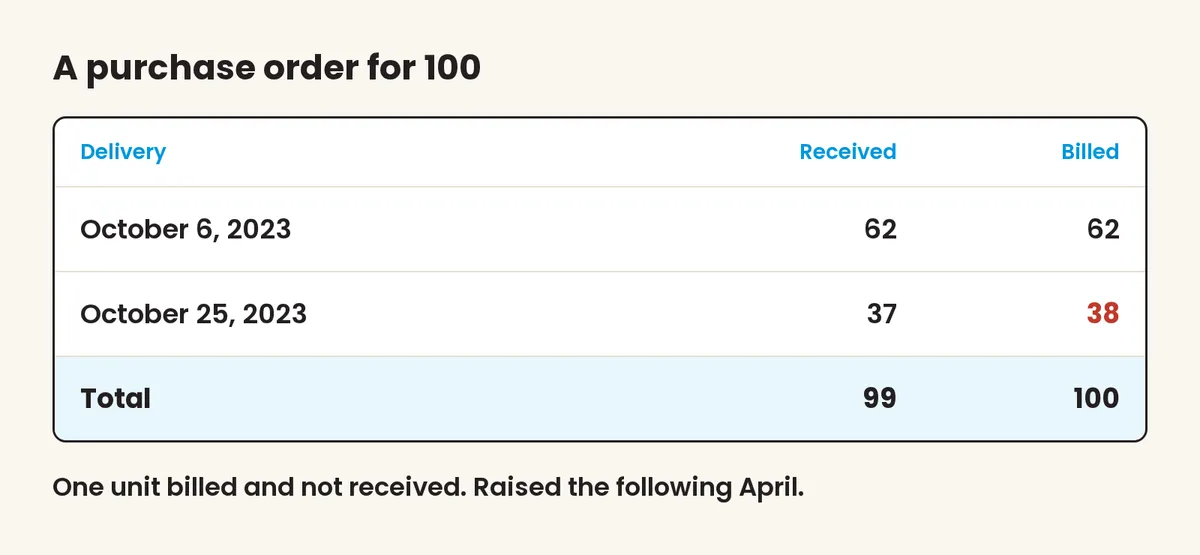
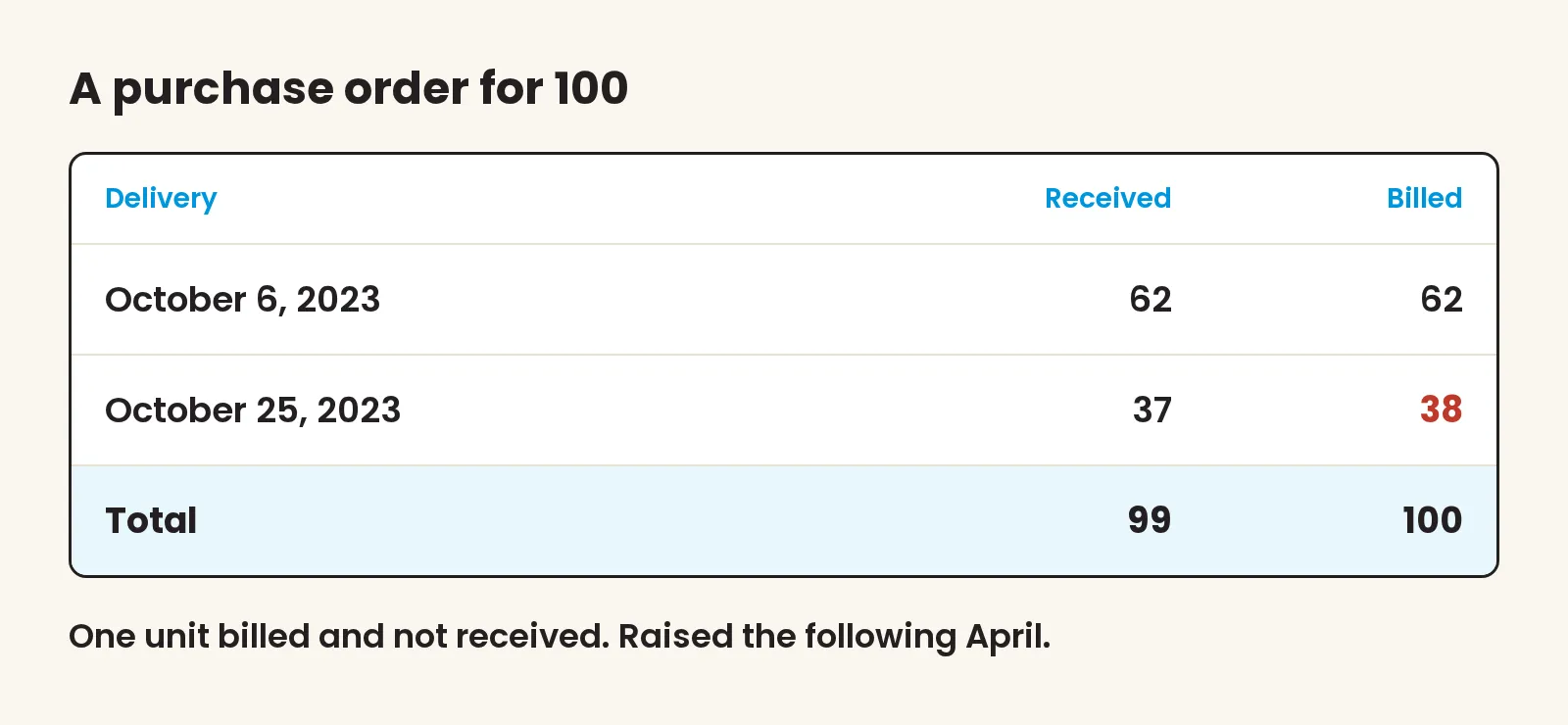
At my company we had a PO for 100 of one part, placed in June 2023. The supplier had some of it on backorder, so it came in October in two deliveries, 62 and then 37. The invoice for the second said 38. The 3PL counted 37 and that’s what we recorded. The next April I was looking at that PO, it said 99 of 100, and I couldn’t find any follow-up. Our operations manager had noticed the missing unit and looked for it without luck. But nobody had raised it with the supplier or the 3PL.
It’s one unit. But after six months you can’t ask anyone to go and look.
Count units before anyone reads the paperwork
I had an import shipment where the 3PL said it had half the quantity and asked if it should wait for the rest. The customs broker said all ten pallets had been delivered. The 3PL checked, and yes, ten. Then I had to go back and ask for the units, because pallets aren’t what I ordered.
Receive what was counted, on the day, even when you’re sure the rest is on the next truck. In SKU.io a PO takes as many receipts as it needs and the line shows what’s outstanding. If you type in 100 because 100 were ordered, the bill will match, the stock will be wrong, and you won’t hear about the short until someone can’t find the hundredth unit.
Then write to the supplier the same day, with the count and a photo of the label. You’re asking one question: is the rest coming, and if so when?
Give out the units you have
If orders were waiting on the PO, some of them now get less than they expected. Pick the rule before the truck arrives. SKU.io fills the oldest waiting orders first until the units run out, after any units somebody reserved on that PO line. The last order it reaches may be filled in part. Who gets the next delivery has the full example, including when I’d put a wholesale order first.
And look at what’s already allocated to marketplace restocks. This July 78 of one product at our 3PL, all we had, were allocated to three Amazon shipments. My team wanted 50 back for 25 drop-ship orders. The 3PL said they were already packed, and days later we were out of stock.
If an order gets some of what it wanted, tell the customer what’s in the box. A parts seller I talked to prints “back order” beside the item on the paperwork, so nobody has to call and ask where it is. Another seller holds the order until it’s complete and splits it only for a customer who pays the extra shipping. Either can work. Whichever you pick, your support team needs to know which one it is.
Is the rest coming?
Nothing on the PO tells you. A line with five units left looks the same whether they’re on a boat or they’re never coming, and people need opposite things from it. I’ve talked to a brand where every PO that came up three or five units light stayed open, so there was always a pile of them. And to another that saw a shortfall flagged on a PO that wasn’t nearly done: “the shortfall is going to be there for months while we get the rest of the stuff in.” Someone has to find out, and write it on the line.
It’s coming, with a date. Leave the line open and change the date on the PO, and on the inbound shipment if one is still open. Orders still waiting keep their place and show the later date. Don’t raise a second PO for the balance. You’ve already bought those units.
It’s not coming. Close the line short at what arrived, that day. In SKU.io that keeps the original quantity on record and lets go of the orders that were counting on the missing units, so they match to the next open PO, if there is one. You can undo it if the box turns up. Leave it open and the five still count as on order, so your next buy is five light.
They won’t say. Give it a number of days. For POs that suppliers shipped straight to Amazon for us, my rule to the team was that if the backordered items were close we’d wait, and if they were more than a week out we’d take them off the shipment. One supplier had also been sent an email from us saying to hold the order until it was complete. We removed the items, and six weeks later the supplier still thought they were on the order. So when you take something off, say so in writing.
Sometimes they say it all shipped. We had one like that in January, where the supplier said complete and the 3PL said no. There was quite a bit missing. I wasn’t ready to call it a loss, so I gave it a few days, because we needed to buy more of it whatever the answer was. Put a date on the argument and reorder when it passes.
Pay for what came
Expect a bill for the full quantity. SKU.io matches each line against what you ordered and what you received, and a line billed above received holds up approval. It leaves the bill alone, and the credit is yours to raise.
Don’t edit the purchase order to agree with the bill. A customer who sells online described doing it and called it “doing things the Wrong way,” which I’d agree with: afterward nothing in your system says you were shorted. If the price was wrong, change the PO. If the quantity was short, leave it and let the receipts and bills add up against it. One of my POs has had ten invoices over two years and that’s fine.
What you pay depends on whether the rest is coming.
| They’ll send it | They won’t | |
|---|---|---|
| PO line | Open, new date | Closed short at what arrived |
| Bill for the full amount | Pay for what you received if they’ll take it, and the rest when it lands | Ask for a credit, and record it against the bill |
| Orders waiting | Keep their place, later date | Move to the next PO, or refund |
| Your accounts | Nothing to write off yet | Nothing left owed for units that never came |
I have a PO this year where the supplier came up short and is crediting us, so there’s nothing left to receive. The credit’s recorded and the PO can close. What I wouldn’t do is hold up a whole invoice over one unit the manufacturer has promised to send. I’ve talked to a company where that’s the process, and they pay late because of it.
For a handful of units out of thousands, set a number below which you close the line and take it as a cost of buying. Supplier deposits and the three-way match goes further into the bill, including when you paid before it shipped.
Tell the customers whose date moved
Work from the orders that lost units. In the US, a customer who bought online and won’t have the order by the date you gave has to be offered a choice between waiting and a refund before that date passes, and an open-ended delay needs a yes. The rule is laid out in backorder management. Give one new date, with some slack in it.
Keep score
One short is a packing mistake. If the same supplier is short on three POs out of ten, order earlier from them, promise later, and stop paying the whole bill up front. In SKU.io the supplier scorecard’s fill rate has it, counting units ordered against what the supplier filled.
Then once a week go down every PO line that’s past its date and ask which of these it is. Our line would have been on that list by the end of October. How to close one is in close, reopen and short-close a purchase order, and there’s an older post on everything that happens after the PO exists.
With one warehouse and a couple of suppliers, under about $1M a year, a spreadsheet and Zoho Inventory or inFlow will do all of this. If several channels are waiting on the same short delivery, book a demo and bring the PO.