
Can a Contract Manufacturer Hold Your Stock? How to Keep Count of It
Most contract manufacturers will keep your packaging, labels and materials between runs, and most brands let them, because shipping boxes to your own warehouse and back again costs freight twice. It’s still your stock, on your books at what you paid, and a box that goes missing there is your loss. The count, though, is usually the factory’s. A brand that keeps its materials at the factory said it plainly: “We store all our ingredients in the warehouse of the contract manufacturer. So their system shows us what we have in stock.”
Another brand described what it keeps at its co-packer as “kind of like a pile of old stuff in the freezer. And then we technically pick it up and we bring it to them.”
What they hold isn’t always what’s there
The founder of a brand that buys all its own materials and stores them at its contract manufacturer told me how a run actually draws on them. An order for 2,000 units needs 18 kilos of one ingredient, which comes in 25-kilo boxes. The factory takes the whole box, makes the run, and is meant to credit the rest back into stock. Asked whether it does: “Sometimes. Sometimes they don’t.” Once the factory said an ingredient had never arrived, then a month later found “30 kilos of this ingredient that… we said that we didn’t have. Somebody just put it in the wrong place.” The brand knew it had been delivered, and had billed the factory for it. What it didn’t have was a count of its own to point to.
What the founder wanted was simple: purchase orders for materials go into one warehouse, the order for finished goods draws on it, and the factory can’t come back with “ah, but we thought and we used and we lost.”
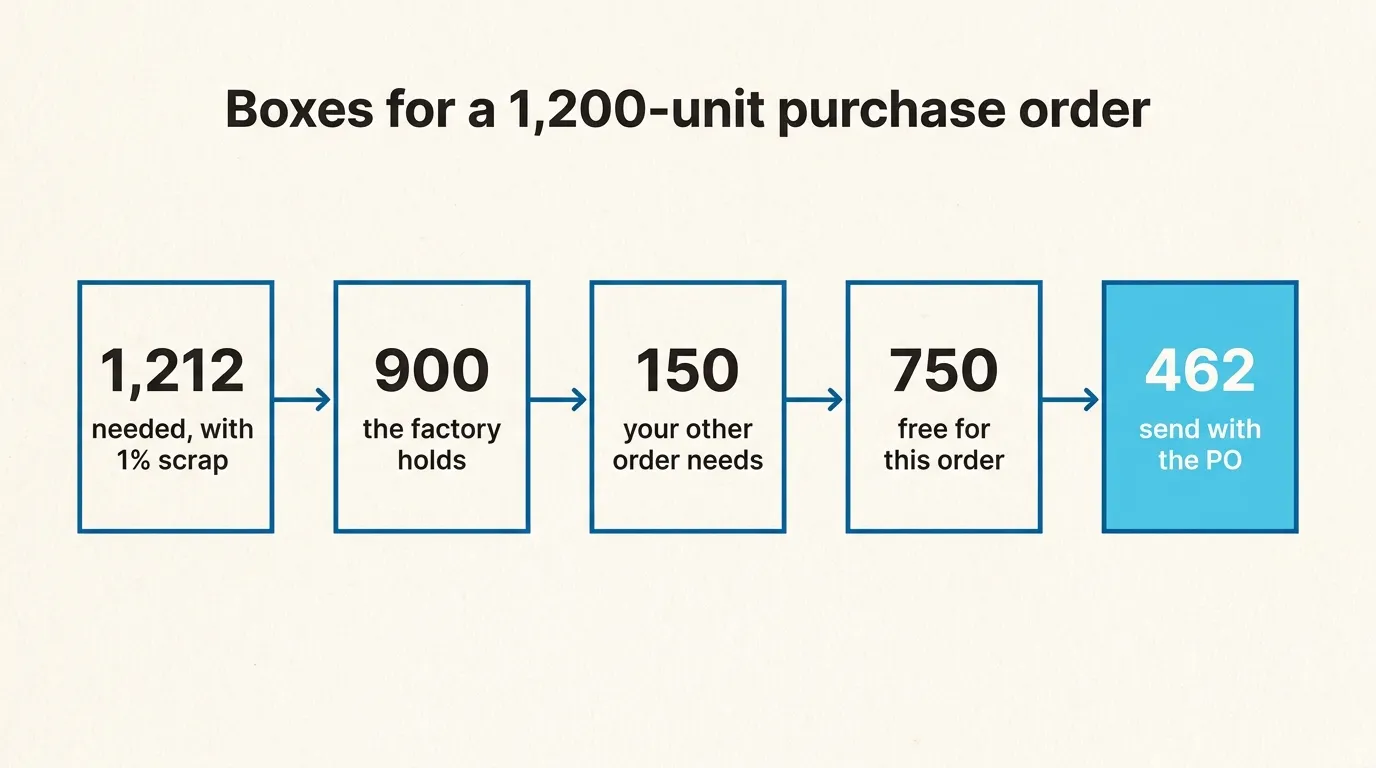
There’s a second gap between what the factory holds and what you can use: your own other orders. The factory may hold 900 of your boxes, but if another of your orders there is due to run first, some of those boxes are already spoken for. Take a made-up purchase order for 1,200 units, where each unit uses one box, two labels and a twelfth of a shipping carton:
| Packaging | Needed for 1,200 units | Factory holds | Other open orders need | Free for this order | Send |
|---|---|---|---|---|---|
| Box (1% scrap) | 1,212 | 900 | 150 | 750 | 462 |
| Label (3% scrap) | 2,472 | 3,000 | 300 | 2,700 | none |
| Carton (12 units each) | 100 | 40 | 10 | 30 | 70 |
Against what the factory holds, you’re 312 boxes short. Against what’s free, you’re 462 short. The 150 boxes in between belong to the order that runs first. Skip that subtraction and the earlier order is the one that runs out of boxes.
The factory’s count, and yours
You don’t need the factory’s system to keep your own number. Give each factory a warehouse of its own in your inventory system. Packaging goes in on the purchase order that delivered it there, or on a transfer from your own warehouse. It comes out when you receive finished goods from the factory, at whatever one unit uses. Write that down once per product, with the scrap you’ve agreed, and your number moves with every receipt instead of waiting for the factory’s next count.
An operations lead described doing it by hand: “So when I issue a PO for 10,000 [units], I need to be able to say, this is consuming 10,000 glass bottles. And I do that all now in a Google sheet.” That works for one product at one factory. With a second factory, the same bottle sits in two buildings on two run schedules, and the sheet needs a column per factory and someone to keep both current.
Then get the factory’s count on a schedule, before each run or once a month, and compare the two line by line. Agree in writing what scrap is fair for each component, that leftovers stay yours and show up on their next count, and what happens to the old stock when you change a label. When the gap is bigger than the scrap you agreed, send the factory both counts and ask where the difference went.
The packaging belongs in the cost of the unit
In March 2025, with new tariffs pushing costs up, I went back through a shipment for my other company. I’d put the inbound freight on the order and forgotten the customs fees, and those products were showing more margin than they really made. Once the customs invoice went onto the order, every sale already taken from that stock got its cost corrected, and the margin dropped back to what it really was.
Packaging left off the unit cost does the same thing, and it’s harder to catch, because no invoice arrives later to remind you. You bought the boxes months ago. Say the box cost $0.38, each label $0.03 and each carton $0.90. One finished unit carries $0.38 + 2 × $0.03 + $0.90 ÷ 12 = $0.515 of your packaging on top of the factory’s price, or 1,200 × $0.515 = $618 on this order. If that sits in a packaging account, or was expensed when you bought the boxes, the product looks $0.515 a unit better than it is on every sale until somebody goes looking.
When they pack with packaging that isn’t there
Say the factory finishes the 1,200 units and your records show it only had 1,170 boxes. Maybe its count was off, maybe it borrowed 30 from another of your orders. Receive the finished goods anyway, so they’re on hand and sellable that day, and record the 30 boxes as short, to settle once the factory’s count is corrected or more boxes arrive. If you hold the receipt until the boxes are explained, 1,200 sellable units sit off the books while you wait.
How SKU.io handles it
In SKU.io you activate the factory as a contractor, which gives it a warehouse of its own. That’s part of the optional Manufacturing add-on. Each product you buy from the factory lists its factory packaging: which packaging products, how many one unit uses, and the scrap you expect. Turn on using up packaging on purchase orders for that factory, and every PO to it gets a packaging card with the columns in the table above, ending in what to send, such as “Send 462.”
Receiving the goods takes the packaging off the factory’s stock and adds its cost to the units received, shown as a factory packaging line in their cost breakdown. What you owe the factory doesn’t change. If packaging was short, receiving still goes through, the card says so, and you record the rest once it’s there. Delete a receipt and its packaging goes back to the factory. Change a received quantity and the packaging follows.
Across factories, one tab shows each site’s packaging with its status, days of cover and a suggested send. You can set a reorder point per component per factory, and an alert goes to your team and to the person you name for that factory before a site runs short. The steps are in use up packaging on purchase orders.
Who this isn’t for
If your factory supplies its own packaging and sells you finished goods, there’s nothing of yours to count there, and an ordinary purchase order covers it. If you sell under about $1M a year from one factory, a sheet per factory and Zoho Inventory or inFlow will do. And if stock left your warehouse with someone who isn’t using it up, such as an installer, that’s stock sent out but not sold.
This post is part of the contract manufacturing guide, which covers stock at the factory, ordering from it, and receiving what it ships. If you send packaging to more than one factory, book a demo and bring the last count they gave you.