
Contract Manufacturer Wastage: Count What Went In Against What Came Back
“We buy stuff, we give it to our contract manufacturer, we get finished goods back. I just don’t trust them in terms of wastage.” That was the founder of a brand that buys all its own raw materials and stores them at the factory, explaining why they were shopping for software.
An order for 2,000 units needs 18 kilos of one ingredient. That ingredient comes in 25-kilo boxes. So the factory takes a whole box off the shelf, makes the run, and is supposed to put the 7 kilos that are left back into stock. “Sometimes. Sometimes they don’t.” When the brand finally lined its numbers up against the factory’s, one ingredient was being wasted at 20%, at 700 dollars a kilo. Part of it turned out to be leftovers that had “just sat in the production warehouse and next thing you know, that one’s back into stock and the wastage has reduced.” Some of what looked like waste was an open box nobody had counted back.
What shows up as wastage
When a factory’s usage runs over the recipe, it can be any of these, and only the first is waste you should be paying for:
- Real scrap. Material spoiled in setup, a batch that failed, labels that jammed. Every process has some, and you should agree how much.
- Leftovers not put back. The rest of the 25-kilo box, still on a production shelf, counted as used.
- Stock in the wrong place. The same brand had the factory say an ingredient had never arrived, then find “30 kilos of this ingredient” a month later. “Somebody just put it in the wrong place.”
- A recipe that’s wrong. Say the line can’t dose 9 grams exactly and runs at 9.5. The recipe still says 9, so every run looks about 6% over.
From your side each of these is the same number: more material gone than the units should have used. Telling them apart takes a count at the factory and a conversation about what it found.
The sum that finds it
For each material at each factory, over a period:
What it should hold = what it held at the start + what you sent − what the finished units should have used − scrap and adjustments you recorded − anything moved out
Then the gap = what it actually holds − what it should hold.
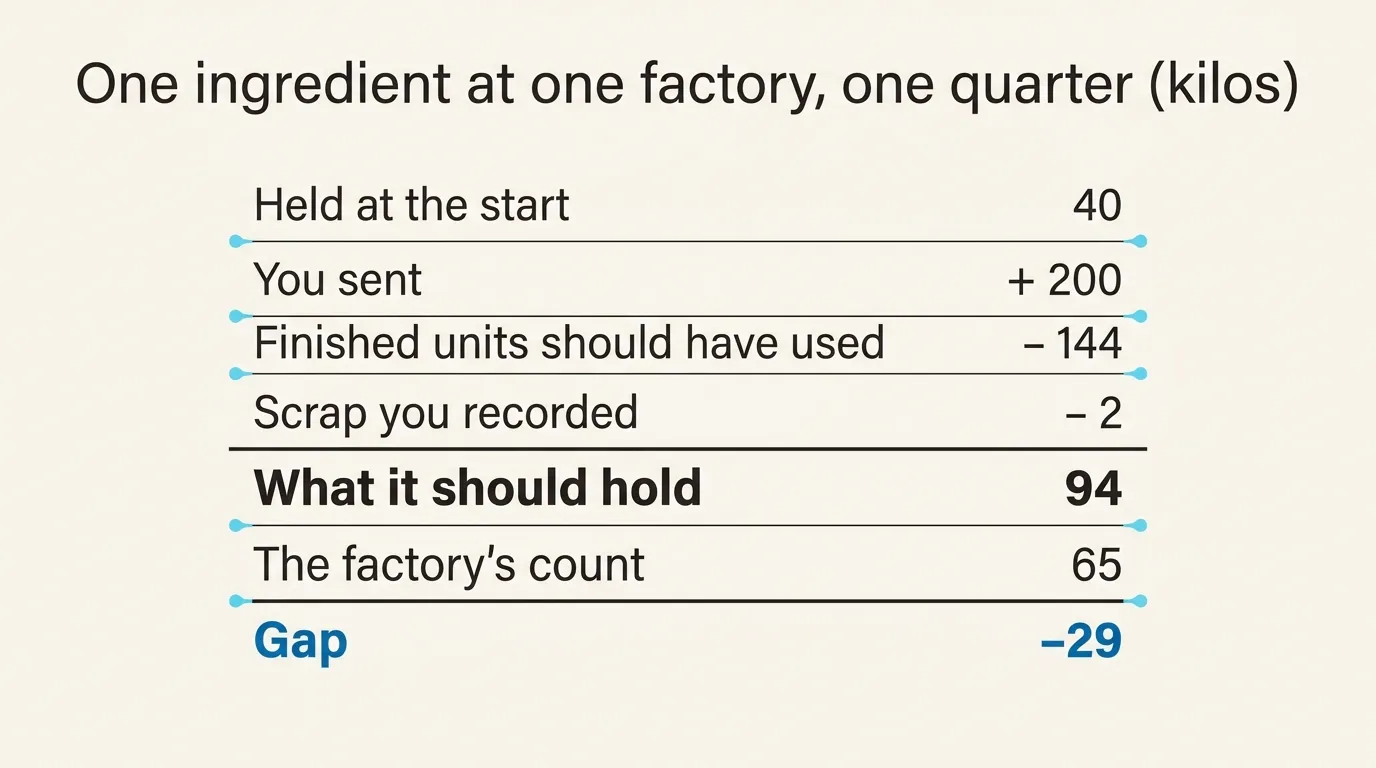
A made-up example, using the run above. The recipe is 18 kilos per 2,000 units, which is 9 grams a unit. Over a quarter:
| Kilos | |
|---|---|
| Held at the start | 40 |
| You sent | 200 |
| Finished units received: 16,000 × 9 g | 144 |
| Scrap you recorded | 2 |
| What it should hold | 40 + 200 − 144 − 2 = 94 |
| What the factory’s count says | 65 |
| Gap | 65 − 94 = −29 |
If you agreed 2% scrap, the allowance on 144 kilos used is 2.9 kilos, and the gap is ten times that. At 700 dollars a kilo it’s $20,300. I’d ask the factory where the open boxes are before I asked it about waste.
Here’s how big the brand’s 20% gets at that rate. 20,000 units at 9 grams is 180 kilos; 20% of that is 36 kilos, which is $25,200. That figure is our illustration: the brand didn’t tell us how much of the ingredient goes into a unit, only that it was “huge.”
Agree the allowance before you need it
A scrap percentage per material, written down, before the first run. Without one, every overrun is “normal for this process” and you have nothing to point to. With one, you can show the factory exactly how far over the allowance a run went.
Set it per material, not per product. A powder that’s weighed loses a little. A printed label that jams in an applicator loses more. A glass bottle that breaks loses whole units.
Record what they actually used
The recipe is what a unit should use. What the factory used is what you pay for. So at every receipt of finished goods, record the actual figure when the factory gives you one, especially on a run where they tell you they went over. Then the cost of that batch is what it really cost, and your next margin report doesn’t average a bad run into the good ones.
The other half is a count at the factory on a schedule they agree to. A count corrects what the system thinks they hold, and if you record it, the gap between expected and counted shows up as its own line instead of disappearing into the next run.
I’d do this per run while a factory is new, and monthly once the gaps stay inside the allowance. Do it soon after the run. I had a purchase order of my own sit at 99 of 100 for six months: our operations manager had looked for the missing unit, nobody raised it with the supplier or the 3PL, and by April there was no one left to ask. With a factory, the people who know where the open boxes went are the ones who ran that shift.
How SKU.io handles it
In SKU.io each factory is a contractor with a warehouse of its own, part of the optional Manufacturing add-on. When you receive finished goods on an outsourced manufacturing order, SKU.io uses up your materials at the factory per the recipe, and you can type over the planned figure with what the factory really used before you confirm. The batch is costed from the lots actually consumed, so two runs of the same product can carry two different costs, and neither is an average. The steps are in manufacture with a contract manufacturer.
The Factory Packaging Reconciliation report does the sum above for every component at every contractor site over the dates you pick. Its columns are Opening, Received, Consumed by completed units, Scrap & adjustments, Transfers out & other, Expected closing, On hand at close and Variance. A variance of at least one whole unit that’s bigger than the recipe’s expected scrap for the units completed is flagged, red for a shortfall and amber for a surplus. Hovering it names the two usual causes: more or less consumed at receipt than the recipe expects, or a stock count at the site. Expanding a row lists each receipt of finished goods with what the recipe expected against what was recorded, and each movement in and out. It exports to CSV for the conversation with the factory.
It can’t see inside the factory. If nobody counts there, SKU.io’s figure is what the factory should hold, not what it does. The report has “packaging” in its name, but it covers every component you own at a contractor site, ingredients included.
Who this isn’t for
If the factory buys the materials and sells you finished goods, its wastage is in its price, and you compare prices, not kilos. If you sell under about $1M a year from one factory, a monthly count in a spreadsheet will catch most of this.
Before any of it, you need to know what the factory holds of yours in the first place: can a contract manufacturer hold your stock? covers that, and both are part of stock at the factory in the contract manufacturing guide. If you’re already arguing with a factory about overruns, book a demo and bring last quarter’s numbers.