
Fulfilled by TikTok (FBT): How It Works When You Also Sell on Shopify and Amazon
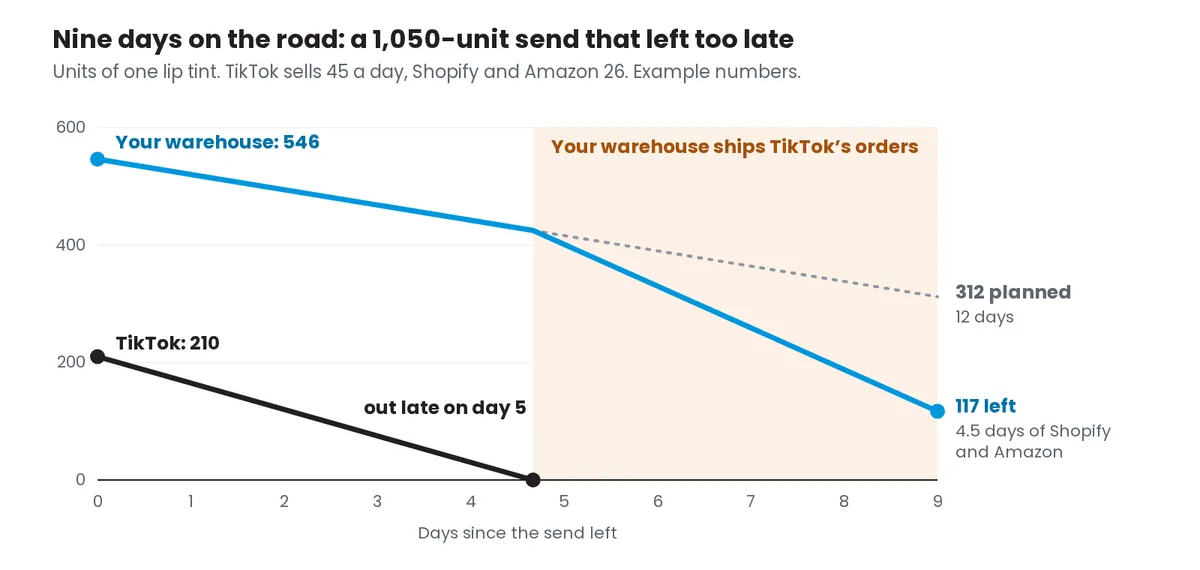
With Fulfilled by TikTok (FBT), you send stock to TikTok’s fulfillment centers and TikTok stores it, packs it and ships your TikTok Shop orders. If the same stock also sells on Shopify and Amazon, send daily TikTok sales × (days of cover + days to arrive), less what TikTok already holds, and only as far as your other channels can spare it. Then send early: at 45 units a day and a nine-day trip, that’s when TikTok is down to 405.
This is for a brand with one pool of stock behind several channels, where TikTok Shop has grown to the point that shipping every order yourself hurts. FBT is one of four ways to ship a TikTok Shop order. The short definition is in our FBT glossary entry.
A six-and-a-half-minute walkthrough of a send like the ones below, on a beauty brand we made up.
Watch on YouTube. Narrated with an AI voice; the brand and its numbers are made up.
Chapters:
- 0:00 What FBT does
- 1:23 How many units to send
- 3:27 Build the inbound plan
- 4:25 After you confirm
- 5:22 Check TikTok’s count
Four things to know first
You still own the stock. TikTok’s reimbursement manual says so in passing: an order cancelled before it leaves the FBT warehouse isn’t reimbursed, “as the seller still owns the inventory.” So it belongs on your books the whole time, including while it’s on the truck.
FBT ships first, then you do. You can keep your own warehouse on the same listing. TikTok’s logistics overview (updated July 6, 2026) puts the order this way: “FBT inventory will be used first. After the FBT inventory is used up, the order will be fulfilled through your own warehouse inventory.” Most of this article follows from that second sentence.
FBT isn’t compulsory. In January 2026 TikTok told US sellers it would end seller shipping, then reversed it. The same overview now says you may use Seller Shipping “if you are currently eligible.”
It’s stock for TikTok. TikTok’s Academy pages describe FBT as shipping TikTok Shop orders. Fulfillment vendors disagree about whether it can ship your other channels too, so check your own Seller Center before you plan around it. SKU.io doesn’t route a Shopify or Amazon order to FBT stock.
How many units to send the first time
Say a lip tint sells 45 a day on TikTok Shop and another 26 a day on Shopify and Amazon together, all from one warehouse holding 1,600. You want 21 days of cover at TikTok and the trip takes nine. The numbers are made up, as are the rest below, and Amazon here means orders you ship yourself.
45 × (21 + 9) = 1,350 units, nine cartons of 150.
Send all nine and 250 are left at home. TikTok can’t sell a unit until it has received it, and on a first send it holds nothing, so for nine days your warehouse ships every TikTok order as well as everything else.
| While the first send is on the road | Units |
|---|---|
| Left at home after sending 1,350 | 250 |
| TikTok orders you still ship, 45 × 9 | 405 |
| Shopify and Amazon orders, 26 × 9 | 234 |
| Short | 389 |
At 71 a day, 250 units last three and a half days. And TikTok tends to win the argument over them. An operations lead told me what their brand does when a delivery lands short: “we’ll often fill TikTok first,” because “if you don’t meet a commitment to TikTok, they’ll pull the plug on your shop.” So the Shopify customer waits for stock that’s sitting in a truck.
Work it from the other end. Keep 405 for TikTok’s nine days and 21 days of Shopify and Amazon, 546. That’s 951 at home, which leaves 649 to send: four cartons, 600 units. When they land TikTok has 13 days of cover. With a nine-day trip, the second send has to leave four days later, so line up the purchase order before the first one goes.
I’d take 13 days. Nobody likes the smaller number, because the whole point was to stop packing TikTok orders. But the 600 units at TikTok can only become TikTok sales, while a unit at home can still go anywhere. I think the same way about FBA. In April my own business had 100 units of a new product coming, already paid for, and I told the team we’d “start selling merchant fulfilled to start while we wait for FBA to receive it.” Selling from home for a couple of weeks is slower, but nothing is stuck.
Send before TikTok runs low, not when it does
Later sends go wrong differently. Now TikTok holds 210 of the tint, under five days. The warehouse has 1,596. TikTok needs 1,350 − 210 = 1,140, and you can spare 1,596 − 546 = 1,050. So you send 1,050, and it looks right: the other channels keep their 546.
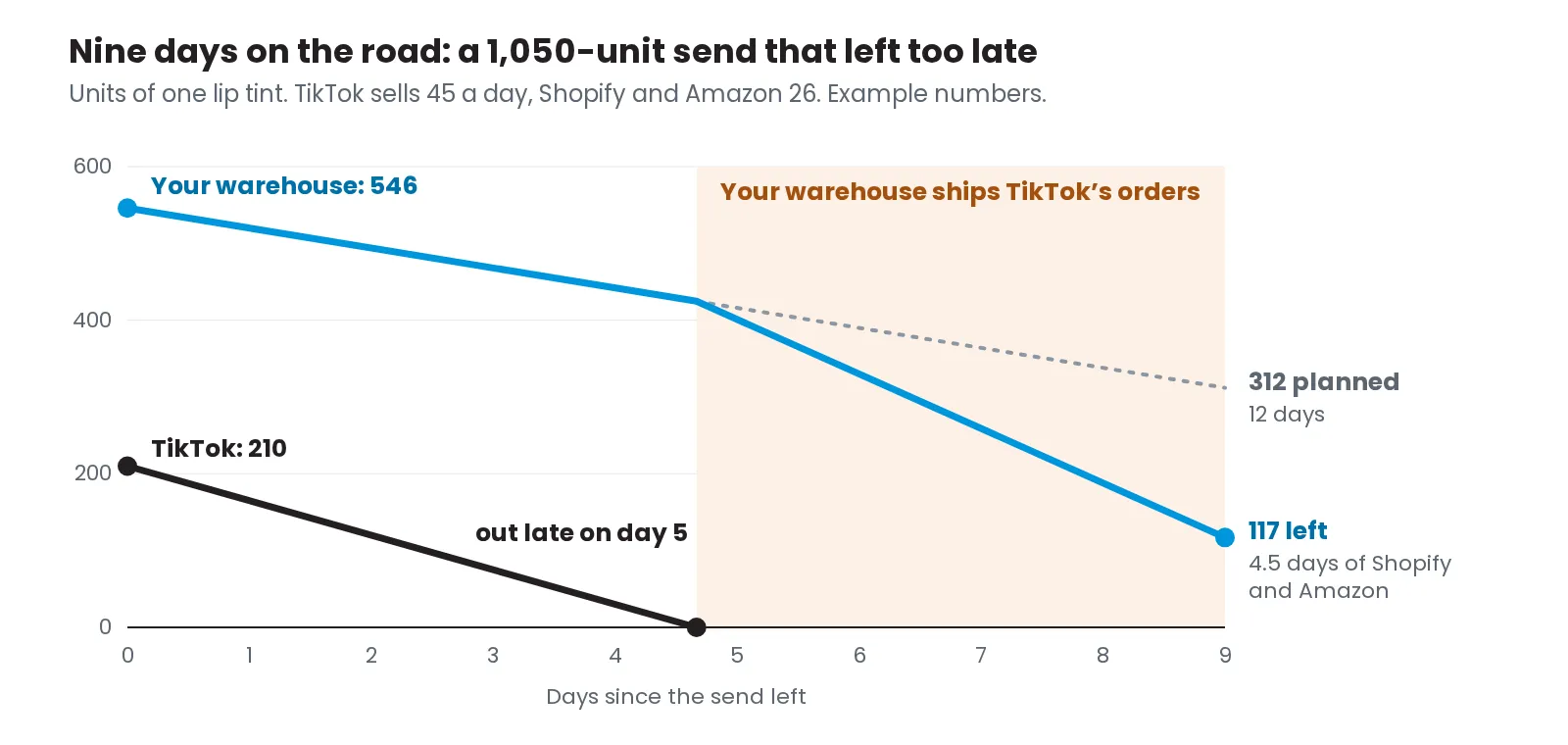
They don’t keep it. TikTok’s 210 run out before day five is over. For the rest of the trip its orders fall through to your warehouse, 405 − 210 = 195 of them, on top of 234 from Shopify and Amazon. On day nine the 546 is down to 117, four and a half days of Shopify and Amazon instead of the 12 you planned on. The formula was fine. The send was four days late: 195 units at 45 a day.
So the date matters more than the quantity. Send when TikTok is down to the trip: 45 × 9 = 405 units. That’s break-even, with nothing for a late truck, so I’d add three or four days, and more if a creator is about to post.
If you can’t send in time, decide what TikTok sees of your own stock. A buffer on that TikTok listing hides a fixed number of your own units from TikTok. At 546 here, TikTok can sell from your warehouse only what’s above 546 once FBT is empty. The listing may go out of stock for a few days, and with one that’s ranking I’d rather lend it the units, but I’d want to have chosen that. Don’t put the buffer on the whole connection: it would hide 546 of every product.
What counts as the trip
Don’t take nine days from me. Take your last three sends and count from the day each left to the day TikTok could sell it. If you haven’t sent any yet, be pessimistic.
SKU.io does that count for you once three inbound orders have been received, using the median, but it stops at arrival. If TikTok usually takes two more days to put your cartons on sale, set the days yourself.
The Send Planner also warns you when a send leaving today would arrive in the ten days from the day after Thanksgiving, November 27 to December 6 this year, when it expects FBT to take nothing in. It doesn’t change the quantity.
Where the number comes from in SKU.io
The Items step of an inbound plan has a panel called Suggested for FBT, and it starts from the same sum, less anything already on the way. Below is the tint in our demo brand’s account: 45.0 a day, 210 at FBT, five days of cover, 1,050 suggested. The warning mark says why it isn’t 1,140. The other 90 aren’t offered because they’d come out of the stock for self-fulfilled orders, 21 days’ worth unless you change it in the Send Planner’s rules.
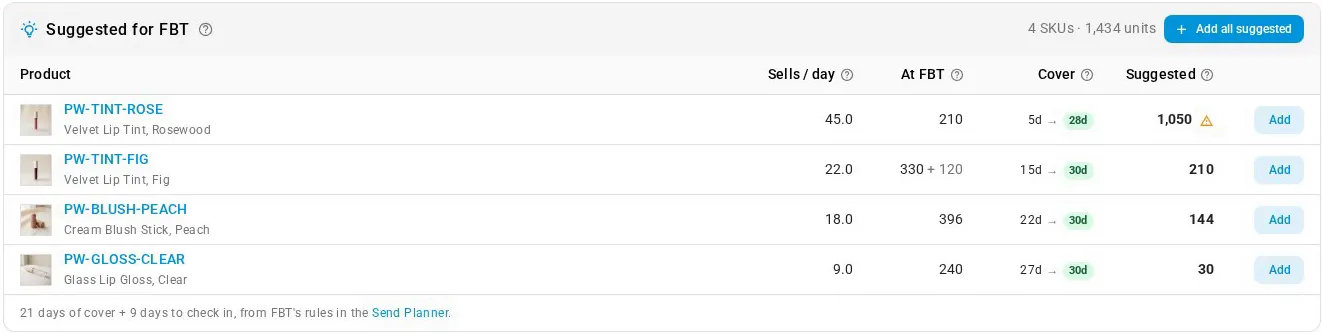
Don’t use it for a first send. With no FBT sales it can only suggest a starting quantity, 120 at most unless you change it, and it protects the TikTok orders you still ship yourself because it can’t know you’re about to move them. Use your TikTok Shop sales and the arithmetic above. It also plans FBT on its own, so if you send to Amazon FBA or Walmart WFS from the same warehouse, plan them together in the Send Planner.
You can also set a floor for FBT in the Send Planner, in days of cover. Stock at FBT or on the way that falls below it raises an alert. There is no alert until you set one, so set it longer than the trip.
When Shopify and Amazon stop seeing the units
A draft plan holds nothing, unless you allocated the stock in the Send Planner first. When you submit it to TikTok, SKU.io allocates the units at your warehouse, so they leave what’s available for every other channel that day, while they’re still on your shelf. They leave your on-hand count when you mark the inbound order as shipped. If it goes by parcel, keep the plan a draft until the cartons are packed. A plan submitted on Friday for a Wednesday pickup takes the units off sale for five days for nothing. With a truck you can’t wait: the appointment needs at least four business days’ notice and an inbound order to book against, and the order exists only after you submit. Count those days in the trip.
What TikTok makes of the plan
You can ship from your own warehouse or a 3PL, or have a supplier ship straight to TikTok. Once you confirm a delivery option, TikTok turns the plan into one or more inbound orders. Yours might become one order to California and another to Texas, with a warehouse transfer in SKU.io behind each (a purchase order when it’s a supplier).
Three of TikTok’s inbound rules (updated October 12, 2026) decide what’s worth sending:
- At least 10 units of each item. SKU.io checks this before it submits.
- Listing SKU, FBT goods record and barcode must match one to one, even when two listings sell an identical product. The tint on two listings is two barcodes.
- An inbound order with nothing delivered 75 days after it was created is closed.
The dock slot for a truck is booked with TikTok or through your carrier. SKU.io keeps a note of it and doesn’t book it. I’ve left fees out because they change; TikTok keeps its current FBT rate card up to date. The screens are in send stock to Fulfillment by TikTok.
When TikTok counts fewer than you sent
You sent 300 blush sticks and TikTok counted 294. When TikTok marks the order received and reports a count for the product, SKU.io opens a discrepancy for the six. They stay in transit on the inbound order until someone decides. For a short line from your own or a 3PL warehouse there are three choices: write them off, return them to the warehouse they left, or no action. When a supplier shipped it, returning isn’t offered, since they never left a warehouse of yours.
Before you write anything off, ask the carrier. TikTok’s manual says the seller “should first verify with the freight forwarder or carrier” whether the shipment went short. Then open a ticket with TikTok, with the packing list. Do it for six units, too. If every send came up 2% short, a product that sells 45 a day would lose more than 300 units a year.
Who this isn’t for
If TikTok Shop is your only channel, there’s nothing to split. Seller Center and a spreadsheet will do, and under about $1M a year Zoho Inventory or inFlow is plenty. FBT also doesn’t suit a long list of slow items, with 10 units of each tied up where only TikTok can sell them.
If TikTok, Shopify and Amazon keep selling the same stock, book a demo. Bring one product and its daily sales by channel, and we’ll work out what TikTok can have.