
Creating the PO Is the Easy Half
I have an e-commerce brand that runs on SKU.io, the system I build. In the spring of 2024 we moved its inbound shipments into SKU.io and I handed receiving to someone new. Stock came in two ways, Amazon FBA inbounds and transfers out of our 3PL, and a lot of our products are a kit on Amazon and a bundle everywhere else. A couple of weeks after the switch I got on a screen share with her to walk through the receipts that weren’t going through. It took most of an hour, and a good part of it was me finding things out about my own software.
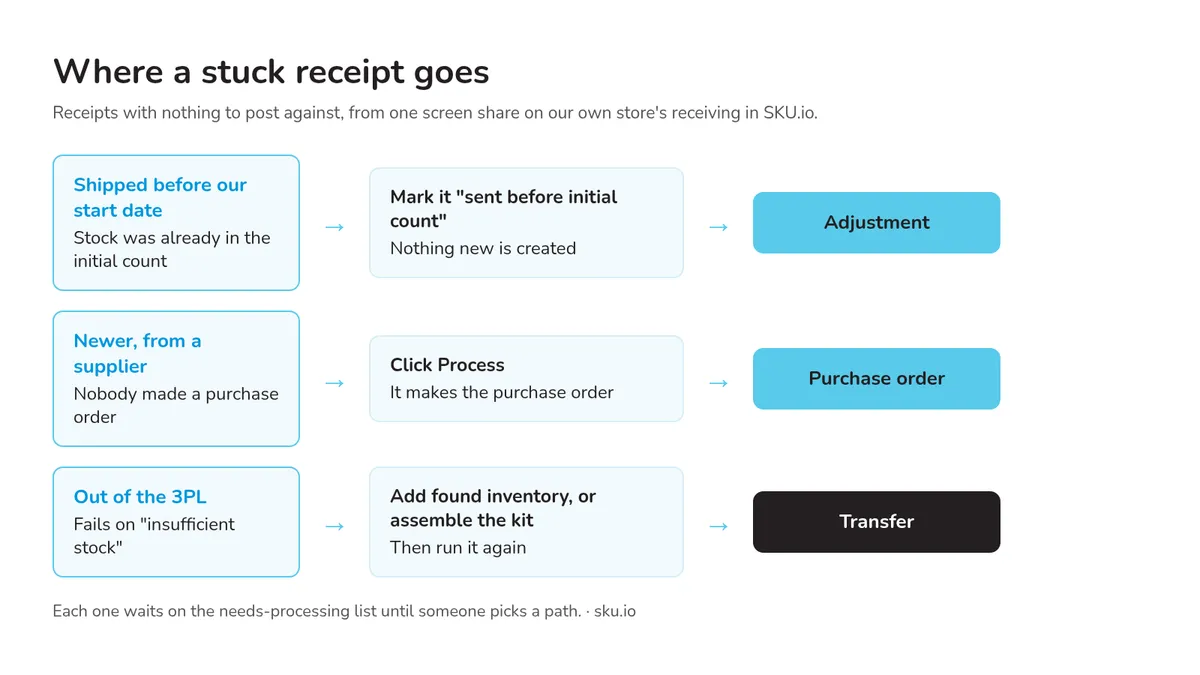
Most of the stuck receipts had nothing to post against. Nobody had ever turned the shipment into a purchase order or a transfer, so the receipt just sat. For the old ones, shipped before our start date, we marked the line as sent before the initial count, which doesn’t create anything and lets it through as an adjustment, since that stock was already counted. For newer ones there’s a process button. I didn’t know what process did until I clicked it. It made a purchase order from the supplier, which was right.
Then the transfers out of the 3PL started failing with “insufficient stock” and a product code, and that’s the part that ate the time. Their month-end report had stock we didn’t, so we’d add it as found inventory, back-dated to the start date because we had no better date, and run it again, and the next line would fail on something else. Some needed a kit assembled first. One needed 82 more on top of an old adjustment of 18, which made no sense until I opened the PO and it was for 100, so we changed the 18 to 100 instead of adding a second one. At some point we were down to 58 ledger entries still waiting on a receipt.
She asked what happens when the warehouse receives more than we sent, or less. I didn’t have a real answer. We opened cases for the shorts and left the overs alone.
Two other things I’d rather not have seen with someone new watching: a transfer that said partially received with 43 of 43 units in (ticket filed before we hung up), and an Amazon merchant-fulfilled listing mapped to the kit instead of the bundle, so every order on it would have come in out of stock.
About eight weeks later the needs-processing list was finally empty, except one shipment from early June had been sitting there, items at zero, because its kits were never assembled. Nothing had emailed anybody. In the meantime the 3PL still showed that stock as there, which overstates it when you’re deciding what to reorder. I exported the list, did a stock take, processed it. Around then the 3PL told us they’d switched systems and “corrected” a lot of inventory along the way, so I asked them for a physical count once things settled, and we’d redo the stock take against that.
With one supplier and one warehouse you won’t hit most of this, and inFlow or Zoho Inventory is fine. If you’ve got kits and two places stock lands, book a time.