
Order in Your Supplier's Unit, Stock in Yours: Cases, Bags and Purchase Units of Measure
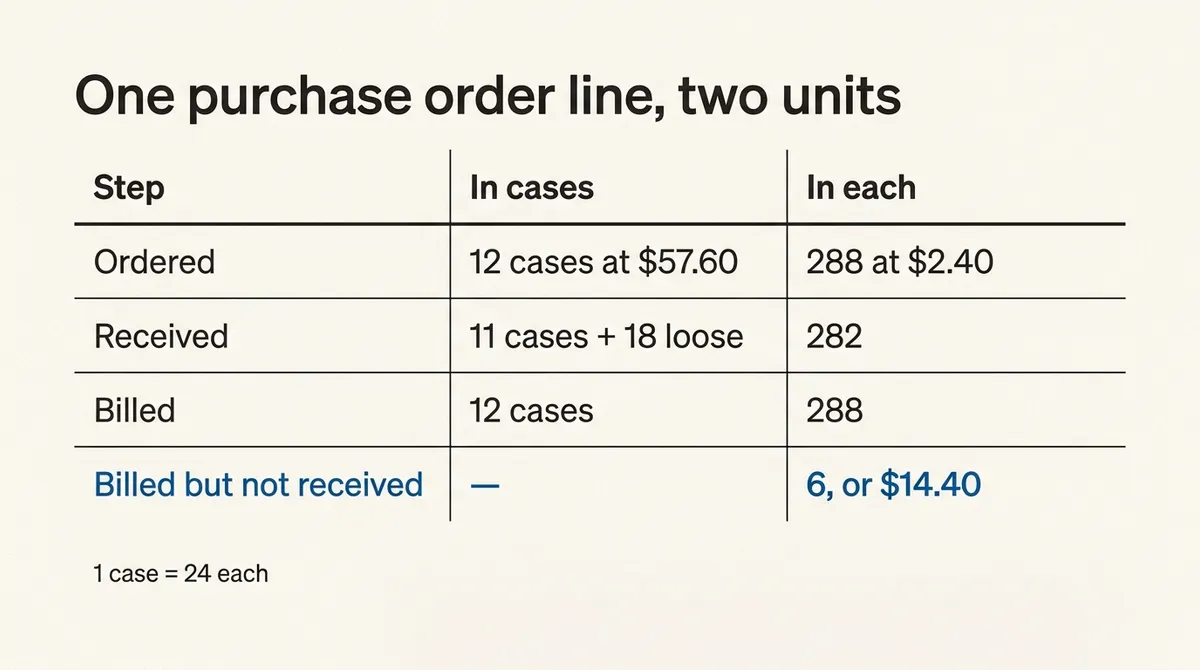
Your supplier sells by the case, the bag, the drum or the roll. You sell one at a time, or measure in pounds or grams. Put the conversion on the product once, order in the supplier’s unit, and let the purchase order carry both numbers: 12 cases to the supplier, 288 each to your stock. Then the receipt can be counted either way, the bill can be priced per case, and the cost per each comes from a division nobody has to do by hand.
A prospect on a call described where they’d ended up: “we now sell more by the case. So why can’t we just order by the case, receive as the case, ship as the case, and then on the few where we have to break it.” In my own business a few suppliers only sell in case packs, and we order in them.
Where the conversion goes wrong
The quantity. The PO says 12 and the supplier reads 12 cases, or the PO says 288 because someone typed in eaches and the supplier ships 288 cases. Either one is a phone call at best.
The cost. A price per case typed in as a price per each puts that product on your books at 24 times its value. Nobody notices until the inventory value looks odd at month end.
The rounding. Another owner explained where years of overstock had come from: “it only comes in a case… We go ahead and order the case at that point. And so I think over time that’s where a lot of the overstock came from.” Rounding up to whole cases is often right. You just want to see that it’s happening.
Weight and volume. A food maker on a call said, “all of our recipes are in grams,” while “the supplier sells it in a liquid measure and then we have to convert it over to a, you know, a mass.” That conversion should live on the product, set once, not in someone’s head every time they place an order.
One line, worked through
Say a part comes 24 to a case at $57.60 a case. You order 12 cases: 288 each at $2.40 each, $691.20 in all. The delivery is 11 full cases and one opened case with 18 left in it, so 282 each. The supplier bills 12 cases at $57.60. You’ve received 6 fewer than you’re being billed for, and the difference is $14.40. That’s small enough to argue about by email and large enough to want on the bill before you pay it. What to put on a purchase order for a factory covers the rest of what a supplier needs on each line.
How SKU.io handles it
The conversion lives on the product’s Units of Measure tab, for example 1 CASE = 24 EA, with the case ticked for purchasing. If one supplier sells in a different unit, you set its Purchase unit on the product’s Suppliers tab. The supplier’s unit wins, then the product’s purchase unit, then your stock unit.
A new PO line starts in that unit. It shows 12 CASE with 288 EA underneath, and the cost per case with the cost per each below it. A quantity that isn’t a whole case gets a warning, and a unit with no conversion can’t be picked until it has one. The PO document and the email print 12 CASE with “1 CASE = 24 EA” under the description, and the supplier portal works in cases too.
When the goods arrive you can count in either unit and switch between them on the receive drawer. Stock is always booked in your unit. Once anything on a line is received, the line keeps its unit. On the supplier’s bill you enter the quantity and price per case, and the stock-unit figures show underneath. Reorder suggestions round up to whole purchase units, so the overstock rounding is at least out in the open.
If you change a conversion later, open POs keep the factor they were ordered at. The product shows which ones, and a line can switch to the new conversion until anything on it is received or billed. Drop-ship lines stay in your stock unit. The steps are in order in your supplier’s unit.
If every supplier sells you single units, none of this is needed. If only one product comes by the case, a note on the PO line will do until it’s two or three.
This post is part of ordering from the factory in the contract manufacturing guide. If your case conversions live in a column of a spreadsheet, book a demo and bring it.