
Final Sale: Make Clearance Items Non-Returnable and Make It Stick at the Return Desk
Final sale means the buyer agreed, at the moment of purchase, that the item can’t be returned for a change of mind. It doesn’t cancel the right to send back something faulty, and in some places it can’t even cancel a change-of-mind return: a UK customer who buys online still has 14 days to cancel a clearance order. Where it does apply, it only holds if it’s still visible after the sale, to the customer, to whoever answers the return request, and to the system that issues the refund. If you run a single Shopify store under about $1M and approve every return yourself, a storefront label and your own memory are enough, and you can stop after the legal section.
The failure is rarely the wording. It’s the return request that lands six weeks later on a support queue, where the order looks like every other order and the agent approves it because nothing on the screen says otherwise. The owner of a distributor described the labels his team relies on, and one of them was exactly this case: an item “priced a certain way to get down on stock and also it’s non returnable so we need to see that you know on the customer order it was a clearance item.” The customer order, not the product. By the time a return comes in, the product page has usually moved on.
Where the law overrides the label
This is not legal advice. Return law differs by country and by US state, so check where your customers are, not where you are. Two primary sources show how far apart the rules sit.
United Kingdom. GOV.UK’s guidance for sellers says customers “have exactly the same rights to refunds when they buy items in a sale as when they buy them at full price,” and that it is illegal to restrict or take away those rights, or mislead customers about them, including with a sign saying you don’t accept returns. Faulty or not-as-described goods get a full refund. For online, mail and phone orders, the customer can cancel within 14 days of receiving the item and has another 14 days to send it back, faulty or not. The online and distance sales page lists the exceptions, and clearance isn’t one of them. Personalised or custom-made items are. So for a UK online shop, “final sale” on a marked-down item mostly can’t do what the label says. On a made-to-order item it can.
California. The Attorney General’s refund policy page starts from the other end: a store may refuse returns, but if it won’t give a full refund, credit or exchange within seven days of purchase with a receipt, it must clearly display that policy. Items marked as final sale are excluded from that posting rule, and the page notes that an implied warranty often exists by law even when the seller makes no guarantee. Final sale is allowed. A faulty item is still your problem.
Other states and countries sit somewhere between, which is why the return desk needs a warning it can override, not a wall.
The stock that comes back damaged earns the mark
What decides it is what a return costs you, not how big the discount was. I learned that on helmets. On paper they made about 75% margin. They came in sizes and colours, so they were returned constantly, a lot of them came back scratched, and they were bulky, so storage fees were high on top. The margin I actually kept was far below the one I’d priced against, and the per-order profit report never showed it; I only saw it when I went looking for returns, damage and storage cost product by product.
Clearance priced at or below landed cost is that problem with no cushion at all. A return gives back no margin, because there is none; it adds shipping both ways, handling, and a unit that resells lower still. Your clearance markdown strategy assumes those units leave for good, and since clearance is the last stage of clearing what’s left, most final-sale stock arrives through a clearance plan. Custom and personalised orders are the other clear case: nobody else will buy a monogrammed one, and it’s the category the UK rules carve out.
Open-box is where I’d slow down. The discount is the price of the opened box, and a second return drops it another grade, so it looks like an easy final-sale candidate. But it has to be sold as its own thing first. We listed open-box units on Amazon as new, open box, and then found out that condition doesn’t exist there. One lot had to come back on a removal order; Amazon hadn’t complained about the others, so we left them, and the rule now is to list open-box as used. Get the listing right on each channel before you worry about the return policy.
And a modest promotion on current stock usually shouldn’t be final sale at all. On eBay we sell blemished returns with a price that drops every week until the unit goes, with a floor so it never sells for less than it costs to ship, and we still accept returns on those listings because an open return policy helps ranking and conversion there. A label that’s on everything stops being read.
Your storefront says it; sku.io remembers it
The buyer has to see it before paying: next to the price, on the cart line, and on the order confirmation. A sentence on the returns policy page alone is not where buyers look.
| Where it’s seen | Who puts it there |
|---|---|
| Product page, next to the price | You, in your storefront theme |
| Cart and checkout | You, in your storefront |
| Order confirmation email or receipt | You, in your storefront’s notification templates |
| Returns policy page | You, checked against the rules where your buyers are |
| Each order line, after the sale | sku.io stamps it when the line is created |
| The screen where staff create a return | sku.io warns them |
| The customer return portal | sku.io blocks the item |
Final sale is not pushed to any storefront. Disclosure at the point of sale is your job; sku.io stamps the order line, warns support in Create RMA and blocks the item in the customer return portal.
Why the mark goes on the order line
A product flag read live at return time is wrong in both directions. Take it off when the clearance ends and every order sold during the clearance becomes returnable again. Put it on a product that used to sell at full price and last year’s full-price orders become non-returnable.
So sku.io records final sale on each order line when the line is created and doesn’t re-read it. You set it on a product by hand, or switch it on for a whole clearance plan, which covers every product on the plan while the plan is active. Lines from every source get the stamp, whether entered by hand or arriving from a channel import, the API, EDI or a CSV, and a line split for a partial shipment or swapped to a substitute keeps it. Change a line to a different product outright and it’s checked again against the new one. The make products final sale guide has the clicks, and create a clearance plan has the plan setting.
What sku.io’s final sale won’t do
Plan around these.
It can’t be applied backwards. If you switch it on after the first wave of markdown orders, those orders were sold returnable and stay that way; there’s no setting to stamp lines already sold. Set it before the markdown goes live.
The mark is per SKU. An open-box unit that shares a SKU with new stock makes the new stock final sale too, so give it its own SKU first.
A product can sit in only one active clearance plan. If it’s already in an older plan that left returns as normal, adding it to your final-sale plan skips it, and its orders stay returnable until the first plan ends and the new one picks it up.
The staff warning is a warning. Anyone who can create a return can click past it, which is deliberate, because faulty and wrong-item returns have to go through, but it means the control is your team reading it.
The block only covers the sku.io customer portal, the site your wholesale buyers sign in to, where a final-sale item is greyed out and the server refuses the line if someone sends the request directly. Returns your DTC shoppers start in a returns app or on your storefront need the same rule set in that tool.
What it’s worth on one clearance
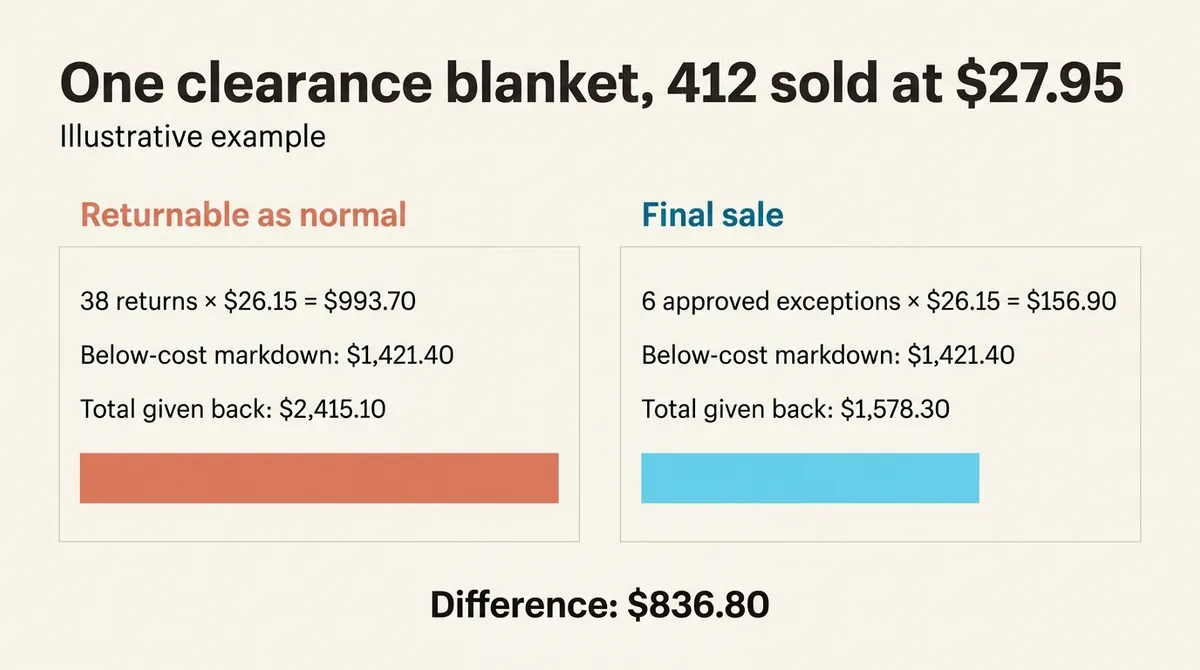
Take a home-goods brand clearing a discontinued throw blanket, landed at $31.40, marked down to $27.95 and sold 412 times. Each return costs it about $26: return label, inspection, the outbound shipping it doesn’t get back, and the drop to the next markdown price when the blanket resells.
| Returnable as normal | Final sale | |
|---|---|---|
| Returns accepted | 38 | 6 (faulty or wrong item, approved past the warning) |
| Cost of returns at $26.15 each | $993.70 | $156.90 |
| Below-cost markdown on 412 units | $1,421.40 | $1,421.40 |
| Total given back | $2,415.10 | $1,578.30 |
The six exceptions still get refunded. For a UK online shop, the 14-day cancellation right applies to this blanket whatever the label says, and the left column is the realistic one.
I founded sku.io, so weigh what I say about it accordingly. Clearance is one stage of a product lifecycle that runs from launch to the last unit, and if you want to see the final-sale stamp on your own orders, book a demo.