
How to Split One Stock Between Amazon FBA, Walmart WFS and TikTok FBT
When Amazon FBA, Walmart WFS and Fulfilled by TikTok (FBT) all need stock from the same warehouse, take your own channels’ stock off the top first. Then lift each network to its floor and share what’s left so the lowest network gets the days of cover first, not by units and not by share of sales. With 2,200 units at home and 40 a day sold from there, three weeks for your own orders keeps 840 back and leaves 1,360 for networks that, between them, want 2,695.
This is for a brand that sends to two or more of those networks from one pool of stock and also ships its own Shopify, wholesale or merchant-fulfilled orders. If FBT is the only network, the arithmetic is in Fulfilled by TikTok, when you also sell on Shopify and Amazon. How TikTok’s FBT-first rule lands on your own stock is in TikTok Shop fulfillment.
Your own channels come off the top
A unit on your own shelf can still become anything: a Shopify order, a wholesale case, an Amazon order you ship yourself, or next week’s send to whichever network sold faster than you planned. Once it’s in a network’s building, selling it anywhere else is slower and dearer. FBA stock can ship your Shopify orders through Amazon’s Multi-Channel Fulfillment, but at Amazon’s price and on Amazon’s schedule. Whether FBT stock can ship anything but TikTok orders is still unsettled, so check your own Seller Center before you count on it.
So before any network gets a unit, keep back:
- some days of what your self-fulfilled orders sell (40 a day × 21 days = 840 here),
- open orders that aren’t allocated yet,
- backorders.
This example has no open orders or backorders, so the 840 is all of it. Three weeks is a sensible start. Go longer if your own channels are lumpy, like a wholesale account that orders a pallet once a month. Go shorter if you send every week and a late send is never far from being fixed.
TikTok gives you a second reason. Its logistics overview (updated July 6, 2026) says that when you stock both FBT and your own warehouse, “FBT inventory will be used first. After the FBT inventory is used up, the order will be fulfilled through your own warehouse inventory.” When an FBT send is late, those orders come out of the 840.
Four ways to share 1,360 units
One product, made-up numbers. It sells 60 a day through FBA, 30 through FBT, and 15 through WFS, which the brand added this year. FBA holds 1,500, which is 25 days. WFS holds 200, about 13. FBT holds 210, seven. A send takes 9 days to be sellable at FBA, 7 at WFS and 6 at FBT. Each network wants enough for the trip plus a target of 45 days at FBA, 30 at WFS and 21 at FBT: 1,740, 355 and 600 units.
What you care about is how many days each network has left on the day its send lands:
| Split | FBA gets | WFS gets | FBT gets | FBA days on arrival | WFS days | FBT days |
|---|---|---|---|---|---|---|
| By share of sales (57/14/29%) | 777 | 194 | 389 | 28.9 | 19.3 | 14.0 |
| By share of need | 878 | 179 | 303 | 30.6 | 18.3 | 11.1 |
| TikTok first, Amazon next | 760 | 0 | 600 | 28.7 | 6.3 | 21.0 |
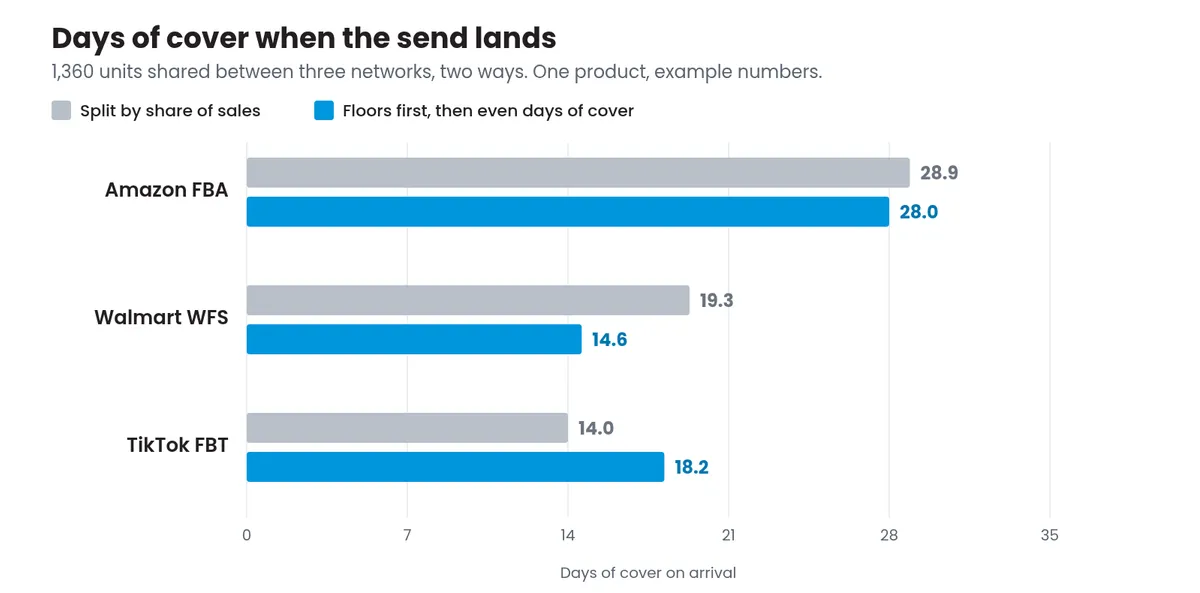
| Floors first, then even days | 720 | 124 | 516 | 28.0 | 14.6 | 18.2 |
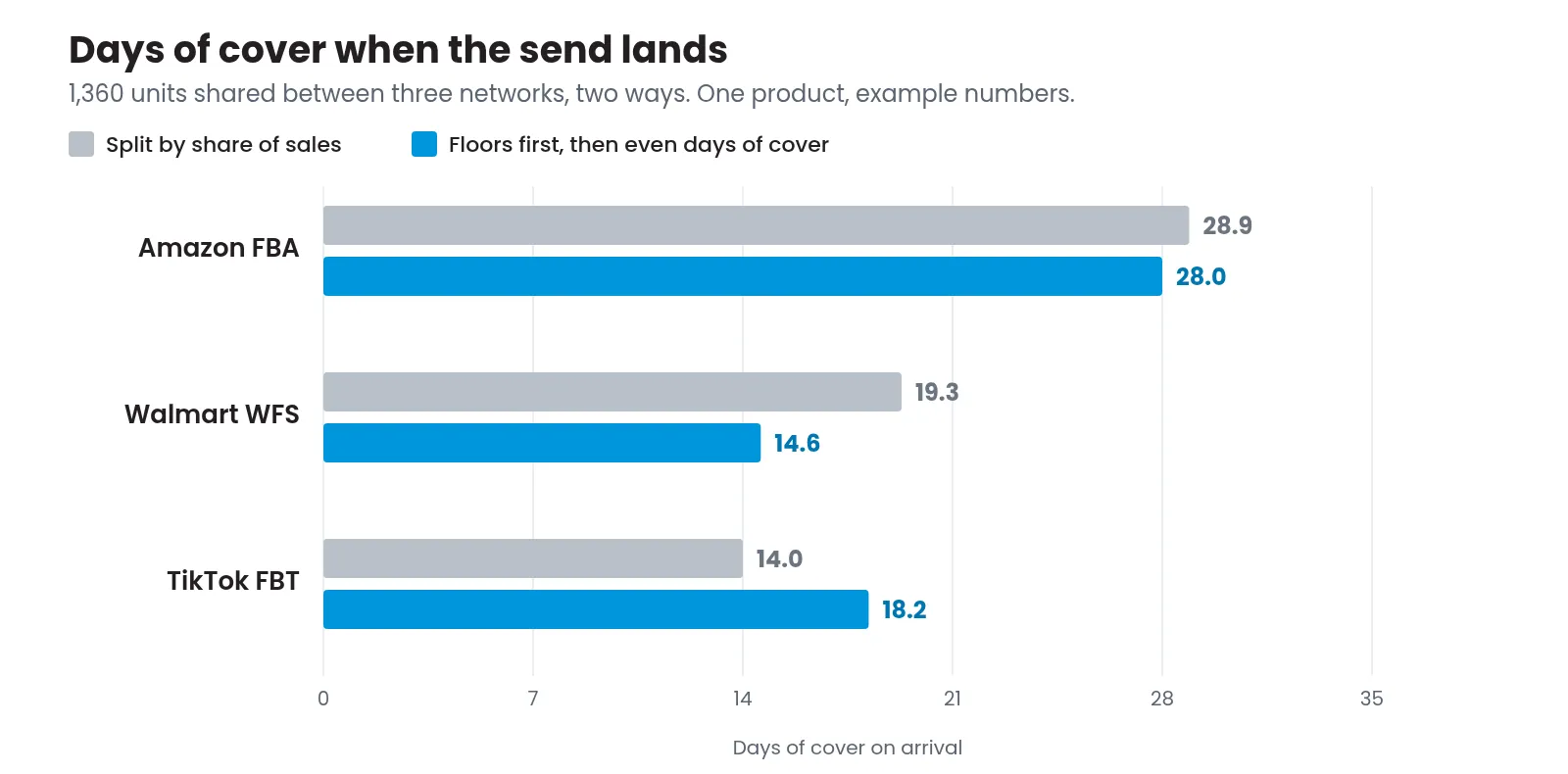
Splitting by sales is what most spreadsheets do, and here it gives Walmart more days than TikTok: 19.3 against 14.0, for the channel that sells half as fast. When TikTok runs short, its orders land on your own warehouse.
Splitting by need does worse still. FBA’s need is the biggest for the same reason its sales are, and its 45-day target makes it bigger still. FBT lands with 11 days, so with a six-day trip the next send has to leave five days after this one arrives.
“TikTok first” is what brands do when TikTok is the channel that punishes them hardest for running out. Here it lands WFS with six days, under any floor you’d set.
The last row is the one I’d use. Every network first gets its floor, the days of cover it should never drop below. Whatever is left goes to the network with the fewest days, weighted by a priority you set, until the days are level or the network has its full target.
Why FBA gets only its floor
FBA sells the most and gets 720, less than half its need.
The floors here are 28 days at FBA, 14 at WFS and 10 at FBT. Lifting each to its floor on arrival takes 720, 115 and 270 units, 1,105 in all, which leaves 255. FBA already lands at 28 days, more than the other two will reach, so the 255 go to TikTok and Walmart. FBT climbs from 10 days to 18.2. WFS gets nine more units and ends at 14.6.
That last part is a choice. WFS levels out at 80% of FBT’s days because I gave Walmart a priority of 0.8 and the other two 1.0. Priority is your setting, not Walmart’s. A channel the brand added this year, selling 15 a day, can sit a little under the others until its sales earn more. Raise it to 1.0 when they do, not because the listing is new and you want it to look busy.
The floors decide the rest. FBA’s is 28 days, the highest of the three, so in a short month FBA keeps 28 days and the other two share what’s left. Lower it to 21 and FBA gets about 170 fewer units, split about evenly: TikTok reaches its full 600 and Walmart gets the other 84 or so.
A network that has never sold the product
Days of cover don’t work for a network with no sales. Zero a day makes any stock look like forever, and any formula built on daily sales says to send nothing.
We hit this in October at the e-commerce business I run alongside SKU.io, planning a Walmart send. As I put it to my operations lead that day: “We haven’t sent enough and had sales on WFS to know.” So stop asking how many days. Ask how many units you’re willing to have sitting where only one marketplace can sell them for a month, and send that. A fair guess is half of what your next-closest channel sells over the same stretch, with a hard cap so a hot Amazon listing doesn’t talk you into a pallet. Then let the second send work from real sales.
A network that ran out looks slower than it is
If FBT was out of stock 10 of the last 30 days and sold 400, it didn’t sell 13 a day. It sold 20 a day on the days it could. Split on 13 and you send too little, it runs out again, and next month’s average is lower still. Divide by the days it was in stock. Just don’t trust the result when it was in stock for only a few days: four good days after a creator video is not a rate.
The same stock-out also distorts the 840. While FBT was empty, TikTok’s orders came from your warehouse, so your own channels’ daily sales went up, and so did what you keep back. After a week or more out of stock anywhere, look at the self-fulfilled rate yourself before you trust the reserve.
When a network is full
In November the same business reached its Amazon capacity limit. We were also planning sends to AWD, Amazon’s upstream warehouse that refills FBA, and one product was refused there: Amazon had tagged it as hazmat, and AWD won’t take it. It isn’t hazmat, and we’ve asked Amazon to fix the tag. Until they do, that product’s share can’t go there, so check that every product is allowed into a network before you plan around it.
TikTok sets FBT space as well. The same overview says each account gets storage capacity “determined by the system based on the store’s sell-through and product volume,” and you can ask for more when an inbound order is refused for lack of it.
When a network is capped, cut its send by whole cartons, your slowest-selling items first, and among those the ones that would have the most days after the send. What FBA can’t take can wait in AWD if you use it and AWD has room. What WFS or FBT can’t take stays home, where it’s still sellable everywhere.
Don’t hold the units until you’re ready to pack
Planning moves nothing, so until you allocate, your other channels can still sell the units you planned to send. Once you allocate, they leave the available count your channels sell from, though they’re still on your shelf. So allocate when you’re ready to build the shipment, not the day you first look at the plan. A send allocated and drafted on Friday for a Wednesday pickup takes the units off your website for five days for nothing.
Where SKU.io does this
The Send Planner does this split for every product at once. The example’s floors and targets are its defaults (28 and 45 days at FBA, 14 and 30 at WFS, 10 and 21 at FBT, WFS at priority 0.8), and it keeps 21 days of self-fulfilled demand before any network gets a unit. A listing with no sales starts at a fixed quantity, 48 units for WFS and 120 for FBT unless you change them, or at half another network’s sales capped at that quantity.
It divides a network’s sales by its days in stock, up to three times the raw rate and only with at least a week in stock, and it notes when your self-fulfilled rate may include a stocked-out network’s orders. Over a monthly capacity limit it cuts whole cartons, starting with C items, the products in your lowest ABC class. Its allocation lasts 72 hours, until a draft takes over: FBA’s once the draft is verified, WFS’s and FBT’s once it’s submitted.
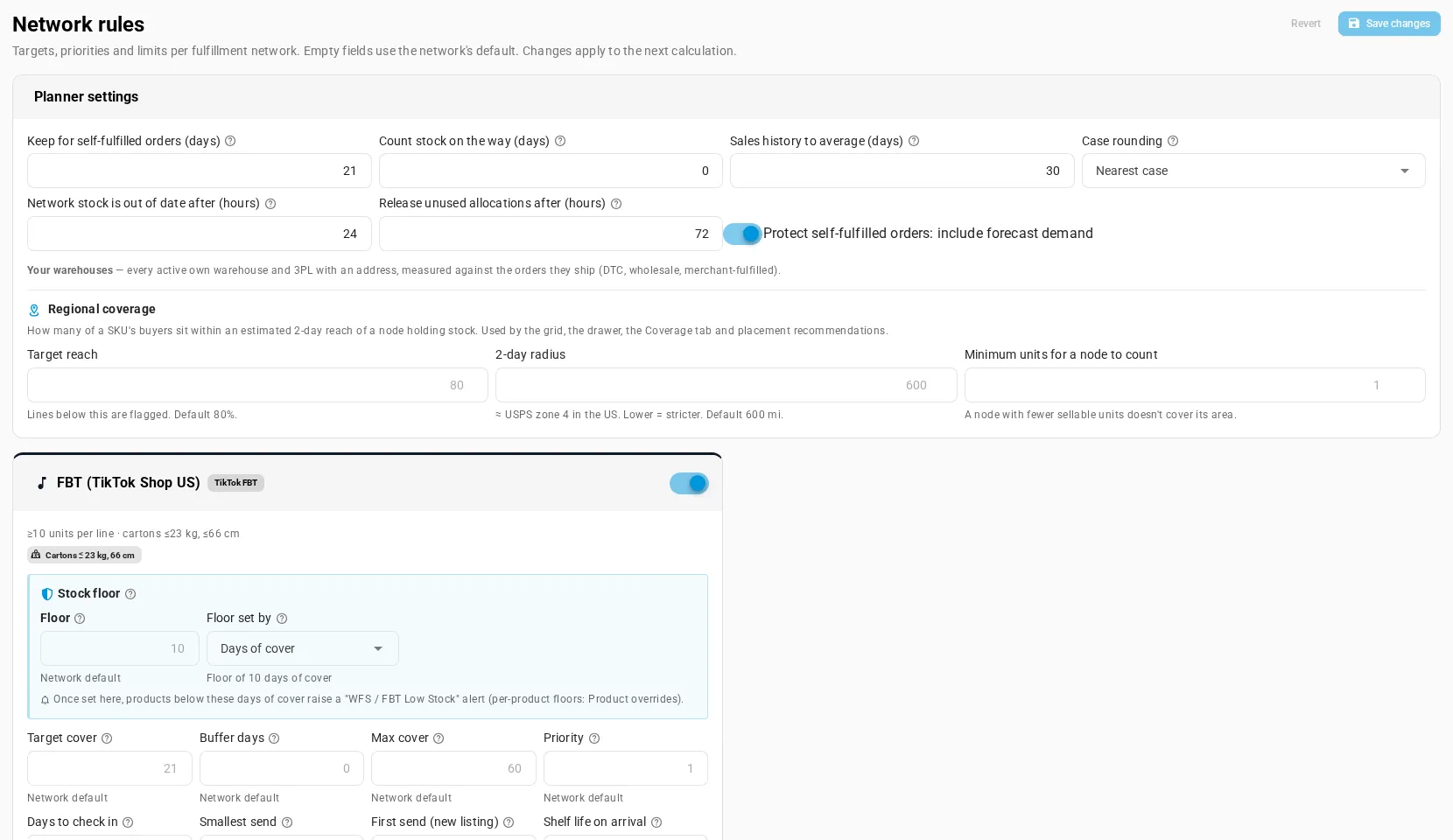
That’s the FBT card in our demo account, a made-up brand we use for screenshots. The FBA and WFS cards have the same fields. How stock is shared between networks walks through each pass on screen.
You can also tell the planner to favor one network over your own orders, so it may use the stock kept for forecast self-fulfilled demand. It never touches stock promised to open orders or backorders. I’d only do that for a launch or a promotion already paid for, and switch it back after.
Who this isn’t for
If you send to one network, this is the FBT article’s problem, or Amazon’s restock report’s. With a dozen products and one or two networks, a spreadsheet does it: daily sales by network, what each holds, its trip, its floor, and days of cover on arrival, filled in the order above.
An e-commerce lead put the real problem as how to “balance that available to promise against all of the channels so that they don’t all think that they have 60,000 units on available for pre sell.” If your FBA, WFS and FBT sends come out of the same shelf, book a demo. Bring one product’s daily sales by network and what each holds, and we’ll split it with you.