
Run Inventory and Purchasing with AI Agents (2026)
I’m Kalvin, SKU.io’s founder. I also run my own e-commerce business, and it runs on SKU.io. Earlier this year I started building an operations agent for that business. The first skill I gave it was simple: connect to my ERP and pull margin data, so I could decide how much room I had for advertising. It pulled the actual margin numbers out of my account and I used them to set that week’s ad budget.
So when I say terminal-based AI agents like Claude Code can operate an inventory system today, through the API, I mean I do it, on my own business, most weeks. In July we shipped the piece that makes this practical for people who are not me: Agentic Skills, an open-source library of ready-made playbooks that teach an agent how to do real tasks in SKU.io.
What can an AI agent actually do in an inventory system?
Today the library covers the work I’d actually hand to an agent first: building a product catalog from a spreadsheet or a supplier price list, creating purchase orders and sales orders, adjusting inventory, setting up saved views of your data. It’s all MIT-licensed, on GitHub at github.com/skuio/sku-skills.
The catalog example is the one I show people. You hand the agent a supplier’s messy price list and it reads the rows, maps them onto real product fields, de-duplicates against what your catalog already has, and creates the products. The practical details that usually eat an afternoon, like which column is the supplier’s SKU versus yours or where the wholesale price goes, are baked into the skill, so the agent gets them right without you explaining your data model every time. The library has gaps, and that’s partly by design. Every skill ends with a note telling your agent how to improve it and open a pull request, so the gaps close from real usage instead of from my roadmap.
But the deeper use is questions, not data entry. A buyer at a kids-clothing brand told me what she did before an important vendor meeting:
“I ran 58 separate reports on Shopify over our sales for the last two years on that vendor, relating to the silhouette, sizes, boy, girl. And then I put them all in Claude… and asked it to condense that material.”
That’s word for word from the call recording, and the ellipsis is me trimming the part where she said she also put them all in ChatGPT. I haven’t asked her whether I can name her, so I won’t. She then asked me whether she could get to the same answer without running 58 reports. She can. An agent with API access goes and gets the data itself.
How do you connect an agent like Claude Code to SKU.io?
Create a Personal Access Token in SKU.io and give it only the scopes you want the agent to have. Copy the skill folders you want into your project’s .claude/skills/ directory. Then point the agent at a task and get out of the way. For OpenAI or Gemini the same skills compile to native instructions and tool definitions, so you are not locked into one model.
The reason this works so well on SKU.io is a design decision that predates the AI wave: the platform is API-first. Every single thing you can do in the front end, we have an API call for, which means an agent can do it too. My view when I started publishing the skills was that anyone could have built them already just by reading our API docs. There are thousands of documented endpoints, and API access is included in every plan. We never charge extra for it. If you’re weighing anyone’s platform on this, inventory management API: what to check first is the checklist I’d use.
Do you need MCP for this?
No, and this is where I hold a minority opinion. The industry default is to stand up an MCP server for everything. My belief is that MCPs are a bridge. The models have caught up so quickly that they can understand a well-documented API directly, and a curated skill on top of good API docs beats a protocol layer that has to be maintained separately. It’s really the API that matters. The skills library reflects that bet: each skill tells the agent which endpoints to call, in what order, with which fields, and the e-commerce context to get it right. If you prefer MCP, nothing stops you wrapping our API in one, and the skills are MIT-licensed so they don’t lock you into my opinion either way.
Start read-only
Margin reports, stock questions, catalog audits. That is where I started on my own business and the risk there is nothing, because the token cannot write.
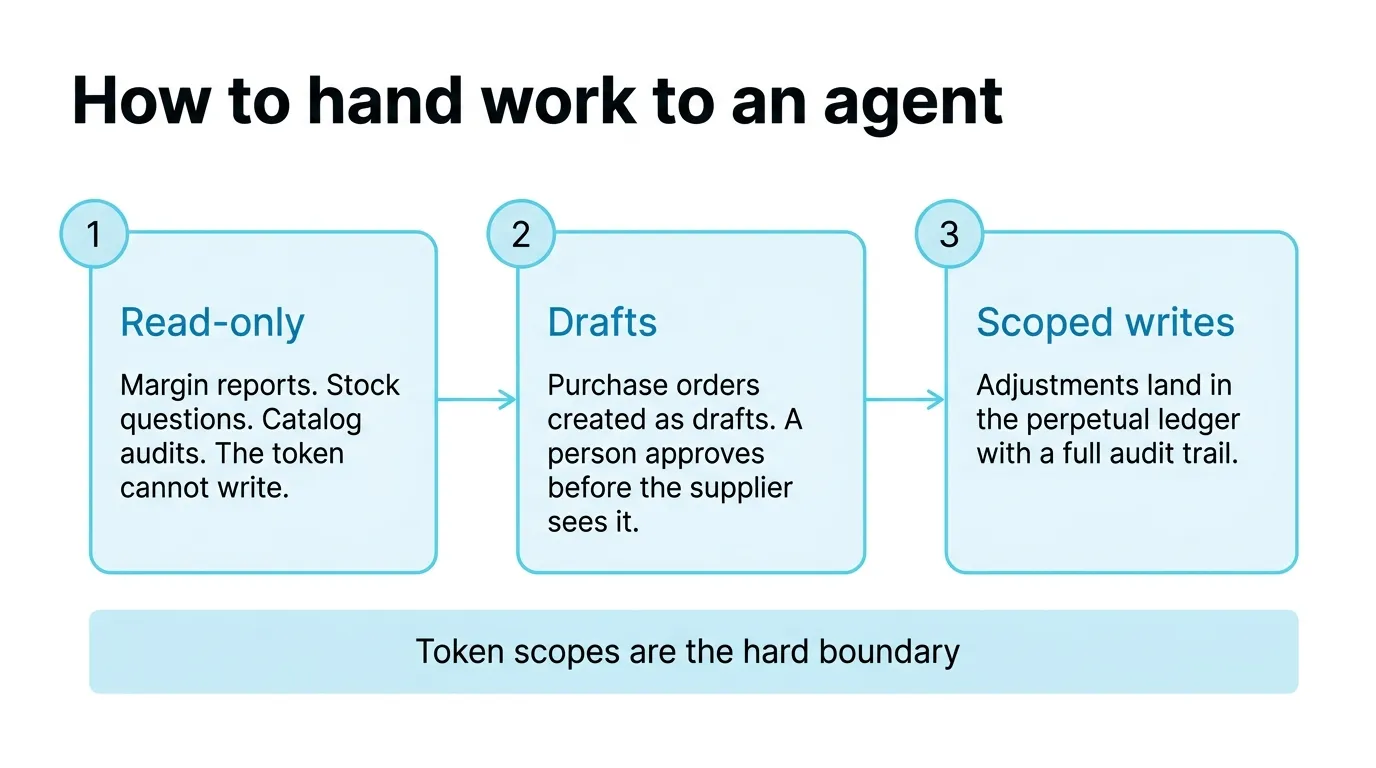
Then move to writes that have a natural review step. The purchase-order skill can create POs as drafts, so a person still opens and approves the order before it goes to a supplier.
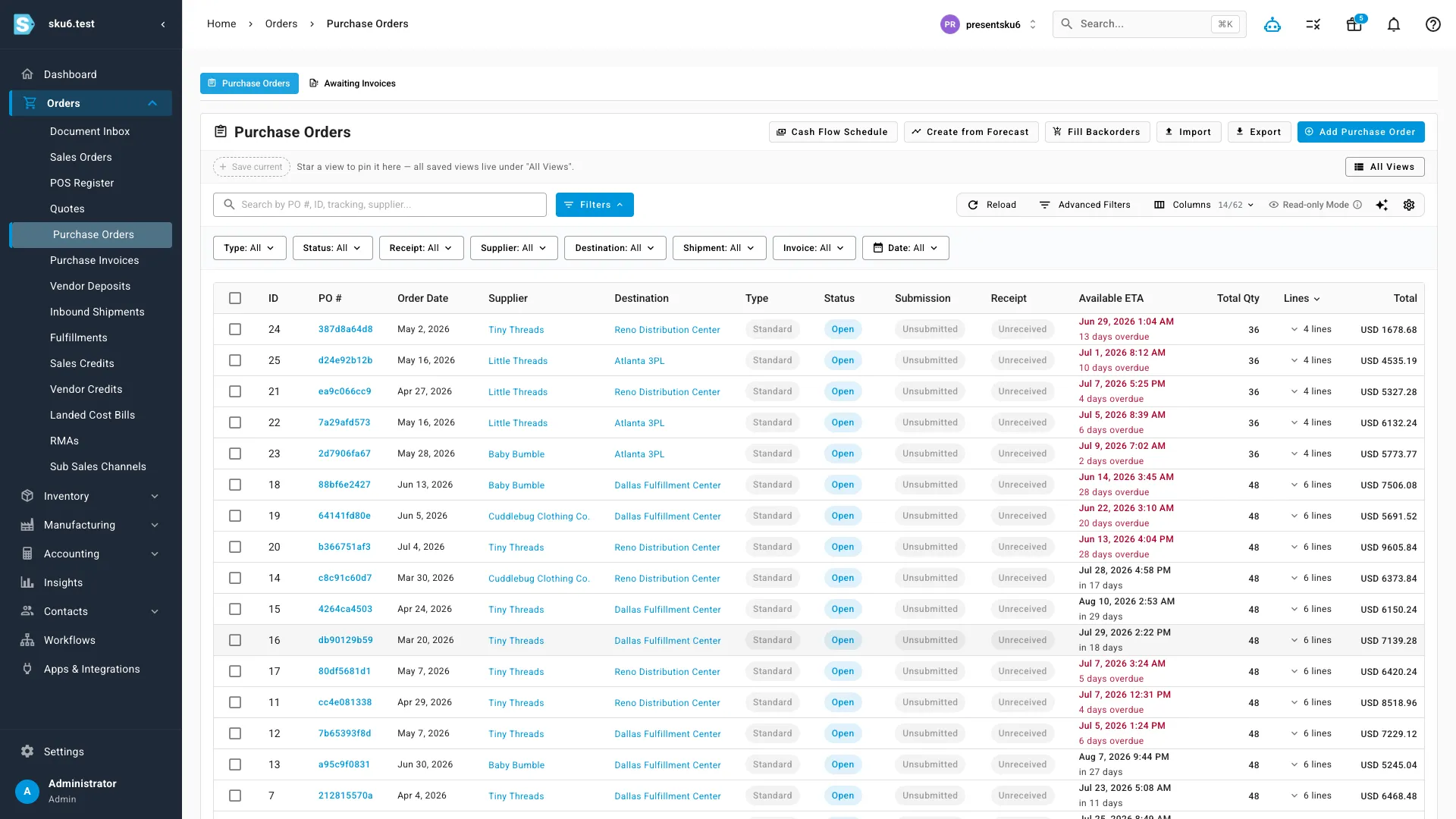
Status and submission are two different columns on purpose. An agent can fill the list; the order does not reach the supplier until a person submits it.
Inventory adjustments land in SKU.io’s perpetual ledger like every other movement, with a full audit trail of what changed and when, so an agent’s work is exactly as inspectable as a person’s. And the token scopes are the hard boundary: an agent with read-only scopes cannot write, no matter what it decides to try.
An operations manager at one of our customers asked me on a call for “a remind me feature — like, remind me that I need to add landed costs to this PO.” She was already running her own reminder tasks through Claude on the side, without asking anyone’s permission or waiting for a feature.
Where I think this goes
The UI becomes optional for a growing share of operations work. I was saying this on sales calls before we had anything to sell around it, and it keeps coming up in them now without me raising it. I even build the product this way. When I demoed our forecasting module in January, the person on the call noticed Claude in my taskbar, and I told her the truth: I didn’t write the code for that module. I directed AI that wrote it, iteratively.
The same drop in cost is why more operators now ask whether they should just build the whole system themselves. I did exactly that in 2008 and ran it for eleven years, and what that actually costs is the part the weekend prototype doesn’t show you.
Not everything belongs in a terminal. You still want a scanner in your hand when you receive stock, and a guided pick path in the warehouse. But the administrative middle of the job is mostly running reports and drafting orders, and that part an agent already does well. Honestly, that part is most of the week.
The argument for the platform underneath, the ledger and order-level profit and the multichannel engine, lives at what SKU.io is. The skills are free regardless of what you decide about us. Take them, point your agent at our API docs, and see what it does on your data. Or book a demo and I’ll show you my own agent working.
If a vendor tells you their AI is the selling point, the one-minute console test shows whether an outside agent could do any of this.