
Bill of materials template
How to make a BOM, and what each unit costs to make
A bill of materials (BOM) lists what one finished unit is made of and how much of each. Make yours in six steps, cost it in the calculator below, and keep it in the free sheet, which converts units and adds scrap for you.
- Free, no email, no sign-up
- Opens in Excel, Google Sheets and Numbers
- The math is built in
Fill it in here, or download it
Bill of materials template, with the reasons for each part
Type over the underlined parts and print it or save it as a PDF. Or download the Excel file, which has the same layout and formulas plus room for more lines.
Swipe the sheet sideways to see all of it.
-
What it makes
One BOM per SKU you sell, with a version and the date it takes effect. When the recipe changes, start v2 and keep v1 for the units already built.
-
Every component, by SKU
Raw materials, packaging, labels and inserts. If making one unit uses it up, it gets a line. Use the SKU your purchase orders use.
-
Quantity for one unit
Ounces of wax in one candle, not pounds in a batch. Type it in the unit you measure with; the sheet converts it to the unit you buy in.
-
Scrap
What making one unit wastes: wax left in the pot, misprinted labels, a cracked jar. 4 means 4% more than the recipe says.
-
Unit cost, as you buy it
Per pound, per ounce or each, from the latest invoice with freight and duty in. Pick the unit the price is per in the next column.
-
Cost per unit
Materials plus labor and overhead for one unit. This is the cost your inventory and cost of goods sold should carry for the SKU.
Run this in SKU.io
Build from the BOM, and let the cost follow
In SKU.io a bill of materials is a recipe on the finished product: components with a quantity, unit and expected scrap on each line, versioned so a change does not rewrite past builds. A manufacturing order builds from it, draws the components from stock oldest cost first, and puts the finished units into stock at what they cost to make.
| In the spreadsheet | In SKU.io |
|---|---|
| One tab per product, copied by hand | A recipe per product, versioned, with one default |
| Recipes typed in one at a time | Import every recipe from one spreadsheet, a row per component |
| Unit costs typed from the last invoice | Components drawn from stock at their FIFO cost when you build |
| Cost per unit copied into the product | Finished units costed into stock, labor and overhead included |
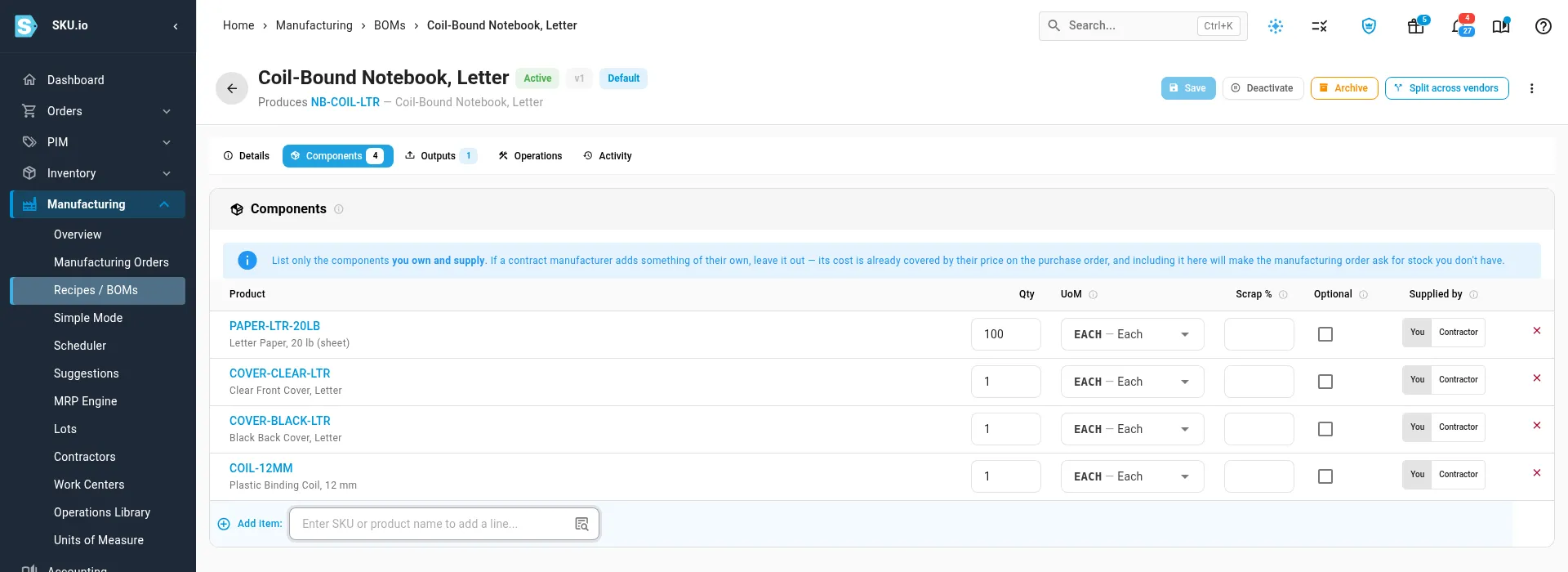
How to make a BOM in six steps
- Start from the SKU you sell. One BOM per sellable unit. A three-pack you pack yourself is its own product with its own BOM, and its main component is the single unit.
- List every component one unit uses up. Raw materials, packaging, labels, inserts, the shipping carton if every unit gets one. Watch one unit being made and write down everything that goes into it. Tools and machines are not components; their cost belongs in overhead.
- Write the quantity for one unit, in the unit you measure. 7.5 oz of wax, 1 jar, 18 in of ribbon. A batch recipe divides by the units the batch makes.
- Add the scrap you expect. Some material never reaches a finished unit. A percent on the line covers it, so the BOM matches what you actually use up.
- Put a unit cost on each component, in the unit you buy it. Wax by the pound, fragrance by the ounce, jars each. Use the landed cost, with freight and duty in: the landed cost spreadsheet works it out per unit.
- Add it up, then add labor and overhead. Each line is quantity × (1 + scrap) × unit cost, after converting the quantity to the unit the cost is in. The lines add up to the material cost. Labor and overhead per unit on top give the cost the SKU should carry.
Then give it a version and a date. The day the jar supplier changes, you start v2. The units already in stock were made from v1, and their cost should stay what v1 says.
BOM cost calculator
The sample is an 8 oz soy candle, made up for this page. Change any number, add your own components or clear it and start from scratch. Add what you have on hand and a build quantity to see what a production run is short of before you schedule it.
Your BOM
On hand is counted in the cost unit: pounds of wax when wax is priced per pound. A sub-assembly is a component like any other: put in its own cost per unit from a second run.
Cost to make one
$5.87
$4.72 materials + $1.15 labor and overhead
Where the materials money goes
Build 500
- Materials for the build
- $2,359.95
- With labor and overhead
- $2,934.95
You can build 369 now. SOY-WAX runs out first. Short by $153.00 of stock.
| Component | Needed | On hand | Short |
|---|---|---|---|
| SOY-WAX | 243.75 lb | 180 | 63.75 lb |
| FRAG-OIL | 375 oz | 900 | none |
| WICK-CD10 | 510 ea | 2,000 | none |
| JAR-8OZ | 505 ea | 600 | none |
| LID-BLK | 500 ea | 650 | none |
| LABEL-FRONT | 525 ea | 1,500 | none |
The arithmetic
- SOY-WAX: 7.5 oz × 1.04 = 0.4875 lb × $2.40 = $1.17
- FRAG-OIL: 0.75 oz = 0.75 oz × $1.90 = $1.43
- WICK-CD10: 1 ea × 1.02 = 1.02 ea × $0.12 = $0.12
- JAR-8OZ: 1 ea × 1.01 = 1.01 ea × $1.35 = $1.36
- LID-BLK: 1 ea = 1 ea × $0.45 = $0.45
- LABEL-FRONT: 1 ea × 1.05 = 1.05 ea × $0.18 = $0.19
- Materials $4.72 + labor $0.85 + overhead $0.30 = $5.87 per unit
The BOM cost formula
Line cost = quantity per unit × (1 + scrap %) × unit cost, with the quantity converted to the unit the cost is quoted in. The candle's wax line: 7.5 oz with 4% scrap is 7.8 oz, which is 0.4875 lb, and at $2.40 a pound that is $1.17. Six lines like it add up to $4.72 of materials, and $0.85 of labor and $0.30 of overhead make $5.87 a candle.
The sorted lines are worth a look. In this sample the fragrance oil costs more than the wax (30% of materials against 25%), which is the opposite of what the recipe's quantities suggest. A BOM that only lists quantities hides that. Costed, it tells you which supplier price to negotiate first.
Units are where hand-built BOMs go wrong
The recipe is written in ounces and the wax is bought by the pound. Type 7.5 against a price per pound without converting and the wax line costs $18.72 instead of $1.17, sixteen times too much. The opposite mistake, a pound recipe against a price per ounce, makes the line sixteen times too cheap, and that one nobody notices until the margin report looks too good.
So keep two units on every line: the one you measure in and the one you buy in. The calculator and the sheet convert weight to weight, volume to volume, length to length and dozens to each. They refuse to turn fluid ounces into pounds, because that takes the density of the ingredient. In SKU.io you set a density on the product once and a recipe line in fluid ounces converts to the grams you stock it in.
Multi-level BOMs, kits and bundles
A gift set of three candles has a BOM whose main component is the candle, which has a BOM of its own. Costs roll up: three candles at $4.72 of materials, a $1.60 box and a $0.35 insert put the set at $16.11 of materials.
Labor is the part to decide on purpose. Carry each candle at its full $5.87, with the pouring labor and overhead, and the set's components come to $19.56 before anyone packs the box. The Excel file works that way: the gift set tab reads the candle's cost per unit from the candle tab, and the packing labor goes on the set.
Stock rolls up too. The wax on hand covers 369 candles, so it covers 123 gift sets, even though there are boxes for 150. Kits and bundles sold on several channels are where this bites, because every channel needs to know how many sets the component stock allows.
Before a run: what you can build
A BOM also tells you what a production run takes. Five hundred candles need 243.75 lb of wax, and there are 180 lb on the shelf, so the run is 63.75 lb ($153.00) short. You can pour 369 now, or order the wax first. That is a purchase order, and the purchase order template has room for the supplier's SKU beside yours. How early to order it is the reorder point, worked out from what the BOM consumes.
Where a BOM spreadsheet stops working
A sheet is the right place to start. It shows you what each product is made of, and the cost per unit it gives is far better than a guess. It stops keeping up in three places. Unit costs change with every purchase order, and the sheet holds whatever was typed last. Building a run does not take the components out of stock, so the count and the sheet drift apart. And a new version means a copied tab, with nothing to say which units were made from which.
If you have many products, the SKU.io Ops Calculators cost a whole BOM export at once in Claude or ChatGPT, every level of sub-assemblies included, with the same math as the calculator above. When it is time to move the BOMs out of the sheet, SKU.io imports them from a spreadsheet, one row per component.
Questions people ask
How do you make a BOM?
Start with the finished SKU. List every component one unit uses up, with the quantity one unit takes and the unit that quantity is in. Add the scrap you expect, then the unit cost of each component in the unit you buy it in. Multiply each line out and add the lines: that is the material cost of one unit. Add labor and overhead per unit for the full cost.
How do you calculate the cost of a bill of materials?
For each line: quantity per unit × (1 + scrap %) × unit cost, with the quantity converted to the unit the cost is quoted in. The sample candle uses 7.5 oz of wax with 4% scrap, which is 0.4875 lb at $2.40 a pound, or $1.17. Its six lines add up to $4.72, and $0.85 of labor and $0.30 of overhead make $5.87 per candle.
What should a bill of materials include?
The finished SKU, a version and the date it takes effect. Then one line per component: SKU, description, quantity per unit, unit of measure, expected scrap and unit cost. Add stock on hand when you want to check a production run against what you have.
What is a multi-level BOM?
A BOM where a component has a BOM of its own. A gift set of three candles uses the candle as a component, so the candle's cost rolls up into the set. In the sample, three candles at $4.72 of materials each, a $1.60 box and a $0.35 insert put the set at $16.11 of materials.
Is a BOM the same as a recipe or a kit?
The math is the same. Food, cosmetics and candle makers often call it a recipe. A kit or bundle is a BOM whose components are products you also sell on their own, like three candles packed as a gift set.
How much scrap should I allow?
Measure it rather than guess. Over a few production runs, compare what the BOM says you should have used with what you actually used, and put the difference per unit in as a percent. Leaving scrap at zero makes every unit look cheaper than it is.
Bring your BOM sheet to a call
Bring the sheet you cost your products with today. We will import it into SKU.io on the call and compare the cost per unit with the one your books use.
Book a DemoFounder-led demo · 2-day onboarding · no onboarding fees