
Free landed cost template
A landed cost spreadsheet that splits every bill by what drives it
Type in what arrived and each bill that came with it, pick how each bill should be split, and read the landed cost of every unit. A check cell proves every dollar of every bill landed on a line. Try it right here.
- Free, no email, no sign-up
- Opens in Excel, Google Sheets and Numbers
- The math is built in
Fill it in here, or download it
Landed cost spreadsheet, with the reasons for each part
Type over the underlined parts and print it or save it as a PDF. Or download the Excel file, which has the same layout and formulas plus room for more lines.
Swipe the sheet sideways to see all of it.
-
What arrived, at what it cost
One row per SKU: units received and the supplier's unit cost. Add a weight per unit if anything will be split by weight.
-
One row per bill
Freight, duty, the customs broker, insurance, a labeling charge. Each third-party bill keeps its own row, so the sheet matches the invoices you will be asked for.
-
Split each bill by what drives it
Weight for air, parcel and truck freight. Value for brokerage, insurance and a duty bill at one rate. Units for a flat per-unit charge. The Excel file adds volume and a duty rate per line.
-
The cost to put on the product
Line value plus its share of every bill, divided by units. This is the cost your cost of goods sold should use when the unit sells.
-
Every dollar accounted for
Landed total minus the goods and every bill. It must be 0.00. If it is not, a bill was split by a basis that is empty, such as weight with no weights typed in.
Run this in SKU.io
Landed cost on the purchase order
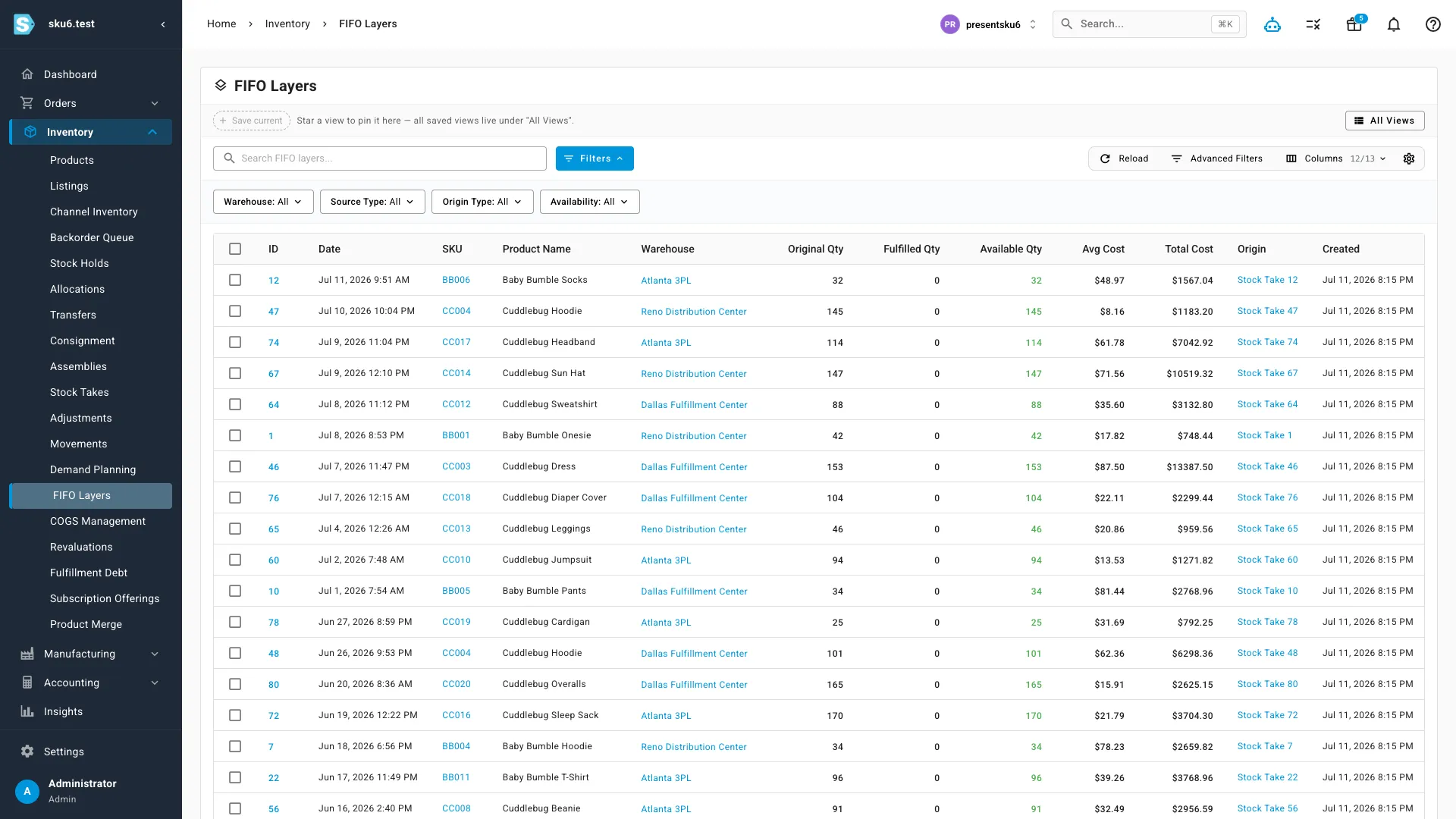
In SKU.io each freight, customs, duty or brokerage invoice is a landed cost bill on the purchase order, and you choose how it spreads across the lines. Each product's per-unit cost goes up to match, so the FIFO cost layers created at receipt and the COGS recorded at each sale both carry it.
| In the spreadsheet | In SKU.io |
|---|---|
| Type each bill into its own row | A landed cost bill on the PO, typed in or read from the PDF |
| Split duty by value or by each line's rate | Import the broker's 7501 entry and split duty by the duty charged on each product |
| Amazon's inbound fees added by hand | Inbound fees Amazon takes from a payout become a landed cost bill on the shipment |
| Copy the per-unit result into product cost | Cost layers per SKU and warehouse that COGS draws from, oldest first |
Why the split matters more than the formula
The landed cost formula is easy: what you paid the supplier plus every bill that got the goods to you, divided by the units. The hard part is the split, because one freight bill covers a container of different products. Most tools split everything by value. That is the wrong default for anyone who imports mixed shipments.
The sample in this sheet shows it. One air shipment of yoga mats, band sets and foam rollers, with $1,380.00 of freight. Split by weight, the mats take $720.00 of it, because they are 360 of the 690 kilograms. Split by value they would take $613.33, and the band sets, which weigh almost nothing, would carry $147.22 more than their share. Each wrong share goes straight into the margin you read on that SKU.
When I would use the sheet, and when the calculator
For a quick answer on one shipment, the landed cost calculator does it in the browser. Use this sheet when you want the working kept with the purchase order, when lines pay different duty rates, or when ocean freight should be split by volume. Once you are doing it on every purchase order, the bills belong on the PO itself, where they reach cost of goods sold without being copied anywhere.
What belongs in landed cost, how to split each kind of bill and the mistakes that make COGS wrong are in the landed cost guide. Whether landed cost is capitalized is check 6 of the ecommerce accounting standards checklist. If your POs still live in a spreadsheet, the purchase order template has freight and duty on their own rows too.
Questions people ask
How do you calculate landed cost per unit?
Landed cost per unit is the line's supplier cost plus its share of every freight, duty, insurance and fee bill, divided by the units on the line. In this sheet's sample, the yoga mats cost $2,400.00 from the supplier and take $954.67 of the shipment's bills, so 300 mats land at $11.18 each.
Should freight be split by weight or by value?
By weight for air, parcel and truck freight, and by volume for ocean freight, because that is how carriers bill. In the sample, $1,380.00 of air freight split by weight puts $720.00 on the yoga mats. Split by value it would put $613.33 there, and the light band sets would carry $147.22 more than their weight justifies.
How should a duty bill be split?
By value when every line pays the same duty rate. When rates differ, split it by each line's value times its own rate, so a duty-free line carries none of it. The Excel file has a duty rate column for that.
What costs belong in landed cost?
The supplier's price, freight to you, cargo insurance, customs duty and tariffs, broker and filing fees, inbound fees to get stock into a marketplace warehouse, and labor that makes the sellable unit. Shipping to customers, selling fees, storage and advertising do not.
What is the difference between this and the landed cost calculator?
The calculator works out one shipment in your browser. This spreadsheet is the file you keep with the purchase order: up to 30 lines and 5 bills, a volume basis for ocean freight, a duty rate per line, and a check that the bills were fully spread.
Bring a purchase order and its freight bill
Bring one recent PO with its freight and duty invoices. We will run it through SKU.io and compare the cost per unit with what your books use today.
Book a DemoFounder-led demo · 2-day onboarding · no onboarding fees