
An Annual Purchase Budget per Supplier, and a Target Value per Order
When you buy forward from brands, two numbers sit on top of the demand forecast. One is what you’ve agreed to buy from a brand this year. The other is the smallest order worth shipping, set by freight and the brand’s minimums. Divide the first by the second and you know how many orders the brand gets, often only a handful a year.
A plan has to fit inside both, and a demand forecast knows neither. One comes from a conversation with the brand, the other from a freight quote. A forecast that only looks at the next order makes it worse: it doesn’t know a second or third shipment is planned for later in the year, so it keeps suggesting stock you’d already planned to buy.
That gap is most of what buying on your suppliers’ calendar looks like before it’s set up. The forecast suggests an order that makes sense for demand and not for the deal, and someone fixes it in a spreadsheet.
A five-minute walkthrough of buying on your suppliers’ calendar, on an outdoor gear distributor we made up. The part on the year’s budget per brand starts at 3:04.
Watch on YouTube. Narrated with an AI voice; the distributor, its people and its numbers are made up.
Which number wins?
This isn’t an open-to-buy. Open-to-buy starts from a sales plan, by brand or category and by month, and doesn’t care which supplier fills it. A supplier budget starts from what you promised one brand for next year, and the brand will hold you to it. If the two ever disagree, I’d go with the number the brand agreed to and cut somewhere else.
Where the minimum bites
At my other company, which resells other brands’ products, we still hadn’t reordered one brand. A forecast at 90 days of stock gave a small order. At 180 days it was still small. The supplier’s minimum, at that brand’s recent pace, came to about a year of stock. We were tight on cash, so I decided to wait and keep a close eye on it rather than tie up a year of stock in one brand. A days-of-stock forecast has nowhere to put that minimum, so you only see the problem when you try to place the order.
Other people get it wrong the other way. The owner of a consumer brand described a long lead time item: “We sit on eight months worth of tins and I’m like, how did this happen? Oh, well, I didn’t want to run out.” The fix there is the reverse of mine: a second, smaller order in the year, which costs some freight and frees cash and shelf space.
Putting both numbers on the supplier
SKU.io puts the target per order and the budget for the year on the supplier, and every suggested order is shown against both.
I’d set the target from the freight, not from the brand’s minimum. The minimum is the smallest order the brand will accept. The freight break, a full pallet or a container, is the smallest order that pays for itself. They’re often different numbers, and the target should be the bigger one.
Say, for a made-up supplier, the target per order is 50,000. Demand only fills 41,000 of it, 18% under. There’s a button that scales the quantities up toward the target. It keeps case packs and minimum order quantities, so it won’t land exactly on 50,000. Say it lands at 48,000. Anything within 5% counts as on target, so that’s done.
I’d be slow with that button. The extra 7,000 is stock you’re choosing to carry so the freight works out, and often that’s the right call, but check how many weeks it adds on your slowest products before you press it.
The year, added up
Under the order, the year is added up. Same supplier, with a budget of 200,000 for the year: 50,000 already committed on purchase orders, this order at 48,000, 80,000 planned for later in the year, and 22,000 left.
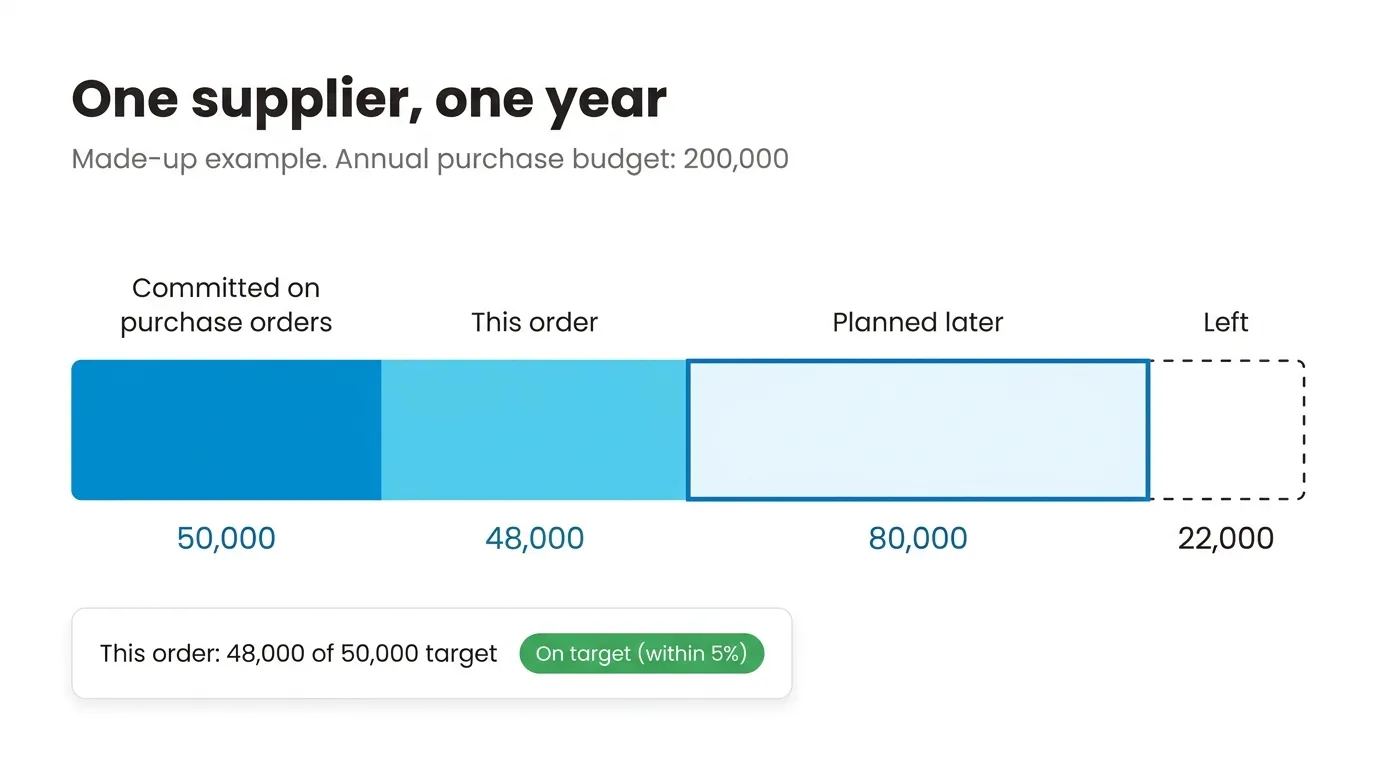
The 80,000 is the number a next-order forecast doesn’t have. It only means something when the supplier is set to order on set dates, because then the later orders in the year are projected instead of guessed. The setup guide covers it.
If the targets on the year’s planned orders come to more than the budget, the year is highlighted with how far over it is. Then you have three moves: shrink a planned order, push one into next year, or go back to the brand and raise the number. I’d try the second before the third. A brand remembers the year you asked for more and didn’t buy it.
Being well inside a brand’s budget doesn’t mean you have the cash this month, either. At the reseller, cash was as much the reason we waited as the minimum was.
If you buy a few cartons a month from a local wholesaler, you won’t recognize any of this, and you shouldn’t pay for it. A reorder point is enough. If your brands expect a number from you every year, book a demo and bring one supplier’s budget and minimum order.