
Price Levels and Quantity Breaks for Wholesale Customers
Keep three or four price levels off one base, put quantity breaks on them as a percentage off, and check the margin under every price before you save. Give a customer their own price only where somebody negotiated one. That’s the pricing side of selling to retailers, and it’s close to what I run myself.
A four-minute walkthrough of selling to retailers, on an outdoor gear distributor we made up. The part on prices and quantity breaks starts at 1:59.
Watch on YouTube. Narrated with an AI voice; the distributor, its people and its numbers are made up.
Why my breaks follow my own buying
My other company resells other brands’ products, and car parts are the one line it sells wholesale. The dealers we go after are performance shops. They get a pricing level that isn’t retail, so they’re discounted just for being a wholesale customer, and there’s no flat discount on top. Bigger orders get more off, in two steps by order size.
I set it up that way because of what happens upstream. I signed dealers up so that when we order from the supplier, we can justify the higher volume, since some of it goes out at wholesale. So that’s the test I put on a break: does the larger order let you buy better yourself? If it doesn’t, the discount is a gift.
Nobody gets their own level. A dollar price for every customer on every SKU is a lot of numbers to keep current, and when a supplier raises cost they’re all wrong the same morning.
There is one case where I’d type a level in by hand instead of tying it to a base: a level sold in another currency, through distributors who have resellers under them. Those distributors can’t be calling their resellers every other day with a new price, so that level gets typed in its own currency and only changes when someone decides it should. Margins only show for levels in your base currency, so on that level you’re checking the price against cost yourself.
The break nobody argues about
When a wholesale buyer haggles on the phone, decide from the margin on the line in front of you, not from memory of what you gave them last time. Breaks need the same check, and they rarely get it, because a break applies itself. Nobody is on the phone arguing about it.
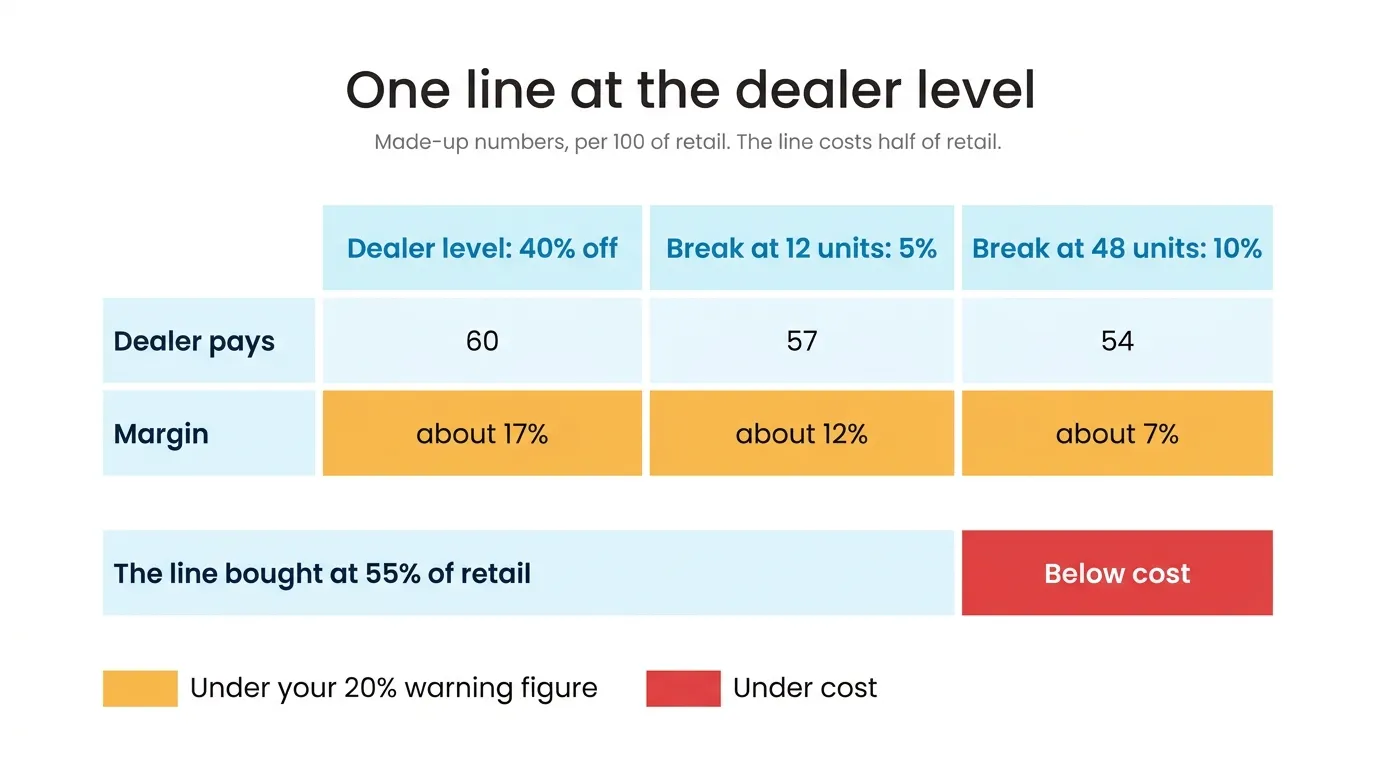
Say your dealer level is 40% off retail, with breaks of 5% at 12 units and 10% at 48. On a line that costs you half of retail, the dealer pays 60 for every 100 of retail and you keep 10, about 17% margin. At the 12 break they pay 57 and you keep about 12%. At the 48 break they pay 54 and you keep about 7%. Now take the one line you bought off a bad container at 55% of retail. At the 48 break you’re selling it below cost, and the same break percentages that were fine on the rest of the range did it.
In SKU.io the product’s pricing grid puts the margin on average cost under every price, amber under your warning figure (20% by default) and red under cost. After a change like that, scroll for red before saving, and type in a what-if cost before a supplier’s increase lands.
Where should the breaks start?
If a product ships six to a case and the portal sells it only in full cases, a break at 10 really starts at 12, since 12 is the first quantity a buyer can order past it. Set the breaks at 12, 24 and 48 and the price sheet says what actually happens.
The break also has to reach the order. If your reps take orders in one app and the order lands in another system, check that a quantity break survives the trip. When it doesn’t, somebody fixes it by hand after the retailer complains.
If you sell to a few accounts at one wholesale price, skip all of this and keep a spreadsheet.
If you run several levels on a cost base that moves with every container, book a demo.