
Credit Limits for Wholesale Customers, Without Stopping the Order
A parts seller who does about 40% of his business wholesale told me how his store’s B2B feature had gone for those accounts. The discounts were one problem. “Then we’ve also had issues with the net 30 terms,” he said.
A storefront expects a card at checkout. An account on terms doesn’t pay at checkout. The goods go out first, and what’s owed lives in a bookkeeper’s aging report the warehouse never sees, so whoever approves the order can’t tell how much room is left. Fixing that is the credit part of selling to retailers.
A four-minute walkthrough of selling to retailers, on an outdoor gear distributor we made up. The part on credit limits starts at 2:45.
Watch on YouTube. Narrated with an AI voice; the distributor, its people and its numbers are made up.
Put the limit where everyone can see it
The limit goes on the customer record, beside the payment terms, and every order reads it from there, whether it came through the portal, a rep or an email. Next to it you want what the customer owes right now and the room that leaves, kept current without anyone running a report.
I’d show the dealer their own numbers as well. A dealer signed in to the portal sees their limit, their balance and the credit they have left, so they can see they’re close before they order.
Start a limit lower than feels polite: about one normal order’s worth on its terms, raised after a few invoices are paid on time. Nobody complains when a limit goes up. Taking one down is a call nobody wants to make.
Warn or hold?
Once you turn credit checking on, an order over the limit can get a warning or a hold. I’d use hold. A warning is a message on the order, and whoever is busy that afternoon clicks past it. A held order is approved and its stock is reserved, but it can’t be picked until someone releases it. It’s held, not refused, so the retailer’s order is safe and you still decide when it ships.
Say a retailer has a $10,000 limit and owes you $8,500, and their rep keys in a $2,000 order. That takes them over. With warn, it ships. With hold, it waits, and whoever releases it looks at the customer’s receivables first. An invoice well past its terms means a phone call before anything leaves the building. If the order is paid in full while it waits, the hold lifts by itself.
Paid means recorded on the order, not sitting in your bank. At my other company, which resells other brands’ products, the first dealer to order on our portal paid by wire. We don’t take PayPal from that dealer, because I don’t want to pay PayPal’s fees on a wholesale order. So we added a payment method called wire, and I set up a watcher on our bank transactions: when a payment from that dealer comes in, it marks the order paid in SKU.io. For one order I didn’t need it, but I try to automate everything in my business. On terms it matters more. A wire nobody records leaves the account looking full, and the next order holds for money you already have.
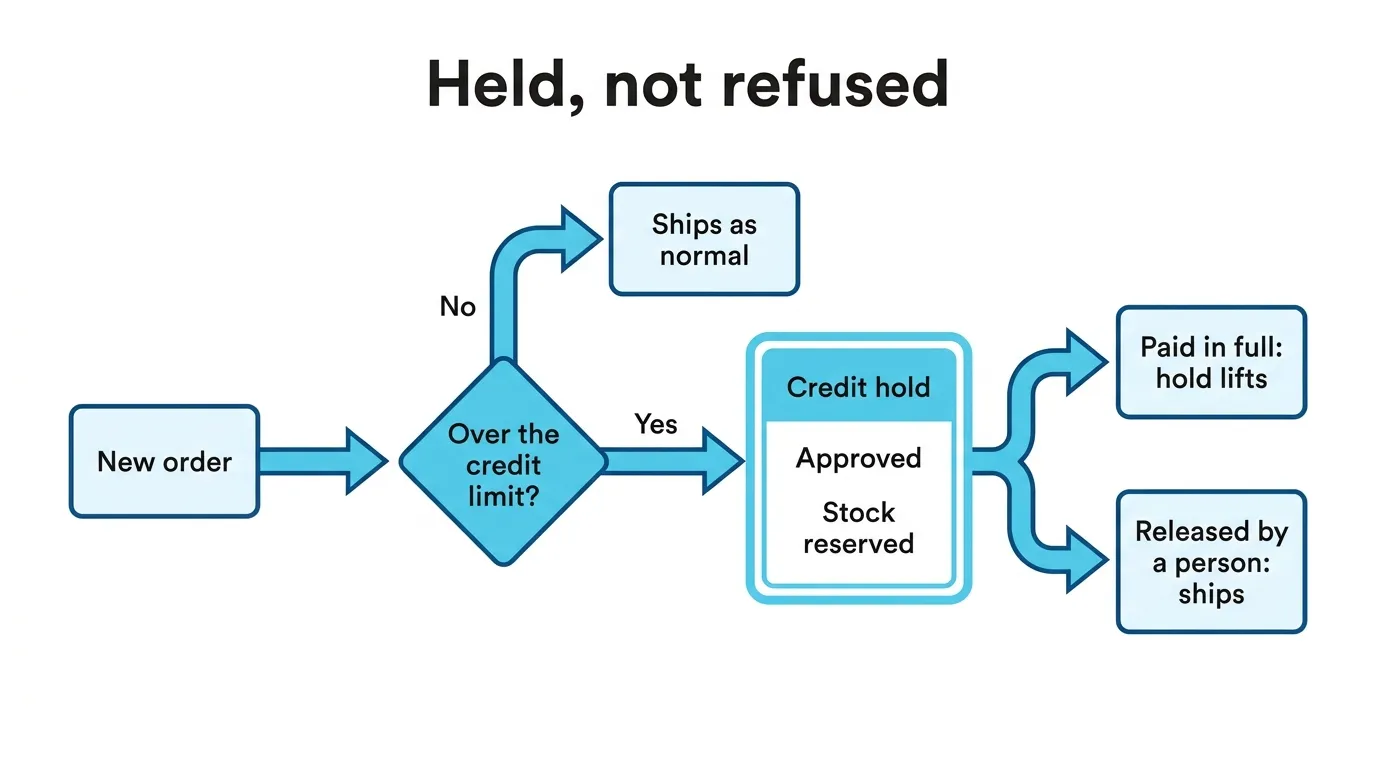
Hold costs you some clicking, since each held order is released on its own and raising a limit doesn’t release orders already held. Give one person the credit hold filter on the sales orders list every morning, or a good customer’s order sits for a week. The credit holds guide has the steps.
Should a bigger customer get a bigger limit?
Not automatically. I keep credit and price apart. Spending more earns a dealer a better price level. It says nothing about paying on time. Some distributors raise both together as a reward, and I think that’s how a good customer ends up as your biggest receivable. Raise the limit when the payment history earns it.
If every wholesale customer pays upfront, you need terms and not limits. With five accounts on credit, I’d keep using the aging report and the phone.
If you ship on terms to dozens of retailers and have found out an account was over its limit after the truck left, book a demo.