
Specific Identification for Refurbished Goods: Which Unit Did You Sell?
In June 2019 the person who ran our eBay listings asked me what starting price to put on a returned machine going to auction. “Start at 30% off,” I said. They asked whether every auction item started there. “Yes starting price. Usually we refund partial.”
Then they said what that meant: “I am wondering if we auction them 30% off, you don’t have any profit on it.”
“Yes we often lose money,” I wrote back.
I knew that in total. What I didn’t know was which returns lost the most, because none of them carried its own cost. Specific identification is the name for that: each unit you sell carries what that unit cost you, including what you spent on it after it came back. With refurbished goods no two units come back costing the same, so it’s the only method that can tell you whether a repair paid for itself.
One rotary machine, eight months
On November 7, 2019, a large rotary floor machine came back to our 3PL. It got the SKU every return got from us, in the pattern Z_<model>_R-<return date>.1. The Z_ sorted returns to the bottom of every list, the date tied the unit to its return, and the .1 meant there was one of it.
It went to the manufacturer for repair. In January I was asking our support channel whether anyone had approved a $1,620 quote from them to refurbish one of these machines. Nobody could say.
In April I started a monthly review of what we had in stock. The first pass is how I found the refurbished units “just sitting in [the 3PL] not being sold,” and that the big machines weren’t moving at all, so we put them up on eBay as well.
By May the manufacturer had put our account on hold. They had repaired this unit, shipped it back and billed us for the repair. I hadn’t authorized it, and it was “the $400-$500 repair charge that is in question.” I refused to pay, and suggested they send a freight pickup for it, which I’d rather pay for than try to sell it again and have it damaged in shipping again. What I offered instead: I’d pay the repair if the machine sold, “which so far it hasn’t at a much discounted price.” If it didn’t, I’d have them take it back and “declare the whole item a loss.”
It sold at auction in June, and the buyer had a problem with it. It was the last one we had, so there was nothing to swap. I asked whether they’d keep it for a 50% refund. They wrote back: “Looked at the prices of getting the parts to get the unit repaired and would cost about $875. If you wanted to sell it for $300 I would keep it.”
I refunded them down to $300 and told the team to keep following up on the insurance claim.
What that unit cost
Here is everything that unit had on it by the end:
- what we paid the manufacturer for it new
- freight to the manufacturer and back
- a $400 to $500 repair bill, disputed
- a refund that brought the sale down to $300
- an insurance claim, still open
Even without the first line, the repair bill alone was more than the $300 it sold for.
Our books had none of that on the unit. Its cost was the first line, from the day we bought it until it sold. The freight went to shipping expense in whatever month the carrier billed it. The repair sat in a support ticket. The refund came off eBay revenue. So in May, when I was choosing between paying for the repair and writing the whole thing off, the one number that choice turns on wasn’t anywhere I could look it up.
Why I let it ride
Four years later I said it out loud, on a call about how damaged returns come back into stock in SKU.io. They come back as one more active unit at full value. My answer was:
“I’m not concerned about having it full value because it sorts it out within a few months. And the only bad thing is for taxes. Arguably I’m going to overstate my profit when I could potentially for a given year, but it all works out in the end and it’s probably not by a huge margin.”
For a scratched helmet you auction inside a month, that’s fine. For a machine that sits for eight months and picks up freight and a repair bill, I was wrong. The year does come out close. What doesn’t come out is the repair-or-write-off choice, which I made on every one of those machines without its cost.
How I’d cost a refurbished unit now
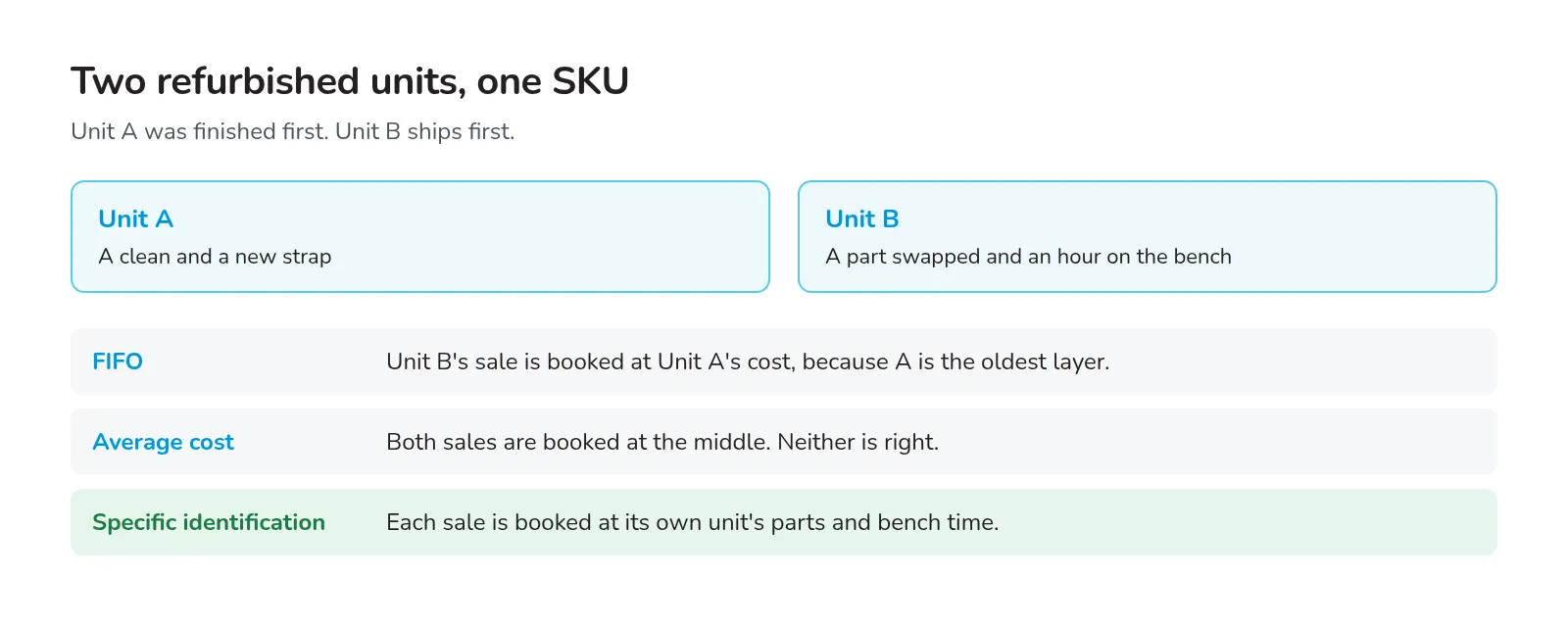
I picked FIFO for SKU.io because of the system I ran my store on before it. That system kept one unit cost per product, so when I bought half my stock from one place and half from another and changed the cost, my month’s profit jumped up or down for no real reason. For new stock from a supplier, FIFO is still what I’d pick. But it books whatever is oldest in the SKU, it doesn’t know one refurbished unit from another, and SKU.io doesn’t keep a cost per serial number.
So I’d keep the Z_ habit. A unit on its own SKU can only sell at its own cost. Units share a SKU only when they really are the same, like a batch refurbished to one standard.
Then put the cost on the unit. In SKU.io’s repairs, every part, hour of labor, freight leg and vendor fee is a cost line, and when the unit goes back to stock as refurbished, those lines are added to its cost as one layer. If the total is more than the unit can sell for, the excess is expensed when it goes back to stock. For that machine, that would have been May, before the auction.
If you refurbish what you sell, book a demo.