
What Happens to Your Cost When AWD Sends Units to FBA
When AWD sends units to FBA, nothing should change in your books. It isn’t a sale, so COGS doesn’t move, and the value of what you own stays the same. The cost just has to leave one layer and land in another. The trouble is that Amazon’s record of the move carries a unit count, sometimes a reference, and never a cost.
How long this took us
On November 4th our own demo order said it had sold nothing. 0 units, a 1.00x return, every unit stuck in transit between AWD and FBA. One piece of code still only followed references starting with FBA, and Amazon’s replenishments don’t start with FBA. We fixed it that afternoon. That was eleven months into a job I’d told my purchaser would take two or three weeks.
I was wrong about the estimate because I thought the hard part was getting API access. In December 2025 that was what we were stuck on, a customer’s account where Amazon kept answering “unauthorized” until their developer support sorted it out. My purchaser had been doing AWD in Seller Central, which meant SKU.io had no idea the stock had left. “If we send 100 units in, the 100 units will still exist on SKU, and then it will exist on FBA eventually, once AWD transfers it over. So then we have 200 units in our evaluation, but we only have 100 in reality.” When access came through I told her we could start, “maybe three weeks, two weeks, I don’t know, something like that.”
The hard part was the IDs. Amazon’s AWD ledger file has no unique ID on its lines, so we fingerprint whole files to stop rows landing twice. On a customer’s go-live day in February someone on their team was linking shipments out of AWD by hand, and I explained that our screen only groups lines that share a shipment ID, and “they’re all unique. So we don’t really know that they go together.” He told me why that was never going to work: “They will be unique because I create one shipment and it has five items. Every single item has its own id.”
And then the one I still find annoying. Amazon describes a single trip from AWD to FBA in two unrelated ways. The AWD ledger says units departed, and the row often carries Amazon’s own outbound order ID, starting repl-ship-, or no ID at all. The FBA feed says a shipment arrived, under a shipment confirmation ID, and nothing in either record points at the other. We looked at building the missing departures from the FBA feed, but in what we’ve seen most FBA shipments with no matching departure are those same departures under the other ID, so you’d deduct the units twice. So SKU.io links the two records once a day and leaves the movements alone. It’s slower, and some days a few units sit as departed with nowhere to go yet.
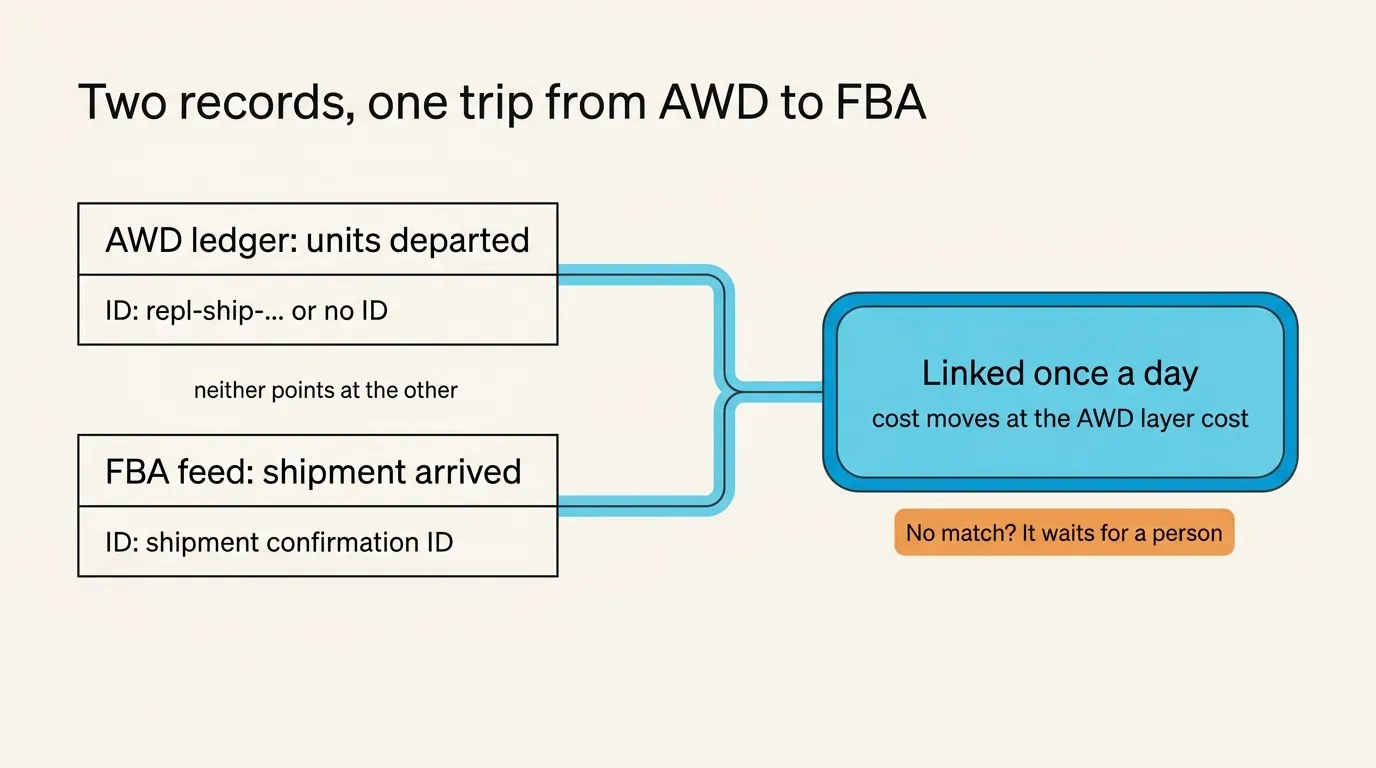
Even that isn’t airtight. In October 2026 one customer’s ledger stopped listing outbound orders after the 14th, while the daily AWD snapshots kept showing stock drop a case pack at a time. We can’t invent a departure Amazon didn’t report, so now we show which units fell, about when, and that the ledger doesn’t explain them.
Where the cost sits at each stage
| What happened to the units | Where the cost is | What you do |
|---|---|---|
| Sitting in AWD | The AWD cost layer | Nothing |
| Left AWD, matched to an FBA shipment | In transit, at the AWD cost | Nothing |
| Received at FBA | A new FBA layer: AWD cost plus any fee billed to that shipment | Nothing |
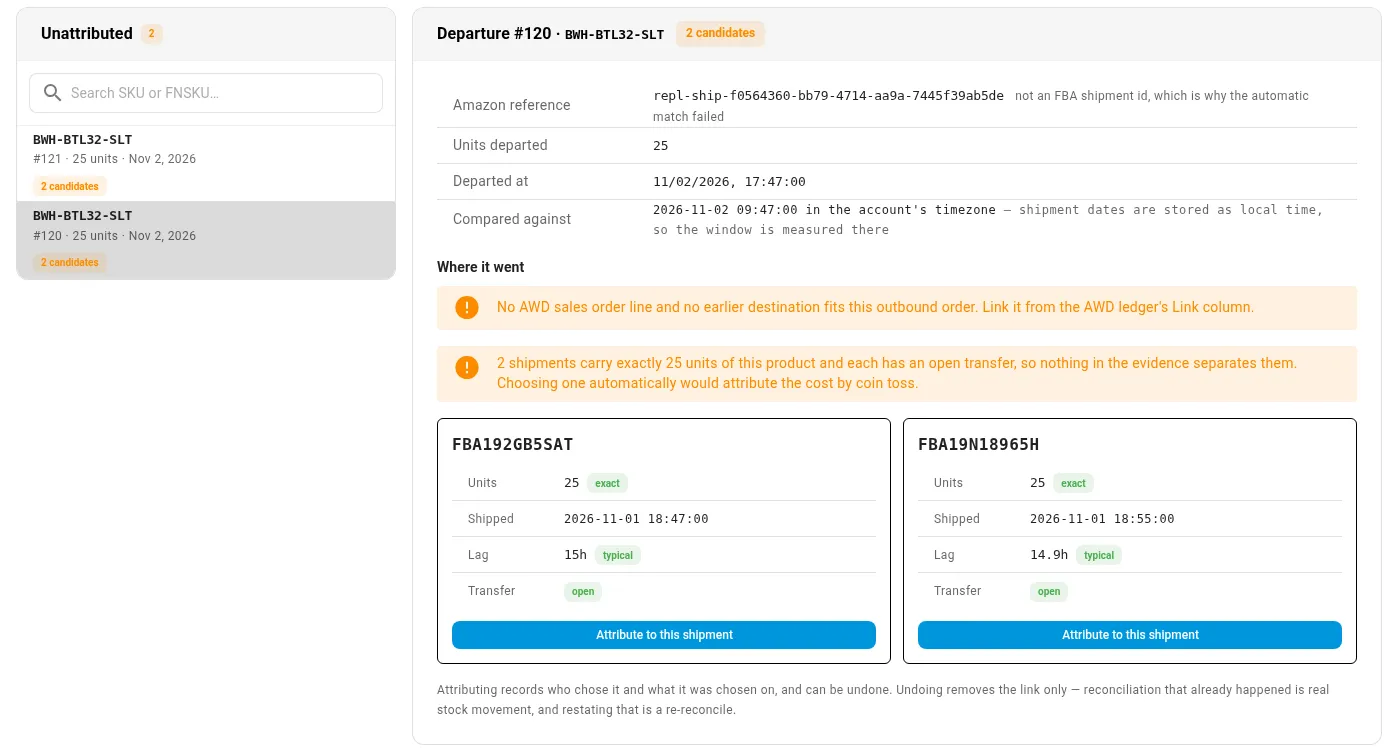
| Left AWD, nothing matched | Unattributed, on the Departure Attribution tab | Pick where it went |
| Left from an AWD site nobody mapped | Unattributed, and FBA receipts use the fallback cost | Map the facility |
| Shipment closed short | On the books until Amazon finds the units or pays | Submit the claim in Seller Central |
A unit can sit as departed for up to a day before it has a home, since matching is daily. The unmapped site is easy to miss, because until you map it those shipments can’t become transfers at all and FBA receipts get costed by the fallback rule. A banner on that tab says how many are waiting and how many units have already left.
On the fictional order in our AWD walkthrough, 2,500 water bottles reach FBA in about 100 shipments over four months, each one drawing from the AWD layer at $8.86 until the layer’s gone.
Stock doesn’t only go to FBA
It also leaves AWD for your own warehouse, and Amazon doesn’t say where those outbound orders went, so we work it out. If your 3PL’s reported stock of that product rises by exactly the units that left, within two weeks, that warehouse gets suggested. It stays a suggestion until someone clicks, because picking wrong puts stock somewhere it never arrived. If two shipments fit a departure equally, it asks you too.
Most of the time, FBA cost equals AWD cost
A fee only gets added to the FBA layer when it names an inbound shipment. Our fictional bottle lands in FBA at $9.24, the $8.86 plus about $0.38 of placement and partnered carrier, because we seeded that shipment with those fees to show what happens when one does.
Your replenishments probably won’t look like that. Amazon’s AWD page says “AWD pricing covers FBA inbound placement, so there is no separate charge for this service,” at least as I write this. The fees it does charge on the way out, processing and transportation, reach us without an inbound shipment on the line, so they stay expenses. On a plain auto-replenishment I’d expect your FBA unit cost to match your AWD unit cost, with those fees in your Amazon fee account. I went through those fees one by one in which Amazon fees belong in landed cost.
Short shipments
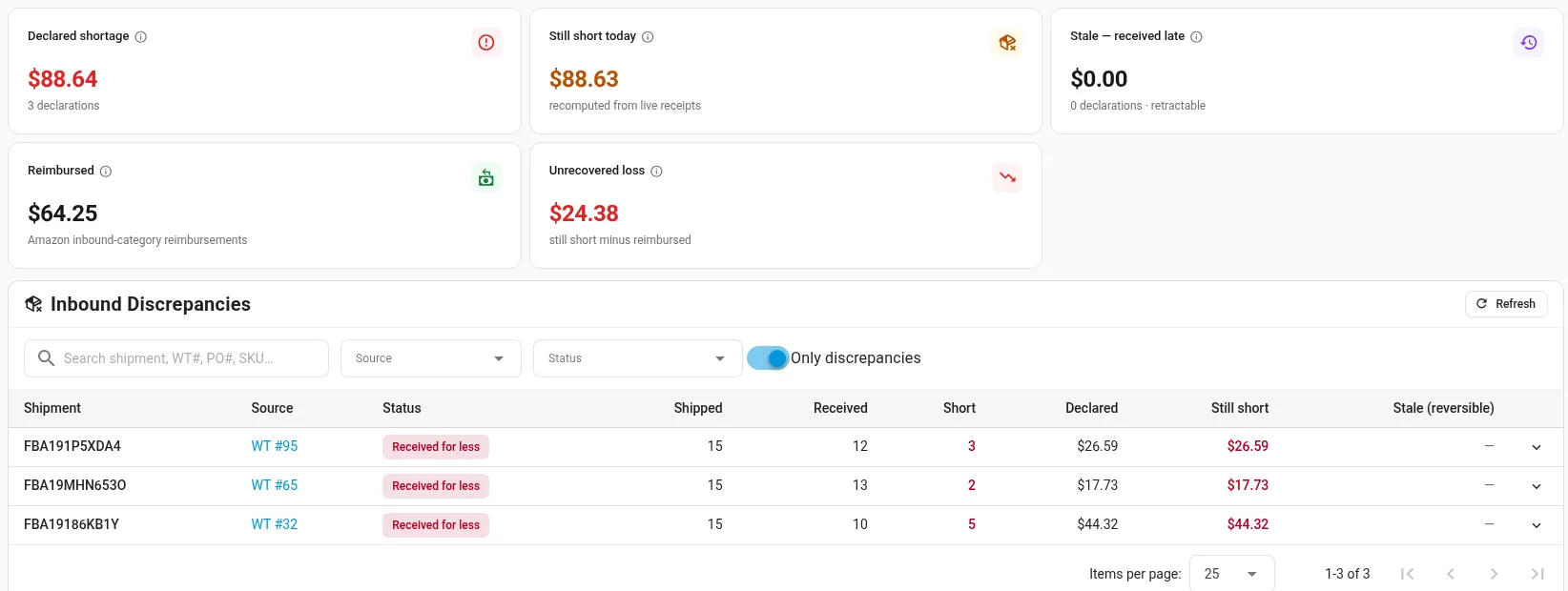
Short units stay on the books until Amazon finds them or pays for them. When an FBA shipment closes short, SKU.io opens a recovery case with the details Amazon asks for, and you submit the claim in Seller Central because we don’t file for you. When the reimbursement arrives we match it to the case, and it counts as dated cash back on the original purchase order, against the FIFO cost those units carried. Don’t expect it to match. My own team works these cases, and their summary was “sometimes you cannot really get the reimbursement as per our cost.”
If you send a few pallets to AWD a year, keep a spreadsheet of departures and tie it out monthly. Once an order breaks into dozens of replenishments you won’t keep up. Book a demo, bring an AWD ledger export, and we’ll trace one of your own departures to its shipment.