
Six Questions to Ask Any Inventory System About Amazon AWD
On go-live day in February 2026, someone on a customer’s team asked me a question I could only half answer.
We were looking at how Amazon’s inbound fees would reach his purchase orders. I said we’d take the STAR- shipment number off the settlement line and use the AWD shipment as a pivot to get to the PO. He said, “So what you’re telling me is magically you will find a way to. Because I don’t understand how.” Then he gave me the case that breaks it. Two shipments into AWD for the same SKU, one a transfer of 300 units from their warehouse, one a purchase order of 500 coming from China. Which one does the fee belong to?
There was an answer. A person links each AWD shipment to its PO once, and everything after that follows the link. But he’d gone straight past “do you support AWD” to the question that matters, because when a vendor says yes to AWD they might mean a stock number in a column, or they might mean what he wanted, and those get sold under the same word.
So here are the six I’d ask. Bring one real purchase order, because every one of these is easy to answer on a slide.
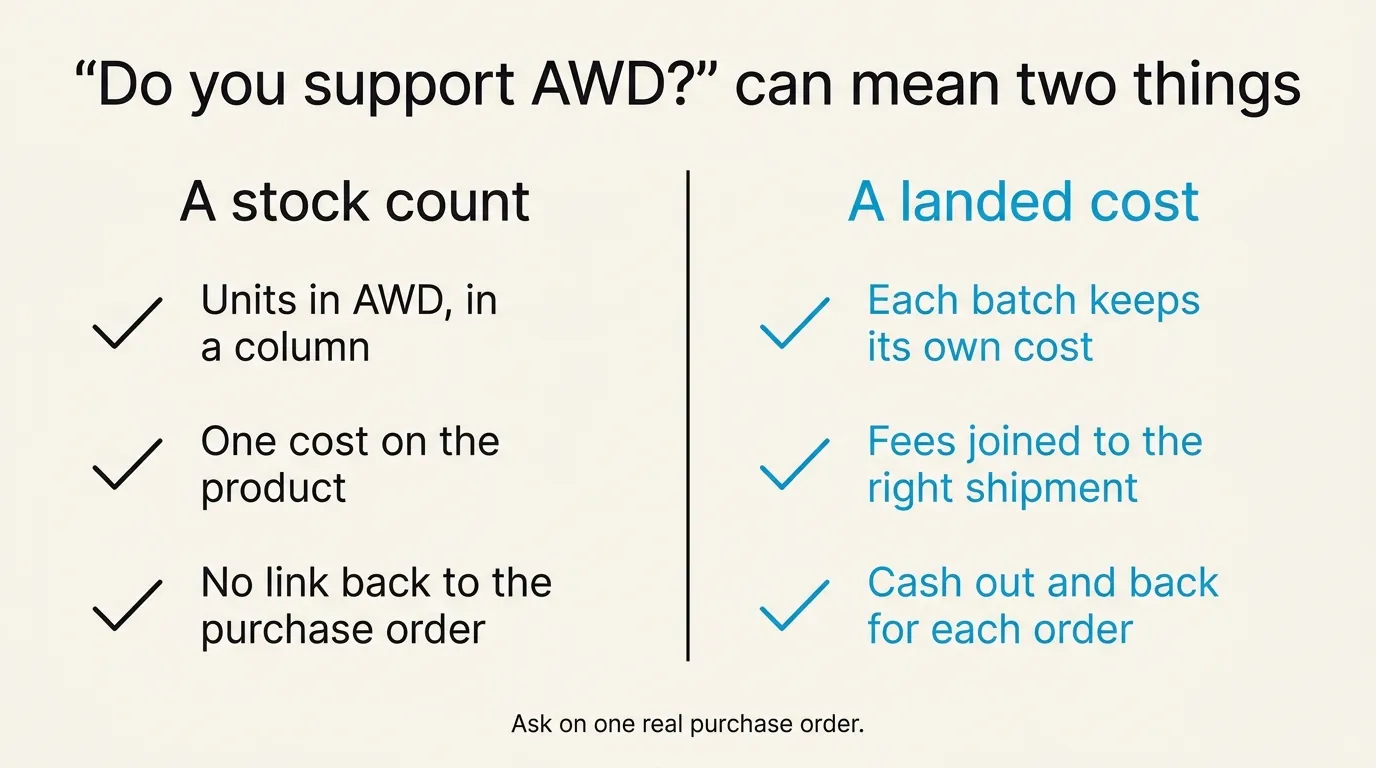
1. Where does the batch get its cost?
Amazon’s inventory reports don’t carry what you paid. So if a system builds its AWD and FBA stock from those reports, the cost has to come from somewhere else, and with one cost field on the product every batch you ever bought costs the same. Have them show you one unit’s cost at AWD, at FBA and on the sale, split into product, freight, duty and fees, the way our walkthrough does.
2. What do you do when Amazon’s two records disagree?
This one has cost us a lot of time. Amazon describes a single movement out of AWD in two different ways. The ledger row often carries its own outbound order ID, starting repl-ship-, or nothing at all. The FBA feed carries a shipment confirmation ID. They don’t match, so the obvious move, building the missing departures from the FBA feed, deducts the same units twice.
On one customer’s account in October 2026 the ledger stopped listing outbound orders after the 14th, while the daily AWD snapshots kept showing stock falling a case pack at a time, and nothing errored. We can’t create movement Amazon didn’t report, so we flag it: these units left, on about these dates, and the ledger doesn’t explain them.
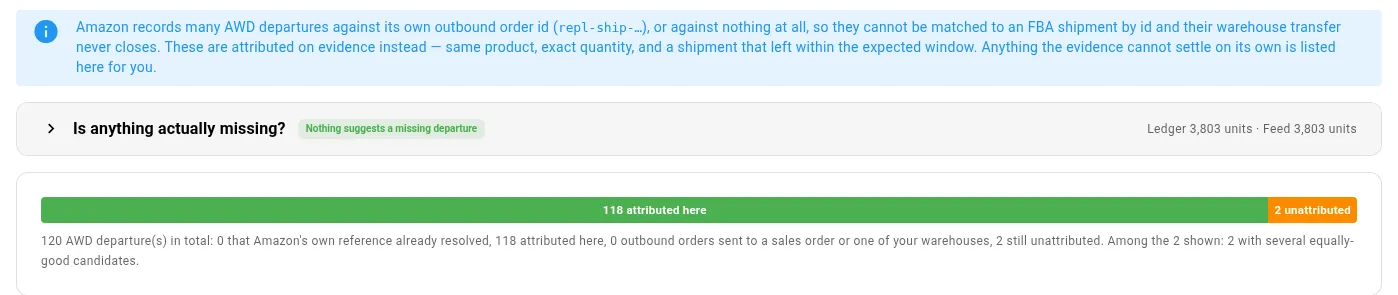
Two follow-ups. Is there a list of units that left AWD and aren’t tied to anything? And when two shipments fit a departure equally, does it pick one or ask you? Ours asks. Here’s how the cost moves.
3. The fees, one at a time
This was the item still open on that customer’s go-live list, in their words “AWD inbound shipping to cogs issue,” so don’t accept “we import your fees.” AGL freight and duty, AWD processing in and out, AWD transportation, AWD storage, placement, partnered carrier. For each one, ask if it’s automatic and whether it became inventory or an expense.
A fee that names its inbound shipment joins our batch by itself. AWD storage doesn’t, because Amazon offers no API report for AWD fees as I write this, so spreading it across products is a monthly file or a script. If a vendor says per-SKU AWD storage is automatic, I’d ask where they’re getting it.
Then hand them the late one, a freight invoice for a batch that’s mostly sold, and watch where the money goes.
The last three, faster
If I only had an hour with a vendor I’d spend most of it on the second question. These three take five minutes each.
Four, ask for cash out and cash back for one order, by date. The deposit, the balance, the freight and the duty on the days they left, and the Amazon payouts on the days they landed. Amazon pools a product’s units, so it never says which batch a sale came from, and somebody’s rule decides. Ours is first in, first out, the same as COGS, and you can’t change it today. If a vendor shows you a profit report instead, that’s a different question answered.
Five only matters if you’ll build anything yourself. Name the events, purchase, receipt, landed cost by cost type, transfer, sale, return and settlement, and ask if one batch ID ties them together. Then go read their docs rather than the sales deck. Ours has carried a “Not yet available to API tokens” label on some endpoints, mostly Amazon ones that started life as screens, so check it on the day you evaluate.
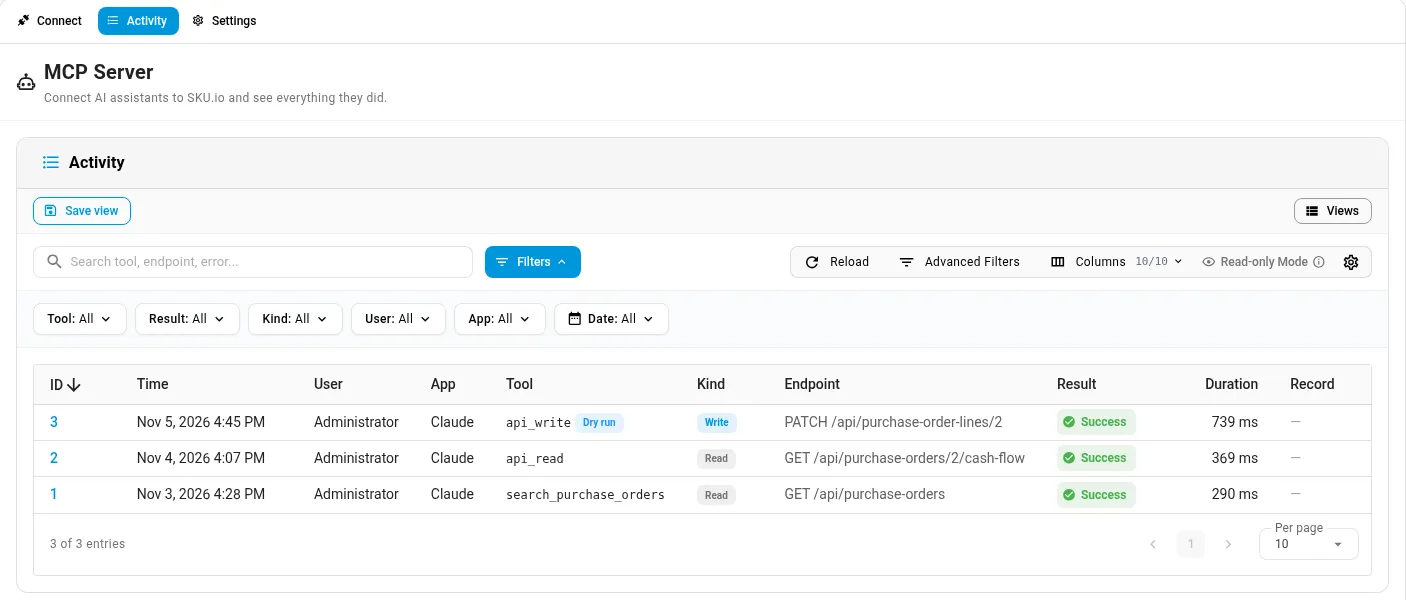
Six is for an AI assistant. Does each person connect as themselves, is it read-only until someone turns writes on, is every call logged, and what can’t it do at all? On ours, nothing connected through MCP can delete, void, cancel or make a payment. It can draft a supplier deposit, and a person pays it.
A handful of orders a year and one person touching them, and a spreadsheet with a row per receipt will do. Under about $1M on one channel, try Zoho Inventory or inFlow before us. SKU.io pushes transactions to QuickBooks or Xero, so your bank reconciliation stays there either way.
If most of your stock goes through AWD, book a demo and we’ll answer all six on one of your orders.