
Why Wholesale Orders on Shopify Still End Up in Email
A founder I talked to this year sells their own products direct and through a handful of retailers. One of the retailer accounts explained how it works on the retailer’s side: “we don’t do online orders. We email our orders through.” The founder’s answer was the one most of us give. “I’ll just give it to one of the team and they can load the sales into Shopify and we’ll load the sales into Xero. Like, easy.”
It is easy, the first time. I hear some version of it on sales calls a lot. I counted at least seven since 2024, nearly all from brands that sell mostly direct and do some wholesale on the side. The order arrives as an email or a PDF, and somebody types it in. Sometimes into the store, sometimes into the accounting system, sometimes into both.
I don’t think the email is the problem. Buyers have their own purchasing systems, and some of them will only ever send a PO. Others had one bad week with a brand’s wholesale portal, a price that came out wrong or terms that didn’t show, and went back to email for good. You can’t make them stop. The problem is what can’t see the order once someone retypes it.
Shopify does more B2B than it used to
Shopify’s answer has gotten better. Since April 2026 its native B2B runs on the Basic, Grow and Advanced plans, not only Plus. That gets you company profiles for wholesale buyers and payment terms. The limit that matters for wholesale is pricing: outside Plus you get up to three custom catalogs with their own pricing. If more than three of your accounts negotiated their own price, the rest of those prices live somewhere else, usually in an email thread.
What the retyped order doesn’t reach
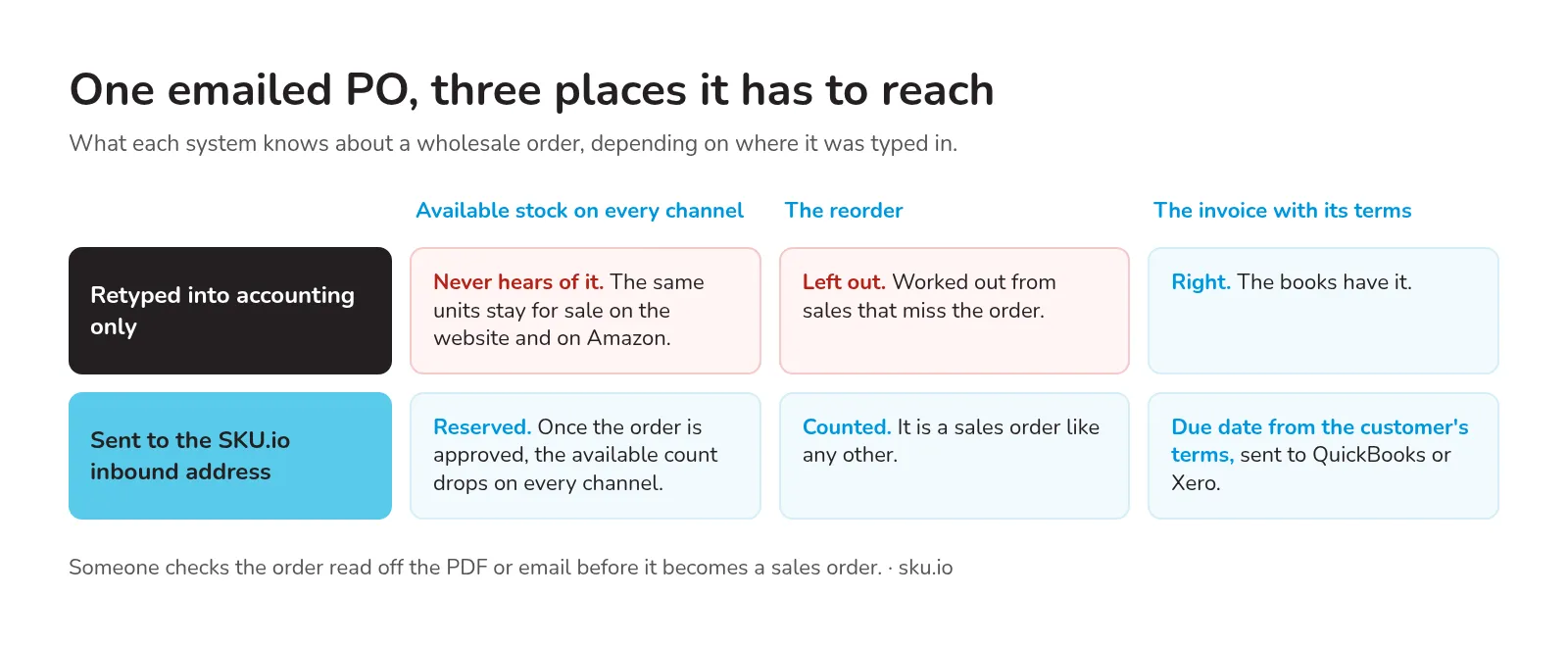
I have my own version of this. At my other company, which resells other brands’ products, I was going through our sales report by brand and channel on a call in June last year, and one line showed zero sales for May. It wasn’t zero. Those were wholesale orders we’d keyed in by hand, and an order typed straight into SKU.io instead of coming in from a store gets filed under a channel called “SKU.io”. The brand’s wholesale sales were all sitting on that line. That one was just a report. The same thing happens to stock. An order that only reaches the accounting system leaves the units for sale on the website and on Amazon, and the next reorder is worked out from sales that leave out the biggest order of the month.
An operator whose brand sells through distributors asked me exactly this on a demo: “We get a, you know, an email of an order, we put it in here. Then what. Then are we then also putting it in QuickBooks Online”. Typed into two systems by hand, the two will disagree, and you find out at month end.
What we do with it
In SKU.io the email can stay an email. Your account has its own inbound address, and anything forwarded there is read. I first tried it in May on our own purchasing side, with a supplier’s invoice I forwarded from my inbox on a call. The first address I typed was wrong. On the second try it took maybe half a minute, and it found the supplier, the invoice number, the date (written the European way round, and it got it right), the purchase order it belonged to, and every line. The discount it didn’t handle properly.
A customer’s PO goes the same way in the other direction: the order is read off the PDF or the email, and someone checks it before it becomes a sales order. For my own store I mostly skip even that screen. I open a terminal and tell Claude Code “I just got an email from this person, I want you to do something with it,” and it makes the order through our agent skills. Then I go into SKU.io to look it over. Either way, once the order is approved the stock is reserved, the available count drops on every channel, and the customer’s payment terms set the due date on the invoice that goes to QuickBooks or Xero.
For buyers who will use a portal there’s one of those too. At the reseller I’ve started using it for dealers: they log in, see the catalogs we give them at their pricing, and place the order themselves. A dealer that already bought from us wholesale just placed its first order through it. I haven’t played with it much beyond that, and we take wire from that dealer, not PayPal, because I don’t want to pay the PayPal fees on a wholesale order.
Who this isn’t for
If you have two or three wholesale accounts and the orders are small, retyping them is fine, and Shopify’s own B2B on your current plan may be all you need. It starts to cost you when wholesale is a real share of revenue and the same stock is also selling on three channels. If that’s you, book a demo and send me one of your emailed POs to run through it.