
Is Your Sales Tax Filing Missing Your Wholesale Orders?
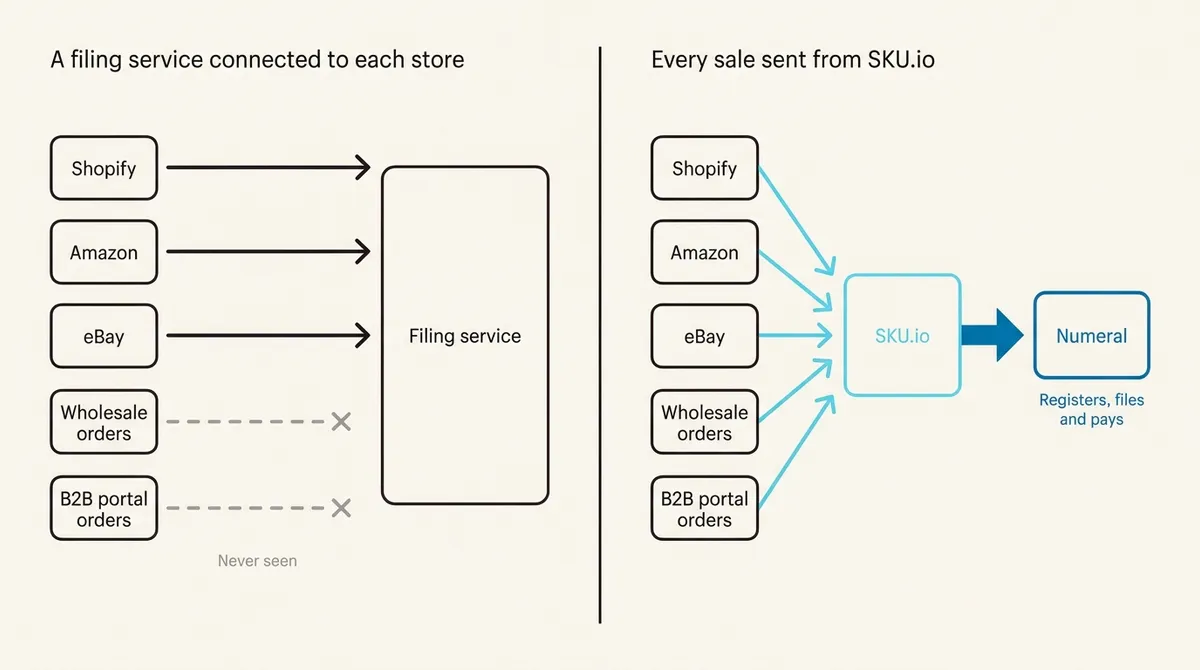
If you sell wholesale and your sales-tax filing service is plugged into Shopify or Amazon, it is probably filing without your wholesale orders. A filing service only files what it is shown. The order you keyed in from a retailer’s emailed PO was never on Shopify, so the service connected to Shopify never heard of it. Most of those orders are exempt, so nothing looks wrong. Some states count them anyway.
I sell inventory software, and today we shipped an integration with Numeral, a filing service, built for this gap. So I have a stake in you believing it exists. Check it yourself with the steps further down before you believe me.
I said no to this last year
In August 2025, on a call with a prospective partner, someone asked whether we integrated with Avalara or TaxJar. I said no, and here is the reason I gave, word for word from the recording:
“We don’t see a need because… there’s not a lot of users that do a high volume off sales channels, like, directly. Like by entering orders into our system.”
At the time that was mostly true. Shopify or eBay worked out the tax at checkout, we copied it onto the order and pushed it to QuickBooks or Xero, and filing happened somewhere else.
Then wholesale grew inside our customers’ accounts. Dealer orders, orders retyped from emailed POs (I wrote about where those end up on Monday), orders placed on the B2B portal SKU.io gives you. None of those sit on a storefront. By the time I got on a call with Numeral’s integrations lead on October 26 to settle the technical details, I’d come around completely:
“People do wholesale more and more with our platform too, so those aren’t going to be on any sales channel, so they’re going to have to push to Numeral regardless.”
The exempt order still counts in some states
Since South Dakota v. Wayfair in 2018, a state can make you collect its tax once your sales into it cross a threshold. South Dakota’s was $100,000 or 200 transactions a year; it dropped the transaction count in 2023.
What counts toward that threshold is where wholesale comes in, and where the published guidance gets thin. Some states count only taxable retail sales. Others count total sales, which includes the case of product a retailer bought from you for resale, certificate on file, no tax charged. Kintsugi, Zamp and TaxJar each publish a list of which states do which. Colorado excludes wholesale on Kintsugi’s and on TaxJar’s, but the lists don’t line up everywhere. So the nexus report we shipped in June doesn’t hardcode an answer. Each state has a checkbox for whether exempt sales count, so whoever does your taxes can set it, and change it when the state does.
On the October call I asked whether we should send Numeral only the orders we thought were taxable.
“All orders, especially because like the states, they care about all those non-taxable orders as well.”
You probably didn’t under-collect on wholesale. The trouble is a threshold you crossed without your filing service knowing, or an audit that turns up sales your returns never mentioned.
Check one month by hand
Pull every order for one recent month from wherever orders get created: the store, each marketplace, anything entered by hand or through a portal. Pull the same month from your filing service. Total both by state, side by side. An order in the first pile and not the second is a sale your return doesn’t include.
If the difference is all wholesale and manual orders, you have the gap I’m describing. The other thing that turns up is marketplace orders in the filing service twice, from two connections. Amazon already collected that tax, and a copy that arrives without the marketplace flag can read as tax you owe.
Why we send from SKU.io and not from each store
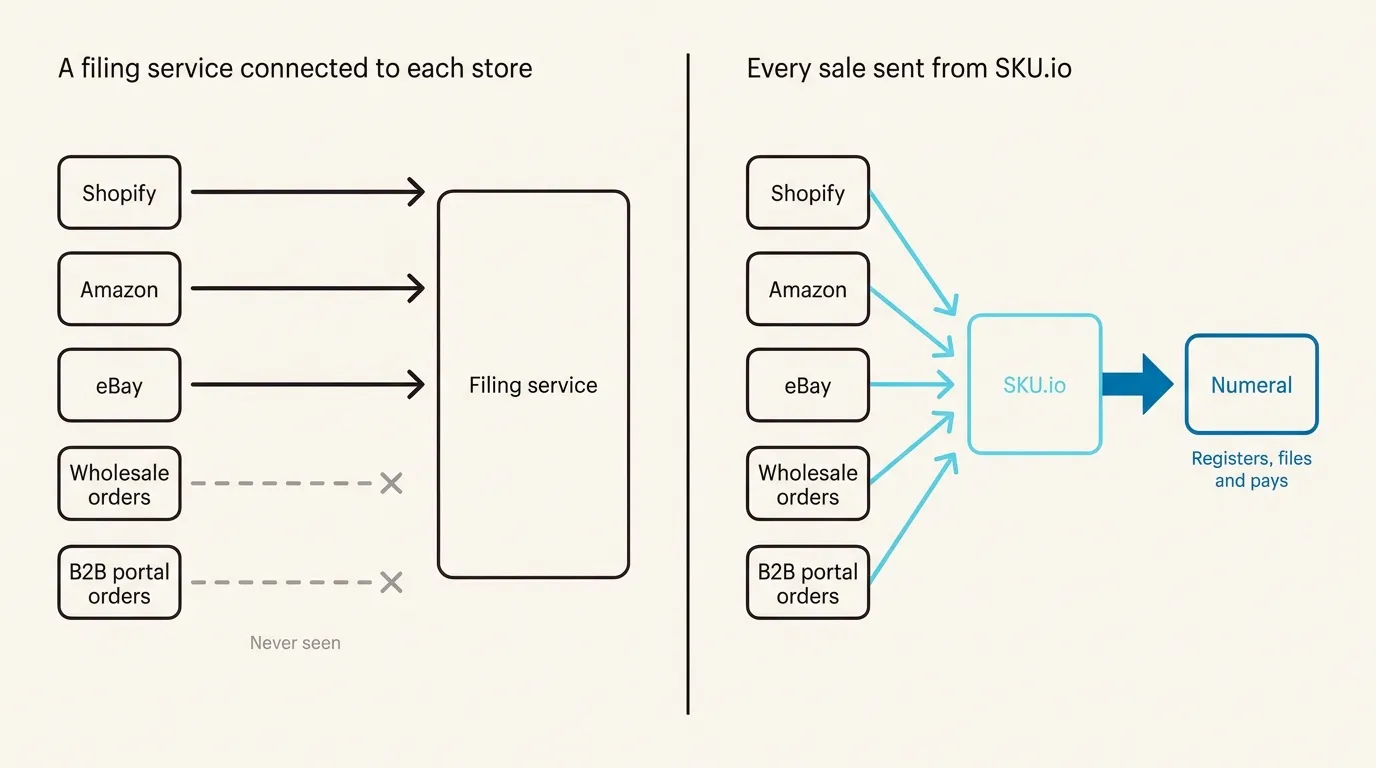
Numeral has about 40 integrations, Amazon among them, and on the call the obvious option was to let customers connect Amazon to Numeral directly and have us send everything else. I didn’t want that, for the reason I gave at the time:
“Do our users ever add items or substitute items after the sale from the marketplace? And yeah, I mean, sometimes they do. So then, you know, we’re no longer the source of truth.”
Swap a line after an order imports and the marketplace’s copy is stale, and two connections is how you get the duplicates above. So SKU.io sends every sale, marketplace ones flagged as such, and setup asks you to confirm nothing else is connected to Numeral.
The question I spent longest on was refunds. A retailer returns two cases from an order in a month Numeral has already filed: does that reopen the old return? It doesn’t. The refund goes on whichever filing is open when you record it. Sensible, but not what most people expect, so if you edit a sale from a month Numeral has already filed, SKU.io warns you the change will land on the next filing.
Sales from your channels go to Numeral within a minute of coming in or changing, with the tax the channel charged. Orders you create yourself, on the B2B portal or by hand, are the one place you choose: keep a flat rate, or turn on live calculation and let Numeral work out the tax from your warehouse and the ship-to address at portal checkout and each time the order is saved. Either way the order is committed to Numeral once, when it’s invoiced, so a draft that gets edited five times is still reported once. Anything that can’t be sent, like an order with a ship-to state that doesn’t exist, waits in Needs action with the reason. The rest (a monthly reconciliation by state, your Numeral registrations showing on the nexus report) is in the Numeral guide. Numeral does the registering, filing and paying; we don’t file anything.
If you only sell on Shopify, skip us
Connect your filing service straight to Shopify. Shopify has had B2B on every plan since April, so if every sale and every edit happens in Shopify, the service connected to it sees all of it and there’s nothing for us to add. Under about $1M on one channel, Zoho Inventory or inFlow will suit you better than we would.
This is for the business on two or three channels that also sells wholesale outside them. A word search of our recorded calls finds sales tax on 27, and 18 of those also mention wholesale or B2B, which tells you more about who calls us than about the market. In June a sales-tax consultant who’s done this for 15 years told me where he sends people:
“I still just push everybody to Zamp and Numeral and let them take care of it. But if you have better reporting, that really does help people out.”
The release notes list everything that shipped. There are three short narrated videos: connecting Numeral, why a sale is held and reconciling a month. If you’d like to see it on your own orders, book a demo. If you don’t have a Numeral account yet, you can create one here. We’re a Numeral partner, so we may earn a referral fee if you sign up through that link.