
In Stock, Not Listed
I have an e-commerce brand that runs on SKU.io, the system I build. In July I was on the phone with one of our suppliers about whether to buy from them again. To answer that I needed to know if we were still selling through what we had, so I opened their supplier page in SKU.io while we talked. It lists each of their products with our on-hand and its listings. One of them said 77 on hand, and no Amazon listing with any stock behind it.
Right after, I sent a screenshot on Slack to the person who runs our Amazon side, with one line: “why dont’ we have inventory on this listing?” Her answer came in overnight. We’d stopped ordering from that supplier and were just selling through what was left at our 3PL. So the plan for that product was to sell out what we had, and it wasn’t for sale anywhere.
We had our regular call the next day. First it turned out I’d sent her the wrong product. “Oh, it’s the same asin, maybe. No, it’s a different asin. Okay. I don’t know how I saw that.” On the right one the answer was the same: “I don’t see any inventory in Amazon, but we have a ton of inventory in SKU.” I told her it needed to go to FBA. I said I wasn’t sure why it never got on an inbound. I’m still not. My guess is that once we stopped buying from them, nothing in anyone’s week touched that product again. No purchase order, no receiving, and no reorder question until I asked one.
Why Amazon never flagged it
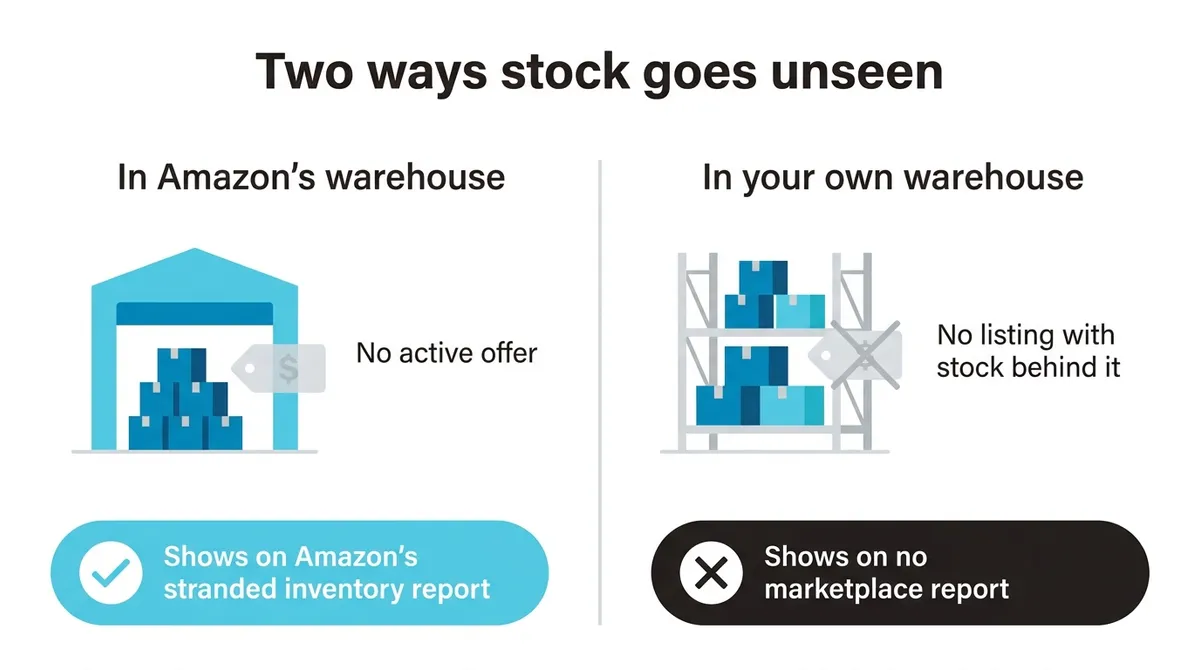
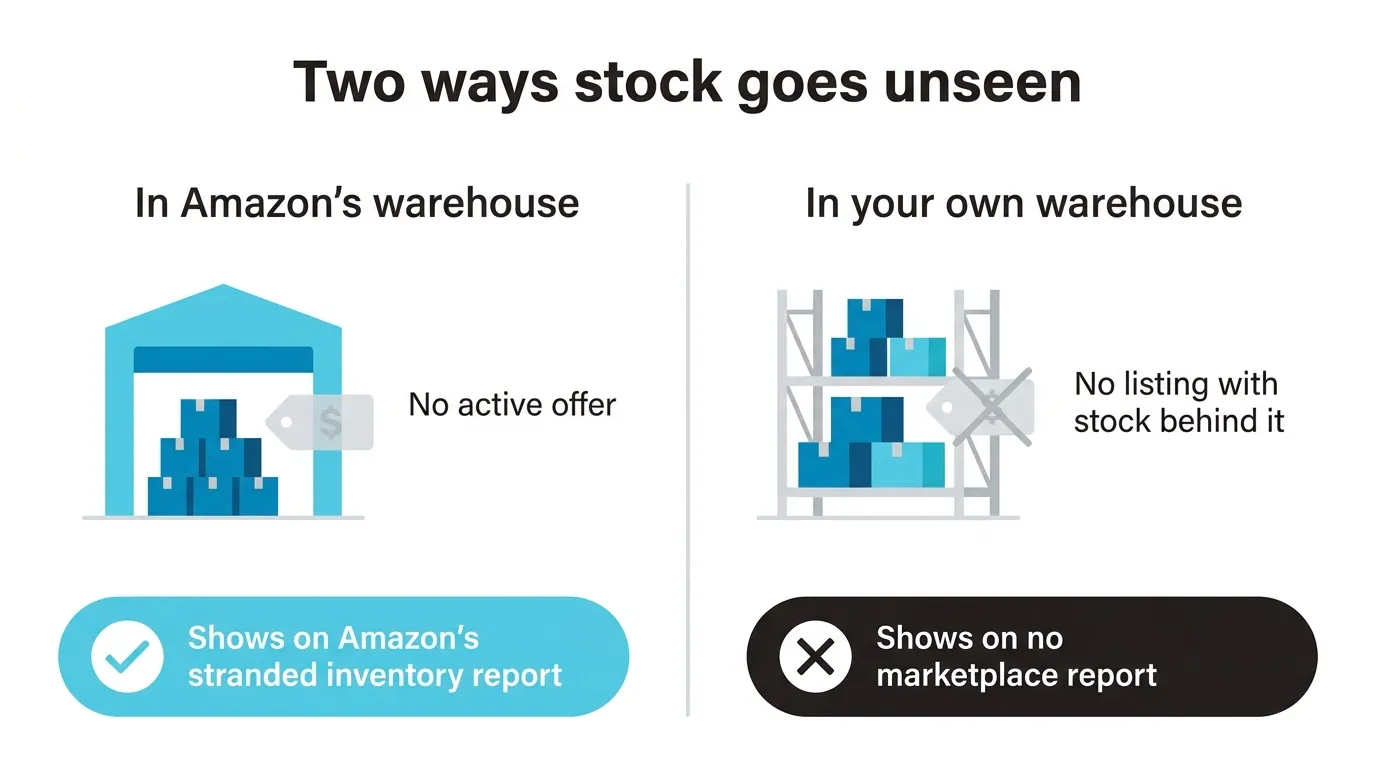
Amazon does have a report for stock that can’t sell. Its help pages call it stranded inventory: FBA inventory without an active offer. That is stock already in Amazon’s building. Ours was at our 3PL. Amazon had never been told about those 77 units, so there was nothing to put on a report.
eBay is no different. Its reports are about your listings, and a unit with no live listing isn’t one of them. The only place that holds both numbers, what’s on the shelf and what each channel is offering, is wherever you keep on-hand. If that’s a spreadsheet, nobody puts the two columns side by side until something forces it. For us it was a reorder call.
Some sellers do it on purpose
An Amazon seller I talked to a while back closes his listings by hand when stock gets thin. Amazon moves inventory between buildings, and when stock is low “it says on the listing, deliver in 10 days to the customer and they’re never going to buy it. So I always close the listing. But the thing is, I still have stock in my inventory. I might have 10 units.” His word for those units was “stranded.”
What he wanted from his data was one field. “Is the listing active or not?” I said you’d want the history of it too, not just today’s answer. His way works as long as he remembers which ones he closed.
What we look at now, and what it misses
The inventory aging report in SKU.io marks a product Not Listed when it has no active listing on any channel, and its first suggestion for that product reads “Not listed anywhere”, followed by “buyers can’t see this product”. You can also filter it to products with no listing on one channel. I’ve been reworking that screen this year. In April I showed it to our Amazon lead and said the Not Listed view was the one I cared about. On the July call I admitted I hadn’t spent much time with it since.
It wouldn’t have caught the 77 units anyway. The product had an Amazon listing. What it didn’t have was any stock behind that listing, and a check that counts listings can’t see that. What caught it was the supplier page, on-hand next to the listings, and I only opened it because a supplier asked.
Before we moved on I said if one was missing there were probably others, so “you may want to do a full audit of that to see, you know, what we’re. What we’re missing. Not just on” that supplier, “but everything.” In September I asked about the aging list. “They already shipped some so we removed them already.” Then we talked about discounting used units on FBA, which was working. I didn’t ask which ones had shipped, or whether the audit happened.
If you sell on one channel from one shelf, an export of active listings and a spreadsheet will find this in an afternoon, and inFlow or Zoho Inventory is fine. If stock sits in more than one place and feeds more than one channel, the listings guide shows how SKU.io maps them, or book a time.