
A Flat COGS Percentage Is a Stand-In Cost
Partway through a long call in 2024, an e-commerce systems consultant I talk to regularly stopped me while I was walking him through cost reports. He fixes accounting files for a living. He asked: “Do you have any logic that looks for zero costs before somebody looks at a COGS report or an inventory valuation report or anything else?”
I checked I had it right: “Zero, meaning zero cost.” He spelled it out. You import a bunch of costs, some come in as zero, “either by logic or by wrong or somebody screwed something up.” Before you hand that report “to your accountant or somebody buying your business,” does anything tell you that 20% of your costs are zero and invalid?
My answer was “No, that would be very custom.” Then I reached for the warning we show on the inventory valuation report when your FBA inventory hasn’t been reconciled up to the current date, and called it “the same principle of an alerting system.” It isn’t. That warning says a source is behind. He was asking whether a number in the report is wrong.
He moved on to his rule. When a client gets something free, he tells them to enter a penny. I’d done the same in my own business. A supplier threw in a free security box with some cameras I was buying, and I wanted it at zero so it wouldn’t move my numbers.
The penny rule had worked for every client for a decade except one. A prepper shop that sold guns bought out a warehouse from a business that was closing, and “they basically got like, 10 million rounds of ammo for free.” They entered it at a penny a round, the way he’d taught them. Ten million rounds at a penny is $100,000 of cost nobody paid. The financials stopped making sense, and it took him a while to dig down to a handful of SKUs with huge quantities at one cent. They set those back to zero, and in his words, “it all split back into place.”
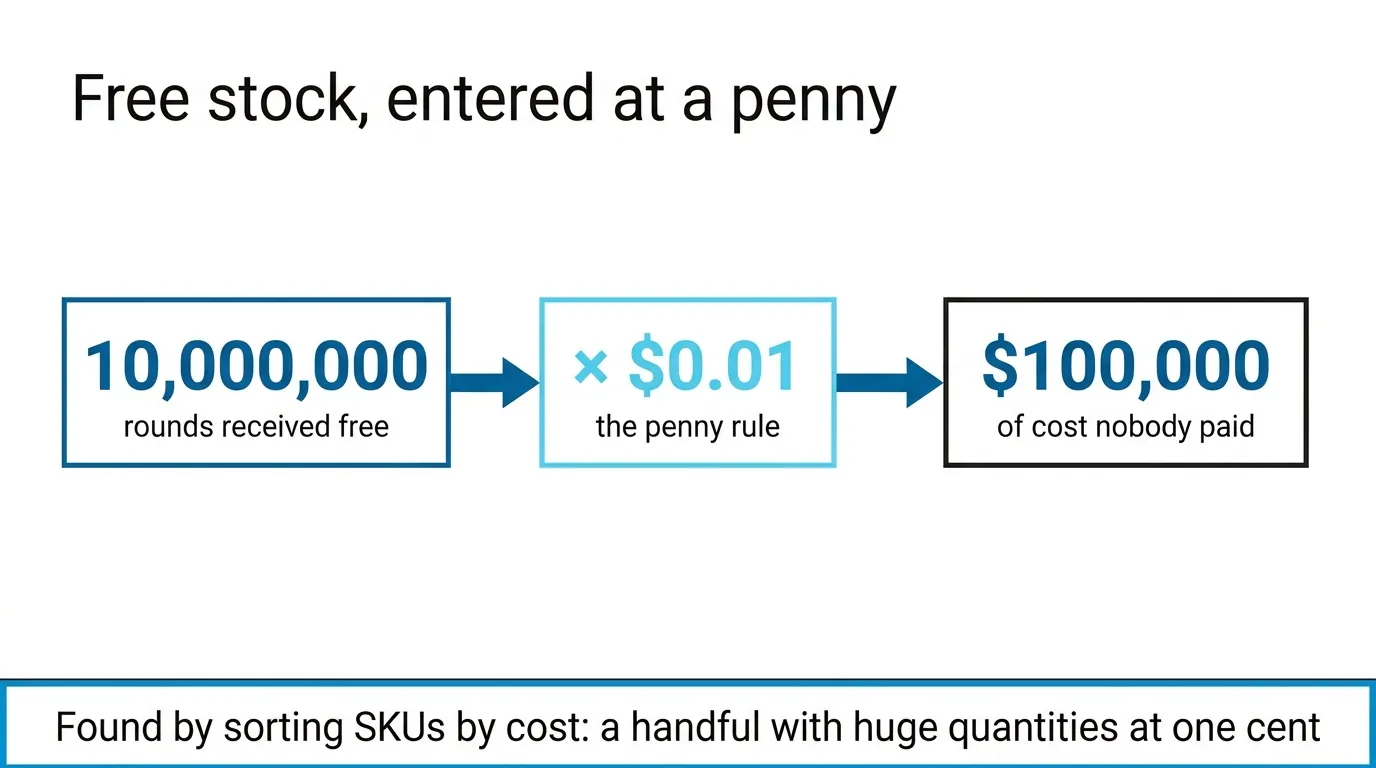
We didn’t settle penny versus zero. His point was that if everything free is zero, you can’t tell the 50 items that really cost nothing from the ones “that should actually be $50 each and it’s coded wrong.” I still said I’d rather see zero, and that the check felt like something you’d run after moving to a new system, not a warning on every report. I’m less sure of that now.
My own store ran on a stand-in before SKU.io existed. The system I used kept one unit cost per product, and every sale took whatever was in that field. When half a run came from one supplier and half from another, I picked a number. Changing it repriced every unit already on the shelf, so a month’s profit could jump or sink because I edited one field. With one supplier and one price that field is fine, and a spreadsheet or inFlow holds it as well as anything.
The version I still hear on sales calls is the bookkeeper’s. Nothing records what each unit cost, so cost of goods gets booked as a flat share of sales, picked once. The year can come out close. But every product then reports the margin it was handed, so a SKU that loses money on every order looks the same as the one paying the bills.
When I built SKU.io I made it cost inventory FIFO: each receipt is its own layer with its date and landed cost, a sale takes the oldest layer’s cost, and a new price starts a new layer instead of rewriting the old ones. I didn’t study weighted average much before choosing it, and some accountants would have pushed me the other way.
Item cost doesn’t catch his zero-cost problem by itself, either. A movement with no cost shows as $0.00 on our COGS report. The COGS Health page lists each product’s lowest and highest layer cost and turns the variation red at 30%, so a one-cent layer among $40 ones would show up there if you open the page. Nothing pushes it at you.
A layer’s cost can also change after the sale, when the supplier’s bill arrives higher than the PO.
If your books carry a COGS percentage and you want to see it by SKU, book a demo and bring a month of sales.