
Where Should a Bundle Turn Into Its Parts?
In April a brand told me their overseas warehouse had shipped two of their main product to a customer who ordered one. It’s a large product and not a cheap one. It comes in three models and hangs on a wall by default, so every unit ships with a wall mount, and a buyer can pick a door mount or a floor stand instead. Their Shopify store had no clean way to say “this model, with this mount,” so it sent the mount through as a second item, and somebody at the warehouse read the second line as a second unit. Their operations lead said the same thing was why they couldn’t automate fulfillment.
I told them what I tell everyone. Make it a bundle in SKU.io and map the Shopify product to it. When a bundle sells, we replace that line on the order with one line per component and spread the price across them, so the bundle never holds stock and the warehouse only gets the parts. Nothing needs to change in Shopify.
By late June they’d done most of their onboarding with an outside consultant and the plan had moved. The bundle would stay in Shopify as a placeholder SKU for each model and mount, and SKU.io would only see the real products under it. Some order lines would come through at $0. I said yes. My reasoning, from the recording, was that a bundle “is really just a sales concept that is going to translate in SKU regardless to the individual components,” unlike a kit, which involves assembly. “So I don’t see any impact on the, you know, demand planning side, because it’s the same net effect.”
That holds when something does the split, and in the plan I’d just agreed to, nothing did. Shopify had a placeholder, we had products, and the warehouse was left to work it out from whatever the order said.
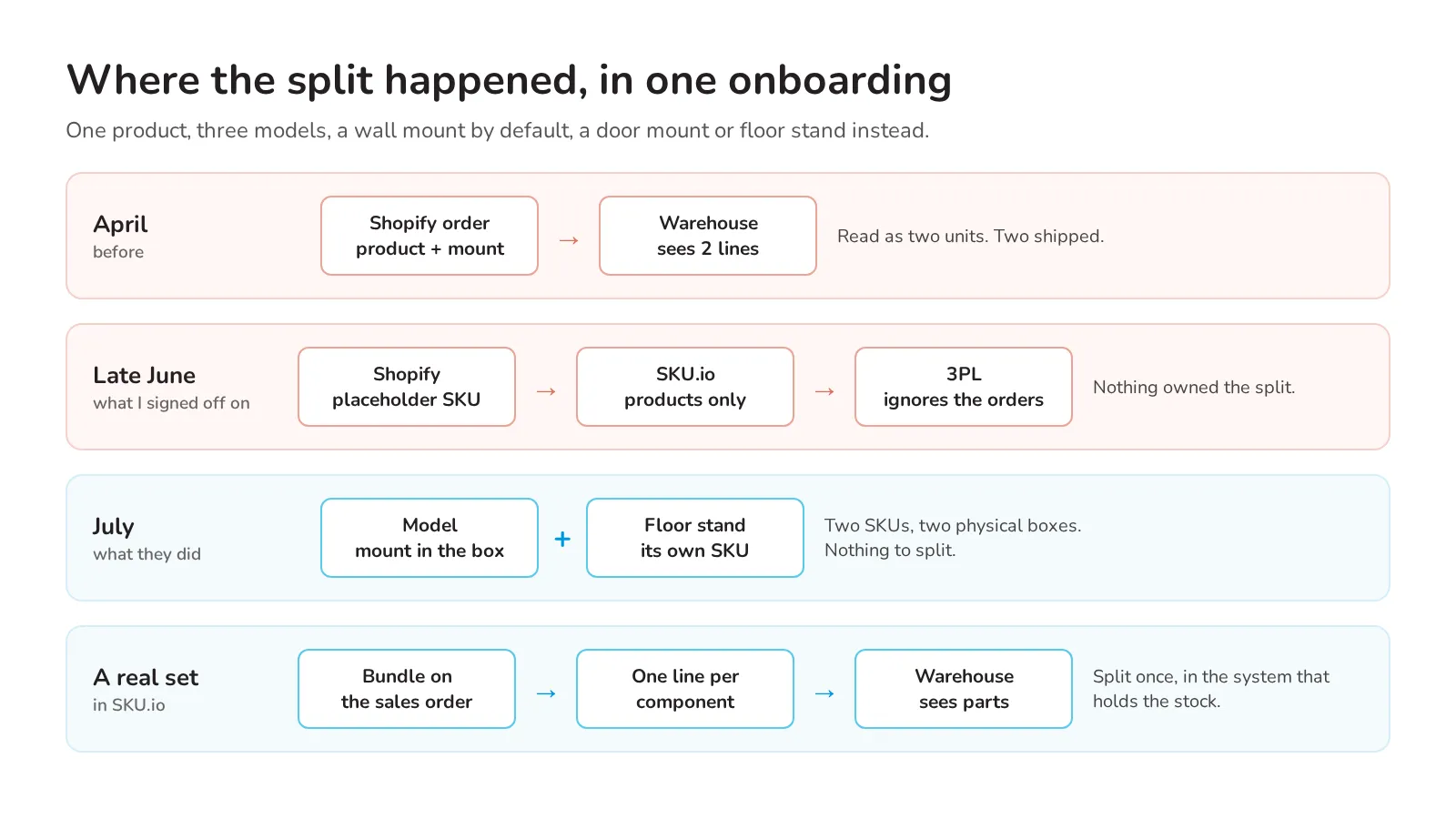
The clue was on the same call. I asked why their 3PL didn’t just pull orders from Shopify directly, since it has a Shopify connector. Somebody said “bundle issue.” I said the data coming out of the store wasn’t clean, someone added that the 3PL was ignoring those orders for now, and we went to the next item on the list. I didn’t connect it to what I’d said earlier.
It stayed the top open item for most of July. At one point I proposed switching the product mapping over on a set date, so the old placeholder SKUs and whatever replaced them could run side by side for a while. When we finally got on a call just for the bundle, I spent the first few minutes on their order import instead: two years of Shopify history, 8,847 orders, 21 that hadn’t come in. I guessed a missing product and moved on. Then I tried to show them a way to version a kit’s components so a mount could change without a new SKU. I went looking for it on their site, then on ours, and it hadn’t been released yet, so I described it.
They didn’t need it. They had decided to drop the Shopify bundle. Each model would be sold as itself with the base mount in the box, and a floor stand would be its own SKU on its own line, “two SKUs, two physical boxes,” as their operations lead put it. I told them the mapping switch I’d proposed probably wasn’t needed anymore.
I’d been treating it as a question of where to split the bundle, and for most of that product line there wasn’t anything to split. The mount always goes in the box. The stand always ships in its own carton. I still think a real set, three things a customer buys together that you also stock and sell separately, belongs in a bundle that’s split on the order by the system holding the stock. I’d also want to be sure nothing upstream is splitting it too.
At the end of July they asked how to stop a floor stand from shipping with a model it doesn’t fit, so it doesn’t come back as a return. I said I’d rather Shopify blocked that at checkout than have us catch it after the order is placed. We left it open.
If you have an order where one thing sold and two lines reached the warehouse, book a demo and bring it.