
Same SKU, Different Parts: What Did Each Unit Cost?
In July I was demoing manufacturing to a shop that builds almost everything to order. Paper products, cut from big master sheets, then punched and the corners rounded. Four of them were on the call. Their operations lead had worked in a plant that built motorhomes, so he knew this part of the software better than I did, and it showed.
I built a recipe on screen with 13 master sheets per finished unit and a fixed cost for the labor, then a manufacturing order for 100. The sheets weren’t in stock, so I adjusted 3,000 into inventory just to get past the warning. Someone said, “Wow. You don’t even care about money.” It was demo data. I confirmed the order and the sheets were allocated.
The fixed cost didn’t come through. “It should have known fixed costs,” I said. “That’s a hole, needs to be fixed. But I’ll just remember it was like five bucks.” We shipped fixed costs on operations the next morning. On the call I was doing it in my head.
Then I opened Record Production, the screen where whoever did the work says what actually went in. The operations lead got there before I explained it: “So this is our opportunity to adjust master sheets if we used more or less.” Yes. Every component line has an actual quantity, and the actual quantity is what comes out of stock and what the finished goods are costed at. It can be zero. It can be more than the recipe said.
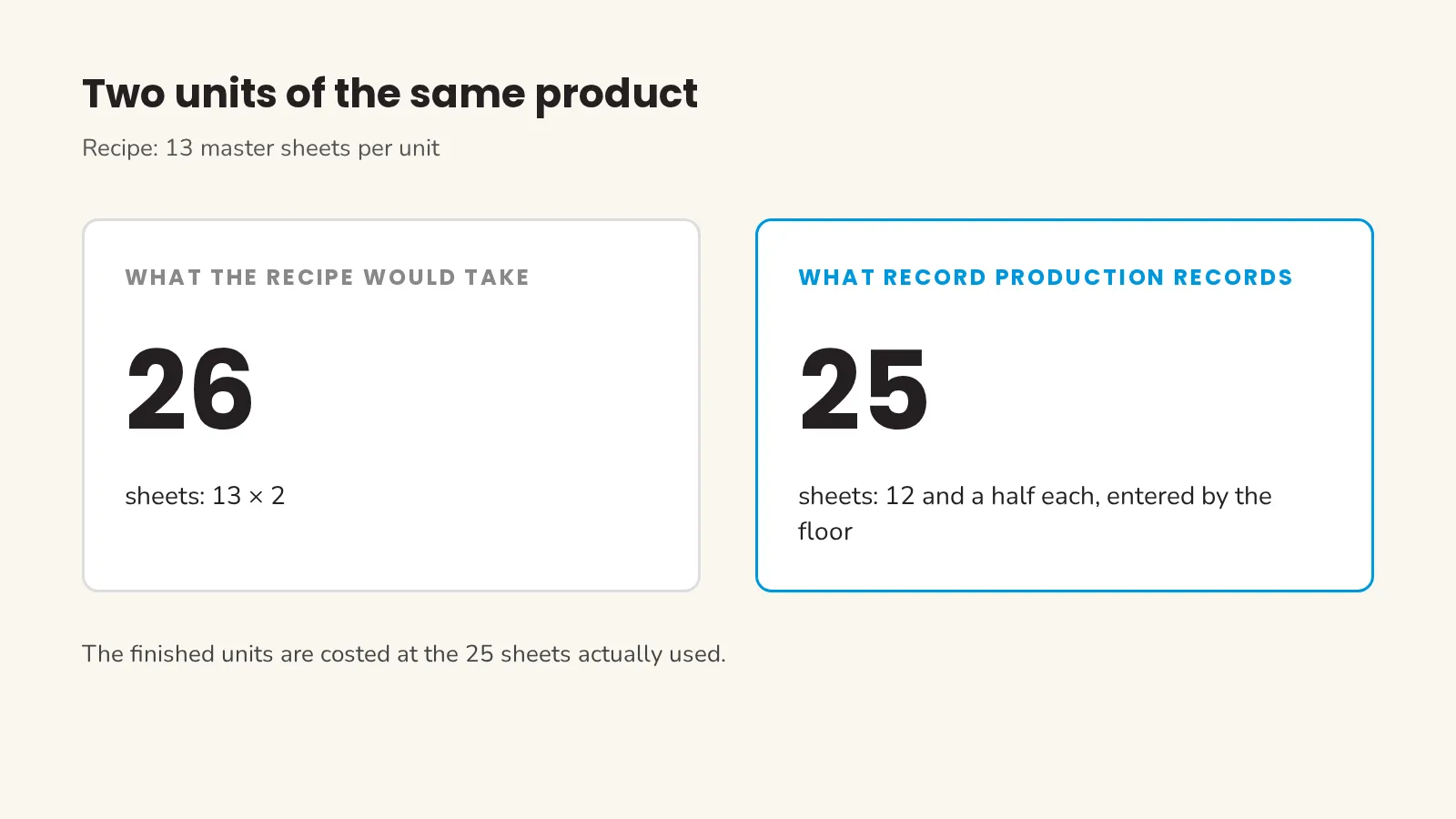
A little later he told us why that mattered to them. The recipe says 13 sheets to make one. “But really you need 12 and a half. Well, I don’t want to deal with half sheets in my inventory.” So if a guy makes two, he takes 25 sheets off the shelf and records 25, not the 26 the recipe would have taken. Two orders for the same product, two different costs, and the second one is right.
His next question was the one I didn’t have a good answer for. “Any opportunity here to change the raw material if we needed to?”
I said to put the alternate on the recipe as an optional component. He didn’t want that. He wanted to own the recipe and still let the floor use up some other stock on a single job. “So for just this one order, could they affect the work order itself?”
They can’t. You can change how much of each listed component an order used, but you can’t add one that isn’t on the recipe. What I said on the call was, “I would think there would only be a small set of, like, equivalent replacements so that you would do it as optional BOM components.” He said it wasn’t the end of the world, it didn’t happen a lot. I said it would be a small customization, around $200, and we moved on. I haven’t built it.
For a paper shop that’s a fair answer. The substitute stock is a short list.
I’ve had the same question from people who rebuild returned and used goods, and there my answer is worse. I don’t run a rebuild bench, so I’ll say what I know. The unit gets sold under one SKU, it gets opened after it’s sold, and what it needs isn’t known until then. The short list of equivalent replacements is most of the parts shelf. You can still put every part that commonly gets swapped on the recipe as optional and zero out the ones a unit didn’t need, and some shops will. At some point that stops being a recipe and becomes a parts list.
The cost side holds up better than the parts side. One manufacturing order per unit makes its own cost layer from the parts it actually consumed, at what those parts cost you, plus the labor on it. An order can be linked to the sales order line it was built for, by hand. The sales order doesn’t open the manufacturing order on its own yet, which was the other thing he asked for, since they’d be running about ten of these a day.
The catch is at the sale. When the SKU ships, cost of goods comes from the oldest cost layer for that SKU, not from the unit in the box. If you build after the sale and keep none on the shelf, that’s the same unit. If you have three rebuilt ones sitting there, it probably isn’t.
If you want to walk through it with your own recipes, book a demo.